Two of Swords Tarot Card Meaning

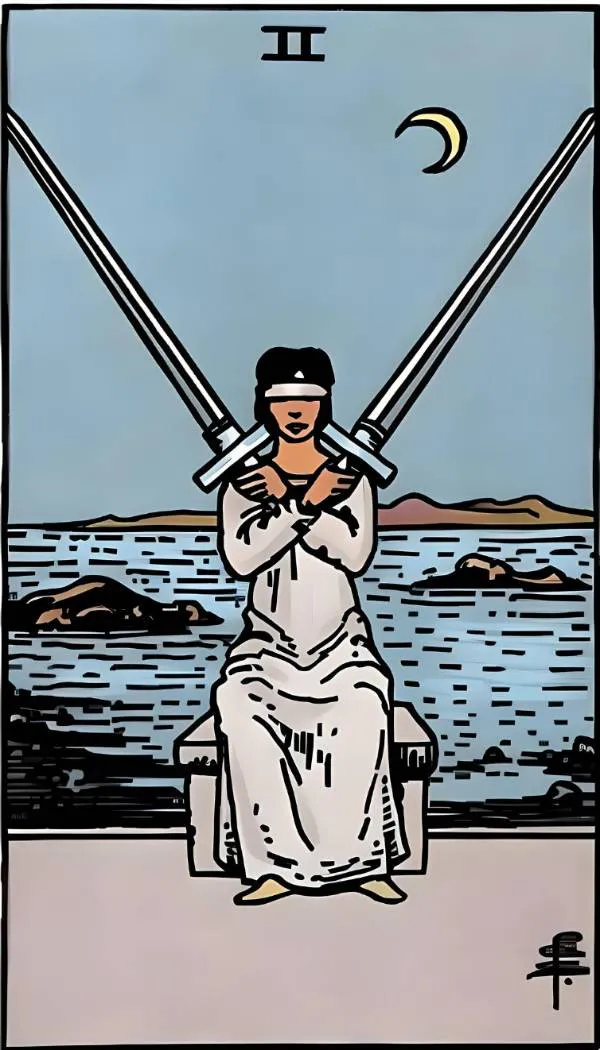
On a quiet night, a woman sits alone on the shore, her back to the sea, perched on a cold stone slab. She is dressed in a white robe, her hands crossed over her chest, each holding a long sword, forming a V-shape. Behind her, the sea is calm and dimly lit, the small island in the water is darker than the distant opposite shore, and a bright crescent moon can be seen in the sky, positioned between the two swords.

The moon is yellow, matching the yellow boots on her feet, and the moon's connection with the coastline represents the ebb and flow of the tides, while its interaction with the sea symbolizes the fluctuation of emotions. Whether it will be high tide or low tide is uncertain. This tension, destined to change yet hard to predict, echoes the swords held by the woman.

This posture cannot be maintained for long; eventually, she will have to let go of the swords and lower her arms due to stiffness and soreness. Thus, persistence can still be relinquished. This woman, with her stance and setting, represents tension, the choice between two directions. She blindfolds herself to listen to the sound of the tide, to listen to the voice within her heart. She must rely on her deepest intuition to predict her future and direction. She is caught in a dilemma, striving to keep herself in a state of calm, contemplating in silence. The future is still uncertain, but answers can be found. The moment she finds the answer, she can let go of the swords, remove the blindfold, and walk towards the direction she must take. If she cannot solve her own questions for a long time, she may be overwhelmed by the tide or the tide may dry up.

The image of this woman blindfolded is very similar to the 'Goddess of Justice' we have mentioned before, implying a situation of judgment and assessment, and connecting to the meaning of the Justice card.

Crossed Swords

The two swords crossed over the heart signify a stalemate, a pause in conflict, or indecision. They represent a balanced force but also indicate a barrier, suggesting that the solution to the issue at hand is not straightforward.

Blindfold

The blindfold on the woman’s eyes symbolises a lack of clarity or unwillingness to confront the truth. This could point to being in denial or avoiding making a difficult decision, emphasizing the need for introspection to attain clarity.

Seated Woman

The woman seated in the card embodies passivity, suggesting that now might not be the time for action. Instead, this is a moment for contemplation, weighing options and considering consequences.

Body of Water

The calm sea in the background symbolizes the realm of emotions and unconscious mind. The stillness indicates that emotional clarity may be needed to make an informed decision.

Moon

The moon above is often associated with intuition and the unconscious mind. It suggests that in this situation, it might be beneficial to trust one’s intuition in addition to logical thinking.

Grey Sky

The grey sky behind the woman symbolizes uncertainty and ambiguity. It hints at the unclear nature of the situation, and the need for careful deliberation before taking any decisive action.

Psychological patterns in Two of Swords
Avoidance Coping
The woman sits with her back to the sea, keeping the emotional field behind her while the swords protect the front of the body. The water is present, the moon is present, and the choice is present, but the figure's posture keeps all of it at a controlled distance. Avoidance Coping grows from that spatial arrangement. The body appears composed, yet the composition shows a deliberate refusal to fully face the material that would make the decision emotionally real. In a choice reading, this pattern often feels like neutrality, patience, or being 'not ready.' The card asks a sharper question: whether the pause is still creating clarity, or whether it is protecting you from the conversation, consequence, or desire that would force the choice into the open.
Emotional Cutoff
The woman's face is covered, her heart is guarded by crossed blades, and the emotional sea sits behind her rather than in front of her. Nothing in the image reaches outward, even though the whole scene is saturated with feeling. Emotional Cutoff forms when protection becomes disconnection. In friendship, You may stop replying, go flat, or act unaffected because direct hurt feels more dangerous than distance. The reversed Two of Swords intensifies the card's stillness into an inner shutdown. The defense is understandable, but the image shows its cost: the swords keep pain out only by also keeping repair, clarification, and mutual vulnerability from getting in.
Analysis Paralysis
Two identical blades form a V around a gaze that cannot use ordinary sight. The composition funnels attention into an internal corridor: the moon, the tide, the hidden horizon, and the two possible directions all become data points that cannot quite resolve into movement. Analysis Paralysis appears when the mind treats timing as a problem that must be solved with perfect information before the body is allowed to act. The card's balance is precise but costly; every factor is counterweighted so carefully that the system cannot update. You may feel as if more analysis will create safety, while the image shows analysis becoming the structure that keeps the moment suspended.
Certainty Seeking
The crescent moon hangs between the two swords like a small signal caught inside a controlled frame. The sky is grey, the water is dim, and the figure sits still on stone, trying to let one clear line emerge from a field that is built out of ambiguity. The image does not offer total visibility; it offers containment. Certainty Seeking appears when the inner compass is treated as something that must become unmistakable before movement is allowed. You may keep waiting for a sign strong enough to cancel doubt, a feeling stable enough to remove risk, or a future image clear enough to justify commitment. The swords create the illusion that ambiguity can be held still until it turns into certainty. In a direction reading, this card shows the trap of asking the future to become safer than life can be. Some clarity arrives only after contact with a path, not before it. The moon between the blades suggests that intuition is partial, cyclical, and real, but it cannot become a guarantee without being distorted into another control mechanism.
Timing Perfectionism
The two swords are held with exact balance, but the posture is physically unsustainable. Reversed, the image becomes a body waiting for conditions to become safe enough while the arms grow tired and the tide keeps its own timing behind her. Timing Perfectionism in study says the work can begin once the mental state, topic, evidence, plan, or confidence level is finally right. The demand sounds disciplined, but it quietly makes academic action dependent on a moment that may never arrive. The moon in the card reminds the system that timing always contains change and uncertainty. This pattern reveals the trap of treating readiness as a gate you must fully unlock before producing anything visible.
Rumination
The woman's crossed arms create a closed circuit of effort: two blades held in balance, no release, no chosen direction, no movement toward the shore or the sea. The scene is quiet, but the posture is physically demanding. That is the reversed mechanics of Rumination in a career field. You may replay a meeting, a promotion conversation, a rejection email, a tense message, or a manager's offhand comment as if one more pass will finally produce certainty. The card makes the loop concrete. The mind keeps holding the same two blades because setting one down would mean accepting incomplete information and choosing a next move. Rumination preserves the illusion of processing while draining the energy required for action.
Decision Deferral
The woman is not standing at a crossroads; she is seated on a stone slab, holding both swords in a posture that demands effort but produces no forward movement. The crossed blades create a temporary architecture of control, as if the decision can be kept stable by refusing to let either side fall. Decision Deferral appears when waiting begins to feel like wisdom because action would disturb the balance. You may be preserving several possible futures at once, not because they are all equally alive, but because lowering one sword would make the cost of choosing visible. The posture protects you from premature movement, but it also trains the nervous system to equate stillness with safety. In a direction reading, the card does not shame the pause; it audits what the pause is doing. If the delay is giving your inner compass time to register, it has value. If the delay has become a ritual that keeps every future hypothetical, the crossed swords are no longer protecting clarity; they are preserving the stalemate.
Insight Hoarding
The woman’s posture looks disciplined, almost ceremonial, but the crossed swords are heavy and the hold cannot last forever. The moon between the blades invites meaning, intuition, and interpretation while the body remains fixed in the same place. That is the trap of collecting insight without release. You may gather another interpretation, another journal entry, another reading, or another elegant framework, while the emotional system stays in the exact posture that made the insight necessary. Insight Hoarding is not curiosity; it is meaning accumulation used as a substitute for integration. The card shows a mind that keeps finding symbols while the body waits for permission to lower the swords.
Conflict Avoidance
The woman's arms are crossed so tightly that the swords become a barrier over her heart, and her blindfold removes the direct line of sight to whatever conflict might be in front of her. The scene looks calm because the confrontation has been suspended, not because the tension has disappeared. In social life, that suspended posture becomes Conflict Avoidance when staying neutral starts to cost more than speaking clearly. You may keep the group from erupting, but the unspoken disagreement stays locked in your body as stiffness, second-guessing, and a quiet fear of choosing a side.
Shadow Avoidance
The woman’s blindfold prevents direct sight, and her back is turned to the sea that carries the emotional background of the card. The swords protect the chest, preserving composure while the unseen tide remains active behind her. That arrangement shows a psyche keeping its most uncomfortable material outside the field of direct awareness. You may know something is charged, but the mind keeps the source half-hidden so the inner system can maintain balance. Shadow Avoidance appears when introspection keeps approaching the edge of a feeling and then redirects into calmness, symbolism, or waiting. The card makes the avoidance visible: the emotional sea is present, but the defended body is oriented away from it.
Core Struggles in Two of Swords
Threshold Disorientation
The card places the figure at a shoreline threshold, but the blindfold and crossed swords remove the usual cues for crossing it. Stone, sea, moon, and horizon all offer different reference points, and none of them fully takes command of the body’s next movement. In the reversed field, Threshold Disorientation appears when that ambiguity becomes familiar. You may no longer be able to tell whether you are waiting wisely, hesitating from strain, recovering your rhythm, or missing the moment altogether. The body keeps treating an abnormal pause as the baseline for judgment. For timing questions, this is the struggle of losing the felt difference between not yet and no longer. The card gives that confusion a boundary: it is a collapsed reference system, not a failure to care about the future.
Autonomy Guilt Bind
The woman sits at the edge of the sea with both swords crossed over her heart, her body making a choice-shaped barricade before any path is taken. The blindfold keeps the decision from being solved by facts alone, while the tide behind her keeps moving through a rhythm she cannot fully control. In a family system, that posture becomes the bind between self-direction and belonging. You are not simply choosing between two options; you are holding the possibility that choosing yourself may expose you to guilt, withdrawal, or being recast as disloyal, while staying compliant keeps the heart guarded and still.
Readiness Loop
The figure’s pause has a physical shape: crossed arms, covered eyes, swords held close, feet planted on stone. In the reversed state, that pause stops functioning as a temporary assessment point and starts behaving like the only posture the body remembers. Readiness Loop emerges when preparation keeps recycling the same guarded position. You may return again and again to checking, waiting, bracing, and asking whether the moment is right, but the card shows the action tools never leaving the closed circuit around the chest. For timing questions, this struggle marks the difference between incubation and repetition. The tide may offer new information, yet the system keeps processing it through the same closed stance, so each fresh cycle feels like another reason to wait.
Knowledge-Output Gap
The woman’s arms stay lifted across her chest, but the posture produces no forward action. Its cost accumulates in the shoulders, wrists, and breath, while the sea behind her continues to move outside the body’s closed circuit. Knowledge-Output Gap is the academic version of that locked posture. You may understand the reading, have thoughts about the topic, or know what the exam requires, yet the knowledge cannot cross into paragraphs, answers, presentations, or submitted work. The card makes the gap visible as a blocked passage between inner material and outer expression. It shows the place where comprehension is real, but the structure that would translate comprehension into evidence has seized up.
Binary Choice Lock
Two long swords cross in front of the figure's chest, turning the body into the meeting point of two equal and incompatible directions. The crescent moon sits between the blades, so even the intuitive signal is caught inside the split rather than opening a route through it. This visual structure gives Binary Choice Lock its exact shape. You are not merely deciding between two options; your inner world has been compressed into a frame where only two answers feel legitimate, and both require some part of you to be denied. The shore, the tide, and the moon all imply movement, but the seated body cannot move while the swords remain raised. The struggle is the moment when inner clarity gets trapped inside an either-or architecture, and the first task is seeing the architecture before mistaking it for truth.
Cycle-Action Desynchronization
The woman sits motionless at the edge of water, holding a pose that the body can only sustain for a limited time. Behind her, the moon and tide imply a cycle that continues whether or not her arms lower, whether or not her decision arrives on schedule. Cycle-Action Desynchronization appears in the gap between the still body and the moving environment. You may be exerting real discipline, but the card shows discipline applied at a rhythm that no longer matches the field around it. The swords preserve the pause while the water keeps changing the conditions of that pause. For timing questions, this is the shape of pushing, waiting, or bracing at the wrong part of the cycle. The struggle is not a lack of willpower; it is the friction created when your action system and the moment’s actual current are out of phase.
Analysis Paralysis
The woman sits with two swords crossed over her chest, each arm holding an equal and opposite line of force. The posture looks balanced from the outside, but the balance depends on keeping both alternatives suspended without letting either one become action. That is the exact academic shape of Analysis Paralysis. You can keep comparing thesis angles, study plans, sources, majors, or revision strategies until the comparison itself becomes the task, while the body of the work stays untouched. The blindfold and the quiet shoreline make the pause feel deliberate, but the raised arms show that the pause has a physical cost. The card locates the struggle at the point where thinking is no longer clarifying the work; it is holding the work in a controlled freeze.
Truth-Connection Split
The blindfolded figure faces forward while the sea of feeling remains behind her, and the crescent moon hangs between two blades that cannot both become one path. The swords create a clean visual split, but the water and moon keep the situation fluid, ambiguous, and emotionally alive. In friendship, that geometry matches the moment when telling the truth could protect the bond or change it permanently. You are carrying the split between honesty and connection in the same place, so silence feels safer than conflict while also keeping the real friendship just out of reach.
Inner Tribunal Lock
The blindfolded figure sits like a silent judge, with the swords held across the heart instead of used in the world. The scene carries the form of assessment before any outside verdict has arrived. Inner Tribunal Lock becomes academic when the grading voice moves inside the study process and starts judging every sentence before it exists. Drafting, revising, emailing a supervisor, or raising a hand in class can feel like entering a court where the verdict is already waiting. The card does not reduce this to fear of feedback. It shows a deeper structure in which evaluation has taken over the inner workspace, so the student must pass through an internal judgment chamber before reaching the actual assignment.
Avoided Closure
The figure's posture has become a sealed decision chamber: blindfold in place, swords held steady, body fixed on the stone. The shore and sea remain present, but the posture treats stillness as the only tolerable way to hold the situation together. In love, this is the unresolved ending, answer, or truth that stays unnamed because naming it would force the whole arrangement to move. You may keep collecting time, silence, and almost-conversations, but the relationship remains organized around a door that no one fully opens. The reversed Two of Swords frames Avoided Closure as an internalized stalemate. The problem is not that closure is impossible; it is that the system has learned to survive by postponing the moment when clarity would create consequence.
Inner Emotions in Two of Swords
Performative Calm
The woman’s posture looks balanced from the outside: the swords are symmetrical, the robe is still, and the face is covered in a composed white band. Yet the raised arms cannot stay there forever, and the sea behind her marks the emotional field being kept out of view. Performative Calm is carried by that polished surface under strain. The card shows a calm that has become a presentation layer, arranged to keep inner conflict from disrupting the image of control. In introspection, this emotion appears when even your self-awareness starts performing stability. The card exposes the cost of looking internally orderly while the deeper system is waiting for permission to admit that the stillness has become effortful.
Directionless Urgency
The V of the swords points toward two directions at once, while the blindfolded body cannot verify either path. The arms are active, the posture is tense, and yet the figure remains seated on the shore. Directionless Urgency emerges from that split force. You feel pressure to act now, but the available energy has no clean route, so urgency becomes louder than orientation. The card gives this state a concrete structure: motion is gathering in the body before direction has become trustworthy. It asks the timing question at its sharpest point, where speed would only intensify the split unless the path itself becomes clearer.
Liminal Stillness
Two swords held over the chest create a pause that is not empty; the whole body is organized around suspension. The blindfold removes the pressure to scan every signal, while the quiet sea and distant shore keep the future present without demanding immediate movement. This is the emotional weather of Liminal Stillness: You are not asleep, checked out, or powerless. You are inside a threshold where timing has texture, and forcing motion too early would flatten information that is still arriving. The card gives the pause a visible structure. It shows a moment when agency is not expressed through speed, but through the capacity to remain with unresolved timing until the next signal becomes clear enough to meet.
Contained Overwhelm
The two swords create a hard container across the chest. Behind the figure, the sea remains part of the scene, suggesting pressure that has not disappeared simply because the body is holding still. Contained Overwhelm in academics is the feeling of keeping everything tightly managed while the volume of tasks, decisions, and expectations keeps rising behind you. You may still have the planner, the notes, the schedule, and the outline, but the internal load has outgrown the structure meant to hold it. The card's stillness is what makes the overwhelm so precise. It is not scattered everywhere; it is compressed, guarded, and silently accumulating until the effort of containment becomes as exhausting as the work itself.
Submerged Anxiety
The woman's back is turned to the sea, yet the water remains close enough to define the whole scene. Her crossed arms cover the chest, making breath feel guarded while the tide carries movement she cannot directly monitor. In love, Submerged Anxiety is the pressure under the surface when the relationship looks quiet but the body is waiting for the emotional water to rise. The conversation may be delayed, the message may be unsent, or the truth may be sitting just behind the silence. This card captures anxiety that does not announce itself loudly. It stays beneath composure, behind the blindfold, and under the controlled pose, asking to be recognized before it becomes the tide that decides the emotional weather for you.
Intuitive Self-Doubt
The crescent moon sits between the swords while the blindfolded figure cannot verify the outer scene with her eyes. The card gives intuition a place, but it also places that signal inside a tense frame of competing evidence. At work, this becomes the feeling of sensing something important and then doubting your right to trust it. A role may look good on paper, a manager may sound supportive, or a promotion path may seem logical, while an inner signal keeps registering a mismatch. Intuitive Self-Doubt belongs to the reversed card because the inner reference point is present but destabilized. The card shows the pain of having a read on the situation before you have enough external proof to defend it.
Decision Dread
Two long swords cross over the woman's chest while the blindfold removes the simplest route to certainty. The V shape stays stable only because both arms keep equal pressure, turning the body into a temporary bracket for an unresolved choice. In a social field, that image maps to the dread of choosing which circle, message, invitation, or boundary receives your limited energy. You are not simply being indecisive; the card shows a pause where every option seems to open one room while closing another, and clarity begins when the pressure of choosing is finally named.
Hard-Won Composure
The woman sits with both swords crossed over her chest, holding a posture that is balanced but physically costly. The blades do not look relaxed; they look managed, kept in place through discipline, symmetry, and sustained muscular control. That image maps cleanly onto the career experience of staying composed while the situation is still unresolved. You may be dealing with vague feedback, stalled advancement, or a political decision that requires restraint before movement becomes useful. Hard-Won Composure names the feeling of keeping yourself steady without pretending the pressure is gone. The card shows calm as an active hold, not a passive mood, and that makes it especially relevant when professional self-control has become part of the emotional labor of survival.
Decision Fatigue
The crossed swords are heavy, symmetrical, and held away from the body by force. The figure can keep the balance for a while, but the wrists, shoulders, and chest are paying for every second of suspended choice. Decision Fatigue grows from that exact posture when daily life becomes a chain of small but loaded choices. You may be choosing between sleep and exercise, chores and recovery, planning and rest, until the act of choosing starts to feel like the most expensive task in the system.
Analysis Paralysis
The blindfolded woman holds two swords in a perfectly balanced V over her chest while the dark water stays behind her. The image turns decision-making into a held muscular equation: every option remains lifted, every consequence stays suspended, and the body has no free hand left for movement. In personal growth, that posture maps to the moment when insight becomes a blockade instead of a bridge. You can see too many angles at once, so the next step stops being a step and becomes a mental courtroom with no clear ruling. Analysis Paralysis belongs to this card because the visual system is not confused in a loose or chaotic way; it is too evenly balanced to move. The swords show a mind trying to protect clarity so intensely that clarity itself becomes immobilizing.
Outer Contexts in Two of Swords
Analysis Paralysis
The woman’s crossed arms can hold the swords in balance, but the posture has a physical expiration point. The longer the blades remain suspended, the more the scene becomes about maintaining the standoff rather than resolving what the standoff was meant to protect. In introspection, this is the outer environment of endless interpretation: one more reading, one more thread, one more framework, one more private theory about why the same issue keeps returning. The tools of clarity start acting like the swords themselves, precise but immobilizing. The card makes the cost visible through the body. When analysis becomes the container and the cage at the same time, the real leverage is not another explanation; it is seeing where the reflection process has stopped producing movement.
Decision Cliff Edge
The figure sits exactly at the edge where land gives way to water. Her crossed swords create a hard stop in front of the body, while the tide behind her keeps marking time outside her control. This is the moment when postponement starts to become a decision with consequences of its own. The threshold is no longer neutral because access, leverage, timing, or emotional bandwidth may be narrowing while the body remains fixed. The card exposes the edge without forcing a leap. It asks where delay is still protecting good judgment, and where delay has begun choosing for you by letting the field change without your participation.
Bad Timing Loop
The crossed swords can be held for a while, but the body cannot keep that exact brace forever. Behind the figure, the tide continues to move under the moon, meaning the outside cycle does not stop just because the body is trying to preserve balance. Bad Timing Loop emerges when the pause outlives its purpose. The same structure that once protected the decision starts consuming the window: too early creates friction, too late creates stiffness, and every delay makes the next opening harder to read. For timing work, this card exposes a repeated misalignment between force and cycle. You are not simply choosing slowly; the environment keeps changing while the decision posture stays fixed, creating a loop where every potential move feels slightly out of sync.
Designated Peacekeeper Burden
Two long blades held in balance across one body create a visible social workload. The figure is not merely sitting between options; her arms are physically recruited to keep opposing forces from touching. In a friend group, that becomes the burden of being the one who translates, softens, mediates, and prevents conflict from becoming visible. You may have been given belonging in exchange for holding the group together, and the card exposes how exhausting that role becomes when everyone else gets to stay lighter than the person carrying the tension.
Strategic Timing Window
The crescent moon hangs between the two swords while the sea waits behind the seated figure. Nothing in the image is fixed in a final state: the tide can rise or fall, the arms can hold or lower, and the distant shore remains visible but not yet entered. That visual structure makes Strategic Timing Window one of the strongest timing contexts for the Two of Swords. The issue is not whether action exists; the swords prove that capacity is already present. The question is whether the outside cycle, available information, and personal readiness are synchronized enough for the action to land cleanly. You are looking at a window, not a command. The card reveals the difference between forcing progress because pressure is loud and moving when the environment gives the action somewhere to go.
Friendship Boundary Reset
The crossed swords held over the chest create a visible stop sign in the body: access is paused, not because the bond has no value, but because the current form of access has become too costly to hold without structure. The blindfold removes the demand to react instantly to every cue, message, or expectation coming from the friendship field. In a close friendship, that posture maps onto the moment when warmth needs a container. You may still care about the person, but the old arrangement of instant replies, unlimited emotional availability, and automatic forgiveness can no longer run without a review of what is actually mutual. The shore and stone slab make the pause concrete. This is not emotional disappearance; it is a temporary perimeter where the terms of closeness can be named before the connection is allowed back into the center of your life.
Triangulated Family Mediator
Two swords point outward while one blindfolded person sits in the center. The image creates a triangle of force: separate sides, blocked sightlines, and a central body required to hold the connection. Triangulated family mediation appears when relatives speak through you instead of to each other. Messages, complaints, updates, guilt, and loyalty tests pass through your position, making your nervous system the relay point for a conflict that belongs elsewhere. The card clarifies the structure by showing that the problem is not your inability to explain things well enough. The problem is the route itself: communication has been displaced into a triangle, and the first point of clarity is seeing who has been made responsible for carrying it.
Information Gatekeeping
The landscape contains information, but the figure is deliberately cut off from it. The sea, island, shore, moon, and tide all carry signals about direction and timing, while the blindfold makes the person holding the decision rely on fragments. In career terms, this captures a workplace where the information needed to move is present somewhere in the system but not available to you. Pay ranges, promotion timing, stakeholder priorities, role risk, or political context may be known by others while you are expected to make professional choices through a narrow channel. The card shifts the focus from personal uncertainty to controlled visibility. You are not failing to see; the structure is limiting what can be seen, and that distinction matters for how you protect your leverage.
False Binary Trap
Two swords dominate the woman’s field of action, but the wider scene contains more than two elements: shore, sea, island, moon, and distant land. The body is organized around a pair of opposing blades even though the environment quietly shows a more complex map. In introspection, this becomes the trap of forcing a layered issue into a binary: stay or leave, forgive or cut off, speak or disappear, trust the feeling or trust the facts. The pressure of the pair makes the decision feel cleaner than the reality actually is. The card’s deeper logic is that the third path has not vanished; it has been pushed out of the frame by the demand for immediate symmetry. Seeing the false binary gives you agency back because the real question expands from choosing a blade to redrawing the field.
Decision Criteria Black Box
The two swords form a clean, almost official barrier, but the blindfold prevents the woman from seeing the field she is supposedly judging. The crescent moon sits between the blades like a signal caught inside the system, visible to the viewer but inaccessible to the person who must make the call. That visual tension fits a career environment where decisions are presented as rational while the real criteria remain opaque. Hiring panels, promotion committees, calibration meetings, and stakeholder reviews can all look orderly from the outside while keeping the actual scoring logic behind a screen. The card names the pressure of being asked to choose, perform, or wait inside a process whose standards are not fully available to you. It redirects attention from personal indecision to the missing criteria that would make a clean decision possible.