Four of Pentacles Tarot Card Meaning

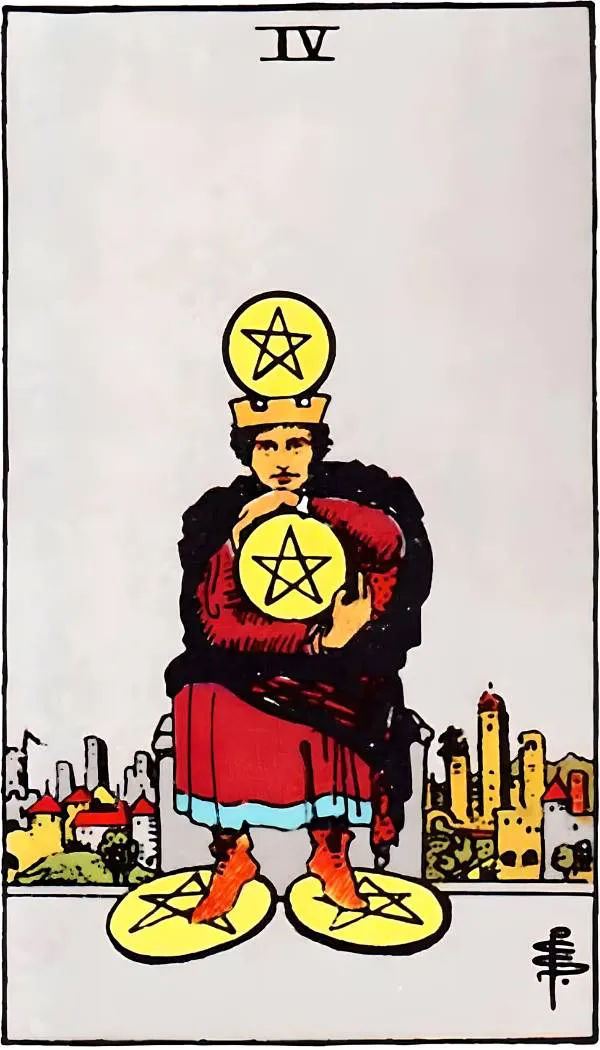
Four pentacles are arranged in a pattern of two vertical and two horizontal, though the lines do not intersect. The two vertical ones are positioned above the two horizontal ones.

The central figure in the scene faces us, sitting on a square stone seat with a firm and unyielding posture. He has strung together these four pentacles in a vertical and horizontal arrangement.

He tightly embraces the pentacles with both hands, with one foot on each pentacle, and a crown on his head, which also has a pentacle on top.

He must remain still, or else the pentacle on his head would fall first, but he seems to take pleasure in possessing this wealth.

This wealthy man has a greedy look in his eyes, his lips tightly pursed, and his entire body is in a state of stillness, appearing very rigid. He is dressed in a deep reddish-brown garment, with two sleeves and the hem exposed, draped in a black cloak, showing a noble demeanor, but also revealing his inner closure.

Behind the wealthy man is the backdrop of an entire town, with rows of high and low buildings clearly visible, and in the far distance, mountains can be faintly seen as a barrier. The foreground ground is flat and colorless, and the background sky is also a colorless expanse.

Indeed, the entire arm encircling and still as a mountain is also a posture of practicing. The posture of holding money in the hand, if replaced with something else, could represent a different state. However, if one is too attached to material things, it becomes a kind of rigidity.

Man Holding and Stepping on Pentacles

The main figure in the card is a man who holds a pentacle close to his heart and has his feet firmly placed on two other pentacles. This is a direct representation of his deep attachment to material possessions, wealth, and security. He is unwilling to let go, clinging to what he owns with great intensity.

Fourth Pentacle on the Crown

The fourth pentacle placed above the man’s head or on a crown signifies his mental and perhaps egotistical attachment to wealth. It shows that his thoughts are consumed by his possessions, to the point where it rules over his identity and self-worth.

Background Town or City

The town or city that is often portrayed in the background of the card indicates that the figure is disconnected from his community and social ties. His concern for material wealth has distanced him from society, suggesting the loss of something more valuable than material goods.

Rigid Posture

The man’s rigid posture points to his emotional and spiritual rigidity. He is closed off to anything that doesn’t directly concern his wealth or material possessions. This lack of emotional and spiritual flexibility is indicative of how his material concerns have overshadowed other areas of his life.

Throne or Seat

The throne or seat upon which the man sits is often adorned or structured in a way that denotes stability and power. However, this is a double-edged symbol. While it suggests that he has achieved some level of material success, it also traps him, becoming almost like a cage that restricts his freedom and ability to connect with more ephemeral, but equally important, aspects of life.

Psychological patterns in Four of Pentacles
Illusion of Control
The figure can only keep the crown pentacle balanced by staying almost completely still. His arms hold the chest pentacle, his feet pin the lower ones, and the entire body becomes a control mechanism with no spare movement left for response. In the reversed state, this same containment turns into a psychological trap. The system tries to prevent disruption by controlling every resource point, but the more control it demands, the less adaptive capacity remains when life inevitably shifts. Illusion of Control appears when You mistake a perfectly held structure for a resilient one. In lifestyle terms, the card shows how a tightly managed routine, budget, home setup, or wellness plan can create temporary certainty while quietly removing the flexibility that real stability requires.
Certainty Seeking
The pentacle balanced on the crown makes the figure’s stillness feel conditional: one wrong movement and the symbol of control drops first. The square seat, rigid torso, and fixed four-point arrangement create a closed system where stability depends on keeping every variable in place. Certainty Seeking grows from that same geometry. The decision-making mind tries to protect itself by demanding a guarantee before it moves, but the guarantee has to be maintained by staying still, so clarity becomes another form of immobilization. For You, the card points to the difference between useful information and impossible proof. A choice reading can reveal the structure of the trade-off, but this pattern keeps asking the reading to remove uncertainty itself, as if the right decision should come with no psychological exposure.
Sunk Cost Fallacy
The stone seat supports the figure, but it also fixes him in the exact position required to keep every coin in place. The town is visible behind him, yet the body cannot turn toward it without disturbing the structure it has spent so much effort maintaining. Sunk Cost Fallacy emerges when past investment becomes a reason to keep paying with future mobility. You may stay with a role, project, or professional identity because leaving would make the years spent there feel unprotected, even when the structure has already stopped serving movement.
Emotional Gatekeeping
The pentacle is clamped directly over the figure's chest, with both arms forming a locked frame around the heart area. His lips are tight, the dark cloak closes around the torso, and the distant town receives no gesture of welcome. The defense turns feeling into guarded property. You may still show up socially, speak politely, and appear steady, but the pattern keeps emotional truth behind a controlled gate until the environment proves safe enough. Emotional Gatekeeping protects your inner life from careless access, while also making closeness harder for people who cannot tell whether the door is locked or simply waiting.
Achievement Fusion
The same pentacle symbol appears at the crown, heart, and feet, linking thought, identity, and grounding to one visible measure of value. The man is not just holding resources; his body is organized around them as if they define where the self begins and ends. Achievement Fusion shows up when salary, title, output, or manager approval stops being feedback and becomes a mirror for worth. You can still be ambitious, but the card's rigid structure exposes the cost of letting career metrics sit on top of identity instead of beside it.
Insight Hoarding
The man's hands clutch one pentacle while his feet pin two others, repeating the same act of possession through the whole body. Behind him, the town is visible, but the foreground is still and sealed, as if value has been gathered into the body and prevented from moving outward. That repetition matters psychologically. The card does not show learning, trade, practice, or exchange; it shows accumulation without circulation. In personal growth, this can become a cognitive holding ritual where insights, frameworks, courses, and theories are collected because collecting feels safer than being changed by them. Insight Hoarding turns self-awareness into another possession. You may know a lot about your patterns, but the card exposes the hidden trap: when insight is held too tightly, it stops functioning as a bridge into action and becomes a substitute for transformation.
Energy Scorekeeping
The four pentacles are positioned like countable units across head, heart, and feet, and the figure's limbs act as auditors that keep each unit in place. The scene turns security into an accounting system, with no visible movement toward the town behind him. Within a support network, this becomes the habit of measuring care through inputs and withdrawals: who listened, who texted, who took up space, who gave back. The pattern is an attempt to protect depleted energy by converting emotional reciprocity into a ledger.
Loss Aversion
The seated figure locks one pentacle to his chest, presses two more under his feet, and balances the fourth above his crown. Every contact point of the body is assigned to protection, so the card’s visual system turns possession into posture: to keep what is already held, the figure must reduce movement. That structure maps directly onto Loss Aversion in a choice reading. The mind begins treating the current option as safer because it is already owned, while any alternative is coded as a potential loss before it is assessed as a potential gain. For You, the card exposes the hidden trade-off inside the decision: the protected option may not be the truly aligned one, but it has become the one your nervous system can picture losing most vividly. The pattern does not make You irrational; it shows where the fear of loss is being mistaken for objective evaluation.
Comfort Zone Attachment
The seated body is stable, front-facing, and enclosed by its own grip, while the city and mountains remain behind him as unused depth. The square seat acts less like a vehicle than a fixed base. Comfort Zone Attachment forms when security becomes a container that starts to outlive its purpose. In a direction reading, the pattern shows up as staying with the route that no longer expands you because its walls are familiar. You are not confused because there are no possibilities; the familiar structure is absorbing the energy that would test them.
Transactional Intimacy
The town sits behind the figure while the pentacles occupy his head, heart, and feet. Social life is visible, but value is physically mapped onto possession rather than shared presence. The system translates connection into assets: access, usefulness, status, security, and emotional return. You may approach friendships, group chats, and networking spaces by asking what each tie protects or provides. Transactional Intimacy keeps you from wasting energy, but it also makes belonging feel conditional, as if closeness must prove its value before it can be trusted.
Core Struggles in Four of Pentacles
Control Lock
The square seat, locked arms, planted feet, and balanced crown pentacle turn the body into a closed control system. Nothing is falling, but the price of that stability is that every limb has been reassigned from movement to containment. Control Lock appears when a decision is treated as valid only if all variables can be held at once. You stay braced around the choice instead of entering it, because any uncertainty is felt as a breach in the structure that keeps the whole scene upright.
Sunk Cost Paralysis
The man sits with one pentacle against his chest, one on his crown, and two pinned under his feet; every point of contact turns what he owns into a condition for remaining still. To stand up would not simply change position; it would disturb the arrangement that proves he has something secured. That is the exact pressure behind Sunk Cost Paralysis in a choice reading. You are not only comparing future paths; you are carrying the weight of what has already been paid, built, or endured, so the act of choosing feels like making a visible loss instead of reclaiming movement.
Comfort Entrapment
The stone seat supports the figure, but the support becomes inseparable from restraint. His feet press down on two pentacles, his arms close around another, and the coin on his head makes even a small shift costly. Comfort Entrapment lives in that exact mechanical bargain: the position is secure because it does not move. You may be looking at a future that is technically open, yet every route seems to require disturbing the stable arrangement that has made life feel manageable. The distant town remains visible, which matters. The card is not showing an absence of possibility; it is showing possibility separated from bodily permission. The trap is the safe life that can be defended more easily than it can be outgrown.
Timing Control Strain
The figure sits squarely on stone, hands locked around one pentacle while both feet pin two more and a fourth balances above the crown. The body can keep this arrangement intact only by reducing movement to almost nothing, so security is preserved through muscular stillness rather than responsive timing. For you, the struggle is not simply impatience; it is the pressure to make the right moment stay still long enough to feel controllable. Four of Pentacles locates Timing Control Strain in the exact place where protection becomes a timing cage: every variable is held, but the cycle outside the body keeps moving.
Boundary Rigidity
The seated figure holds one pentacle against the chest, presses two under the feet, and balances another on the crown. The body can keep everything in place only by reducing movement, narrowing the breath, and turning every limb into a guardrail. In a social field, that posture maps to a boundary system that has become too rigid to let connection circulate. You may know you need limits, but the card shows the moment protection stops being a flexible edge and becomes a fixed enclosure around the whole self. The distant town matters because connection is not absent; it is visible, nearby, and structurally separated. This struggle is not about having no social world, but about needing so much internal bracing to enter it that belonging starts to feel like exposure.
Boundary Control Strain
The card's order is not effortless. The figure has to keep the chest covered, both feet planted, and the crown balanced, so the entire body becomes a monitoring device for keeping the arrangement intact. In friendship, this is the strain of managing access instead of simply having a boundary. You may be checking how much you reveal, how much you owe, who gets your time, and whether one small opening will become a demand you cannot pull back from. The empty foreground turns space into a buffer. Four of Pentacles locates the struggle in that buffer: not in the need for limits, but in the exhausting control system that forms when every friendship boundary has to be manually defended.
Grade-Identity Fusion
The crowned figure balances one pentacle on his head, clamps another to his chest, and pins two under his feet, turning every point of contact into a security checkpoint. His posture does not simply show possession; it shows a body organized around keeping evaluation objects from slipping. In academic life, that arrangement maps onto the moment grades, rankings, scholarships, or supervisor praise stop being information and start feeling like proof of who you are. You can still study, but every task carries the extra load of defending identity, so one mark can feel physically too heavy for the system holding it.
Golden Handcuff Bind
The pentacles are not scattered around the figure; they are attached to the body at the head, heart, and feet. The wealth symbol becomes a restraint system, and the square stone seat gives the scene the posture of status without the mobility that status is supposed to buy. Golden Handcuff Bind forms when the safest option carries enough reward to make leaving feel irrational, even when staying costs agency. In decision work, the card shows a secure path that is real, but also a path that keeps your feet occupied and your horizon behind you.
Inner World Entrapment
The town sits in the background as an open field of life, while the foreground is reduced to a stone seat, four pentacles, and a body that cannot safely shift position. The scene contains space, but the figure’s usable world has collapsed into a guarded interior. In the reversed state, that compression becomes an inner architecture. You may be surrounded by thoughts, memories, and self-protective meanings, yet still feel unable to move within them; the card shows the mind becoming a room with visible windows and no trusted door.
Emotional Containment Strain
The figure is not only holding the pentacles; he is sealing them against his own body. The arrangement has no visible passage for release, and the hands and feet repeat the same immobilizing function until stillness becomes the only way the system can keep working. In friendship, this image speaks to the role of being the container: the person who receives the venting, remembers the secrets, absorbs the tension, and keeps the peace without letting anything spill. The outside may look stable because you are still sitting upright, but the structure shows a body turned into storage. Four of Pentacles names the strain of containment when friendship gives you too much to hold and too little room to be held back. The issue is not that you care too much; it is that the bond has assigned you a holding function without building a return channel.
Inner Emotions in Four of Pentacles
Independence Guilt
The pentacle balanced above the crown turns possession into identity, while the town behind the figure sits close enough to be seen but far enough to feel emotionally unreachable. The image holds a strange kind of separation: the figure has a defined self, but that self has to be guarded in place. In a family reading, this creates the emotional weather of becoming independent while still feeling watched by inherited expectations. You may have your own apartment, income, partner, values, or timeline, yet part of you still moves as if the family system owns the final interpretation of who you are allowed to become. Independence Guilt is the ache of stepping into your own shape while fearing that differentiation will be read as betrayal. The Four of Pentacles gives that guilt a concrete form: a self built carefully enough to stand, but still tense because belonging and autonomy have not yet learned how to coexist.
Hollow Control
The square stone seat, the fixed body, and the four sealed pentacles create an architecture of control, but the colorless ground and sky keep the scene from feeling nourished. The figure has secured the objects, yet the space around him remains emotionally bare. In family dynamics, Hollow Control appears when managing everything becomes the substitute for feeling safe. You may control what you reveal, what you spend, when you visit, how long you stay, or which topics remain untouched, but the control itself does not create warmth or relief. The Four of Pentacles captures the emptiness that can sit inside a perfectly defended position. It reflects the moment when self-protection is working on paper, while your inner world still feels unheld, untouched, and quietly starved for a form of safety that is not built from tension.
Contained Overwhelm
The figure in the Four of Pentacles is overloaded without looking dramatic: crown balanced, chest guarded, feet pinning value to the ground. The pressure is not scattered across the scene; it is packed into stillness. In family dynamics, Contained Overwhelm often appears as controlled functioning. You may keep your voice even, answer the group chat, attend the visit, manage the bill, or sit through the same old comments while the real emotional volume stays trapped behind your face. The reversed current of this card shows pressure that has lost its outlet. Nothing visibly breaks, but nothing moves either, which is why the overwhelm feels so difficult to prove from the outside and so heavy to carry from within.
Boundary Guilt
The figure’s arms lock the pentacle against his chest while both feet pin the others to the ground. In friendship, that closed circuit turns care into something that has to be held in place before it leaks out through obligation. You may not be refusing connection; you may be trying to stop unlimited access from being treated as proof of love. Boundary Guilt appears when protecting your private emotional supply feels morally suspect, even though the card’s whole posture shows how much energy it takes to keep yourself intact.
Cozy Suffocation
The figure is wrapped in a heavy cloak, seated on a firm stone block, and sealed off from the town behind him by his own posture. The image contains comfort markers: wealth, insulation, status, and a fixed place to sit. Yet the body has no visible opening, and the coin held at the chest turns protection into pressure. Cozy Suffocation belongs to the lifestyle moment when a stable setup starts feeling airless. The apartment is comfortable, the routine is predictable, the spending is controlled, and the habits may even look impressive from the outside, but the inner atmosphere has no circulation. The card does not shame comfort; it audits the cost of comfort without movement. You may be sensing that your life has become padded enough to reduce risk, yet too sealed to let freshness, social contact, or spontaneous desire enter the room.
Comfort Numbness
The black cloak wraps the figure like insulation, while the coin at his chest is held so tightly that the body has no visible softness. The foreground is flat and colorless, and the face remains compressed, giving the scene the feel of a protected surface with very little sensory circulation. In lifestyle questions, this image points to the kind of comfort that can become emotionally muted. A clean room, stable account, predictable routine, or controlled schedule may reduce chaos, yet the same insulation can also lower the volume on pleasure, curiosity, and real contact with the day. Comfort Numbness is the feeling of being secure but under-stimulated, safe but strangely absent. The card helps separate genuine stability from a life that has become so protected that it no longer gives enough texture back to you.
Status Anxiety
The pentacle placed on the crown makes the head itself look occupied by a symbol of possession and proof. Behind the seated figure, the town stretches out like a watching social world, while the body remains fixed in a display of guarded composure. This is the emotional logic of Status Anxiety in a social field. The card does not show relaxed participation in a community; it shows visibility organized around ownership, image, and the fear of dropping the thing that appears to validate your place. For you, the social charge may come from feeling that every circle has an invisible scoreboard. The more your belonging feels tied to what you can display, achieve, or hold together, the harder it becomes to experience people without measuring yourself against them.
Analysis Paralysis
The figure faces forward, but the body does not follow the direction of the gaze. The town and mountains are visible behind him, while the coins remain fixed at head, heart, and feet. Analysis Paralysis takes that split and turns it into an inner state: the mind can see the decision field, but the body cannot translate visibility into motion. Every new angle adds another point to secure, another cost to count, another reason to remain still. The card gives the paralysis a concrete form. It shows that the blockage is not a lack of information; it is a system where information has been recruited to prevent the discomfort of movement.
Wrong Choice Panic
The pentacle on the crown makes the whole posture precarious. The figure can keep the arrangement intact only by freezing, because one wrong shift would be visible immediately at the highest point of the body. That is the emotional geometry of Wrong Choice Panic. In a major decision, the mind starts treating movement itself as the risk, as if the first imperfect choice will expose a failure that cannot be contained. The card gives you an objective mirror for that panic. It shows the difference between a real strategic risk and the felt terror of losing a perfectly controlled self-image the moment you act.
Control Fatigue
The square stone seat, rigid elbows, pinned feet, and coin pressed to the chest show control as something the whole body has to maintain. In academic work, the same structure appears when planners, trackers, note systems, grade targets, and productivity rules become a second workload sitting on top of the actual learning. Control Fatigue enters when stability has to be constantly performed. The card reveals the drain of holding every part of the study system in place, where the effort to prevent slipping begins to consume the energy that was supposed to support thinking.
Outer Contexts in Four of Pentacles
Scorekeeping Friendship
The four pentacles form a rigid accounting grid across the body: one above, one at the chest, and two under the feet. Nothing is loose, nothing is casually shared, and every point of contact appears fixed enough to be counted. Scorekeeping Friendship follows from that grid when a relationship starts measuring effort instead of metabolizing it. You may be tracking texts, money, invitations, apologies, or emotional labor because the structure no longer feels reciprocal enough to trust without a ledger.
Sunk Cost Exit Dilemma
The figure cannot stand up casually. A coin sits above the crown, the feet pin two more to the ground, and the hands lock the central one against the body, making even a small movement feel structurally expensive. That is the exact outer pressure of a sunk cost exit dilemma. The path may no longer be alive, but it is loaded with time, money, reputation, credentials, relationships, and proof that once made the choice seem rational. For long-term direction, this card points to the moment when staying is no longer purely chosen and leaving is no longer purely available. The useful clarity comes from separating what is truly still supporting your future from what is only expensive because it has already been paid for.
Bad Timing Loop
The pentacle on the crown makes the whole posture fragile: one move and the most visible symbol of control falls first. The flat foreground offers no active road into the town, so the body keeps repeating stillness as a way to prevent immediate loss. This is the architecture of a timing loop. You push, the structure tightens; you wait, the window feels smaller; you prepare, the preparation becomes another reason not to move. The card shows how timing can become a closed circuit when security depends on staying fixed. In this context, the issue is not whether action is good or delay is bad. The card points to the pattern itself: the same blocked rhythm keeps returning because the external opening, the available resources, and the need for control are not arriving in the same moment.
Family Resource Gatekeeping
The coin locked to the chest, the coins pinned beneath both feet, and the coin set on the crown create a body that owns by blocking movement. Nothing is broken or missing, yet every useful object sits under one figure's control. In a family system, that image maps cleanly onto money, housing, paperwork, gifts, or introductions being held behind a gate. You may not be dealing with scarcity as much as with access: resources exist, but the person at the center decides when they count as support and when they become leverage.
Decluttering Paralysis
Both arms close around the central pentacle while both feet press down on the lower ones. The objects are intact, but they are not available for movement; they have become anchors held in place by the body itself. Decluttering Paralysis is the physical-life version of that locked posture. The wardrobe, boxes, notes, backup items, old supplies, and digital clutter are not just mess; each object has been assigned a protective function, so removing it feels like disturbing the whole operating system. The card connects this context to the moment when minimalism stops being an aesthetic preference and becomes a confrontation with stored security. You are facing a room where objects have become load-bearing, and the first task is seeing which ones are actually supporting life and which ones are simply pinning it down.
Academic Hoarding Loop
The hands clutch one pentacle against the chest while both feet pin down two more, turning resources into objects that cannot be released, shared, tested, or transformed. Nothing in the body is available for outward motion because every limb is assigned to keeping possession intact. In study life, this becomes the loop of collecting notes, lectures, PDFs, screenshots, tabs, flashcards, and study systems without converting them into recall, argument, or finished work. The material is there, but its function has shifted from learning support to proof that control is still possible. You can see the academic trap in the closed circuit around the body. The card does not criticize having resources; it reveals the point where resource protection becomes output paralysis, and where clarity begins by asking which material must be used, not merely kept.
Resource Gatekeeping Role
The pentacles are not scattered across the scene; they are gathered into one body. Hands, feet, chest, and crown turn material symbols into a private circuit, while the town behind the figure receives none of that flow. In a workplace, that visual arrangement mirrors control over budget, approvals, information, access, or headcount. The person holding the resources may appear stable and important, but the structure makes everyone else's movement dependent on what is released, withheld, or personally authorized. Resource Gatekeeping Role captures the career stage where power comes from controlling the channel rather than expanding the work. The card makes the leverage visible, along with its cost: influence grows, but trust, collaboration, and strategic range can narrow around the locked resource point.
Conditional Family Support
The pentacles form a closed circuit around the seated figure: head, heart, hands, and feet all occupied by keeping possession intact. The town behind him is visible, but no coin moves toward it. That still circuit mirrors support that is technically available but not freely circulating. You can receive help, shelter, money, or approval, yet the structure asks you to stay still enough that the family system does not have to renegotiate control.
Relationship Power Play
Both hands wrapped over the central pentacle, feet planted on the lower coins, and the crown coin balanced above the head create a body that cannot relax without losing control. In love, that image becomes a relationship stage where affection, time, labels, or practical support are not simply shared; they are guarded and released only when the power balance feels favorable. You are not dealing only with a difficult mood or a communication glitch. The structure around you rewards stillness, leverage, and strategic withholding, so clarity starts with naming where access is being controlled and where mutual choice has been replaced by negotiation under pressure.
Transactional Friendship Circle
The town sits behind the figure, but the visible center of power is the sealed arrangement of coins around his body. Social life is present, yet the relationship to it is mediated through ownership, access, and what can be kept underfoot. In a friend group, that structure mirrors a circle where belonging is tied to favors, social currency, introductions, gifts, or constant usefulness. You may still be inside the room, but the cost of staying connected has become measurable in ways the group does not openly admit.