Saying Yes Under Pressure, Then Opening the Calendar Before Deciding

The 4:47 p.m. Yes and the Calendar Left Unopened
I met Alex (name changed for privacy), a Toronto project coordinator who said "that should be fine" while their calendar was still closed. I recognized the pressure-triggered people-pleasing pattern immediately: a manager asking for a next-morning commitment in a live Teams call, or a Slack message marked "quick ask," with the silence after the question feeling impossible to survive.
I asked Alex to take me back to the most recent moment. At 4:47 p.m. on a Tuesday, a Slack notification had flashed beside a half-finished coffee. Alex told me about the laptop fan humming, the faint smell of reheated lunch, and their fingers typing, deleting, and retyping "I need to check my bandwidth" before sending "Yes, I can make that work." Their jaw tightened as the message left; only then did they open Google Calendar and see a week already packed with coloured blocks.
"Why do I keep saying yes when I feel rushed to commit?" Alex asked. They wanted their commitments to be genuine, but feared that slowing down would threaten approval, opportunity, or connection. A quick yes brought the immediate relief of taking a hand away from a hot pan, then left them carrying the burn through the rest of the week.
I heard the apprehension in the way Alex leaned toward the screen before an answer had arrived, chest tight, breath held, jaw set. I said, "You are not confused about every commitment; you are being asked to decide before your own answer has had time to arrive. I am not here to judge the pattern or predict what anyone else will do. Let's sit with it, look at the sequence clearly, and draw a map. Today's Journey to Clarity begins with giving you the pen back."

Choosing the Shadow Spread as a Compass
I invited Alex to take three steady breaths and focus on one precise question rather than on the imagined reactions of everyone who might be waiting for an answer. I shuffled slowly while the room settled around the soft movement of the cards. I use that pause as a psychological threshold: a way to move from notification speed into observation, not as a performance of supernatural certainty.
I explained how tarot works in this room. The five-card Shadow Spread is useful when a repeated boundary behavior persists across work, friendships, and dating, because it separates the visible automatic pattern from the fear beneath it, the pressure that activates it, the corrective principle, and the behavior that can integrate the insight. It gives card meanings in context a clear structure for examining an automatic yes.
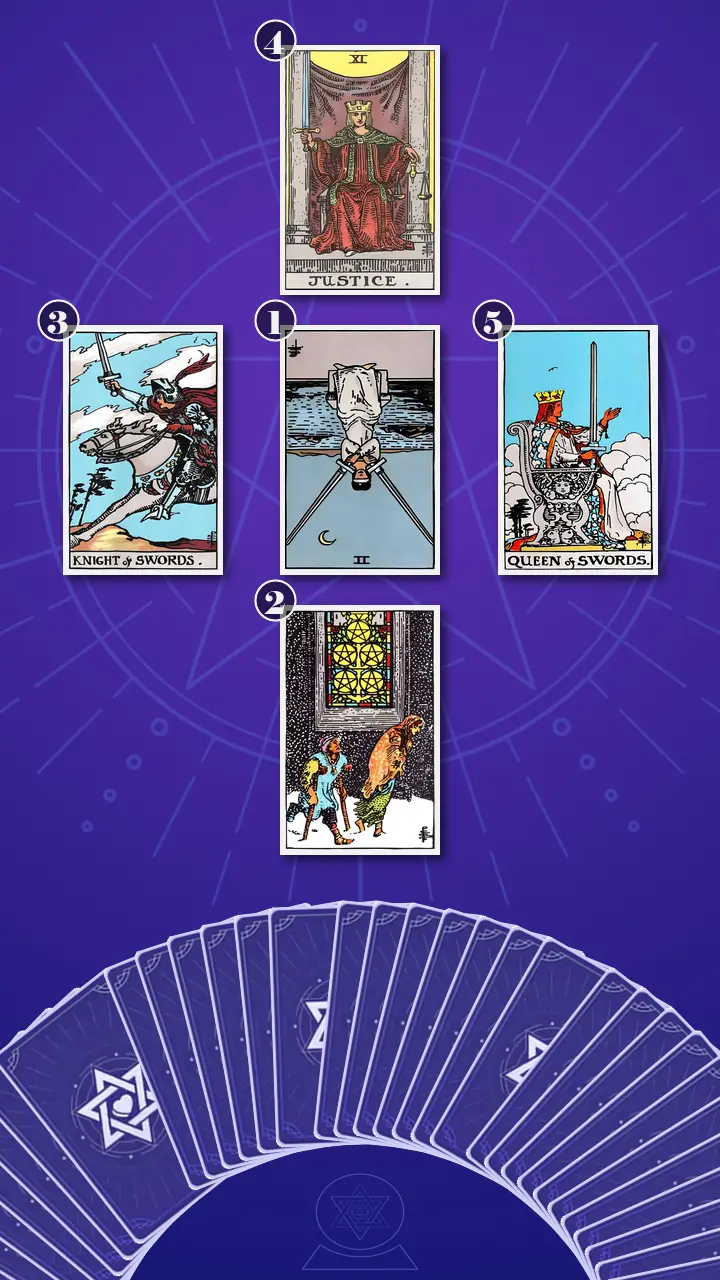
The center card would reveal the observable shadow pattern: the moment Alex says yes before checking capacity. The card below it would show the root fear that makes a pause feel dangerous. The card to the left would identify the rushing trigger. Above the center, the key card would offer a fairer principle, and the card to the right would turn that principle into language Alex could actually use. I told Alex that the spread could offer actionable advice, but Alex would remain the person deciding what to do.
Reading the Map Beneath the Rush
The Automatic Yes: Two of Swords Reversed
I began by saying, "The first position reveals the observable shadow pattern in the diagnosis: you give an immediate yes before checking your capacity because remaining undecided under pressure feels intolerable. Traditionally, this position shows the disowned, automatic, or insufficiently examined pattern shaping behaviour." I turned over the Two of Swords, reversed.
The blindfolded figure immediately brought Alex back to that 4:47 p.m. Slack thread. The crowded Google Calendar was visible, but Alex had mentally screened it out. The draft asking for time had been deleted, and the one-line acceptance had been sent to end the tension. The crossed swords had lost their stable balance: instead of protecting a thoughtful decision, they represented a defensive stalemate breaking under pressure.
In energy terms, I read the reversed Air here as both excess and blockage. Alex's mind scanned rapidly for every possible consequence of hesitation, yet that mental activity could not evaluate time, energy, willingness, or existing promises. The automatic yes became a pressure-release behaviour rather than a considered choice. I asked, "What happens in the first ten seconds?" Alex looked down and answered, "I could pause, but they might think I'm difficult. I could say no, but then they might give it to someone else. Fine. Yes."
I watched the reaction arrive in three small movements. Alex's breath stopped halfway in; their fingers hovered as though the deleted message were still on the keyboard. Their eyes then went unfocused, replaying the calendar-after-the-commitment scene. Finally, they gave a short, bitter laugh and let their shoulders drop. "That's too accurate," they said. "Almost rude."
I let the laugh have its dignity. "The yes may have protected you from an uncomfortable silence," I said, "but it did not tell the truth about what you could offer. That is information, not a character verdict." Alex slowly nodded, though their hand remained wrapped tightly around the coffee cup.
The Warm Window Alex Could Not Trust: Five of Pentacles Upright
I said, "The second position reveals the mechanism beneath the pattern: the fear that delaying or declining could threaten approval, access, or belonging. Its standard meaning is the origin, underlying belief, or emotional root that gives the shadow pattern its power." I turned over the Five of Pentacles, upright.
I brought Alex into a Toronto WhatsApp group chat where a weekend booking had shifted from "maybe" to "confirmed tonight." Alex had been checking the cost, travel time, and the exhaustion waiting at the end of a full work week. Then the phrase "everyone else is in" had appeared, and Alex had imagined the group moving on without them. They replied "Count me in" before checking whether they could afford or even enjoy the trip.
I pointed to the two figures moving through snow and the illuminated window holding the five pentacles. "The window is not proof that you will be welcomed," I said. "It is a reminder that support may still be available even when your fear makes it hard to trust. The card shows perceived exclusion, not a prophecy of rejection." In this position, Earth carried the fear of scarcity and belonging, while the practical evidence of connection remained difficult for Alex to notice.
Alex's stomach visibly tightened. They reread the imagined sentence in silence: "If I ask for time, they might stop making space for me." I asked them to separate the prediction from the evidence on the screen. Nobody had said the invitation would disappear. The pause had simply become emotionally larger than the request itself.
"I think I treat asking for time like I'm already outside the room," Alex said. I answered, "That distinction matters. We can respect the fear without allowing it to make the decision. A normal pause does not automatically mean a relationship is being tested."
When Someone Else's Speed Becomes Your Deadline: Knight of Swords Upright
I said, "The third position identifies the specific trigger described in your question: compressed time, forceful momentum, and a request framed as needing an immediate commitment. Traditionally, this position shows the situation or cue that activates the shadow response." I turned over the Knight of Swords, upright.
I described the live Teams call Alex had mentioned. A colleague had said, "I need to know now. Can I put you down for tomorrow morning?" The fast voice, follow-up pings, and compressed deadline had made Alex's body lean toward the laptop before the scope of the work was visible. The charging horse became conversational velocity; the raised sword became the feeling that another person's urgency had the authority to set the deadline for Alex's consent.
I read this card as excess momentum, not as a diagnosis of the colleague. "The request may be genuinely time-sensitive," I said. "But the question is whether it is urgent for the situation or whether you are absorbing the momentum as a command. Is this genuinely time-sensitive, or am I absorbing someone else's urgency?"
Alex's thumb stopped moving over their phone. Their shoulders pulled forward, then eased back by an inch. I told them that an urgent-looking Slack thread could resemble The Bear's ticket rail, with every new demand appearing before anyone has checked what can realistically be served. "The speed may be real," I said, "but it is still somebody else's speed. Urgency is information about the request, not automatic authority over your consent."
I felt a brief flash of my own studio practice while I watched Alex study the card. On a film set, a close-up can make one moment feel like the whole story, but the camera angle is not the same thing as the character's destiny. I have always believed our lives are films in production. The task here was not to defeat the charging Knight, but to stop letting its pace write every next scene.
When Justice Asked Who Gets to Set the Clock
The Scales Before the Answer: Justice Upright
I said, "The fourth position presents the key transformation from automatic compliance to a fair assessment of willingness, capacity, and consequences before answering. Its standard meaning is the lesson or conscious capacity the shadow is asking you to develop." I turned over Justice, upright. As the Bridge card of the reading, Justice would connect insight to a behaviour Alex could practice.
The modern scene was simple. At 10:14 a.m. on a Wednesday, another next-morning request appeared. Instead of replying from the notification, Alex opened Google Calendar, listed existing obligations, noticed the tiredness they had been ignoring, and asked whether they genuinely wanted to take on the work as well as whether they technically had time. The scales gave equal weight to the request and Alex's capacity. The upright sword became the answer after assessment, not the impulsive reply before it.
In the sequence of the spread, Justice regulates the distorted Air of the Two of Swords reversed and the accelerated Air of the Knight. The three facts that belong on the scales are available time, genuine willingness, and the cost to existing commitments. This is fair self-assessment, not automatic refusal. A yes can still be honest after the check; so can a no.
The Fork in the Scene
The room grew quieter when I placed Justice above the center card. At 4:47 p.m., the familiar thread was back in front of us. Alex's chest tightened; their fingers drafted a request for time, deleted it, and hovered over yes while a crowded calendar waited behind the window. They were trying to protect belonging by outrunning their own answer.
An instant yes is not proof of care; put your capacity on Justice's scales, then let the upright sword turn a measured decision into a clear answer.
For a moment, Alex did not blink. Their pupils widened and their mouth parted; a breath caught behind their teeth. Their eyes moved past the card to the dark window, as if the late deck, the rearranged weekend, and every rehearsed explanation were replaying there. Then their shoulders lowered by a fraction, their jaw loosened, and their clenched hand opened on the table. "But does this mean I have been doing it wrong?" they asked, their voice thin. I heard grief inside the question, not failure. I told them that an instant yes had been an adaptive way to end pressure, and that a protective habit could be revised without shame. Alex exhaled, shaky but longer this time, and looked back at the scales. "Now, use this new perspective to recall: was there a moment last week when this insight could have made you feel differently?" I asked. Their eyes softened as the answer began to arrive.
Within ten minutes, I asked Alex to choose one low-stakes, non-urgent message and write the unsent version first: "I need to check my capacity, and I can answer by tomorrow at noon." I asked them to put that response time in the calendar, then decide later. The pressure would still be present, but it would no longer be holding the pen.
I used my Narrative Fork Analysis to make the difference visible. The first plotline was the familiar one: say yes now, end the silence, look dependable, and carry the cost alone in the next scene. The second plotline began with an awkward pause, then opened space for a measured answer and a more truthful kind of connection. I also named what I call Safe-Choice Sabotage Recognition: the immediate yes looked logical because it prevented rejection in the moment, but it was also protecting Alex from the necessary inciting incident of letting another person experience a pause. I was not choosing the ending for Alex. I was helping them see which plotline served the character they were becoming.
This was the first real movement from pressure-triggered apprehension and approval-seeking compliance toward measured self-trust. The clarity was not a sudden disappearance of fear. It was the moment Alex could include their own capacity as evidence without needing to punish themselves for having limits.
The Sentence That Keeps the Door Open: Queen of Swords Upright
I said, "The fifth position translates the transformation into an integrated behaviour: communicating a response deadline, a conditional answer, or a clear no without excessive apology. Its standard meaning is the practical way to bring the insight into conscious choices and daily behaviour." I turned over the Queen of Swords, upright.
I showed Alex the modern version of her upright sword: "I cannot confirm today. I can answer by noon tomorrow." When the answer was already clear, the sentence could be even cleaner: "I do not have capacity for this, so I am going to pass." The Queen's open palm kept the interaction human while her vertical sword kept the boundary from dissolving into an apology spiral.
I read the Queen as mature Air, no longer borrowed from another person's speed. "Clear does not have to mean cold," I said. "A boundary is not emotional disappearance. It is accurate information about what you can offer, which makes your future yeses more trustworthy." Alex typed the first sentence into their Notes app, deleted three extra apologies, and stopped editing.
I watched them read the message aloud. Their voice shook on "cannot confirm," then steadied at "tomorrow at noon." A small smile appeared when they noticed that the sentence left room for warmth without making their limit negotiable. I said, "Warmth does not require instant availability. You can stay connected without answering from guilt."
The Justice Pause and the Warm Boundary Script
The Story the Cross Told
I gathered the five cards into one story. The reversed Two of Swords showed the automatic yes at the center: Alex answered first and checked their life afterward. The Five of Pentacles revealed why the pause felt dangerous, because imagined exclusion had been mistaken for evidence. The Knight of Swords showed how another person's conversational velocity entered the body as a deadline. Justice offered the corrective principle of weighing the request alongside time, energy, willingness, and existing promises. The Queen of Swords turned that assessment into a sentence that could be spoken without hostility.
The cross made the mechanism visible. A quick yes ended the pressure without telling the truth, and the later exhaustion appeared to confirm that instant compliance was what preserved connection. The blind spot was not that Alex cared too much or needed to become rigid. It was the belief that relief was the same thing as consent, and that a pause was already a social failure.
I told Alex that the key shift was simple enough to remember: replace the immediate yes with a default time boundary before making any non-urgent commitment. This is the practical heart of the Shadow Spread tarot method. Tarot did not decide which requests deserved a yes. It gave Alex an objective visual language for noticing the trigger, testing the fear, checking the facts, and speaking from deliberate consent. I handed the pen back to Alex, where it belonged.
Next Steps That Keep the Pen in Your Hand
- The Justice PauseWithin the next seven days, choose one low-stakes, non-urgent request from a manager, friend, or dating partner. Send, "I need to check my capacity. I can give you an answer by tomorrow at noon," then put that response time in Google Calendar as a ten-minute reminder.Implementation tip: Keep the message short and specific. A pause is not an indefinite maybe; it is a real promise to return with an answer. If the situation is genuinely urgent, use a shorter window; if it feels unsafe or coercive, choose the level of contact that protects you.
- The Three-Line Capacity CheckBefore replying to one request this week, open your phone Notes app and write three lines: available time, actual willingness, and the existing promise this request would affect. Take three minutes, circle the most honest line, and reply with a conditional answer if needed: "I may have the time, but I need to confirm by tomorrow after I review the scope."Implementation tip: If three questions feel too formal, begin with one: "What would this cost me after the conversation ends?" Treat guilt as a reaction to notice, not an instruction you must obey.
- The Protagonist Pivot ActionWithin 24 hours, choose one low-stakes request that is still waiting and take one micro-action aligned with the more daunting but authentic plotline: give a real response time or send a clean no without adding a long explanation. Leave the thread for ten minutes after sending it so you can experience the pause instead of immediately managing the other person's reaction.Implementation tip: This is a creative mandate, not a test of perfection. You are writing one new scene in which someone else's silence does not automatically become your emergency. The goal is one truthful action, not a solved relationship.
A Week Later: The Quiet Proof
Three days later, I received a message from Alex: "I used the script for a low-stakes work request. I slept through the night, then woke thinking, What if they think I'm difficult? I opened my calendar first anyway. The fear stayed; it no longer held the pen."
I smiled when I read it. Alex had not solved every boundary question or become instantly comfortable with every pause. They had made a small, observable change: the calendar came before the reaction, and the answer came after the facts. That was enough evidence for a beginning.
I told Alex, "The cards made the pattern visible, but you made the choice. Your Journey to Clarity moved from pressure-triggered apprehension and approval-seeking compliance toward measured self-trust, deliberate consent, and warm boundary-setting. You are still the author of the next scene."
When a rushed request tightens your chest and makes you reach for yes before you have checked your own life, part of you may be trying to protect belonging while another part is already bracing for the cost of disappearing inside the promise. You do not have to shame either part to hear what it knows.
Warmth does not require instant availability. If you let one pause belong to you before the next yes, what small detail about your real capacity or desire might you finally notice?