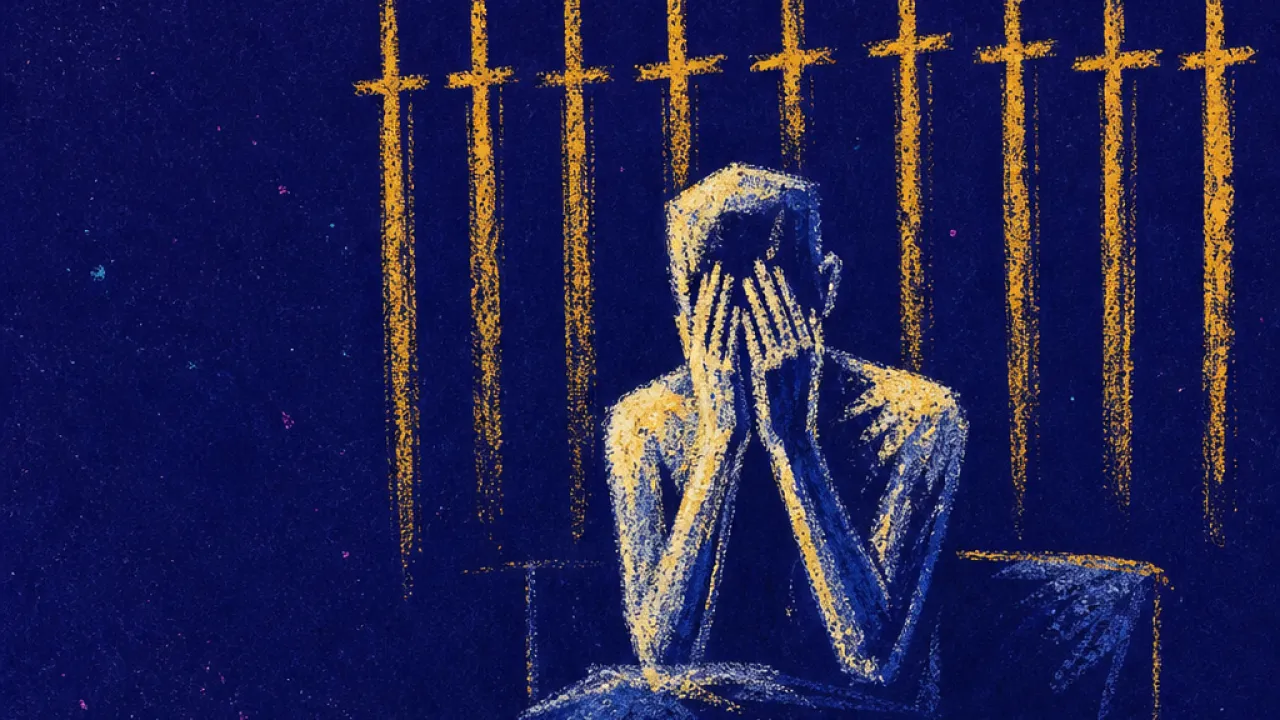
The reflex to replay conversations, messages, choices, and small tone shifts long after the moment has passed has a body signature: your chest buzzes while your breathing stays shallow. From a Jungian perspective, archetypal theory gives that repeated inner scene a visual language without turning it into a verdict. The cards below mirror the unconscious dynamics of thought circling the same impact point; here are the Tarot Cards that connect to Rumination.
The Hanged Man ReversedThe card places the figure in an empty white field with almost no external detail to interrupt the eye. Rope, body, trunk, and halo form a single line of attention, keeping perception inside one repeated axis. That narrowness gives Rumination its reversed shape. The mind keeps circling the same inner material, not because it is lazy or broken, but because it is trying to extract release from repetition. In introspection, the old scene, old shame, or old interpretation becomes a mental object that never fully digests. The Hanged Man’s stillness becomes costly when the changed perspective stops changing anything. You are not lacking depth; the pattern shows where depth has become a loop that keeps returning to the wound without moving the emotional charge through it.
Death ReversedThe black flag pulls the eye into a narrow field of contrast, and the horse’s procession fixes attention on the moment of impact. Even with a river and horizon in the distance, the foreground keeps replaying the encounter with the ending. That visual narrowing becomes Rumination when the mind treats repetition as a substitute for integration. In love, You may keep returning to the last text, the last fight, the exact sentence that changed everything, as if one more replay could finally produce control. The card shows why the loop is so compelling: the scene is not emotionally neutral. It contains status falling, bodies reacting, and a force that cannot be negotiated with, so the mind circles the evidence in search of a missing lever that may not exist.
Temperance ReversedThe liquid keeps moving between the two cups, and in the reversed psychological field that movement no longer looks like integration. It becomes circulation without landing, a perfect transfer that never becomes completion. That is the mechanism of Rumination. The mind keeps handling the same emotional material, believing that one more pass will finally purify it, explain it, or make it safe. In introspection, You may experience this as being unable to stop reviewing a trigger, memory, conversation, or flaw. The repetition feels productive because something is always moving, but the movement is trapped inside the same narrow channel.
The Devil ReversedThe downward torch keeps heat concentrated near the chained figure instead of spreading light through the whole chamber. The surrounding darkness and bat-like wings make the scene feel enclosed, as if attention has been pulled into one charged internal object. In the reversed texture, Rumination appears as heat without release. The mind keeps returning to the same flaw, failure, missed chance, or self-diagnosis because repetition creates the illusion of control, even when it produces no new clarity. In personal growth, You may confuse constant self-analysis with evolution. The card marks the point where reflection stops being a tool and becomes a loop, keeping the psyche busy around the wound instead of letting the insight become a different action.
The Tower ReversedThe figures hang in the air after the strike, frozen inside the motion of falling. They cannot return to the tower, but the ground has not yet received them, so the image holds the psyche at the exact point between rupture and integration. Reversed, that suspended moment can become a mental loop. You may keep replaying the sentence, memory, realization, or emotional impact that cracked the old structure, hoping repetition will create certainty, closure, or a cleaner explanation. Rumination fits this card because the mind circles the lightning strike instead of metabolizing what it revealed. The loop is not useless; it is trying to stabilize a system after shock. But without a container, the replay keeps you falling through the same inner scene.
The Moon UprightThe dog and wolf keep howling toward a moon they cannot reach. Their bodies are active, but the action does not change the light, the road, or the distance between them and the unknown. The scene turns energy into repetition rather than resolution. That is why The Moon can map Rumination so precisely in an introspective context. The mind keeps returning to the same memory, dream, message, mood, or imagined meaning, hoping one more pass will reveal the hidden answer. But the path remains dim because the loop is not the same as integration. The card's value is in showing the mechanism, not condemning it. You are trying to make the unseen feel safe by thinking it into clarity. The Moon shows where reflection has crossed into a closed circuit, and where the emotional charge is being maintained by the very analysis meant to discharge it.
ReversedThe winding path runs away from the water into darkness, lit only by the Moon's partial and reflected glow. The animals keep calling toward the same source, but the scene gives no clear answer back. Rumination follows that same night route: the mind keeps returning to unclear family signals, replaying tone, wording, pauses, and old scenes as if one more pass will make the truth appear. The Moon shows why the loop feels compelling; the material is emotionally loaded, but the available light is too indirect to deliver certainty.
Four of Cups ReversedThe three cups sit directly before the young man like a small archive of prior emotional evidence, while his closed eyes keep attention turned away from the new cup. The composition creates a loop between memory and evaluation, with the fresh offer present but excluded from the evidence set. Rumination forms when inner attention keeps returning to the same emotional data until it feels like truth. You may call it introspection, but the pattern is not opening the field; it is replaying old material until the mind mistakes repetition for resolution.
Five of Cups UprightThe black-cloaked figure bends toward the three spilled cups with the whole posture narrowed around what has already gone wrong. The two upright cups sit behind the body, and the bridge across the river remains visible, but neither enters the figure's working field of attention. That visual arrangement turns mourning into a cognitive loop: attention keeps returning to the same evidence, not because it is useful, but because the mind is trying to extract control from an event that has already happened. In personal growth work, Rumination often disguises itself as insight, analysis, or accountability, while quietly preventing the next experiment from beginning. You are not looking at a lack of depth; you are looking at depth trapped in repetition. The card shows how reflection becomes a closed circuit when the psyche keeps facing the spilled cups instead of letting the remaining cups become data for the next stage of self-development.
ReversedThe three spilled cups dominate the foreground so strongly that the rest of the card begins to feel psychologically muted. The two cups, bridge, river, and castle still exist, but the visual gravity keeps dragging attention back to the same emptied vessels. In the reversed texture, Rumination is no longer a contained attempt to process pain. It becomes an exhausted inner engine that keeps revisiting the loss because repetition now feels safer than reorientation. For introspective tarot, this card exposes the point where self-analysis turns into psychic noise. You may be searching for the missing insight, but the pattern shows that the mind is extracting more activation from the memory than clarity from the meaning.
Seven of Cups ReversedThe figure faces the cups as if the mind has been caught by a rotating display of images. Nothing in the scene lands on the ground; the visions hover in clouds, which means attention can keep moving without ever arriving. Rumination is the reversed pressure of this image: the psyche replays symbolic material because repetition feels like processing, even when it is not producing integration. The cups become mental loops, each one offering another angle, another fear, another possible explanation, another almost-answer. In introspective tarot, this pattern can make inner work feel exhausting and strangely addictive. You may keep revisiting the same dream, trigger, message, reading, memory, or imagined future, not because it is revealing more, but because the mind is trying to metabolize emotion through repetition alone.
Page of Cups ReversedThe Page's gaze is locked onto one small exchange: cup, fish, face, and back again. The empty sky gives almost no competing information, while the water behind him keeps moving, as if emotional energy continues to feed the scene without creating resolution. That is the visual engine of Rumination. A single inner image becomes a closed circuit, and attention keeps returning to it because the mind mistakes repetition for processing. The cup contains the signal, but the fixed gaze keeps the psyche circling rather than digesting what has surfaced. For introspective tarot, this pattern appears when You keep pulling the same feeling, memory, reading, or symbolic message back into focus, hoping one more pass will finally unlock it. The card shows the cost of over-contact with the inner world: the message is no longer emerging; it is being replayed.
Queen of Cups ReversedThe Queen's attention remains fastened to the lidded chalice, while the wall behind her cuts off the wider view. The scene is calm, but the visual pathway is repetitive: gaze, cup, containment, return. Rumination begins when processing becomes orbit. You keep circling the same inner object, hoping that one more pass will open it, explain it, or make it stop hurting. In the reversed texture, the cup does not release new material; it becomes the center of a closed attentional circuit. The mind can feel active and emotionally serious while the actual feeling remains sealed, unchanged, and endlessly revisited.
King of Cups ReversedThe king's gaze stays trained on the cup while the wider sea continues to move around him. In the reversed texture, that focus can become a closed loop: one object of feeling is inspected again and again while the larger emotional field remains unprocessed. The mind believes it is going deeper because it keeps returning to the same symbol. But the posture does not change, the water does not get integrated, and the system spends energy circling rather than metabolizing. Rumination fits this card when introspection loses movement. You are not failing to think enough; the pattern is that thought has become a still throne in the middle of moving water, repeating contact without allowing release.
Two of Pentacles ReversedThe infinity cord does not lead the pentacles anywhere; it keeps them circulating. The hands repeat the same catch-and-release motion while the background sea echoes that restless, wave-like return. That is the embodied logic of Rumination. Thought stays active, but the movement becomes circular: replaying, reinterpreting, checking, and mentally rebalancing the same emotional material without letting it settle. In introspective tarot, this card points to the difference between processing and looping. You may feel productive because the mind keeps moving, but the image shows how repeated motion can preserve the very tension it is trying to solve.
Eight of Pentacles ReversedThe hammer-and-chisel rhythm fixes the whole scene around one small surface, with the craftsman bent close enough that the wider world recedes. Repetition is necessary for craft, but the image also shows how a focused loop can shrink the field of awareness. Rumination is the inner version of that loop when reflection stops producing new information. You may keep striking the same memory, flaw, or emotional detail because repetition feels like control, even though the mind is no longer making contact with anything new.
Page of Pentacles ReversedThe Page's hands and eyes form a closed circuit around the pentacle. Reversed, that circuit stops feeling like study and starts feeling like a loop, where the same object receives attention again and again without creating movement. This is the card's route into Rumination. The mind keeps returning to the same inner material because repetition creates a false sense of progress, even when the emotional system is no longer receiving new information. In introspection, you may call it processing, but the body can tell when reflection has become friction. The landscape is open, yet the gaze keeps circling the same coin, keeping the psyche busy instead of free.
Queen of Pentacles ReversedThe Queen's gaze settles on the pentacle with such concentration that the rest of the living scene becomes secondary. The card gives a precise image of attention narrowing into one held object, while the body remains seated and the surrounding field stays still. Reversed, that focused contemplation can become a mental loop. The same inner detail is checked again and again, not because it is producing new understanding, but because the mind is trying to create certainty through repetition. The garden is fertile, yet the energy does not circulate; it keeps returning to the object in the lap. In introspective tarot, this pattern names the point where reflection turns into rumination. You may be trying to think your way through shame, resentment, or a symbolic message, but the loop persists because the feeling is asking to be contacted and metabolized, not merely reviewed one more time.
Ace of Swords ReversedThe sword is raised in a decisive position, yet the image freezes before any cut is completed. The blade stays suspended in open sky, holding the viewer inside a single line of thought without showing a grounded endpoint. Reversed, that suspended decisiveness becomes mental repetition. The mind keeps returning to the same hidden wound, the same memory, the same unexplained reaction, as if one more pass of the blade will finally produce a clean answer. This is the introspective trap of cutting into the same material until it fragments. You are not failing to think hard enough; the loop reveals a cognitive system trying to extract emotional closure from a process that has no body, no ground, and no final object to cut.
Two of Swords ReversedThe crossed arms hold the swords in a position that looks balanced from the outside but would become exhausting from within. The grey sky, still water, and seated body keep the whole scene suspended in a pause that has no natural release point. That is the physical shape of a mental loop. You return to the same evidence, the same symbolic clues, the same inner arguments, hoping repetition will create certainty, while the loop itself keeps the system activated. Rumination appears here as reflection after it has lost movement. The card shows thought circling around the unresolved point between the blades, not because you are careless, but because the mind is trying to resolve a feeling it has not allowed itself to fully feel.
Three of Swords UprightThree swords converge into the exact center of a red heart, so the image does not show pain passing through; it shows pain being held in place by repeated mental contact. The rain and clouds remove any distracting horizon, forcing the whole field to keep returning to the same puncture point. That visual structure mirrors a mind that mistakes repeated contact with the wound for understanding. In personal growth, Rumination can feel like self-awareness because You are thinking, reviewing, and naming what happened, but the energy remains pinned to the injury rather than moving into integration. The card makes the mechanism visible by turning thought into blades. Each replay may seem like a different angle of insight, yet all three lines end in the same place, revealing a loop where analysis keeps reopening the center it claims to heal.
ReversedThe sword tips converge on a single point, and the rain repeats the same slanted motion across the grey sky. Nothing in the image gives the eye a horizon, so attention keeps returning to the center of impact. That is the mechanics of Rumination inside timing anxiety. The mind revisits the exact moment you moved too soon, waited too long, or missed the opening as if repeated review could change the entry point. The card makes the loop visible because thought becomes another blade when it keeps piercing the same memory without producing new information.
Four of Swords ReversedThe knight appears silent, but the swords still surround the body: three above and one beneath. The image suggests a mind that has stopped outward movement without fully releasing the unresolved thought structure around it. Rumination emerges when rest becomes mentally occupied by repeated internal review. The body is still, yet the symbolic pressure of the swords keeps cognition circling the same material, looking for relief through more thinking. In personal growth, this pattern can make You replay stalled progress, old choices, and identity doubts until reflection loses its usefulness. The card reveals the difference between restorative stillness and a closed mental loop disguised as contemplation.
Five of Swords ReversedThe battle appears to be over, yet the foreground figure's hands are still occupied with swords. One blade remains planted upright, turning the body into a fixed holding pattern while the other figures move away and the scene loses the possibility of direct resolution. That is the visual logic of a mind that cannot release the conflict after the event has ended. With no living exchange left to complete, mental energy loops around what was said, what should have been said, who was right, and what the outcome meant. The swords no longer function as tools of action; they become objects of repetition. Rumination appears when your inner world keeps the argument alive because unresolved meaning still wants a container. The reversed quality is not simply thinking too much; it is thinking in a way that burns energy without metabolizing the emotion. The card shows the trap clearly: the mind keeps holding the weapons because it has not found a way to put the conflict down.
Six of Swords ReversedThe water is calm enough to reflect, but the figures do not turn toward it. Their visual field is dominated by the swords in the boat, the carried mental material that travels with them even as the landscape changes. Rumination forms when reflection stops opening the future and starts circling the same internal evidence. In personal growth, the mind may keep reviewing old failures, missed potential, past versions of the self, and the reasons change has not happened yet. The boat is technically moving, which makes the pattern harder to spot. You may feel productive because thought is active, but the card shows attention locked around what is being carried rather than what is being transformed. The crossing becomes a loop when the mind keeps rehearsing the past instead of metabolizing it.
Seven of Swords ReversedThe figure's careful steps and backward glance can become a closed loop: move, check, adjust, check again. The swords cluster near the body, drawing attention into a tight mental corridor where every detail seems to require calculation. That corridor is the visual base of Rumination in family dynamics. After a conversation, the mind keeps returning to tone, timing, wording, and implication because the interaction never felt fully safe or complete. The two swords left behind become the unfinished pieces the mind cannot stop revisiting. This pattern is not simply overthinking. It is the attempt to create certainty after a family exchange where direct clarity was missing or unsafe. The card shows a mind trying to finish emotionally what the family system only allowed to happen indirectly.
Eight of Swords ReversedThe swords create a closed loop of attention around the blindfolded figure. With the hands bound and the body held in place, energy has nowhere practical to go, so it circulates inside the mental field. The image is not empty stillness; it is motion trapped inside thought. Rumination works by repeatedly reviewing the same fear, flaw, or unfinished decision until repetition starts to feel like problem-solving. You may believe you are getting closer to clarity, but the loop keeps returning to the same internal corridor without allowing new evidence, action, or relief to enter. In personal growth, this can make self-awareness feel punishing. The mind replays what is wrong, what failed, and what must be fixed before you begin, while the body remains in the same place. The card reveals the mechanism as a misdirected energy system: thought keeps moving, but life does not.
Nine of Swords UprightThe nine swords press across the image like a row of thoughts that have become too sharp to set down. The figure is not solving a problem; she is sitting upright in the dark with her face sealed in her hands, held inside the same mental impact over and over. That visual structure mirrors the way Rumination can disguise itself as self-awareness in personal growth. You may believe the repeated review is helping you learn, but the loop is actually keeping the nervous system inside the original wound instead of moving toward integration. The bed should be a place of restoration, yet the mind has turned it into an audit room. This is why the card links so directly to the pattern: the scene shows reflection after it has lost its exit point and become a closed circuit of self-interrogation.
Ten of Swords UprightThe ten swords do not scatter randomly across the image; they repeat a single downward logic with almost mechanical precision. The face is hidden, so the living person disappears behind the visible record of impact, as if the scene has been reduced to one replayed mental event. Rumination works the same way in personal growth. The mind returns to the failed launch, the abandoned routine, the embarrassing attempt, or the moment of underperformance, not to extract usable data, but to keep pressing the same blade into the same interpretation. The card makes the cost visible: reflection becomes immobilizing when it stops opening a path. You are not being asked to erase the event; the pattern being audited is the loop that keeps treating repetition as insight.
Page of Swords ReversedThe Page turns back over the terrain he has already crossed while his sword remains raised for what might come next. The body is split between past and future, and the rough slope below gives the scene a sense of movement that cannot fully resolve. Rumination lives in that backward turn. You may keep reviewing old conversations, emotional injuries, or moments of shame because the mind mistakes return for repair. The pattern offers the feeling of doing something, but the same path keeps being walked without releasing the charge stored in it.
Queen of Swords ReversedThe low clouds gather around the throne while a single bird crosses the distant sky. The Queen's gaze and sword both create a directed mental corridor, but the surrounding space is sparse enough for thought to keep traveling without landing. This is how rumination becomes different from reflection. The mind appears active and even lucid, yet it circles the same material from a distance, reopening the same file without moving the emotional charge through the system. Rumination is the reversed drift of the Queen's mental clarity: thought keeps flying because it has not found a place to metabolize. The card shows the cost of mistaking repeated analysis for resolution inside your inner world.
King of Swords ReversedThe raised sword forms a single channel of attention, and the King's gaze locks into that line as though the correct cut must be found before anything else can happen. Behind him, the sky is wide and changing, yet the visual force keeps returning to the same blade and the same seated verdict. Reversed, that concentration can become a closed mental circuit. You may keep reviewing the same flaw, same missed chance, or same future possibility, hoping the next pass will create relief, but the thought loop only deepens the groove. In personal growth, this pattern can disguise itself as self-awareness. The image shows the difference between clarity that cuts through confusion and rumination that keeps sharpening the same question until no energy remains for change.
Ace of Wands ReversedThe wand concentrates the whole image into one vertical charge, while the river below keeps moving across the ground. In a reversed state, the hand can seem suspended in a fixed grip even as the landscape continues to flow. Energy is present, but it is being held in place rather than metabolized into movement. Rumination in family dynamics often works exactly like that. One comment, comparison, silence, or implied demand becomes the wand your attention keeps gripping. The mind returns to it not because the loop is productive, but because the nervous system is still trying to extract safety, meaning, or control from an unfinished family signal. The Ace of Wands gives this pattern a sharp edge because the card is normally about ignition. Reversed, ignition becomes mental reactivation. The same inner fire that could initiate a boundary or a new choice gets redirected into replaying the family scene until the original spark becomes self-consuming.
Three of Wands ReversedThe sea gives the eye too much room to travel, and the ships keep the mind attached to what is distant, unfinished, and still moving. The figure's body does not follow them, so the motion happens internally as repeated mental return. That is the visual basis of rumination: energy circulates around an unresolved object rather than completing contact with it. The mind keeps revisiting the same horizon because each pass promises a new meaning, but the emotional charge remains unprocessed. In introspective work, Rumination appears when reflection loses its metabolizing function and becomes repetitive surveillance of the same inner material. The pattern feels like depth, but its cost is bandwidth: the psyche keeps watching the ships instead of letting the feeling arrive, dock, and be named.
Five of Wands UprightThe wands in the Five of Wands do not rest, plant, or form a useful structure. They keep crossing the same crowded center from different angles, creating motion that looks purposeful but never becomes resolution. That is the bodily logic of Rumination: repeated contact with the same unresolved material without psychological digestion. The mind keeps returning to the conflict because each pass creates the illusion that one more angle will finally settle it. In introspection, this pattern can disguise itself as depth. You may be reviewing a trigger, a shame memory, or a contradiction in your identity, but the movement keeps generating more friction than clarity. The card exposes the difference between reflection that integrates and repetition that keeps the inner field activated.
ReversedThe wands cross in so many directions that the eye keeps re-entering the same collision points. In the reversed texture, the image becomes a mental loop: movement continues, but no new information changes the structure. Rumination after friendship conflict works through that same repeated return. A pause, a text, a facial expression, or a group chat delay becomes replayed until the mind mistakes repetition for clarity. The card's unresolved motion shows why the loop feels urgent. You may be trying to understand what happened, but the pattern keeps feeding the mind back into the clash instead of letting the friendship move toward direct contact or clean distance.
Nine of Wands ReversedThe bandage wraps the head, the eyes keep tracking the side of the scene, and the vertical wands repeat the same upright mark again and again. Nothing in the image is moving, yet the body looks as if it is replaying an unfinished impact. That stillness becomes a mental loop when the mind keeps returning to the wound as if one more pass will finally make it safe. You are not gaining new information; the attention system is circling the same breach and calling it preparation. In introspection, Rumination appears when old hurt becomes psychological cache that never clears. The past is not remembered once; it is rechecked, reworded, and internally cross-examined until self-reflection becomes another way to stay trapped at the fence.
Ten of Wands ReversedThe face is hidden behind the wands, and the foreground is visually dominated by the burden. The landscape is still there, but perception is trapped inside the immediate structure being carried. In its reversed texture, the card shows thought looping inside overload. The mind keeps returning to the same questions, the same costs, and the same feared consequences, but each return narrows the field rather than creating real direction. In a direction reading, Rumination appears when You keep thinking about the future without actually regaining orientation. The card exposes how mental repetition can feel like responsibility while quietly becoming another way of carrying the same weight.
No cards available for this filter.