The Red Flags Inside the 11:40 p.m. 'No Worries'
“You are a 29-year-old London creative who can untangle an ambiguous content brief by lunchtime, yet after another last-minute cancellation you rewrite one relationship question four times and send 'no worries' instead,” I said to Maya when she sat down across from me.
She had shown me the message from 11:40 on a wet Tuesday night. She had been perched on the edge of her bed in her London flat, WhatsApp bright against the dark room and the phone warm in her palm. The radiator clicked behind her while a bus hissed along the street below. Four times, she had typed, ‘Can we talk about why this keeps happening?’ Four times, her throat had tightened. Then she had deleted the question and sent, ‘No worries, hope everything is okay.’
“What red flags do I keep brushing off to make this work?” she asked me. “They are great when we are actually together. I don't want to be dramatic over one more cancelled plan. I just need to explain it in a way that doesn't push them away.” I heard the contradiction immediately: she wanted clarity, but she feared that taking the repeated red flags seriously might make continuing impossible.
Her uneasy doubt had the physical shape of a lift dropping half a floor whenever her phone lit up, then stopping before she could decide whether to get out. Warm messages brought relief, but vague plans, unanswered questions, and another evening kept on hold left a tight throat, a sinking stomach, and restless energy that followed her into the next morning's content reviews.
I understood why empathy mattered to her. She did not want to judge someone by one bad week, and I had no intention of turning uncertainty into a frightening prediction. But I could also see the point where relationship empathy was turning into self-abandonment: she noticed a repeated behaviour, explained it with the other person's possible circumstances, and increased her own flexibility so she would not have to risk an honest answer.
“You are not failing to see the red flag,” I told her. “You are negotiating with what seeing it might cost. I am not going to tell you whether to stay or leave. Let us give the information you already have a cleaner structure, then find one next step that keeps the decision in your hands. We are going to draw a map through the fog, not pretend the cards can choose your destination.”

Choosing a Map for What Keeps Repeating
I asked Maya to place both feet on the floor, take one unforced breath, and hold a narrower question in mind: ‘What pattern am I participating in, what is being contributed, and what can I do next?’ I shuffled slowly while the coffee between us cooled. The pause was not a mystical performance. It was a practical transition from replaying WhatsApp to examining the situation.
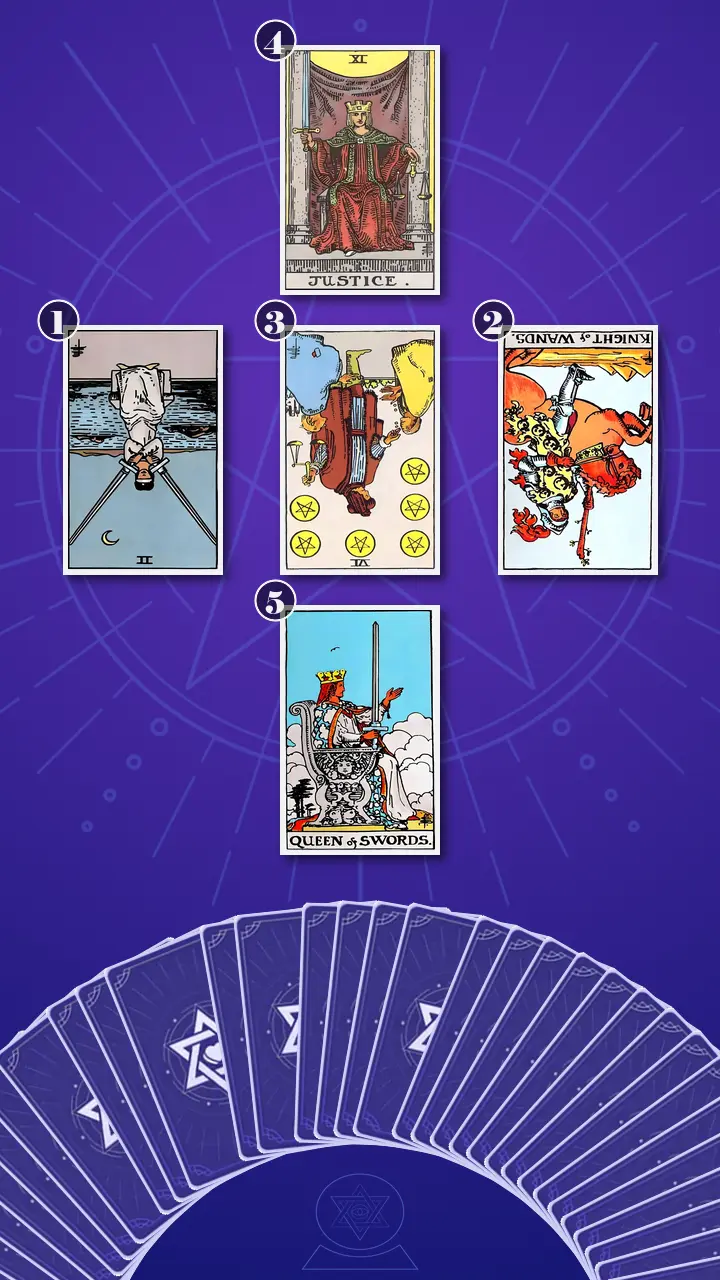
I chose a five-card Relationship Spread. For anyone reading along and wondering how tarot works in a question about relationship red flags, this spread is useful because it separates five things that often become tangled: the querent's stance, the other person's observable contribution, the dynamic created between them, the central challenge, and a self-directed response.
I do not use a relationship tarot spread to claim access to another person's private motives or to predict whether a connection will last. Card meanings in context give me a framework for comparing behaviour, impact, reciprocity, and choice. That distinction mattered here. Maya did not need another theory about why the other person behaved this way. She needed to see what the behaviour was creating in her actual life.
I laid the cards in a cross. The first position on the left would show how Maya delayed recognition and edited her own questions. The second on the right would examine the other person's observable consistency and follow-through. The central card would reveal how time, initiative, accommodation, and repair circulated between them. Above it, the fourth card would identify the key challenge; below it, the fifth would turn that insight into communication and a boundary.
The layout resembled scales crossed by a plumb line. The horizontal axis compared contribution without assigning blame. The vertical axis moved from evaluation to action. It was the smallest map I could use to examine inconsistent communication and unequal effort without forcing a verdict about the relationship's future.
The Blindfold and the Bright Message Box
Position One: The Question She Kept Deleting
I began with the card representing Maya's current stance: the specific way she delayed recognition, edited her questions, and kept contradictory evidence suspended to preserve the connection. I turned over the Two of Swords, reversed.
I pointed to the blindfold and the two swords crossed over the figure's chest. Upright, the image can hold a difficult choice at a temporary standstill. Reversed, I read the energy as a blockage becoming unstable. Maya's effort not to consolidate the evidence was no longer protecting her from discomfort. It was producing an excess of analysis and a deficiency of usable information.
At 11:40 p.m., she could list the cancelled plan, the vague explanation, the affectionate follow-up, and two earlier incidents. Yet she kept those facts in separate mental browser tabs so she would not have to open the dashboard showing the recurring issue. Her inner sequence sounded like this: ‘I can see another cancellation, but maybe work is chaos, so I should wait for more proof.’ She wanted honest information and, at the same time, wanted the connection protected from whatever that information might require.
I asked, “The last time the plan changed, what direct question did you draft, what did you send instead, and what outcome were you trying to prevent?”
Her breath caught first. Then her eyes moved away from the card as if she were watching the four deleted drafts appear again. Finally, she gave a short, bitter laugh. “That is so accurate it feels a bit brutal.”
“Accurate does not have to mean accusatory,” I replied. “This card is not calling you foolish. It is showing that postponing the question is an active protection strategy, not evidence that the concern is insignificant. Before your next conversation, the useful correction is small: three observable facts, the impact of each, and one question that does not contain an excuse for the other person.”
Position Two: Heat Without a Calendar Event
I moved to the card representing the other person's observable contribution as Maya experienced it, with attention to consistency and follow-through rather than hidden motives. I turned over the Knight of Wands, reversed.
The rearing horse and raised wand made movement and heat impossible to miss, but the reversal showed energy with no settled direction. I described it as an excess of intensity paired with a deficiency of dependable follow-through. The card did not tell me whether the other person cared. It showed the rhythm Maya had repeatedly experienced.
At 4:12 on a Friday afternoon, an enthusiastic message might arrive: ‘Miss you, let's do tonight.’ Maya would feel the connection restart at full brightness, reply immediately, and keep the evening open. By 8:05, there might still be no time or place, or the arrangement might change at the last minute. She would then take responsibility for converting the enthusiasm into an actual plan.
“An enthusiastic message is a push notification, not a calendar event,” I said. “It can create urgency without confirming that anything will happen. Chemistry can restart the feeling. Only follow-through changes the pattern.”
Maya pressed her thumb into the side of her cup and nodded slowly. “When the attention comes back, it feels so real that I decide the gap shouldn't count.”
“The warmth can be real,” I said. “The gap can also count. For one week, try treating an invitation as a plan only when it has a time, a place, and confirmation. That is not a punishment. It simply stops exciting contact from automatically taking control of your schedule.”
Position Three: When Flexibility Starts Accumulating
I turned to the card representing the relationship pattern created between them, especially whether time, accommodation, initiative, and repair were circulating reciprocally. I revealed the Six of Pentacles, reversed.
I drew Maya's attention to the figure who held both the scales and the coins. In the reversal, I read the energy as distorted earth: practical and emotional resources were not circulating evenly. Access, timing, and repair were repeatedly organised around one person's availability, while Maya absorbed more of the operational cost.
I repeated the sequence she had described. Maya kept Thursday free. The other person cancelled late. Maya checked whether they were okay, suggested two replacement evenings, and sent warmth to remove the awkwardness. Days later, she realised they had not asked how the cancellation affected her. The apology might be affectionate, but comparable planning and repair did not consistently return.
“If the same person keeps making it workable, the effort is not circulating; it is accumulating,” I said. “You can be generous without becoming the permanent scheduling team, emotional check-in, and repair department for a two-person connection.”
Her stomach visibly tightened. She put the cup down, folded her arms, then slowly uncrossed them. “I don't mind doing it once,” she said. “I just hate admitting that I am nearly always the one doing it once more.”
I let the silence settle before I answered. “We do not need a rigid ledger or a moral label. Over the next two interactions, we can simply observe who initiates, confirms, accommodates, and attempts repair. The point is not to score the other person. It is to stop excluding your own labour from the picture.”
When Justice Faced the Evidence
Position Four: The Standard That Included Her
The room seemed to quiet as I reached for the card above the centre. Even the traffic outside softened, and for a moment the radiator's small metallic clicks marked the silence like a metronome.
I turned the card representing the central challenge and key transformation: replacing incident-by-incident explanations with fair, explicit, evidence-based relationship standards. The card was Justice, upright.
I placed Justice beside the reversed Six of Pentacles so Maya could compare the two scales. In the Six, one participant controlled both the measurement and the distribution. Justice held an evenly balanced scale beside an upright sword. I read that energy as balance: context and impact could coexist, but the same criteria had to apply to both people.
For a second, I was back at the small cafe table where I gave some of my earliest readings, watching a barista count the till after a room full of warm conversations. I remember thinking that warmth could be completely genuine and the figures could still fail to balance. Fairness is not only a feeling. It is a structure.
I used the diagnostic lens I call Analysis Paralysis Deconstruction. I stripped away every abstract branch Maya had been trying to solve: whether the other person was secretly afraid, unusually stressed, confused, or about to become more consistent. I kept only grounded realities and immediate constraints: what happened, how often it happened, who absorbed the cost, whether repair occurred, and what Maya needed in order to participate willingly.
At 11:40 p.m., the phone had been warm in her hand as she rewrote the question again. The plan changed, her stomach dropped, and one affectionate apology made her wonder whether the pattern was real or whether she was being unfair. She had become trapped inside the demand to prove her discomfort beyond doubt.
I said, “An explanation can be completely understandable and the repeated pattern can still fall below your standards. Justice asks you to weigh consistency, reciprocity, and repair, not just the warmth of the latest promise.”
You do not need a courtroom case to justify your discomfort; you need observable evidence, fair standards, and the willingness to let Justice's scales weigh repeated behaviour more heavily than isolated promises.
The silence lasted long enough for the radiator to click twice. Maya's breath stopped, and her fingers froze above her cup. Her pupils widened; then her brow pulled tight, and a flash of anger crossed her face. “But doesn't that mean I've been wrong this whole time?” she asked, her voice suddenly sharp.
I kept my tone level. “No. It means your strategy protected you from a feared loss, and now it is costing more than it protects. We are updating the strategy, not putting your past self on trial.”
Her gaze drifted beyond the card as if she were replaying Thursday. Her fist loosened one finger at a time; her shoulders dropped, but the release left her briefly unsteady, almost blank before the responsibility of knowing. A shaky breath became a small “Oh.” I asked, “Now, using this new perspective, was there a moment last week when this insight could have made you feel different?” She swallowed and said, “When I cancelled dinner with Liv for a maybe-plan. I could have let maybe mean maybe.”
I named the shift I had just watched: from uneasy self-doubt and explanation-based accommodation toward evidence-based self-trust and clear relational boundaries. It was not yet a decision about the relationship. It was the first movement from asking whether every incident could be explained to asking whether the repeated pattern met her standards for consistency, reciprocity, and repair.
“I can understand their context and still count the impact on me,” Maya said, more quietly.
“Exactly,” I replied. “An explanation can be true and the pattern can still not work for you.”
The Sword That Did Not Need to Shout
Position Five: One Pattern, One Request, One Boundary
I turned the final card, representing the constructive next step: communicating one observed pattern, one impact, one request, and one self-directed boundary, then allowing the response to provide information. It was the Queen of Swords, upright.
I showed Maya the Queen's vertical sword and open left hand. The sword established a clear line; the open hand remained available for honest exchange. I read this as air restored to balance. Direct language did not have to become hostility, and receptivity did not require self-erasure.
I asked her to imagine reducing the long Notes app draft to four lines: ‘I have noticed several plans changing at the last minute. It leaves me unable to plan my time and uncertain about what we are building. I need plans to be confirmed by the evening before. If that cannot happen consistently, I will stop holding evenings open.’
“I can be clear without prosecuting them,” I said, “and receptive without deleting myself. A boundary is not a verdict on them; it is a decision about your participation. You are not forcing a particular reply. You are making your needs visible enough for their response and subsequent behaviour to become useful information.”
Maya read the four lines again. Her jaw released, and her shoulders settled against the chair for the first time that evening. “It is so much shorter than what I would write,” she said. “There is nowhere to hide in it, but it doesn't sound cruel.”
“That is the Queen's balance,” I told her. “No pleading, no diagnosis, no ultimatum delivered after months of silence. Just an observed pattern, its impact, a testable request, and a statement about what you will do with your own time.”
A Clearer Standard Than 'Maybe This Time'
I drew the five cards back into one story. The reversed Two of Swords showed why Maya felt stuck: she had linked honest recognition with the possible loss of belonging. The reversed Knight of Wands supplied enough heat to restart hope after every disappointment. The reversed Six of Pentacles showed the cost of keeping that hope alive through extra flexibility, initiative, and repair. Justice offered an impartial standard, and the Queen of Swords turned that standard into language.
She had been holding together a cracked container by squeezing it more tightly. Each accommodation brought temporary relief because conflict was postponed, but the pressure increased the resentment and self-distrust inside it. The red flags were not secret motives. They were repeated same-day cancellations, invitations without workable details, affectionate repair without dependable change, unequal scheduling labour, and the fact that Maya's actual question kept disappearing from the conversation.
I also pointed out what was absent: no Cups appeared. I did not take that to mean feelings were absent. I took it as a reminder that this reading could not and did not need to prove what anyone felt. Its task was to examine whether feelings were supported by communication, reciprocity, repair, and dependable behaviour.
The cognitive blind spot was precise. Maya had confused fairness with endless accommodation. She had treated the other person's possible context as evidence while treating her own repeated impact as an inconvenience. The transformation was not from empathy to suspicion. It was from explaining every incident in isolation to recording the pattern, naming its effect, and testing one clear boundary.
The Coffee Bean Filter and the Next 24 Hours
I used Complexity Reduction to make the next choice smaller. I did not reduce her life to ‘stay or leave.’ That decision was too large and did not yet have enough information. The useful binary was immediate: continue processing each incident through another explanation, or state one fair standard and observe what happened next.
I set two empty espresso cups beside the spread and placed a small stack of paper slips between them. I labelled one cup ‘Absolute Must-Haves’ and the other ‘Emotional Noise.’ This was my Coffee Bean Filter Protocol, a 24-hour sorting exercise for separating decision variables that could guide action from mental material that only created pressure.
I was careful with the language. Her feelings and the impact on her were not noise. Noise meant untestable motive theories, Instagram milestone comparison, the belief that she had to solve the entire relationship tonight, and the urge to make her request impossible to reject. Her must-haves had to be observable: confirmed plans, reciprocal initiative, acknowledgement after disappointment, and repair that included changed behaviour.
- Run the 24-hour Coffee Bean Filter.Before the next conversation, set a seven-minute timer and write the last three disappointing interactions under 'Observable Fact,' 'Impact on Me,' and 'My Standard.' For the following 24 hours, write each decision variable on a slip and place it under 'Absolute Must-Haves' or 'Emotional Noise.' Keep facts camera-verifiable: what was said, what changed, when it happened, and whether repair followed.Tip: This is information gathering, not a prosecution. If three entries feel overwhelming, record one fact, one body response, and one standard. The note can remain private.
- Draft the four-line boundary message.Choose text, phone, or an in-person conversation and complete four prompts: 'I have noticed...'; 'The effect on me is...'; 'What I am asking for is...'; and 'If this continues, I will...' Keep the request testable, such as confirming plans by the evening before. Make the final line about your own participation, not about controlling theirs.Tip: Read it aloud once. Remove apologies for having the need, claims about their motives, and paragraphs written mainly to prevent rejection. The minimum version is drafting the four lines without sending them.
- Use the confirmed-plan rule for one week.Put an invitation in your calendar only when it includes a time, place, and confirmation. If it remains vague, offer one concrete option and deadline, such as: 'I am free Thursday at 7 near King's Cross. Let me know by Wednesday evening if that works.' Across the next two interactions, note who initiates, confirms, accommodates, and repairs.Tip: Treat this as a one-week experiment, not a permanent policy or a scorecard. Keep one existing friend, rest, exercise, or solo plan instead of clearing the slot for an unconfirmed possibility.
“None of these steps guarantees the answer you hope for,” I told Maya. “That is not their job. Their job is to give you cleaner information while keeping your dignity, time, and choices intact. The cards can organise the evidence. You remain the person who decides what that evidence means for your life.”

Six Days Later, One Empty Calendar Hold
Six days later, I received a WhatsApp from Maya. She had sent the four lines, kept dinner with Liv, and slept through the night. Her first morning thought was, ‘What if I'm wrong?’ She noticed it, smiled, and left the unconfirmed Friday hold off her calendar.
She did not tell me that the relationship had been solved. It had not. The response she received was still something she needed to observe alongside future behaviour. The small proof was quieter: her schedule was no longer a waiting room, and uncertainty no longer required her to disappear from her own message.
For me, that was her Journey to Clarity. Tarot had not uncovered a hidden verdict or taken control of her fate. It had helped her place familiar facts beside one another, recover the standard she already used for people she loved, and make one decision she could actually carry out.
When a cancelled plan makes your stomach drop but your fingers still type ‘no worries,’ the hardest part may be the fear that taking your own reaction seriously could cost you the belonging you were trying to protect. If that silent bargain feels familiar, noticing it means you are no longer at the beginning.
If you allowed one repeated fact to pass through Justice's scales instead of opening another browser tab of explanations, what is the smallest clear sentence you might say this week without editing yourself out of it?
This story is adapted from psychological research, written so that those in a similar struggle can see their own pattern in it — and find their next step clearly.These insights are not a substitute for professional psychological, medical, legal, or financial advice.
Learn more about our Journey to Clarity.
How did this insight land for you?
🫂 This Resonates Deeply
🌀 Living This Story
✨ Now I See Clearly
🌱 Seeing New Possibilities
🧰 Useful Framework
🔮 The Confirmation I Needed
💪 Feeling Empowered
🚀 Ready for My Next Step
Author Profile
 AI
AI“For twenty years, I’ve listened to stories unfold over the warm aroma of coffee. I don’t believe life’s complexities always require grand theories to be solved; often, we just need a safe place to tidy up our reality. I don’t offer high-minded preaching—just grounded, heartfelt insights to help you regain your sense of control amidst the clutter of daily life.”
In this Choice Tarot Reading :
Core Expertise
- Analysis Paralysis Deconstruction: Stripping away abstract 'what-ifs' to focus strictly on the grounded realities and immediate constraints of your options.
- Complexity Reduction: Tidy up cluttered decision parameters into a clean, practical binary choice.
Service Features
- The Coffee Bean Filter Protocol: A 24-hour pragmatic sorting exercise to physically categorize decision variables into 'Absolute Must-Haves' and 'Emotional Noise', instantly restoring decisiveness.
Also specializes in :
Explore Related Patterns:
Analysis ParalysisAt 11:40 p.m., Maya types the direct question four times, deletes it four times, and sends reassurance instead. She already has the latest cancellation, earlier incidents, vague explanations, and affectionate follow-ups available to her, but she keeps reopening how each fact might be interpreted before allowing the facts to guide one clear action. The repeated analysis creates the feeling of careful problem-solving while protecting her from the feared consequence of receiving an honest answer. When you require perfect certainty before naming a recurring impact, every new detail can become another reason to wait. Analysis Paralysis keeps the decision technically open, but the cost is that uncertainty continues making decisions about your time and communication for you.
Defensive OverfunctioningAfter the other person cancels, Maya checks whether they are okay, proposes two replacement evenings, sends warmth to remove the awkwardness, and remains responsible for turning future enthusiasm into a workable plan. Each action is understandable on its own, but together they place initiation, scheduling, emotional reassurance, and repair on the same side of the relationship. Doing more can defend against uncertainty because it keeps the connection moving and reduces the chance of an immediate rupture. When you repeatedly perform both your own relational work and the work that would reveal another person's level of investment, effort stops being evidence because your intervention fills every gap. Defensive Overfunctioning makes the relationship temporarily workable while preventing you from seeing how it functions without your constant compensation.
Intermittent ReinforcementAn enthusiastic Friday message brings the connection back to full brightness after a period of uncertainty, and Maya immediately keeps the evening available. When the practical details fail to arrive, the disappointment returns, but another affectionate message later restores enough hope for the sequence to begin again. Unpredictable warmth can become especially influential because relief arrives after tension rather than through steady reliability. When you experience the return of attention as proof that the preceding gap should not count, emotional intensity starts substituting for consistent follow-through. Intermittent Reinforcement explains why isolated moments can feel powerful enough to reset your assessment even when the broader behavioral pattern has not changed.
Self-AbandonmentMaya cancels dinner with Liv for a possible plan, keeps evenings open without confirmation, and sends reassurance after her own disappointment. The connection is preserved by repeatedly removing her existing plans, direct question, and accumulated effort from the visible equation. Flexibility becomes Self-Abandonment when accommodating the relationship consistently requires you to disappear from your own schedule, message, or standard. The defense offers temporary relief because belonging appears protected and conflict is postponed. The longer-term cost is that your life absorbs the uncertainty while the relationship receives no clear information about what participation is costing you.
Self-SilencingMaya deletes “Can we talk about why this keeps happening?” and replaces it with “No worries, hope everything is okay.” The replacement does more than soften her tone. It removes the repeated cancellation, its impact, and her need for an answer from the interaction while directing care back toward the other person. When you make a concern invisible to prevent rejection, short-term relational calm is purchased with less accurate information and less opportunity for repair. Self-Silencing can look considerate because conflict is avoided and the connection remains undisturbed. Its hidden cost is that the relationship responds to an edited version of you, while the unspoken question continues to shape your body, schedule, and trust in yourself.
Cognitive DissonanceMaya can name the cancelled plan, the vague explanation, the affectionate follow-up, and two earlier incidents, yet she also wants to preserve the belief that one more explanation could make the pattern harmless. Her need for clarity and her wish to protect the connection point toward incompatible conclusions, so she keeps the evidence separated rather than resolving the contradiction. When acknowledging repeated behavior threatens a valued bond, the mind may reduce discomfort by changing the weight assigned to each fact. Warmth becomes decisive, impact becomes negotiable, and fairness becomes another round of accommodation. Cognitive Dissonance is the strain created by holding both positions at once, and recognizing it allows you to stop treating the strain itself as evidence that your standards are unfair.
IntellectualizationMaya cycles through whether the other person is unusually stressed, afraid, confused, or about to become more consistent. Any of those explanations could be possible, but none changes the observable sequence of late cancellations, vague plans, unequal scheduling labor, and repair without dependable change. Focusing on motives can create emotional distance from the more exposed question of whether the current behavior works for you. Intellectualization turns uncertainty into an analysis problem, allowing plausible theories to postpone contact with disappointment, anger, and choice. You do not need to reject empathy to notice when explaining another person's behavior has become a defense against counting its impact.
Loss AversionMaya says she needs to explain the issue without pushing the other person away, and she fears that taking the repeated red flags seriously could make continuing impossible. That anticipated loss becomes so influential that current losses of time, clarity, reciprocity, and trust in her own reaction are repeatedly treated as more acceptable. Loss Aversion does not mean the relationship has no value or that leaving is the required answer. It describes how the threat of losing a hoped-for connection can receive more psychological weight than costs that are already occurring. When you place both kinds of loss on the same scale, protecting belonging no longer has to mean automatically discounting what continued participation asks you to surrender.
Boundary DiscernmentMaya's confirmed-plan rule, decision to keep dinner with Liv, and refusal to reserve Friday for an unconfirmed possibility establish a visible line around her time. The line does not tell the other person what to feel or force them to become more consistent. It defines the conditions under which Maya will make herself available. When you can acknowledge someone else's context without converting it into unlimited access to your schedule, empathy stops competing with self-respect. Boundary Discernment means distinguishing a request from a demand, flexibility from self-abandonment, and a promising invitation from an actual commitment. The other person's response remains theirs, while your participation becomes yours again.
Reality TestingMaya's move from separate mental browser tabs to a record of what happened, how often it happened, who absorbed the cost, and whether repair occurred changes the unit of analysis. Affection and possible explanations remain part of the picture, but they no longer overrule cancellations, vague arrangements, or missing repair. When you compare observable behavior with your stated standards, you reduce the space available for projection, optimism bias, and endless reinterpretation. Reality Testing does not demand suspicion or certainty about another person's motives. It lets repeated behavior provide usable information while keeping the final decision in your hands.
Explore Related Struggles:
Clarity-Exposure SplitAt 11:40 p.m., Maya already has a direct question on her screen, but she deletes it four times and sends reassurance instead. Each deletion protects the connection from immediate disruption while also blocking the clarity she says she needs. When you believe that fully acknowledging a repeated pattern could make continued belonging impossible, information starts to carry the weight of a potential loss. The resulting split is not a failure to notice what is happening. It is the struggle to let what you know become actionable without treating clarity as an automatic command to stay or leave.
Evidence DisconnectionMaya can name the cancelled plan, the vague explanation, the affectionate follow-up, and two earlier incidents. She nevertheless keeps each fact in a separate mental tab, allowing the latest warm message to reopen the question of whether a recurring issue exists at all. When every incident must independently prove the entire case, visible evidence remains disconnected from decision-making. You may know what happened and still be unable to use that knowledge because each new explanation resets the standard of proof. Placing repeated facts beside one another does not dictate a verdict; it simply lets the pattern carry weight that isolated promises cannot erase.
Relational Boundary DriftMaya keeps evenings open, offers replacement dates after cancellations, and even drops dinner with Liv for a plan that remains only a possibility. Her flexibility expands with each uncertain interaction until both her calendar and her direct question are organized around someone else's availability. A boundary can drift without one dramatic violation or one conscious surrender. When preserving a connection repeatedly asks you to move your time, standards, and language, the space available for your own participation gradually contracts. A self-directed limit restores that space by defining what you will hold open and what you will do when confirmation does not arrive.
Reciprocity DeficitMaya keeps Thursday free, receives a late cancellation, checks whether the other person is okay, proposes replacement dates, and sends warmth to remove the awkwardness. Days later, she notices that comparable planning, concern, and repair have not returned to her. If the same person repeatedly makes a two-person connection workable, generosity stops circulating and begins accumulating as unpaid relational labor. You can understand each isolated accommodation and still examine the larger structure. Counting who initiates, confirms, adjusts, and repairs brings your contribution back into view without reducing the relationship to a scorecard.
Self-Editing ExhaustionFour times, Maya writes the question she wants answered; four times, her throat tightens and she deletes it. The final 'No worries' message is easy for the other person to receive, but it leaves her carrying the missing question into the next morning's work. When every sentence must be refined until it cannot possibly provoke rejection, communication becomes labor-intensive while your actual position becomes harder to find. You expend more energy making the concern acceptable than making it visible. A shorter statement of the observed pattern, its impact, one request, and one self-directed limit allows clarity to replace the endless task of editing yourself out.
Explore Related Emotions:
Boundary GuiltMaya repeatedly rewrites her question to make it less likely to push the other person away, and the eventual boundary message surprises her because it is direct without sounding cruel. Her need for confirmed plans has become tangled with the fear that setting any consequence around her own time would be unfair. You can feel guilty before a boundary has even been tested, as though defining your participation automatically punishes someone else. Boundary Guilt makes a clear limit feel morally harsher than the repeated cost of having no limit at all. Framing the boundary around what you will do with your calendar keeps responsibility in your hands without prescribing or controlling the other person's choice.
Cautious Self-TrustMaya says, 'I can understand their context and still count the impact on me,' then follows that sentence with modest, observable choices. She sends the four lines, keeps dinner with Liv, and leaves an unconfirmed Friday invitation off her calendar while continuing to observe what the other person does next. You do not need absolute certainty to begin taking your own experience seriously. Cautious Self-Trust grows through small decisions that remain within your control, especially when you can distinguish observable behaviour from theories about motive. It feels measured because the relationship is unresolved, yet it is substantial enough to keep your perception, time, and standards present.
Conditional Belonging FearAt 11:40 p.m., Maya types the question she actually needs answered four times, feels her throat tighten, and replaces it with 'no worries.' She does not lack awareness of the repeated cancellations; she fears that allowing her awareness into the conversation could threaten the connection itself. You can start experiencing belonging as something maintained by careful self-editing. Conditional Belonging Fear is the feeling that closeness may remain available only while your needs stay quiet, your standards stay flexible, and the other person is protected from your full reaction. Recognizing that silent condition does not decide the relationship for you; it reveals the emotional price you have been paying to keep the possibility intact.
Evidence AnxietyMaya can identify the cancelled plan, the vague explanation, the affectionate follow-up, and two earlier incidents, yet she stores them in separate mental browser tabs. Each time the pattern begins to become visible, she asks whether work might be chaotic and whether she should wait for more proof. You may feel uneasy not because the evidence is absent, but because accepting its cumulative shape could require a response. Evidence Anxiety turns ordinary relational evaluation into a courtroom standard where your discomfort must be proven beyond doubt before it is allowed to matter. Placing observable facts, repeated impact, and your standard side by side creates a fairer threshold for action while leaving claims about hidden motives out of the audit.
Mixed Signal DreadAt 4:12 on Friday, an enthusiastic message restarts the connection at full brightness; by 8:05, there may still be no time, place, or workable plan. Maya experiences the warmth as real, yet each return of affection is paired with evidence that another drop could arrive without warning. You can begin bracing inside the very contact that is supposed to reassure you. Mixed Signal Dread names that suspended inner weather: warmth activates hope, inconsistency keeps the body on alert, and neither feeling is allowed to settle long enough to become reliable information. Naming both sides lets you assess the complete pattern without dismissing the affection or allowing it to erase the gap.
Quiet Self-RespectMaya's message names the repeated cancellations, their effect on her, the need for earlier confirmation, and what she will do if that consistency is unavailable. She keeps the wording short, leaves accusations and motive theories out, and preserves dinner with Liv instead of clearing another evening for a possibility. You can honour yourself without escalating the interaction or demanding a predetermined reply. Quiet Self-Respect feels steady because your needs remain visible while the other person retains responsibility for their response. It is carried through participation choices, not through a verdict about anyone's character.
Self-Betrayal AcheMaya sees the cancellation, remembers two earlier incidents, feels the physical drop, and still removes the question that would place those facts into the conversation. She then checks whether the other person is okay, proposes replacement dates, and supplies enough warmth to smooth over the disruption. You can preserve contact in the immediate moment while feeling increasingly absent from your own side of it. Self-Betrayal Ache is the inward pain of repeatedly treating your perception as negotiable and your impact as less authoritative than someone else's possible explanation. Including your experience in the evidence is not an accusation; it is how you stop excluding yourself from a decision that directly affects you.
Unseen Effort GriefMaya holds Thursday open, absorbs the late cancellation, checks whether the other person is okay, suggests two new evenings, and sends warmth to repair the awkwardness. Days later, she notices that the effect on her was never acknowledged and that she is once again carrying the work of making the connection usable. You can feel hurt not only by what failed to happen, but by how invisible your contribution becomes while you keep everything moving. Unseen Effort Grief names the sorrow of investing practical and emotional labour that the relationship neither reflects nor reliably returns. Observing who initiates, confirms, accommodates, and repairs allows that grief to inform your standards without turning the interaction into a moral scorecard.
Low-Maintenance ShameMaya calls the cancellation 'one more cancelled plan,' worries about being dramatic, and tries to explain her concern in a way that cannot push the other person away. Even before she receives a response, she edits the question as though needing dependable plans might itself be an interpersonal offence. You may begin to feel embarrassed by needs that are ordinary, testable, and relevant to your participation. Low-Maintenance Shame makes self-erasure look like ease: the less impact you reveal, the safer and more acceptable you imagine you will seem. Putting the need into plain language separates the existence of your standard from any judgment the other person may make about it.
Standby Mode AnxietyMaya keeps Thursday free, waits for details that never solidify, and even cancels dinner with Liv for a maybe-plan. The empty calendar hold is not empty in practice; it occupies her attention, limits other choices, and carries restless energy into the following morning's content reviews. You may feel as though ordinary life cannot fully resume until another person confirms what is happening. Standby Mode Anxiety captures the strain of being psychologically on call, with your time available but not truly usable. Treating an invitation as unconfirmed until it has concrete details restores your ability to participate in the present while the other person's follow-through remains theirs to demonstrate.
Liberating UncertaintySix days later, Maya has not solved the relationship, and the response to her message still needs to be weighed alongside future behaviour. She nevertheless keeps dinner with Liv, sleeps through the night, and leaves the unconfirmed Friday hold off her calendar. You can remain uncertain without turning your entire life into a holding pattern. Liberating Uncertainty preserves the open question while releasing your time, voice, and friendships from the obligation to wait inside it. Not knowing becomes information you can observe rather than a condition that requires you to disappear.
Hidden ResentmentAfter another cancellation, Maya reassures the other person, offers replacement evenings, and removes the awkwardness, only to realize later that no one asked how the change affected her. Her protest stays out of the message but appears in the bitter laugh, tightened stomach, folded arms, and flash of sharpness when the unequal pattern is named. You may sound accommodating while an unexpressed objection accumulates underneath. Hidden Resentment forms when generosity repeatedly becomes compulsory maintenance and there is no clear route for your impact to return through the relationship. Counting your labour gives that feeling usable information to carry, so it does not have to remain compressed until it emerges sideways.
Clarity ReliefThe long Notes app draft becomes four lines: one observed pattern, one impact, one request, and one decision about Maya's own time. Her jaw releases, her shoulders settle against the chair, and six days later she reports sleeping through the night even though the relationship itself has not been resolved. You may feel relief when complexity stops being a requirement for legitimacy. Clarity Relief arrives because you no longer have to decode another person's private motives, predict the final outcome, or make your request impossible to reject before you can speak. A smaller and more testable question gives your mind somewhere stable to stand while further behaviour supplies the remaining information.
Explore Related Contexts:
Emotional Labor ImbalanceAfter the Thursday cancellation, Maya checks whether the other person is okay, suggests two replacement evenings, and sends warmth to remove the awkwardness. Days later, she notices that they have not asked how the disruption affected her and that comparable planning or repair has not consistently returned. The imbalance is visible in the distribution of relationship work. One person can cancel or leave details unresolved, while the other becomes the scheduler, welfare checker, reassurance provider, and repair coordinator required to keep the connection moving. You do not need a rigid scorecard to examine this structure. Tracking who initiates, confirms, accommodates, acknowledges impact, and changes behaviour can show whether care is circulating or whether your labour is continually compensating for missing participation.
Ignored Red FlagsAt 11:40 p.m., Maya can identify the latest cancellation, the vague explanation, the affectionate follow-up, and two earlier incidents, yet she deletes the same direct question four times. The evidence is already visible; what disappears is the opportunity to place those facts beside one another and evaluate the repeated sequence. The external warning signs are same-day cancellations, invitations without workable details, unanswered questions, unequal scheduling work, and apologies that do not reliably produce changed behaviour. By treating each event as an isolated exception, Maya allows the latest warm message to reset the record before the practical pattern has been addressed. When you recognise this context, you do not need to prove another person's motives or build an impossible case. You can count observable repetition, include the impact on your time, and decide which standard would let the next interaction produce clearer information.
Charm Without Follow-ThroughAt 4:12 p.m., an enthusiastic message can make the connection feel immediate again; by 8:05 p.m., no time or place may have materialised. After a cancellation, an affectionate apology can restore warmth even though comparable planning and repair do not consistently follow. This creates a relationship environment in which intensity repeatedly outruns reliability. Warmth may be genuine, but it does not recover Maya's displaced evening, answer the question she deleted, or establish that the next invitation will become a workable commitment. You can preserve the reality of the warm contact without letting it erase the operational record. Treating promises, plans, and repair as separate categories gives you a clearer view of what the connection can repeatedly support.
Last-Minute Dating PatternMaya keeps Thursday free, receives a late cancellation, and then supplies two replacement evenings. On another Friday, an enthusiastic invitation arrives at 4:12 p.m., but by 8:05 p.m. there may still be no time or place, leaving her evening reserved without an executable plan. Repeated uncertainty transfers the cost of poor planning onto her calendar. The other person's availability remains flexible, while Maya absorbs the opportunity cost of waiting, rearranging, and sometimes giving up confirmed time with people such as Liv. If your schedule is being organised this way, a message expressing interest is not yet a plan. You can require a time, place, and confirmation before allocating the evening, allowing actual follow-through to determine access to your time.
Relationship Boundary NegotiationMaya sends four concise lines naming the cancellations, their impact on her planning, the need for confirmation by the evening before, and what she will do if that cannot happen consistently. Six days later, she keeps dinner with Liv and leaves the unconfirmed Friday possibility off her calendar. This moves the issue from private accommodation into an observable relationship negotiation. Her boundary does not dictate what the other person must choose; it defines the conditions under which her own time will remain available and allows the response to reveal whether mutual planning is possible. For you, the leverage in this stage comes from making one standard concrete enough to test. A boundary tied to your own participation protects agency while leaving room for honest exchange and subsequent behaviour to supply the information that explanations have not supplied.
Measured Reciprocity TrialAcross the next two interactions, Maya is asked to note who initiates, confirms, accommodates, and attempts repair. The response to her message is not treated as a final answer on its own; it remains one piece of evidence to be compared with what happens afterwards. This trial makes reciprocity visible through the movement of practical resources. Time, initiative, flexibility, acknowledgement, and changed behaviour can be observed without turning the relationship into a moral ledger or inventing explanations for either person. You remain free to decide what level of reciprocity is workable for you. The trial simply prevents your own contribution from disappearing and gives repeated conduct more weight than a single reassuring reply.