

Justice Tarot Card Meaning
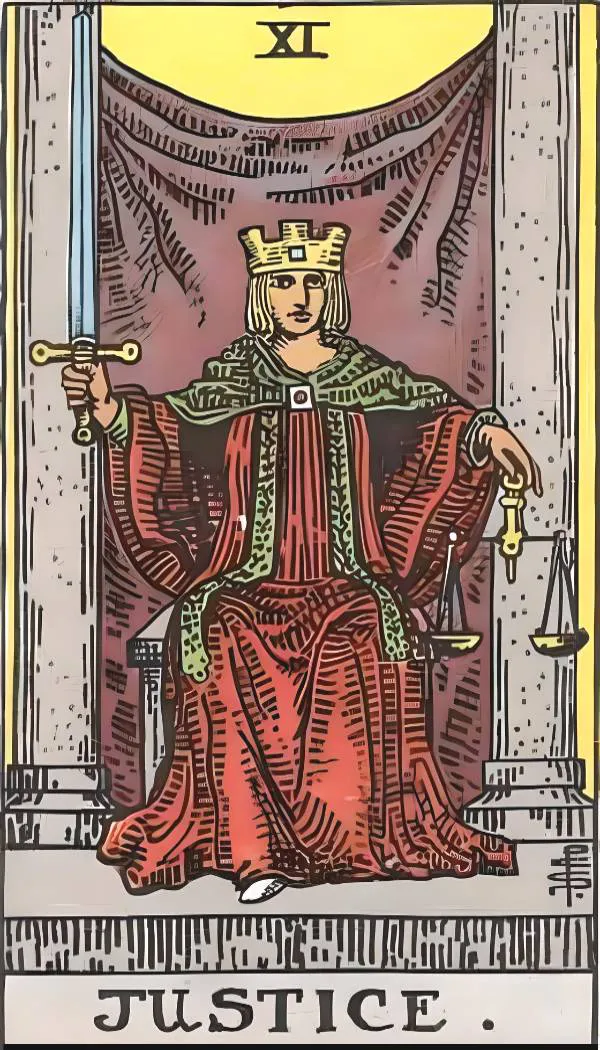
The image depicts a law enforcer in front of a hall, seated between two pillars with a purple curtain behind. She is the Goddess of Justice, the judge of humanity. Is this law enforcer in front of the hall truly a goddess? And which Goddess of Justice is she? The image deliberately presents a face that appears masculine, blending into a neutral form, but originally still female. We can also directly regard it as a person in charge of the law or a judge of the legal system in the world.
The Western Goddess of Justice has a long history, and there are many different images and names to this day. In fact, there has not been only one goddess who has held this position throughout history. This image has been inherited and evolved over a long period, and it can be seen that this position is an important concept for Westerners. The earliest concept of the Goddess of Justice comes from the ancient Egyptian goddess Maat, who was responsible for judging the souls of the dead in the underworld, weighing the hearts of the dead against the weight of feathers with a scale. The concept of the scale related to justice and judgment originated from here. The Greek and Roman myths inherited this position, and the goddess of justice, Themis, gave birth to many gods, and Dike is her successor as the goddess of justice.
Next to take on the role of the Goddess of Justice was the Greek star goddess Astraea, which is a very important image of the Goddess of Justice and a key transition for many images of the Goddess of Justice. Because she is often confused with Dike, she inherits the original line of the Goddess of Justice, and her image has wings and holds a torch and Zeus's lightning, thus also leading to the later similar image, the well-known Pallas Athena. Even later Christian angelic images were also based on this goddess to continue, preserving the image of the Goddess of Justice.
By the Roman era, the formal Goddess of Justice, Justitia, appeared, and she is the embodiment of Roman justice. She guarded the world as a virgin to maintain justice, but the many injustices of mortals forced her to be disappointed and leave, so she returned to the heavens and became the virgin constellation Virgo in the sky. This Roman name is actually equivalent to the Greek goddess Astraea, and the image is consistent. And the Roman name Justitia has become a synonym for justice, and the Western term for justice is based on this root.
As history progressed, the image of the Goddess of Justice changed several times, Justitia added royal attire and wore a crown, and the sword and scale in her hand became fixed. In the end, no matter who the Goddess of Justice is, the image seems to have become a fixed formula, mostly holding a scale in one hand and a sword in the other. Sometimes we see the Goddess of Justice blindfolded (like the figure of the Two of Swords), which represents "blind justice," meaning absolute fairness, without any prejudice or bias and preconceived positions.
Later, with the rise of Christianity, angels inherited and replaced the duties of the goddess, which can also be said to be angels in charge of justice, and this angel is Michael. As an angel in charge of justice, the image is also holding a sword in the right hand and a scale in the left hand. Michael has always been a very powerful angel, and he also controls the "solar fire," which is like a thunderbolt energy that is a shocking force to awaken the world, and he has the ability to protect and suppress, but also has the ability to save and help. Another important duty of this angel is to guide the souls of the dead, and when the final judgment comes, this function becomes a guide for the world and has the power to judge the final fate.
However, no matter who is in charge of justice in heaven, it can finally be collectively referred to as Lady Justice, which represents the embodiment of human law, combining the images of Themis and Justitia. And when the "Lady of Justice" comes to the world, she becomes a "judge," and we cannot call her by one name, and it is necessary to depict her with a new human face, so we can collectively call her the "messenger of justice." People believe that there is always a "messenger of justice" sent by heaven in the world.
The messenger of justice in the card's image is wearing a red robe that covers the whole body and reaches the ground, representing enthusiasm and enthusiasm for public welfare and kindness. A green shawl is draped over the robe, and the tassel of the hat is also green, and it can also be seen that the color of the inner shirt is still green. These combinations of green emphasize his inner characteristics of peace. The messenger of justice's right foot is stretched out of the robe, and we can see that it is a white shoe, and the right foot touches the steps of the hall, which represents the integration of truth and stepping on the truth.
The crown on the judge's head is a symbol of the prestige of the messenger of justice, not power and rank, but trust and reliance, and respect. Gold is the attribute of wisdom and nobility. The shape is like a city wall with three battlements, representing the thinking of left and right and the middle way, and knowing the past, present, and future. There is a gemstone inlaid in the middle of the front of the crown, located above the forehead, representing the third eye or the brow chakra, indicating the opening of wisdom, with a more keen observation to see the truth and truth, and to exert the true knowledge and insight that a just person should have. This also implies a meaning - the Goddess of Justice does not fight against the enemy with a sword, but with her eyes!
The buckle on the chest of the shawl is a mysterious symbol, a square with a red ball shape. This part represents the chakra - the heart chakra represents the characteristics of people's charity, tolerance, and acceptance. Placing this symbol represents the sharpness of the heart and the keen observation.
The right hand holds the sword, holding the sword straight up, and the color of the sword is almost the same as the color of the background stone pillars, which is not easy to distinguish the sword, which represents that the sword is not willing to be activated. The shape of the sword itself and the shape of the hilt and guard are in the shape of a cross, which is also a symbol of holding the cross. The sword in the tarot sometimes has the same effect as the defense and power of the cross. The sword is not easily used unless it is necessary, and it is a sharp weapon that is very reluctant to use. The tool of law enforcement does not want to be cut down, but it is held firmly to show its deterrent power.
The left hand of the messenger of justice holds the scale, and the scale is in a balanced state at this time, and the sword is also held vertically, representing the correct and fair and balanced judgment. The scale pattern is more obvious than the sword, which indicates that the process of judgment and maintaining fairness and balance is important, and law enforcement is a last resort. The sword and the scale are placed in the foreground of the two gray pillars, representing the truth contained in the pillars of truth, and showing the truth as a sword and a scale, which also indicates that it is not easy to provoke, and every action has its reason.
The messenger of justice is open-minded, holding two law instruments and stretching out outwards, which represents tolerance and acceptance, which is also a trait that the messenger of justice needs, but it is not very obvious to be noticed. The law enforcer is sitting on a stone chair, indicating the trait of being upright and unyielding. His position is between the two pillars of the stone hall, indicating fairness, being in the middle, and being in the middle way.
The purple curtain hanging between the two pillars behind the messenger of justice indicates nobility and inviolability, showing the style of justice, and covering the curtain implies mystery and the unknown. The faintly visible three-dimensional protruding shape on the curtain indicates a dynamic sense of ups and downs, implying that the operation behind it is unknown. The pillars of the hall of the messenger of justice are very high, and the top is out of sight, which represents that this is the highest hall, and it penetrates the truth of the law between the world and heaven. And the stone pillars, seats, and ranks are all the same gray, without any color, which also represents that there is no preconceived position and a biased environment.
The Scales
The scales, held in Justice’s left hand, symbolize balance and the weighing of actions and their consequences. They signify the delicate equilibrium of truth, highlighting the universal quest for fairness and the necessity of making impartial judgments.
The Double-Edged Sword
Held upright in her right hand, the double-edged sword conveys the idea that decisions and actions have both positive and negative consequences. It also alludes to clarity, truth, and the cutting through of illusions. The upright position of the sword suggests an alignment with divine justice and the readiness to act upon it.
The Crown
Atop Justice’s head sits a crown, a symbol of divine authority. This emphasizes that true justice is a divine principle and that decisions made with integrity align with the higher truths of the universe.
The Pillars
Behind Justice, the two pillars frame her, representing the duality of situations – right and wrong, good and evil. This further accentuates the card’s theme of balance and the essential role of discernment in achieving justice.
The Robe
The robe worn by Justice, typically depicted as red, signifies the power of wisdom and the importance of making choices rooted in understanding and compassion. It’s a reminder that true justice combines both intellect and heart.
Veil Behind Justice
The veil that often hangs behind the Justice figure represents the veils of illusion, ignorance, and misinformation that must be penetrated in order to reach the truth. The presence of the veil, positioned behind the figure, suggests that true Justice sees beyond superficialities and is not swayed by external influences or biases.

A Researched Range Was Deleted—Then a 24-Hour Pause Changed the Reply

One Name Moved Down a Launch Caption—Then Credit Split from Support

Tomorrow's Alarm Kept Moving, Then One Reply Waited Until Breakfast

Intense Texting Isn't Lasting Security: Let Follow-Through Earn Trust

Keeping the Grainy Opening: From Approval-Seeking to a Steadier Voice
