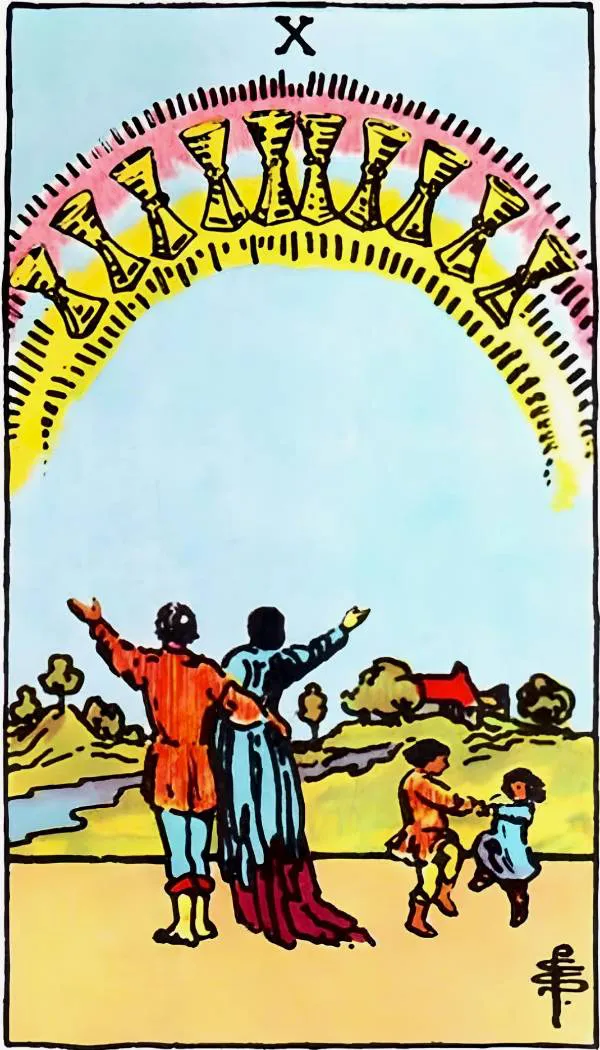
Routine CollapseThe house, river, garden, and paired bodies form a domestic system that only works while each channel stays open. When the overhead arc becomes a standard that everything below must match, the scene turns rigid: home, care, movement, and appearance all have to stay synchronized. In a lifestyle reading, this names the collapse that happens when daily life has no buffer. You may still know what the routine is supposed to look like, but the system cannot absorb work spillover, missed sleep, laundry, meals, errands, and recovery without one part pulling the rest down.
Safe Harbor OptionThe house set into the green landscape, the river moving calmly nearby, and the complete arc of cups above the family make support appear materially grounded. This is not just emotional warmth; it is shelter, routine, shared space, and a visible place to land. In family life, that kind of support can become a real option during transition: moving back temporarily, staying with relatives, accepting help after a breakup, or using the family home as a stabilizing base. The card highlights the usefulness of that harbor while keeping attention on the terms attached to it. You are not asked to romanticize the refuge. The structure asks whether the safe place also respects adult privacy, decision-making, and exit routes, because support becomes stabilizing only when it does not quietly reclaim control.
Conflict Reentry LimboThe couple, children, home, and arc of cups create a complete public image of family continuity and shared emotional life. Reversed, the image of togetherness remains visible while the emotional agreement supporting it is unavailable. You may sit at the same table, attend the celebration, or answer the family chat while everyone behaves as though physical presence settled the rupture. The inverted household exposes the structural split between family membership and repaired belonging, making the unspoken conflict part of every apparently ordinary reunion.
Family Script PressureThe Ten of Cups arranges adulthood, partnership, children, home, landscape, and emotional completion into one perfectly legible picture. When that arrangement hardens, the image becomes a script for what a good life is supposed to look like and which milestones are supposed to prove it. Family Script Pressure is an external context because it reaches You through expectations, comments, timelines, ceremonies, and inherited definitions of success. In introspective work, this pressure can make private self-knowledge feel disloyal to the approved story, especially when the visible symbols of stability are treated as proof that no deeper question should exist. The ordered cups above the family are the key visual anchor. They show a complete emotional ideal suspended over the scene, beautiful but also prescriptive when reversed. This card links to the pressure of a family script by revealing how an inherited picture of fulfillment can crowd the inner world, making clarity depend on separating genuine belonging from compliance with a role.
Toxic Positivity CultureThe ten cups form a flawless arc over a scene where every visible body participates in harmony. In its reversed state, that order can become a rule: only the bright, grateful, composed version of the story is allowed into the frame. In personal growth spaces, this becomes a culture where doubt, anger, stalled progress, or uncomfortable truth are treated as interruptions to the required positivity. You may be surrounded by language that sounds supportive while quietly removing the permission to name what is not working. The card connects this context to a distorted version of fulfillment. It shows how the demand to keep everything uplifting can block real integration, because growth needs room for friction as much as it needs hope.
Late-Life Parental Divorce FalloutThe rainbow of cups arches above a couple, children, green land, and a distant home, assembling the complete public image of one emotionally unified household. In reversal, the arch remains visible but stops functioning as one shared roof, precisely reflecting a family ideal that survives in photographs and expectations after the parental partnership has divided. You may feel pressure to preserve the happy-family presentation for relatives, ceremonies, or holidays even when separate plans are the actual operating reality. The blocked resource is not affection but collective coherence: the reversal allows individual bonds to remain while naming that the old image can no longer organise everyone without concealment or strain.
Unstable Home EnvironmentA family stands beneath ten cups arranged across a rainbow, with children dancing and a house visible beyond them. Reversed, the image of seamless family security tilts away from lived reality, matching a home where everyone may still perform togetherness while moods, access, and rules remain unpredictable behind the door. You may be expected to preserve the appearance of harmony by staying quiet, flexible, grateful, or available for other people's needs. The inversion reveals that visible family membership and functional domestic stability are separate conditions; one can remain intact while the other repeatedly fails.
Golden Child Role ResetThe couple, playing children, home, and rainbow of cups still compose an idealised family scene, but reversal interrupts access to that seamless picture. You may be told that your boundary, partner, or changed path is upsetting everyone when the deeper disruption is that the family can no longer present harmony without accommodating difference. The inverted image separates lived connection from the performance of a happy family. When you are blamed for changing the atmosphere, the blocked resource is not necessarily love itself; it is effortless inclusion in a picture that previously depended on your achievements and agreeableness remaining predictable.
Family Album Performance PressureThe rainbow of ten cups arches above a couple with raised arms while two children dance near a home, river, and open landscape. The tableau presents family happiness as a complete, immediately readable image: every role is visible, the setting looks secure, and the emotional conclusion appears settled before anyone has spoken. Reversed, access to that shared harmony is blocked even though its visual template continues to govern the room. You may be asked to smile inside a family composition that cannot represent conflict, distance, grief, ambiguity, or a life that does not fit the expected roles. The photograph becomes a substitute for relational repair, and the mismatch explains why a cheerful image can leave you feeling more exposed rather than more connected.
Family Role RenegotiationA couple and two children celebrate beneath a complete rainbow of cups, with the family home secured in the distance. Reversed, that idealized canopy blocks honest renegotiation because visible harmony depends on one member continuing to coordinate, soothe, translate, or absorb conflict without changing the mood. The disrupted resource is authentic cohesion, not the appearance of togetherness. You can see where accusations that you have changed are protecting a family performance whose calm was subsidized by your invisible labor.