The Soft Morning That Solved Nothing
If you're a late-20s city creative who can build a clean client deck by 3 p.m. and still freeze after a 12:41 a.m. 'come over?' text, I already know the shape of the silence you're carrying. That was the energy Maya brought into my reading room in Toronto: polished coat, tired eyes, phone turned face-down like it had been working overtime as a witness.
Before I touched the cards, she gave me the scene that mattered. It was 8:12 on a Saturday in a Liberty Village condo kitchen: the kettle hissing, cold condo light catching yesterday's mascara, an oversized T-shirt soft at the shoulders, a kiss landing warm on her shoulder from someone acting like the fight had been a weird little detour. She asked about coffee. Oat milk. Brunch. Not the thing she actually wanted to say.
'I hate how one good night can erase my nerve to ask the real question,' she told me.
What she was describing was the exact ache behind so many searches like why do I feel anxious after make-up sex and how to ask for clarity after hooking up. She wanted closeness and repair. She was also afraid of the vulnerable conversation that might change the relationship. Her unease felt, even across the table, like standing in warm steam with one foot on cold tile. The body got the reunion. The question didn't.
I nodded and kept my voice gentle. 'A soft night is not the same thing as a clear answer,' I said. 'We're not here to kill the warmth. We're here to see whether the connection can hold truth inside it. Let me help us draw a map through the fog.'

Choosing the Map: A Five-Card Relationship Spread for Finding Clarity
I asked Maya to take one slow breath, feel both feet on the floor, and hold a single question in mind: after we make up by hooking up, what are we not saying? Then I shuffled slowly. For me, that part is not about theater. It is a psychological threshold—one clean moment where the nervous system stops reacting and starts observing.
For this reading, I chose the Relationship Spread · Context Edition, a five-card relationship tarot spread I use when the problem lives inside a repeating two-person pattern rather than a whole-life audit. This is how tarot works best in situations like this: not as fate, not as mind-reading, but as a structured mirror. Five positions are enough to show Maya's stance, the other person's observable repair style, the shared chemistry loop, the hidden silence underneath it, and the healthiest next step without overcomplicating the message.
I told her what I was tracking. The first card would show how she participates when she is hurt. The second would stay grounded in observable behavior from the other side—not fantasy, not projection. The center card would show what the bond itself keeps doing. The card above it would name the silence protecting the pattern. The final card below would tell us what honest repair requires if this is going to become more than late-night reconnection without real repair.
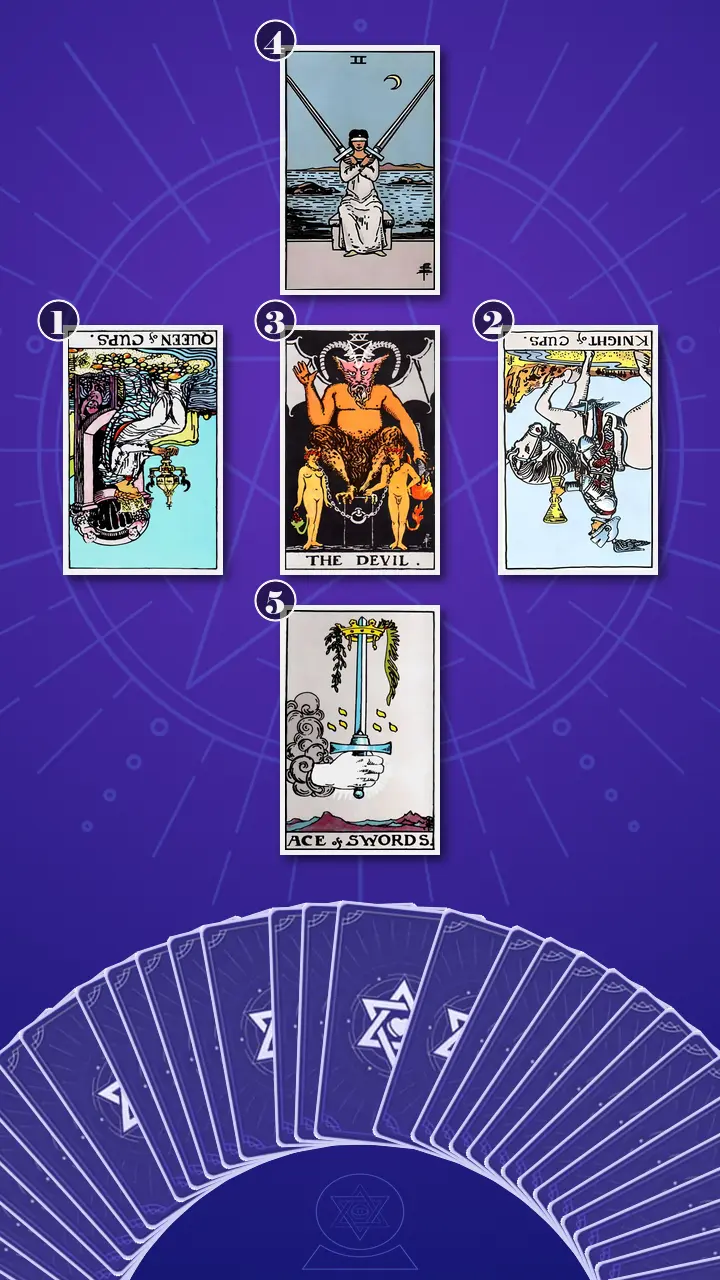
Reading the Loop Between Chemistry and Repair
Position 1: The Cup With the Lid Still On
I turned the first card. 'Now I'm looking at the position that presents your current emotional stance in the dynamic—especially how you manage hurt by softening, intuiting, and withholding direct language.' The card was the Queen of Cups, reversed.
I showed her the image. 'This is the morning-after bathroom card,' I said. 'You wiping under-eye makeup, replaying the exact tone of a sentence like you know I care about you, then choosing to ask whether they want coffee instead of saying I am still hurt by what happened.' In card meanings in context, this isn't lack of feeling. It's feeling so much that expression gets sealed shut. The energy is blocked Water: emotional intelligence with nowhere clean to go.
This is where I used one of the lenses I trust most, what I call Boundary Permeability Assessment. I look for where your emotional weather ends and the other person's begins. With the reversed Queen, the membrane is too porous. Maya was reading his shoulder kiss, his morning tone, the softness in the room, as if those things might answer the question she had not asked. She wasn't failing to understand. She was understanding everything except her own right to say it plainly.
'You can probably spot a Slack vibe shift in five seconds,' I told her, 'but in dating you say all good and then carry the whole atmosphere in your throat.' I watched the recognition land.
Her hand stopped halfway to her tea. Then her gaze slid toward the window as if a memory had just started replaying behind her eyes. Then came a small, bitter laugh. 'Okay, wow,' she said. 'That's... accurate and kind of rude.'
I smiled. 'Accurate is the goal. Rude is optional. You're not weak here. You're adapted. You've learned that staying soft keeps connection alive, even when honesty feels riskier.'
Position 2: The Gesture That Feels Like an Answer
I turned the second card. 'This position shows the other person's observable repair style in the interaction, based on actions and signals rather than me pretending to know their private motives.' The card was the Knight of Cups, reversed.
'This is the 11:58 p.m. text card,' I said. 'Warm, flirty, emotionally loaded, maybe even sincerely tender. The invitation to come over. The soft voice. The hug that feels real. The night carries feeling. But by the next afternoon, there is still no steady follow-through on what actually happened.' The raised cup offers closeness. The slow horse tells me accountability is arriving much more slowly, if at all. This is excess romance and a deficiency of structure.
I kept my tone precise because this card can make people over-read intention. 'I'm not calling this fake. I'm saying the repair style may be emotionally persuasive without being behaviorally stabilizing. Romantic contact is not the same as relational clarity.' The group-chat translation, if I had to give one, would be: girl, what did he actually say though?
Maya nodded this time without laughing. Her jaw shifted once, then settled. 'That's the part that messes with me,' she said. 'Because it does feel sincere.'
'It probably is sincere in the moment,' I said. 'But sincerity and steadiness are not synonyms.'
Position 3: The Reset Button in the Middle
I laid the third card in the center of the spread. 'This position reveals the shared bond pattern itself—especially what hooking up is doing inside the relationship and why it keeps functioning as a reset.' The card was The Devil, upright.
I let that sit for a beat, because people hear that name and brace. I never use it to scare anyone. In relationship readings, The Devil often points to a gripping loop: desire, fear, familiarity, attachment, all fused together until the same cycle starts feeling inevitable. 'This is the chemistry-as-conflict-resolution card,' I said. 'Conflict spikes, distance feels unbearable, you get back in the same room, and within minutes the argument turns into kissing, sex, cuddling, relief. The relief is real. But the unanswered issue stays chained underneath.'
I tapped the figures on the card. 'Notice the chains are loose. That's the crucial detail. This is not destiny. It's participation. The pattern has force, but both people are still helping it happen.'
Then I translated it into her life. 'It's like putting a gorgeous lock screen over a phone with a cracked screen. The image soothes you, but every tap still hits the damage. Or like clearing the notification badge without answering the message underneath. Chemistry can relax the body without repairing the bond.'
As I said it, I had one of those quiet inner flashes I trust. In perfume, a note can smell stunning in the first second and still be structurally wrong in the air around it. I have spent fifteen years learning that diffusion matters. A scent needs space to become legible. So does truth. Looking at The Devil, I could already feel the story moving toward breath, distance, language.
Maya's shoulders dropped an inch, but not in relief. More like the body recognizing a bill it has been paying for a long time. 'That makes me feel sickly seen,' she murmured. 'Like... if we're like that again, I always want to believe it means the fight wasn't that serious.'
'Of course,' I said. 'Because the body loves fast relief. That's why this loop works. It soothes and it postpones at the same time. That's also why it can feel like a tiny Normal People problem playing out in real life—profound chemistry, delayed communication, and a conversation gap wide enough to steer the whole bond through.'
Position 4: The Question Behind Her Teeth
I turned the fourth card and placed it above the center. 'This position uncovers the hidden challenge and names what is not being said, including the unsaid emotional contract that silence is protecting.' The card was the Two of Swords, upright.
'This is the lying-awake card,' I said. 'The quiet morning light. The streetcar outside. The exact sentence hovering in the room—Are we actually okay, or did we just get close again?—and nobody reaches for it.' The blindfold and crossed blades tell me the energy here is blocked Air. Thought is present, language is not. Silence is doing a job.
I leaned in slightly. 'The silence isn't random. It's a contract. If nobody names the obvious, then nobody has to choose, define, disappoint, or change. Temporary peace gets protected. Real repair gets frozen.'
Then I said the part I knew her body already understood. 'If your throat closes right when the room gets tender, you're not making it up—your body has learned that honesty might cost closeness.'
She swallowed hard. First her breath stalled. Then her eyes went unfocused, not dissociated, just suddenly busy replaying a private scene. Then her fingers uncurled from around the mug. 'Once I ask it,' she said quietly, 'there's no un-asking it.'
'Exactly,' I told her. 'And that is why the question keeps getting postponed into logistics, brunch plans, playlists, or one more easy joke. You are not protecting a vibe. You are protecting the relationship from becoming specific.'
When the Ace Rose in Daylight
Position 5: The Sentence That Can Survive Morning
When I turned the final card, the room changed in that small way rooms sometimes do when a truth arrives before anyone speaks it. A pale strip of afternoon light came through the blinds and landed clean across the card like a blade. 'This,' I said, 'is the healthiest next step for repair—the card that shows what honest reconnection requires if the pattern is going to change.' It was the Ace of Swords, upright.
'The strangest part,' I told her, 'is how normal the morning can look: coffee brewing, your toothbrush next to theirs, a joke about brunch—while your throat is still holding the one question the entire night managed to avoid.'
My perfumer mind clicked into focus. This was my Intimacy Distance Calibration at work. Their connection did not have a coldness problem. It had an overcompression problem. They were closing distance so fast after rupture that there was no oxygen left for truth. Spray a beautiful scent too close and all the notes blur into impact. Give it air, and structure appears. This Ace was asking for breathable honesty, not emotional exile.
It is not fixed just because your bodies reconnected; let the Ace's raised sword cut through the blindfold and say the one clean truth chemistry keeps postponing.
Maya went absolutely still. First, the freeze: her lips parted but no sound came out, and even her thumb stopped moving against the edge of her phone. Then the recognition: her eyes dropped to the table, then lifted somewhere past my shoulder as if she were replaying a specific morning, frame by frame—the coffee, the shoulder kiss, the swallowed question. Then the release arrived, not dramatic, just undeniable. Her shoulders lowered. Her breath came out shaky. Her eyes brightened with that thin shine that appears right before someone either laughs or cries.
'But if I do that,' she said, and now there was resistance in it, almost anger, 'then I can't keep pretending the night answered for us.'
'Yes,' I said softly. 'And that does not mean you were foolish before. It means your nervous system chose relief over uncertainty. Most people do. The shift now is different: from reading signs to asking directly, from afterglow-based reassurance to steadier self-respect and a calmer connection.'
I gave her a moment, then asked the question I ask when a key card opens the room instead of just decorating it. 'Using this new lens, was there a moment last week when this insight would have changed how you felt?'
She nodded immediately. 'Saturday morning,' she said. 'If I'd had this then, I wouldn't have been staring at whether he kissed my shoulder like it meant we were okay. I would've known I still needed actual clarity.'
'Exactly,' I said. 'Real repair is what survives daylight.'
From Insight to Action: The Daylight Repair Test
Once all five cards were on the table, the story was remarkably coherent. Maya's feelings were real, deep, and highly attuned—but she was containing them instead of speaking them. The other side seemed to offer warmth, romance, and closeness in the moment, but not the kind of follow-through that makes a relationship less blurry by noon. In the center sat the chemistry loop, strong enough to restore contact fast and strong enough to keep the real issue underground. Above it hovered the silence that protects the moment by postponing definition. Below it, the antidote was simple and demanding: one clear sentence, in daylight, without asking the afterglow to make decisions for her.
I told her the blind spot gently. 'You're not confused because you can't read the connection. You're confused because you've been using intensity as evidence. You keep measuring closeness by how magnetic the night feels instead of by whether reality gets clearer in the morning.'
'So what do I actually do?' she asked. 'Because I know myself. The second the room softens, I go quiet.'
'Then we change the structure,' I said. 'Not by becoming cold. By giving honesty some air.' That is where I brought in my own strategy, the Blank Space Protocol: intentionally creating a little emotional or physical distance so the bond has enough oxygen for truth instead of sliding straight back into chemistry.
- Draft the One-Sentence ClarityOpen your Notes app and write: 'I liked being close to you, and I am still not clear on ___. Can we talk about that directly?' Choose one topic only—the original hurt, what repair means, or what this connection actually is.Keep it simple. No smiley-face cushioning, no essay. If sending it feels too activating, let it live in Notes first. Naming the truth is already a first move.
- Use the Blank Space ProtocolDo not make the next repair attempt at 1 a.m. in a bedroom. Ask for a 15-minute daytime conversation—after work, on a walk, at a coffee shop, on a bench in Ossington, anywhere the nervous system is less likely to confuse closeness with clarity. Before replying to a late-night text, put a hand on your throat for ten seconds and ask your body whether it wants reassurance, contact, or an actual answer.Lower intensity on purpose. Choosing a setting that helps honesty is not being dramatic; it is being intelligent about your pattern.
- Run the Afterglow Truth CheckMake two columns in Notes: 'What actually happened' and 'What I am afraid it means.' Add one line to each after the next close moment. Also track whether affection is followed by daytime clarity and follow-through within 24 hours, or whether the bond only gets another emotional reset.This separates facts from fear without shaming either. If five lines feels like too much, write five words. Small data is still data.
I reminded her that none of these steps were about controlling his response. They were about stopping the self-abandonment that happens when clarity keeps getting traded for temporary peace. Don't ask the afterglow to make decisions for you, I said. Let the answer come from words, behavior, and what the relationship can actually hold.

A Week Later, the Quiet Proof
A week later, Maya sent me a text just after 6 p.m. She had used the Notes draft almost word for word. They met for coffee instead of at his place. She asked one clean question instead of trying to solve the entire relationship in a single talk.
Her message read: 'It was awkward for like three minutes, then weirdly calm. Not everything is solved, but I finally said the thing. I don't feel crazy anymore.'
She told me she slept a full night after that, then woke with the old thought—what if I asked too much?—and actually smiled at it while waiting for the streetcar.
That, to me, was the whole Journey to Clarity in miniature. Tarot did not decide her future. It gave shape to the pattern she was already living inside, and then handed the choice back to her. She moved from using the night as proof to using truth as a test. That is what self-respect looks like at the beginning: not certainty, just a steadier hand on the wheel.
There is a specific ache in lying close to someone while your throat is still guarding the question that could change the relationship.
If you stopped asking the night to tell you whether this is okay, what one daylight truth would you want this connection to be able to hold?
This story is adapted from psychological research, written so that those in a similar struggle can see their own pattern in it — and find their next step clearly.These insights are not a substitute for professional psychological, medical, legal, or financial advice.
Learn more about our Journey to Clarity.
How did this insight land for you?
🫂 This Resonates Deeply
🌀 Living This Story
✨ Now I See Clearly
🌱 Seeing New Possibilities
🧰 Useful Framework
🔮 The Confirmation I Needed
💪 Feeling Empowered
🚀 Ready for My Next Step
Author Profile
 AI
AI“As a perfumer for fifteen years, I’ve learned to perceive human boundaries through the delicate metaphor of scent. Relationships need the right amount of space to breathe, and I've seen too many kind souls exhaust themselves trying to please everyone. I’m here with warmth and understanding—not to teach you to be guarded, but to help you gently clear the air and rediscover the comforting, safe boundaries that are rightfully yours.”
In this Love Tarot Reading :
Core Expertise
- Intimacy Distance Calibration: Using the metaphor of scent diffusion to diagnose whether your relationship suffers from emotional suffocation or detached coldness.
- Boundary Permeability Assessment: Objectively evaluating where your personal identity ends and your partner's begins, identifying unhealthy enmeshment.
Service Features
- The Blank Space Protocol: A behavioral challenge to intentionally create comfortable emotional or physical distance, allowing the 'oxygen' needed to reignite mutual attraction.
Also specializes in :
Explore Related Patterns:
Chemistry ChasingThe late-night 'come over?' and the Liberty Village morning after show how quickly the conflict gets metabolized through proximity: argument, kissing, sex, cuddling, relief, then coffee talk instead of the unresolved question. You are not using chemistry as proof because the warmth is fake; you are using it because the body gets a fast signal of reconnection before the relationship has supplied a clear answer. That is the mechanism behind Chemistry Chasing in this story. Intensity becomes a shortcut for reality testing: if the night feels magnetic enough, the nervous system can briefly treat the bond as repaired, even while the original hurt stays under the surface. The pattern keeps you close enough to feel soothed and vague enough to avoid the conversation that would actually define what happened. The audit point is not to shame the desire. It is to separate physical relief from relational repair, so you can ask whether affection is followed by daylight clarity and follow-through instead of letting afterglow make the decision for you.
Closure AvoidanceThe sentence 'Are we actually okay, or did we just get close again?' is present in the room, but nobody reaches for it. The silence functions like an emotional contract: if nobody names the obvious, nobody has to define the bond, disappoint the other person, or change the pattern. Closure Avoidance is not simply avoiding a breakup or demanding certainty. In this case, it is the habit of keeping the relationship blurry enough that the night can stand in for an answer. The fear is that once the question is asked, there is no un-asking it, so the mind protects the current connection by postponing the moment of definition. The pattern gives you a temporary refuge from uncertainty, but it also keeps the original rupture alive. Real repair begins when the connection is allowed to answer in words and behavior, not just in closeness.
Self-SilencingThe coffee, oat milk, and brunch questions carry the pattern: Maya has the real sentence in her throat, but the room is tender, so she chooses the safer language of logistics. You can be highly emotionally attuned and still use that attunement to keep your own hurt sealed shut. Self-Silencing shows up here as a protective defense, not a character flaw. The body has learned that honesty might cost closeness, so direct language gets replaced by softness, vibe management, and the hope that the other person's warmth will make the question unnecessary. The cost is that the relationship gets protected from becoming specific. You preserve temporary peace, but you also lose the clean data that would tell you whether the connection can hold your truth.
Mind ReadingMaya reading the shoulder kiss, the morning tone, and the softness in the condo as if they might answer the question she never asked is the cognitive trap. You are collecting signals from the atmosphere because asking directly feels like it could change the relationship. Mind Reading operates by treating guessed meaning as usable evidence. A warm gesture may be sincere, but it cannot tell you whether the hurt has been understood, whether accountability exists, or whether the connection is actually clearer by noon. The shift is from interpreting signs to checking reality. You do not have to stop noticing tenderness; you only have to stop making tenderness do the work of a sentence.
Boundary DiffusionThe reversed boundary image is clearest when Maya is told she can spot a Slack vibe shift in five seconds but says 'all good' in dating while carrying the whole atmosphere in her throat. Her emotional attention is so porous that his shoulder kiss, tone, and softness start to outrank her own need for a plain answer. Boundary Diffusion here is not a lack of intelligence; it is a loss of separation under relational pressure. You begin managing the shared mood as if keeping it warm is the same as keeping yourself safe, and your own question becomes something that might disturb the room. Clearer boundaries would let affection and clarity exist as separate data streams. You can enjoy closeness without letting it cancel your hurt, and you can ask for definition without making yourself responsible for preserving the entire vibe.
Reflective DistanceThe daytime coffee plan, the Notes draft, and the refusal to make the next repair attempt at 1 a.m. in a bedroom create a different psychological container. Instead of trying to solve the rupture inside the same intensity that keeps resetting it, Maya gives the bond enough space for language to become possible. Reflective Distance works by lowering activation before the conversation happens. You are not becoming cold or withholding; you are changing the conditions so your nervous system can observe instead of chase immediate reassurance. In this case, distance makes honesty more precise. One clean question in daylight becomes more useful than another soft night, because it tests whether the connection can hold truth when the afterglow is no longer doing the emotional labor.
Explore Related Struggles:
Connection-Repair LoopConflict spikes, distance feels unbearable, and then the relationship gets pulled back into the same room where kissing, sex, cuddling, and relief take over. The night does something real to the body: it restores contact, softens the rupture, and makes the fight feel less dangerous for a while. The problem is that the same move that soothes the rupture also lets the rupture stay unnamed. You are not using closeness only as closeness; you are asking it to perform the job of repair, clarity, and follow-through without forcing anyone to speak directly. Connection-Repair Loop names the bind where reconnection becomes the reset button instead of the repair process. You get the emotional evidence of being wanted, but the relationship never has to prove it can hold the conversation that would make the morning feel clear.
Emotional Containment StrainMaya's feeling is not absent; it is carefully contained. She can hold the whole atmosphere in her body, notice the warmth, remember the fight, track the exact tone of a sentence, and still choose the safer sentence about coffee. The strain comes from carrying emotional truth without giving it a clean exit. Each soft diversion preserves the room, but it also turns the body into storage for the conversation that never happened. Emotional Containment Strain names the pressure of being highly attuned while holding back the sentence that would release the pattern into clarity. You are not being detached; you are absorbing too much of the emotional labor of keeping the moment gentle.
Emotional Contract DriftThe morning looks almost ordinary: coffee brewing, a toothbrush nearby, a joke about brunch, a shoulder kiss that makes the room feel soft again. Underneath that normal surface, the central question is still active, but nobody reaches for it. The silence is doing relational labor. It keeps the peace intact by preventing the bond from becoming specific, which means nobody has to define what repair means, what hurt remains, or what follow-through is required after the night ends. Emotional Contract Drift names the way an unspoken agreement starts running the relationship in the background. You may not have chosen the contract out loud, but the pattern still teaches both people what is allowed to stay vague in order to keep the connection comfortable.
Evidence DisconnectionThe shoulder kiss, the soft voice, the warm night, and the ordinary morning rituals all start carrying more meaning than they can safely hold. Maya watches the tenderness as if it might tell her whether the fight mattered, whether the bond is okay, and whether she still needs to ask for clarity. The evidence problem is subtle because the affection is not presented as fake. It may be sincere in the moment, but sincerity is being mistaken for steadiness. The body registers reunion, while the relationship has not yet produced the words or follow-through that would answer the actual question. Evidence Disconnection names the gap between what feels emotionally persuasive and what is behaviorally clarifying. You are not wrong to notice warmth; the struggle begins when warmth is treated as proof that repair has happened.
Relational Pacing CollapseThe relationship does not look cold; it looks too compressed. After rupture, the distance collapses quickly into touch, softness, sex, cuddling, shared morning light, and the familiar comfort of acting like the fight was only a detour. That pace leaves almost no air for the part of Maya that needs language. By the time the room is tender, the pressure to preserve the tenderness is stronger than the pressure to ask what actually happened. Closeness arrives before repair has a structure. Relational Pacing Collapse names the struggle of a bond moving faster than its own capacity to process conflict. You can feel deeply connected and still be moving at a speed that makes truth harder to say, not easier.
Truth-Connection SplitMaya is standing in a condo kitchen with the kettle hissing, yesterday's mascara still visible, and the question sitting behind her teeth: are we actually okay, or did we just get close again? Instead of asking it, she moves toward coffee, oat milk, brunch, and the safer choreography of a normal morning. That hesitation is not a lack of insight. She can read every tiny shift in tone and tenderness, but the moment truth might change the relationship, her voice becomes the risky object in the room. Speaking plainly would move the bond from atmosphere into definition, and definition could expose whether the closeness can survive pressure. Truth-Connection Split names the place where you want intimacy to become more honest, but honesty feels like the thing that might break intimacy. The struggle is not choosing between being warm and being clear; it is learning whether the connection can hold both at the same time.
Explore Related Emotions:
Clarity HungerThe sentence is already in the room: are we actually okay, or did we just get close again? It hovers behind your teeth while the morning keeps offering safer objects to talk about: coffee, logistics, one more easy joke. Clarity Hunger comes from having enough contact to feel attached but not enough language to feel oriented. You are trying to locate the difference between a tender moment and a real answer, because the relationship only becomes breathable when words and behavior are clear enough to stand on.
Evidence AnxietyShe studies the shoulder kiss, the softness in his voice, the fact that it felt sincere, as if each detail might become proof that the fight was not that serious. The room turns into a set of clues because the direct answer has not been spoken. Evidence Anxiety names the pressure of trying to build certainty from gestures. You keep scanning for signs because signs feel less risky than asking, but every sign needs another sign behind it until closeness becomes data instead of rest.
False Closure UneaseThe kitchen is warm and ordinary: kettle hissing, yesterday's mascara, his kiss on her shoulder, and your mouth choosing coffee, oat milk, and brunch instead of the sentence that would make the morning specific. The body has accepted the reunion, but the bond has not yet answered what broke. False Closure Unease names the strange pressure of a soft reset that looks resolved from the outside while staying unfinished inside. You are not rejecting the warmth; you are noticing that warmth alone cannot carry the truth you still need to ask for.
Relief HungerConflict spikes, distance feels unbearable, and then the same room offers the fastest route back: kissing, sex, cuddling, the body settling before the issue has been named. The relief is not fake; it is simply being asked to do a job it cannot complete. Relief Hunger points to the craving for the nervous system to stop bracing, even if the relationship remains undefined. You are pulled toward the part of the pattern that works immediately, while another part of you knows immediate calm is not the same as repair.
Self-Betrayal AcheYou know the sentence you want to say, but your mouth reaches for coffee. You can read the tone, the shoulder kiss, the softened room, and still lose track of your own right to ask plainly. Self-Betrayal Ache forms when temporary peace asks you to leave your own hurt unaccompanied. The ache is not only about the other person's response; it is about watching yourself trade your need for clarity for one more morning that stays gentle on the surface.
Truth ReliefA week later, the scene changes: coffee instead of his place, one clean question instead of the entire relationship on trial, and three awkward minutes before the room becomes weirdly calm. Not everything is solved, but the sentence finally leaves the throat. Truth Relief is the release that arrives when your reality no longer has to hide inside a warm room. You may still not have every answer, but the inner pressure drops because you have stopped making silence carry the full weight of what you know.
Quiet Self-RespectThe later proof is small: she sleeps, wakes with the old "what if I asked too much?" thought, and can smile at it while waiting for the streetcar. The connection has not become perfectly certain, but her hand is steadier on her own side of the wheel. Quiet Self-Respect is not a grand declaration; it is the feeling of no longer abandoning your question to keep the room smooth. You let affection stay meaningful while also requiring words, behavior, and daylight to participate.
Intimacy ClaustrophobiaThe connection does not go cold after conflict; it closes distance too quickly. Bedroom repair, afterglow, and warm gestures press so close together that there is no negative space left for the question underneath. Intimacy Claustrophobia names the breathless feeling of closeness without room. You are not asking for distance because you want less feeling; you are looking for enough space to tell whether the bond can hold truth without collapsing back into intensity.
Tenderness OverwhelmThe room gets tender and her throat closes. The same softness that makes the bond feel alive also makes the sentence harder to release, because speaking might disturb the warmth she has just gotten back. Tenderness Overwhelm is what happens when contact is real but too saturated to hold direct language. You can want closeness and still feel flooded by the moment of asking for more than closeness, especially when your body has learned to stay soft to keep the connection near.
Reconciliation ReliefThe shoulder kiss, the soft voice, the shared night, and the easy morning gestures all matter. Your body receives contact after rupture and recognizes the immediate comfort of being wanted again. Reconciliation Relief belongs here because the warmth is part of the truth, not a trick to dismiss. The key is that relief can be real while still incomplete, giving you a moment of softness without turning that moment into the whole answer.
Explore Related Contexts:
Accountability Evasion CycleAfter the fight, the relationship moves into softness: the kettle, the oversized T-shirt, the shoulder kiss, the question about coffee, the possibility of brunch. None of those details are random; they show how quickly the pair can return to comfort while stepping around the one conversation that would require accountability. The silence is functioning like a shared external rule. If nobody names the obvious, nobody has to define what happened, risk disappointment, or change the pattern. You can see the cost of that rule in the way temporary peace is preserved while real repair stays frozen. Accountability Evasion Cycle fits because the issue is not one missed conversation. The story shows a repeatable repair script: conflict, reconnection, warmth, avoidance, and another morning where the relationship looks normal before it becomes honest. The loop gives both people relief while keeping the central responsibility unclaimed.
Charm Without Follow-ThroughThe other person’s observable repair style is warm, flirty, tender, and emotionally loaded: the late-night invitation, the soft voice, the hug, the morning kiss on her shoulder. Those gestures carry feeling, but the story is explicit that by the next afternoon there is still no steady follow-through on what actually happened. The structural issue is that romance is arriving faster than accountability. You are seeing a bond where affection can be sincere in the moment while still failing to create a stable repair process. That distinction matters because sincerity without steadiness leaves the other person interpreting warmth as if it were an answer. Charm Without Follow-Through fits because the external behavior is persuasive enough to pull Maya back into closeness, but not concrete enough to make the relationship clearer. The pain point is not a lack of sweetness; it is the gap between tender contact and the behavioral follow-through that would make the repair real.
Situationship AmbiguityMaya is standing in a condo kitchen after a soft night, watching ordinary intimacy return through coffee, oat milk, brunch plans, and a shoulder kiss, while the actual question remains untouched: are they okay, or did they just get close again? The scene carries the classic structure of a blurry connection where gestures feel relational but do not create definition. The external pressure is not simply that she wants reassurance. The relationship itself is organized around ambiguity: late-night access, fast physical reconnection, and domestic warmth all appear before any explicit agreement about what the fight meant or what repair should look like. You can see the trap in how much information she is forced to read from tone, timing, and touch because the bond has not supplied clear language. Situationship Ambiguity fits because the connection has enough intimacy to feel meaningful and enough vagueness to keep the central question suspended. The story’s real conflict lives in that gap between closeness and clarity, where the night can feel like evidence but the morning still has no stable answer.
Unspoken Expectations GapMaya wants to ask whether they are actually okay, but the morning keeps offering smaller scripts: coffee, oat milk, brunch, a joke, a shoulder kiss. The relationship has a visible gap between what the scene is performing and what the conflict actually requires. The pressure comes from expectations that are being carried but not negotiated. One person is looking for clarity about repair, while the observable interaction offers closeness as if that might be enough. You can see how the lack of explicit terms forces every small gesture to become overburdened with meaning. Unspoken Expectations Gap fits because the story is built around the question nobody names. The connection cannot move cleanly while repair, commitment, and emotional responsibility remain implied rather than spoken, and the silence keeps turning ordinary tenderness into a substitute for a real agreement.
Late-Night Texting SpiralThe 12:41 a.m. “come over?” text is the gateway back into the pattern. It arrives after conflict and leads toward a high-intensity setting where contact, reassurance, and physical closeness become easier than naming what actually needs repair. Timing becomes part of the relationship’s external architecture. At that hour, in that kind of setting, the conversation is already tilted toward chemistry and immediate relief. You are not just dealing with a message; you are dealing with a repair environment that makes direct language less likely to survive. Late-Night Texting Spiral fits because the story shows late-night access repeatedly pulling the relationship into reconnection before clarity has been built. The phone becomes the trigger point for another emotional reset, and the daylight conversation has to be deliberately created because the nighttime structure keeps doing something else.
Direct Communication TrialA week later, Maya uses the Notes draft almost word for word, meets for coffee instead of going to his place, and asks one clean question rather than trying to solve the entire relationship at once. The repair attempt moves out of the late-night bedroom script and into a setting where language has more room. That shift gives the connection a concrete test. You are no longer relying on afterglow, shoulder kisses, or tone analysis to carry the answer; the relationship has to show whether it can hold direct speech in daylight. The structure is small, but it changes the conditions around the conversation. Direct Communication Trial fits because the story does not present instant certainty. It presents a live experiment in whether honest, specific language can survive inside the bond. The trial is not about controlling the other person’s response; it is about reclaiming the ability to ask for clarity without letting chemistry answer on everyone’s behalf.