

The Emperor Tarot Card Meaning
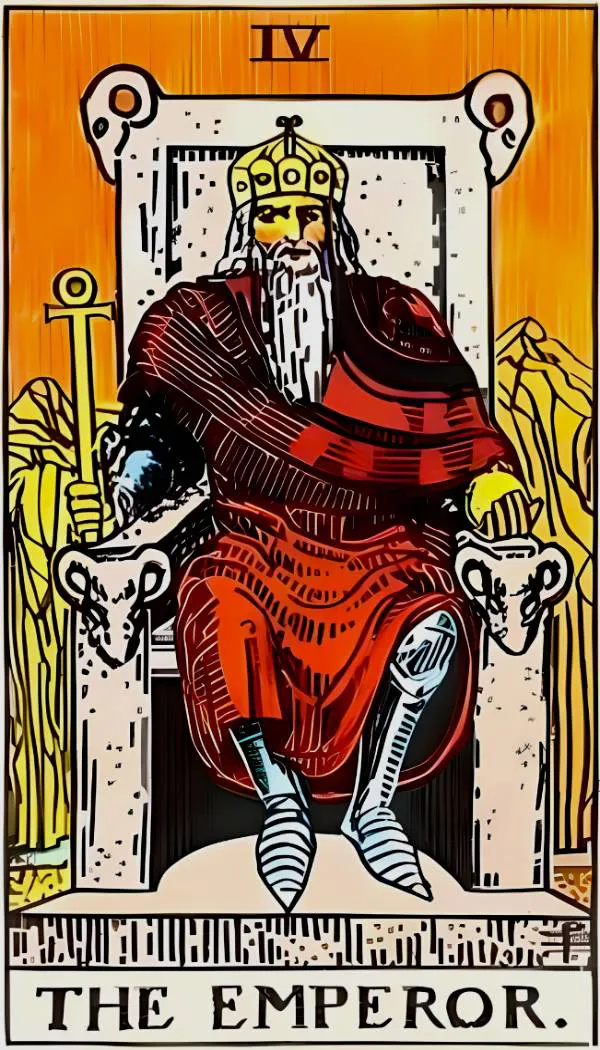
He is the noble and supreme ruler, sitting majestically on the throne, with a commanding presence over vast territories. This proactive and accomplished mature man is not young, and the emperor with a beard represents a long-standing authority, with rich experience and wisdom. His status is rooted in a deep and enduring legacy, inheriting an unshakable authority, yet he continues to expand his dominion, carefully managing the territories and economy over the long term, leading to a stable and prosperous situation today.
The emperor's appearance and demeanor are solemn, with a firm gaze that carries a hint of melancholy, perhaps due to concerns for the state affairs. His eyes are deep-set, with a straight nose and a slightly hooked tip, indicating a fierce and ambitious person. His lips are colorless, tightly pursed and downturned at the corners, showing a resolute character, rational and devoid of emotion. His beard covers his chin and neck, suggesting that he is not adept at expressing and communicating.
Beneath his royal robe is hidden armor, always ready for battle, also representing a strong defensive mindset, not allowing anyone to infringe. Over the armor, he wears a fiery red robe and cloak, displaying his valor and authority. He sits upright, with his feet slightly raised, representing a readiness to stomp in warning or rise to fight, showing a state of readiness.
The emperor's noble throne is a cold and rigid stone chair, with a solid foundation that highlights power and glory. The square and broad back of the chair is higher than the human body, emphasizing a stable support and a strong backing. The entire stone chair is square and angular, all in gray, showing a lack of color and joy in the personal experience. Such a seat does not provide physical comfort; sitting on the throne is not truly a blessed affair, and the daily life of managing affairs is actually monotonous and exhausting.
The emperor represents the highest rank of rulers, and the golden crown on his head is particularly towering, with a closed and rounded top. The edge of the crown is composed of many upright pentagonal planes, each inlaid with different colored gems, usually alternating red and another color. The combination of red and white gems suggests that this card is equivalent to the "Alchemical Monarch" in alchemy, as the red and white combination is a mark of opposition in alchemy and an image commonly used in Waite's tarot. If seen as a combination of rubies and diamonds, it is the two ultimate essences of the fire element and the most noble gem combination in the world. If it is a combination of rubies and sapphires, it is also an opposing combination.
In his left hand, the emperor holds the "Scepter of Sovereignty," a symbol of nobility and power, representing the control of the world's great power. Ancient European rulers were usually granted the Scepter of Sovereignty at their coronation, and the sphere represents the material world. Holding this sphere symbolizes the control of the world's great power, and the creativity and dominion over life. Usually, the Scepter of Sovereignty of European emperors has a cross on top, symbolizing the combination of yin and yang forces, but the protrusion on the sphere in the picture is not obvious.
In his right hand, the emperor holds the Crux Ansata, symbolizing the royal authority and the cross of life's dominion, originating from the ancient Egyptian Ankh. "Ankh" is the source of the original cross, representing the source of life and the key to life and death, and later used as a talisman. Many ancient Egyptian gods hold the Ankh in their hands, symbolizing the control of eternal life. As the representative and communicator of the gods on earth, the ruler holds the Ankh to represent the power to dominate life, with the power of life and death in hand, and to prove that the ability and status are connected with the gods.
The emperor has a dark red cloak draped over his body, with many layers of circular brocade patterns. The innermost part is on the left shoulder, with a black background embroidered with red patterns, which are curly ram horns and half a ram's head. This is the same symbol as the carvings on the four corners of his throne. The front ends of the armrests of the stone throne are carved with obvious frontal ram heads, and the upper edges of the backrest on both sides also show side ram heads, with four ram heads each occupying a side. The ram is the symbolic animal used in astrology for "Aries," representing vitality and ambition. Since ancient times, this ram, representing male reproductive ability, symbolizes positive creativity and masculine energy. The supreme god of ancient Egypt, "Amun-Ra," is represented by the ram as its sacred animal, to embody the infinite vitality of this invisible deity. This image configuration around the emperor is used to represent the exercise of secular power and the willpower to achieve goals.
The emperor's throne is on the top of the mountain, which is the highest place in nature, representing his high position in the real world as the highest ruler, overlooking everything in the world. What the emperor faces is all that belongs to him, which is not shown in the picture. What can be seen is the layered mountains behind him, used to show that the emperor at the peak is at the center of the world.
Between the emperor's throne and the background mountains, there is a stream of water, which can only be seen from the lower sides because it is blocked by the throne. This river symbolizes the subtle emotions and subconscious that are revealed, and the subconscious is invisible and mysterious in operation, which is a metaphor. The color of the water on both sides also has some differences, blue on the left and purple on the right, showing that different emotional feelings are transformed invisibly.
The entire background of mountains and sky is a red color, the same as his clothes, reflecting his fiery ambition. The coldness of the throne is sandwiched between two layers of red, forming a strong contrast. The sky is generally red, and the color near the edge of the mountains is slightly lighter (some versions), and the color of the ground and mountains on the left side of the throne is slightly different. The items on the emperor's body - both hands and the crown are yellow, the same as the color of the ground and mountains on the left side of the background, and the right background is close to orange-red, echoing the color of the emperor's robe. Because the emperor holds different objects in both hands, there is a meaning of mastering dualism and harmonious communication, so the background is also set to the left and right differences to match. However, the color difference of all the backgrounds on both sides of the stone chair is not very obvious, and some versions of the card do not have a difference.
The Throne with Rams’ Heads
The Emperor sits upon a stone throne adorned with four rams’ heads. The ram is a symbol of Aries, an astrological sign ruled by Mars. This emphasizes the Emperor’s leadership, authority, and pioneering spirit.
Ankh and Orb
He holds an ankh in his right hand and an orb in his left. The ankh, an ancient Egyptian symbol, represents life, while the orb represents the world over which he rules. Combined, they signify the Emperor’s power over life and his worldly authority.
Red Robes
The Emperor is clad in red robes, a color symbolizing his passion, power, and energy. This hints at the assertive and foundational energies that the Emperor embodies.
The Beard
His long, white beard signifies age, wisdom, and experience, suggesting that his authority is well-earned and established over time.
Armor beneath his Robes
If one looks closely, one can see the hint of armor beneath the Emperor’s clothing. This suggests that while he is a figure of authority and structure, he is also ready for battle and defense when necessary.
Mountainous Background
Behind the Emperor, we see a range of mountains, indicating stability, permanence, and endurance. Mountains can also hint at challenges or obstacles that he has overcome or will face.
Crown
The crown upon his head symbolizes his status, power, and recognition as a leader.
Straight, Vertical Scepter
The scepter in his hand is straight and vertical, indicating the direct use of power and authority, and the element of order in his leadership.

When Family Help Becomes a Power Fight: Keep the Ask Visible

Carrying the Team, Keeping Final Approval; Testing a Bounded Handoff

From Therapy Performance to Honest Contact: Naming What Stalled

Texting Your Ex or Staying Away: From Longing to a Chosen Boundary

Deadline-Dependent Thesis Procrastination: One Smaller Finish Line
