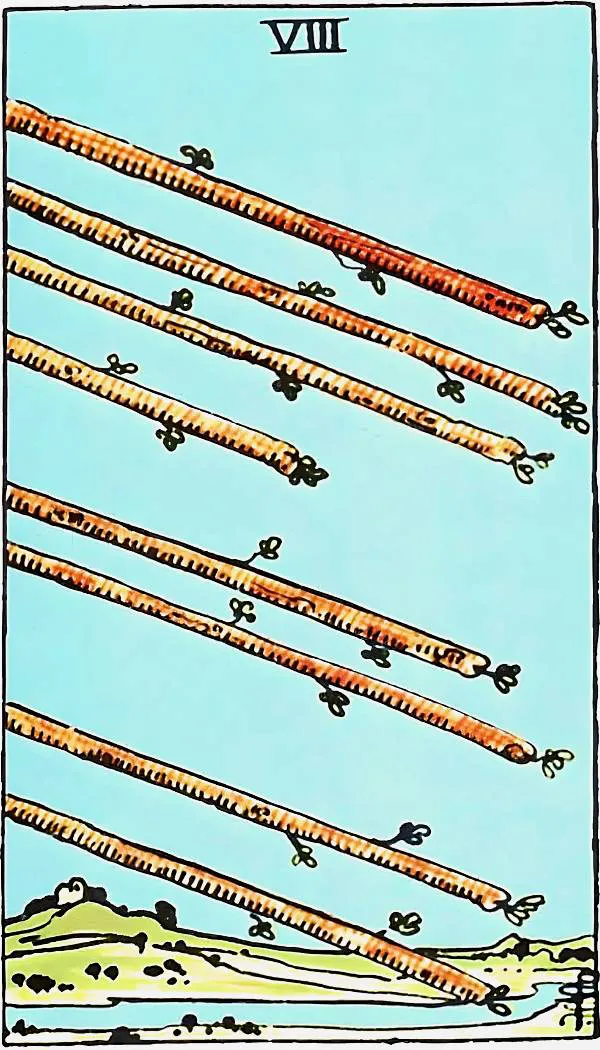
Eight of Wands Tarot Card Meaning

Eight wands are flying through the air, neatly and parallelly arranged, consistently slanting from the upper left to the lower right.

These eight wands in motion in the air are neither touching the ground nor being held, not to mention that there are no figures or animals in the scene at all, only these eight suit-specific objects~wands. The front ends of these eight wands are rushing downwards, yet they maintain their parallelism, presenting a neat and uniform feeling.

The eight wands fill the air, crossing this vast expanse of wilderness, and are about to approach the land. The scene particularly emphasizes the air and has a natural flavor, all of which are rapid operations not caused by human actions, and due to their concentration and consistency, they are powerful.

The ground is a different scene, with undulating terrain and the texture of the strata. There is also water in the scene, a thin stream that crosses the entire ground scene and separates the two banks. The near bank only has an edge, and the land in the scene is all on the open other side. The land in the distance is covered with a greenish hue, while closer to it is a lush green, with a clear gradient. In the lower left corner, a towering hill stands with a small house on top.

The sky is also a plain and simple iron blue-gray tone.

Eight Wands

The eight wands in the air symbolize swift movement, action, and rapidity. They suggest that matters are coming to a quick conclusion and things are set in motion. The straight direction of the wands points to a focused and unambiguous intention or goal.

Blue Sky

The unclouded, blue sky represents clarity and freedom. It suggests that there are no obstacles in the way of the wands, emphasizing the rapidity and ease with which plans can now be executed.

Verdant Landscape

The green, fertile ground below the wands symbolizes growth and potential. It suggests that the environment is ripe for the aims and intents symbolized by the wands to materialize into tangible success.

Streams and River

The water bodies below signify the flow of emotion and intuition, indicating that these aspects are in harmony with the rapid developments occurring. The water can also represent a free-flowing channel of communication or ideas.

House on the Hill

The house on the elevated ground symbolizes a goal or destination that is within sight but requires effort and focus to reach. It serves as a reminder that, although matters are proceeding rapidly, there is still a final point of achievement or realization that must be kept in mind.

Psychological patterns in Eight of Wands
Action Bias
The wands move as a coordinated system, but no person is shown choosing, steering, or evaluating the movement. The card gives the eye a powerful impression of execution while removing the body that would normally sense fatigue, doubt, timing, or friction. That absence matters in academic work because action can become a defense against the discomfort of not knowing what the task truly requires. You may open more tabs, make another plan, rewrite notes, send a quick message, or start the next module because doing something feels more tolerable than sitting with uncertainty. The pattern is not laziness or lack of discipline; it is motion being recruited to protect against ambiguity. The Eight of Wands makes the mechanism visible: movement can be clean, fast, and impressive while still bypassing the reflective contact that turns activity into actual learning.
Forced Progress
The wands descend with such clean force that the image offers no visible brake, grip, or pause point. Their uniform motion can look efficient, but in a reversed psychological field it becomes a system that keeps accelerating because nothing in the scene is allowed to interrupt it. Forced Progress forms when momentum becomes a demand rather than a choice. In lifestyle terms, the schedule keeps moving, the routine keeps tightening, the self-improvement plan keeps expanding, and rest begins to feel like a threat to identity instead of a biological requirement. The card's empty sky matters because the speed has too much room. You may be pushing your life forward without enough friction to tell you when the system is overheating, which turns progress into a form of self-pressure disguised as discipline.
Timing Discernment
The wands move quickly, but the landscape below is not chaotic: air, water, land, and the distant house each keep their own place. The image does not only show speed; it shows speed moving through a field with boundaries, gradients, and a visible destination. Timing Discernment is the ability to tell the difference between a real opening and a nervous-system alarm. In a choice reading, You are not simply asking whether to act fast; the deeper pattern is whether the environment, the cost, and your actual desire are arriving at the same moment.
Urgency Bias
The wands do not meander, hesitate, or negotiate with the landscape; they cut through the sky in a single compressed direction. Their order looks convincing, but nothing in the image shows a hand, brake, or ground contact that could test whether the speed is actually wise. This is the cognitive shape of Urgency Bias in social space. You respond before you know what you want, agree before your boundaries catch up, and treat fast alignment with the group as evidence that the choice is correct, even when the pace itself is the pressure.
Strategic Foresight
The eight wands do not scatter; they hold spacing, angle, and timing across a large open field. Below them, the river, banks, green land, hill, and distant house remain distinct, so the eye can read both speed and terrain at once. Strategic Foresight emerges when momentum is placed inside a map. You are not only reacting to movement; the psyche is tracking layers, distance, and arrival, turning fast change into a pattern that can be read before it becomes irreversible.
Social Overextension
The sky is filled with eight fast-moving wands, but no body appears to choose, pause, or adjust the pace. The motion is powerful, yet it remains suspended above the ground, rushing before it has any visible place to land. In social life, that becomes the structure of overextension: messages, plans, group chats, favors, introductions, and appearances all moving at once without a grounded center checking capacity. You may look socially active from the outside, but the pattern reveals a nervous system spending energy faster than connection can metabolize it.
Family Pattern Recognition
Eight wands cross the sky in the same direction, evenly spaced and moving as one current, while no visible person appears to be throwing, holding, or stopping them. The image makes movement look systemic: the force is real, coordinated, and already underway, but it is not reducible to one individual’s hand. That visual structure mirrors the moment when a family pattern becomes legible as a pattern. A parent’s pressure, a sibling’s comparison, or a relative’s guilt-laced message may look like separate incidents at first, but the repeated trajectory reveals a shared script moving through the system. You gain psychological leverage when the motion is seen from a distance instead of absorbed as a personal emergency. The card’s open sky turns the family current into something observable, which is the core of Family Pattern Recognition: naming the route the message keeps taking before deciding whether you will travel with it.
Action Paralysis
The wands rush toward materialization, but there is no figure to receive them and no hand to translate their force into a first concrete act. The final gap between air and earth becomes more charged than the motion itself. Action Paralysis forms when the pressure to become someone new overwhelms the mechanism that would take the next small step. In personal growth, You can see the direction with painful clarity, yet the landing point feels so loaded with identity consequences that movement stalls at the threshold.
Anxiety Spiral
The eight wands move in one synchronized rush, and there is no figure, obstacle, or hand in the image to interrupt the sequence. In the reversed texture, the absence of interruption can become the problem: one movement triggers the next before the system has processed what is actually happening. That is how an Anxiety Spiral forms in academic work. One deadline becomes a prediction about every future deadline, one difficult reading becomes proof that you are behind, and one imperfect grade becomes a mental cascade about competence, identity, and the entire path ahead. The Eight of Wands gives the spiral a physical shape: parallel thoughts moving too fast in the same direction, gaining force because nothing slows them down. The work of the card is not to shame the speed, but to reveal where the mind has confused acceleration with evidence.
Resource Alignment
The eight wands move through the sky in the same direction, at the same angle, with no visible hand forcing them forward. Their power comes from synchronization: several separate objects have entered one shared current, and the empty sky gives that current room to travel. That visual structure mirrors Resource Alignment because the card does not show effort trying to overcome resistance; it shows conditions moving together. In timing work, this is the difference between pushing against a closed system and noticing that bandwidth, opportunity, communication, and emotional readiness have started to point the same way. You are not being asked to worship speed for its own sake. The pattern reveals whether your action is being supported by the surrounding field, or whether you are mistaking pressure for momentum. When Resource Alignment is active, movement becomes cleaner because the environment is no longer fighting the direction of the choice.
Core Struggles in Eight of Wands
Reciprocity Deficit
All eight wands move one way, with no visible countercurrent, sender, receiver, or return path. The sky is open, but the motion is not reciprocal; it is a concentrated delivery system aimed in a single direction. When reversed, that one-way structure hardens into a friendship pattern where support travels toward you or through you without enough nourishment coming back. The bond may look active because there is constant contact, but activity is not the same as mutual exchange. Reciprocity Deficit names the hidden cost of being the place where everything lands. The card frames the struggle as missing return flow: not a lack of love, but a relationship channel that has learned to move in only one direction.
Social Acceleration Strain
The eight wands cut through an empty blue-gray sky in the same downward slant, with no figure holding them and no pause point between air and land. Their order is clean, but the force belongs to the formation rather than to a visible body. That is the social shape of acceleration before consent: messages, invites, group plans, and weak-tie obligations can all appear aligned, urgent, and already in motion. You are not simply busy; you are trying to locate a human pace inside a field where every connection arrives as if it has already launched. The struggle sits in the gap between open air and grounded choice. The card gives that pressure a boundary: the problem is not that you lack social capacity, but that the whole field is moving faster than your body can sort, select, and metabolize.
Feedback Disconnection
The reversed pressure of the image lives in its clean order without a visible sender or receiver. The wands look coordinated, but no hand releases them, no body tracks them, and no surface has answered their arrival. In a social field, that becomes the unnerving gap between signal and response. A delayed reply, a sudden group-chat shift, or a fast-moving invitation can feel loaded because the channel is active while the feedback loop stays hidden. The card names the struggle as a missing return signal, not a personal failure to read people correctly. You are trying to infer belonging from motion alone, and the structure shows why that inference keeps exhausting you.
Relational Pacing Collapse
Eight wands cut through open air in a single direction, fast enough that no hand, body, or ground appears to regulate their speed. The motion is coherent, but it is also suspended; the wands are approaching land before any receiving structure is shown absorbing their impact. In a relationship, that image gives shape to the moment when momentum outruns mutual pacing. You may feel the bond moving, intensifying, or demanding definition before the two of you have built enough shared timing to hold what is arriving. The struggle is not simply that things are moving fast. It is that speed has become the relationship's organizing force, while consent, readiness, and emotional integration are still trying to catch up from below.
Cycle-Action Desynchronization
The diagonal flight path cuts across a landscape built from slower layers: stream, strata, rising ground, and a small house set apart on the hill. The airborne rhythm does not negotiate with those conditions; it passes over them as if directness were enough. Cycle-Action Desynchronization appears when action keeps launching from one tempo while the environment is moving in another. You may be exerting real force, but the card locates the friction in the mismatch between the moment you are pushing and the cycle that would actually receive the push.
Pacing Control Strain
The wands are not scattered; their pressure comes from how cleanly they share one pace. Their order creates power, but it also leaves no visible braking system between flight and impact. In study, that becomes the strain of trying to learn inside an imposed tempo. You can keep moving through readings, lectures, revision blocks, and submissions, but the system gives little room for absorption, recovery, or recalibration. The open sky makes the speed possible, while the approaching ground makes the cost visible. This card holds the exact academic tension between keeping up and retaining what the pace is forcing through you.
Commitment Threshold Strain
The wands are suspended at the last stretch of flight, angled toward land but not yet landed. The scene holds the moment before impact, where motion is already committed but the final contact point remains untested. That is the exact pressure of a decision threshold. You may be close enough to choosing that every option now feels consequential, yet still far enough from the ground that no outcome can be physically confirmed. This struggle lives in the narrow interval between trajectory and contact. The card gives shape to the strain of making something final when the choice has gained speed but has not yet proven how it will meet real terrain.
Insight-Integration Gap
The wands are unmistakably moving, yet they never visibly touch the earth inside the image. They are all trajectory and no landing, all signal and no embodied result. Insight-Integration Gap lives in that suspended distance between flight and contact. In personal growth, the mind can understand the lesson, name the pattern, and feel the surge of clarity while the daily body, habits, and choices remain on the far bank. The reversed Eight of Wands sharpens this into a loop of activated insight without absorption. The card gives shape to the frustration of knowing more than you can currently live, and it marks the boundary between information that travels through you and wisdom that actually lands.
Clarity-Timing Split
The eight wands cross the plain sky in one clean diagonal, lined up so precisely that direction is almost impossible to miss. Yet they are still airborne, not planted in the green land, not crossing the stream, and not touching the distant house on the hill. That gap between clear vector and unconfirmed landing is the core of Clarity-Timing Split. You may be able to see where an action wants to go, but the card holds the struggle at the moment before contact, when clarity of aim has not yet become certainty about the right moment to release it.
Urgency-Compass Fusion
The wands are perfectly aligned, and their diagonal path is so forceful that it becomes the main coordinate system of the image. The river, hills, and house sit beneath that line of motion, quieter than the rush crossing over them. In social life, a group can create the same false reference point: if everyone is going, replying, posting, attending, or networking, speed starts to feel like direction. You may confuse the pressure to keep up with an actual inner signal about where you belong. The card locates the struggle in that fusion between momentum and orientation. The clear path in the sky is not the same thing as a chosen path in the body, and seeing that distinction restores a cleaner boundary around your own compass.
Inner Emotions in Eight of Wands
Timeline Panic
The wands descend through the sky like a compressed sequence of incoming events. The land is visible, but the exact point of impact is not, so the eye feels the arrival before it can assess the landing. Timeline Panic appears when career time stops feeling spacious and starts behaving like a countdown. Deadlines, promotion windows, role changes, and market shifts can stack into one internal alarm, even when each item has its own logic. The card does not turn the clock into a verdict. It shows how speed becomes panic when multiple timelines enter the same narrow channel and your body has not been given enough room to sequence them.
Directionless Urgency
With no figure, face, or visible hand, the wands carry direction without a visible decision-maker. The diagonal path is strong, yet the scene offers no body that can confirm why this is the right angle or who chose it. For timing questions, this can mirror a rush to move because movement itself has become the loudest signal. You may feel activated by speed while still lacking a grounded internal yes. Directionless Urgency names the charged state where momentum is real but orientation is thin. The card reveals the difference between a clear opening and a pressure current that only looks like timing because it is moving fast.
Wrong Choice Panic
All eight wands angle toward a single landing direction, while the stream below divides the near edge from the open land beyond. The house on the hill gives the landscape a target, but its smallness also makes the destination feel precise and easy to miss. For a major decision, that structure can intensify the fear that one landing point will cancel every other possible route. The clearer the direction becomes, the more the mind may attach to the cost of being wrong, as if commitment itself were a narrow target. Wrong Choice Panic belongs here because the card compresses movement, separation, and destination into one field. It does not confirm the fear; it reveals how a choice can become frightening when the psyche treats landing anywhere as losing everywhere else.
Stalled Momentum Dread
The wands hover between sky and land, visibly moving yet not touching the ground. The fertile landscape is ready below them, but the scene keeps the moment suspended just before contact. In love, that suspended almost-arrival becomes Stalled Momentum Dread. A conversation was moving, chemistry was building, plans seemed possible, and then the connection hangs in the air without becoming anything stable. The card links the dread to unfinished landing rather than to personal inadequacy. It shows you the emotional cost of momentum that has been activated but not embodied, making the waiting visible enough to question instead of simply endure.
Relational Whiplash
The Eight of Wands compresses distance into impact. Its repeated diagonal shafts move like a volley already near landing, giving the image a sense of acceleration that leaves little room for a slower body to absorb what is happening. Relational Whiplash in friendship comes from that same compressed timing. A sudden cold reply, emotional confession, group chat shift, cancellation, or boundary test can make the bond feel as if it changed position before your inner compass had time to update. The card connects to this emotion because its motion is unified and fast enough to become a nervous aftershock. You are not only reacting to an event; you are trying to reorient inside a friendship field that moved too quickly for emotional pacing to stay intact.
Mixed Signal Dread
Eight wands cut across the sky without a visible sender or receiver, so motion is obvious while intention remains unembodied. The message seems to be traveling, but the scene withholds the human context that would tell you what the movement actually means. In love, that gap becomes Mixed Signal Dread. A fast reply, a sudden silence, or a warm line followed by distance can feel impossible to place, because the signal arrives before the emotional source is clear. The card anchors the dread in the split between speed and meaning. Naming that split gives you a way to examine the communication structure instead of letting every ambiguous detail become a verdict on your worth.
Relational Urgency
Eight wands slicing across the open air create a relationship atmosphere where movement arrives before any body appears to hold it. Their parallel descent has no hesitation, no side path, and no hand moderating the pace; the feeling is of signals already in motion and closing distance fast. In love, that visual pressure becomes the sense that the connection needs an answer right now. You may feel pulled into replying, defining, chasing, or resolving before your slower emotional system has had time to register what it actually wants. The card links this urgency to speed itself: not a lack of care, but a narrowing around timing. Seeing the pattern gives you a point of agency, because the rush can be named as a tempo in the relationship rather than mistaken for certainty.
Restless Momentum
The wands do not hover; they travel. Their diagonal rhythm gives the whole card a forward pull, while the green land and thin stream below suggest that this movement is about to enter a living, relational terrain where contact will have consequences. In a friendship reading, Restless Momentum describes the charged feeling of a bond that is already shifting. Plans are forming, replies are speeding up, a boundary conversation is approaching, or a group dynamic is moving toward a visible change, and your inner system can feel the motion before the outcome is settled. The Eight of Wands supports this emotion because its energy is neither still nor chaotic. It is coordinated acceleration, which mirrors the specific feeling of being carried forward by friendship developments that feel alive, promising, and difficult to pause.
Clarity Rush
The wands share one diagonal line, and their tips aim toward the same unseen landing point. The sky is plain enough that the direction does not have to fight through visual noise. That clean vector becomes an inner surge when a social situation suddenly makes sense. A group, invitation, or new connection stops feeling like a maze of possible meanings and starts feeling like a path with a visible line of travel. Clarity Rush belongs to this card because the feeling is fast, embodied, and directional. You are not simply relaxed; something in the social field has snapped into focus quickly enough to create a physical charge.
Synchronized Relief
The stream below the wands, the green land, and the small house on the hill give the card more than speed; they give the speed somewhere to go. Each layer of the scene holds its own place, so motion does not have to fight the environment around it. That is the academic feeling of a system finally clicking into sequence. Notes, deadlines, feedback, and future goals stop colliding and begin to occupy separate, usable lanes. Synchronized Relief emerges because the card does not show a single breakthrough in isolation. It shows multiple channels agreeing with one another, which is exactly what relief feels like when study effort, timing, and direction briefly stop arguing inside you.
Outer Contexts in Eight of Wands
Premature Launch Pressure
The wands rush downward in a neat group, but none of them has touched the land. The fertile ground is present, yet the objects remain suspended above it, moving faster than the scene can show integration. For you, this points to a pressure to turn a direction into a launch before the base is built. A pivot, announcement, move, public commitment, or major reset may be gathering speed because the outside world rewards decisiveness, even when the practical container is still thin. Premature Launch Pressure belongs here because the visual problem is not lack of motion; it is motion arriving before embodiment. You regain leverage by separating real readiness from the rush created by visible momentum.
Launch Window Readiness
The wands are not stored, planted, or waiting in someone's hands; they have already left the launch point. Their movement across the open air makes the scene feel like a plan crossing the threshold from intention into implementation. In a choice reading, that matters because the question is no longer purely theoretical. You may be looking at an offer, project, move, application, conversation, or commitment that has enough structure around it to test whether it is ready to land. The green terrain below gives the motion a material field, while the house on the hill keeps the end point visible but not yet reached. The card frames readiness as a live launch condition: enough has been set in motion to act, but the final decision still needs conscious ownership.
Strategic Timing Window
The eight wands do not drift; they travel in a clean diagonal toward a landscape that already contains a visible destination. The small house on the hill gives the motion a point of reference, turning speed into directed arrival rather than raw acceleration. This is the visual logic of a strategic timing window. The path is open, the destination can be seen, and the moving parts are temporarily parallel enough to make timing itself a resource. You are being shown a phase where the key leverage is precision. The card does not glorify speed for its own sake; it marks the interval when a move can travel farther because the external current, the target, and the route are briefly aligned.
Always On Availability
The wands are already airborne, and no hand is shown choosing when they begin or when they stop. Their motion crosses an exposed sky without a gate, wall, room, or threshold that could create a private interval. Always On Availability takes that visual pressure into daily life. Work chat, social replies, household logistics, family check-ins, delivery windows, and self-maintenance reminders can all move through the same personal channel until availability becomes the default setting. The card ties this context to boundary architecture rather than personal weakness. The problem is a life system with no protected receiving hours, no screened-off recovery zone, and no visible point where incoming motion is allowed to wait.
Timing Signal Overload
The wands move in a clean direction, but all eight arrive through the same sky at once. The orderliness of the formation does not remove its pressure; it concentrates the timing into a single rush. In a family system, timing signal overload happens when updates, demands, invitations, warnings, and emotional cues arrive together. Nothing may look chaotic on the surface, yet the pace makes it hard to tell what actually requires your response and what is only borrowing urgency from the crowd. You are being shown a clear path that has become too compressed to process. The card helps separate true timing from inherited urgency, so the family signal can be read instead of simply obeyed.
Strategic Momentum Window
The wands are already moving before anyone enters the scene, and their direction is unusually clean. Their speed is not chaotic in the image; it has a visible angle, an open route, and a distant landscape that can receive the motion. For inner work, this points to a short practical opening where clarity has enough velocity to change a pattern. You may not have a complete life plan, but the structure shows that one line of movement is temporarily easier to follow than the others. The house on the hill gives the motion a destination without making it fully reached. That is the pressure of this context: the moment is usable, but it has to be read as a timing window rather than a guarantee of permanent certainty.
Assignment Deadline Cascade
Eight wands crowd the air as incoming force, all moving in the same direction without a hand to pace them. The near bank is only an edge while the open land sits across the stream, so the image carries the pressure of work arriving before there is enough grounded space to receive it. For You, this becomes the academic week where every assignment seems to land at once. The problem is not a lack of character; it is a compressed delivery structure where essays, labs, quizzes, and presentations occupy the same airspace and demand sequencing before they turn into a pileup.
Insight Integration Window
The wands are still airborne, but their angle is unmistakably downward. They are not abstract sparks floating in the sky; they are moving toward green land, a stream, layered ground, and a small house that gives the scene a practical endpoint. That visual bridge is the core of an insight integration window. A realization, framework, or self-understanding has enough force to travel, but it has not yet become a schedule, boundary, habit, conversation, or repeated behavior. This card makes the pressure specific: the insight is close enough to land, but it can still remain untouched if it never meets the terrain of ordinary life. You regain agency by tracking where the idea is supposed to make contact with reality, not by collecting another idea above it.
Academic Momentum Window
Eight wands crossing open sky in one clean diagonal create a rare image of academic movement without drag. The shafts are separate but aligned, and the green land below gives the motion somewhere real to land, so the pressure is not just speed but usable speed. For You, this maps to the semester moment when readings, deadlines, attention, and external expectations briefly point in the same direction. The structure is asking for recognition of a real opening: not endless productivity, but a narrow window where effort can convert into visible academic output before the timing shifts.
Thesis Launch Window
The wands are already airborne, aimed toward land that looks fertile enough to receive them. The small house on the hill gives the flight a visible endpoint, but it remains distant, so the image holds both launch pressure and the need for sustained aim. For You, a thesis or capstone starts to become real when the idea leaves the private planning stage and enters deadlines, drafts, supervisor comments, and evidence gathering. The card reflects a launch window where the project has enough direction to move, while still requiring you to keep the endpoint visible instead of mistaking motion for completion.