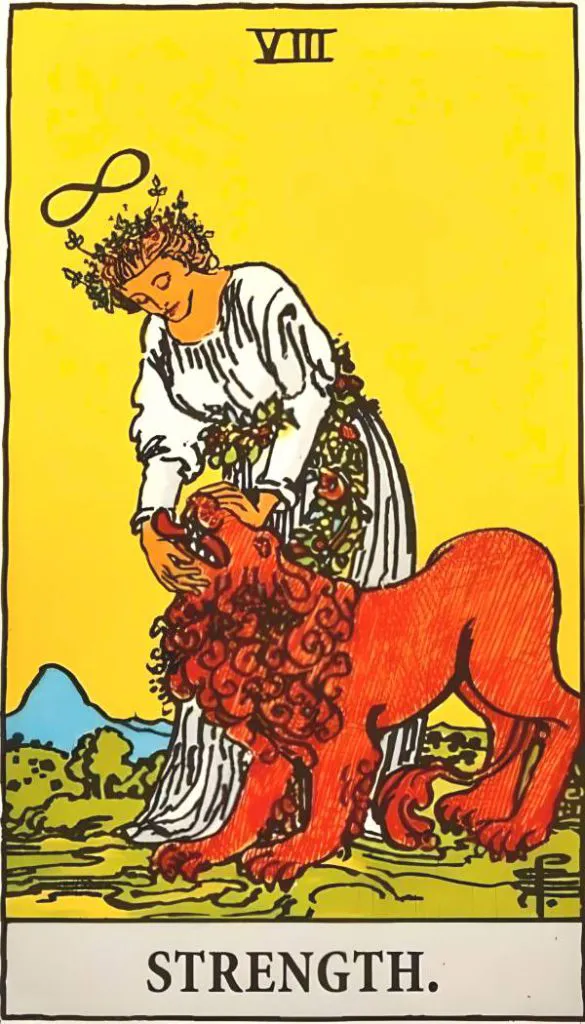
Strength Tarot Card Meaning

This card features a simple composition, focusing on a woman and a lion, embodying a sustained posture with many profound layers of meaning. The woman, dressed in white robes, might be the woman clothed with the sun, taming a fiery red lion. The entire composition is set against a yellow background, symbolizing the bright spiritual force. The contrast between the vivid red and the light white tones represents an alchemical significance and is related to many cards in the Waite Tarot.

The woman, known as 'Strength,' controls the lion's mouth with her hands, showing no fear in the face of the fierce beast. She bends down to reach the lion's jaw with her right hand and places her left hand on the lion's head and upper jaw. Her right index finger is slightly bent, revealing a delicate aspect. As she gazes at the lion with closed eyes, seemingly in contemplation, her face shows a serene expression. These actions indicate that she has tamed the lion with 'beneficent fortitude.'

The lion's situation is quite interesting; its tail tucked between its hind legs suggests that it is completely under the woman's control and is in a state of submission. When an animal tucks its tail, it is showing weakness, and its wild and powerful nature is restrained. However, the lion's mouth was originally open, indicating the strength of its power, with the opening and closing of the mouth representing the release and containment of energy. Now the woman directly controls the opening and closing of the lion's mouth.

In ancient traditional Tarot cards, the hands are about to close the lion's mouth, which has a better symbolic meaning. Some esotericists depict the lion's mouth open, which is also valid as it expresses the same idea of control. The Waite Tarot depicts the mouth closing. This is just a frozen image; whether it is open or closed, it should indicate that both are appropriate, which more comprehensively shows the ability to control at will.

Above the woman's head is an infinity symbol, similar to 'The Magician.' She, a pure maiden, is the female counterpart to the Magician, leading to the mysterious power of women, equal to that of the Magician. The energy and magnetic field that the woman possesses are shown by the 'infinity' symbol on her head, representing the endless inner strength, indicating the operation of a cycle and the power of life and renewal, intersecting at a point in space and time, which is also a way of harmonizing yin and yang.

The woman's waist and head are adorned with garlands of flowers, a sash of roses wrapped around her body, similar to the ribbon on the woman in 'The World' card. This floral garland also alludes to the 'tow-chain' worn by novices of the Masonic class 'Master Mason,' as it is wrapped around the waist with the end hanging on the left, just as they wear it in some rituals, and the use of roses again emphasizes the connection to the Rosicrucians.

Thus, this is not an ordinary garland but one that hides deep mystical meanings, with a special role and efficacy. It connects the woman and the lion, serving as a pattern to convey energy, transferring the energy of the lion through the woman's body upwards, like the conduction of electricity, and connecting with the 'infinity' symbol at the top of her head. Therefore, the woman also wears a crown on her head, with two antenna-like branches pointing towards the infinity symbol. This also shows the flow of the aura during this state of operation.

Next, let's look at the relationship between the woman and the lion: the lion's eyes look up, meeting the woman's gaze. The woman and the lion seem to have merged through the entwining of the garland, with the two forces blending together. The harmony of these two forces is a high state, implying a 'Divine Law,' which actually comes from the meeting and touching of hearts. The woman's posture, like a gesture of gathering energy, seems to be drawing energy from the lion and also seems to be activating the 'infinity' symbol.

The woman's posture of taming the lion forms a very typical image: the lion represents a wild and natural force, and the human represents human or divine power. The two forces meet, and the human taming the lion indicates the ability to use its power and to combine and integrate the two. This is a posture of practice, a Western mystical method. The hand gestures are like the movements of Tai Chi, and overall, it is a state of advanced yoga. The 'infinity' symbol above the head depicts the transfer and elevation of the energy field.

In addition, we can see that the ground around the lion's paws is slightly uneven, depicting the lion's struggling posture, with the force of its paws causing the ground to rise where the claws grip. This indicates that its brute force can affect the surroundings, adding tension to the confrontational scene. The entire ground is covered with green grass, planted on soft soil, and the two masters practicing on it naturally alter the terrain. Against a bright sky, the area around the main picture - the woman and the lion - is brighter, reflecting the aura they create.

The overall composition of this card is particularly related to alchemy, with the flowers in the woman's hair and on her belt - red roses (and white roses), which are often a link to alchemy in the Waite Tarot. The overall color scheme is also a contrasting combination of red and white, a harmony of purity and passion. The woman, with an immovable posture, suppresses the lion, and in the background, there is a towering mountain, serving as another reflection of this scene. Observing the scene of this card: in the distance, there is a large mountain with several green trees in front. This blue, phallic-shaped hill is similar to the mountain on the Lovers card, with a connotation of passionate energy, but it also represents the hidden energy and explosive power, and it is a moment of potential energy and restraint.

The Woman

In the Strength card, the woman symbolizes gentleness, patience, compassion, and the softer side of human nature. Her act of closing the lion’s mouth not through force, but with a calm demeanor, speaks of inner strength and the ability to overcome obstacles or challenges through understanding and patience, rather than through brute force.

The Lion

The lion is traditionally a symbol of raw power, courage, and ferocity. In this card, it represents our animalistic tendencies and passions. The woman’s act of taming the lion signifies mastery over one’s own wilder instincts, harnessing them in a way that they serve rather than dominate. It’s a card that urges the balance between instinct and reason.

The Lemniscate (Infinity Symbol)

Above the woman’s head is the lemniscate, the same symbol seen in the Magician card, representing infinity and limitless potential. Here, it symbolizes a harmonious interaction between conscious understanding and unconscious instinct. It also speaks to the infinite power and potential that can be harnessed when we are able to bring our instincts into alignment with our higher values and understanding.

The Mountainous Background

The rugged landscape in the background suggests challenges and obstacles. Yet, the sky is clear, indicating that clarity and understanding reign in the situation at hand. The combination of the serene sky and the challenging mountains highlight the essence of the card: facing challenges with inner strength, clarity, and calm determination.

The Garland of Flowers

Wrapped around the woman is a garland of flowers, symbolizing victory, success, and the blossoming of one’s endeavors when they act with compassion and understanding. Flowers, with their gentle beauty, counteract the wild nature of the lion, suggesting that with patience and love, even the most challenging situations or primal instincts can be transformed into something beautiful and harmonious.

Psychological patterns in Strength
Illusion of Control
The woman's hands never leave the lion's mouth, and the whole card organizes itself around whether that raw force opens or closes. Her closed eyes make the scene even more revealing: the contact is intimate, but the field of awareness is narrowed, as if safety depends on keeping one volatile force perfectly managed. That is where Illusion of Control enters this card. In direction questions, you can start treating the future as something that will finally feel safe once every variable is anticipated, every urge is disciplined, and every possible outcome is contained. The problem is not discipline itself; the problem is that control becomes a substitute for orientation, so you stay busy steering while drifting further from what your deeper compass is actually trying to say.
Self-Silencing
The lion's mouth is the card's most psychologically charged threshold. It is where instinct would become sound, need, refusal, appetite, or disruption, and the woman's hands are placed exactly there. When the card's regulating force stops circulating and starts locking down, the image stops looking like mastery and starts looking like containment for its own sake. In social life, that becomes Self-Silencing when you edit what you think, mute your humor, suppress disagreement, and keep your needs behind your teeth so the group stays smooth. The mechanism can feel noble because it dresses itself as maturity or self-control. But what it actually does is convert participation into monitoring, leaving you physically present in the social field while your real voice never fully arrives.
Timing Perfectionism
The woman's hands do not overpower the lion with a single move; they meter its mouth with exact, repeatable pressure, while her eyes stay closed and the infinity symbol hangs above like control must be sustained without end. The image is calm, but it is also highly selective about when force is allowed to move. You see this pattern when personal growth becomes a waiting room for the perfect internal state. Launching a project, showing your real capacity, or stepping into a larger identity keeps getting delayed until your timing feels pure, calm, and fully mastered. The scene links that hesitation to a deeper belief that raw life-force cannot be trusted unless it has been completely domesticated first.
Rescuer Identity
The woman's hands do not attack the lion; they organize its mouth. Her body bends toward force instead of away from it, and the infinity symbol above her head gives the whole scene the feeling of sustained capacity rather than a single heroic moment. You can see a role being enacted here: the calm one, the steady one, the person who can stay close to intensity without flinching. In friendship, that visual logic becomes Rescuer Identity when care starts to mean managing another person's storms so the bond can stay intact. You are not only offering support; you are becoming the regulator of the connection, and that slowly trains the friendship to rely on your steadiness more than on mutual emotional responsibility.
Emotional Gatekeeping
The woman's hands rest directly on the lion's mouth while her eyes stay closed, and the whole encounter is conducted through touch rather than force. The image shows instinct being allowed near enough to matter, but not free enough to speak in its own raw language. That is the visual grammar of Emotional Gatekeeping: desire is present, powerful, and intimate, yet it is carefully edited before it is allowed into the open. In a decision crossroads, you may look calm and thoughtful while your real preference stays behind a controlled face. The pattern is not indecision in the abstract. It is a protective filter that lets a choice move forward only after your instinct has been translated into something tidy, defensible, and hard to criticize. The card fits because it does not show the absence of desire; it shows desire being managed so tightly that clarity arrives late.
Overfunctioning
This figure is not merely touching the lion; she is continuously managing it with her own body as the stabilizing instrument. The hold is sustained, close, and deliberate, while the animal's force remains alive underneath. That physical arrangement mirrors Overfunctioning because the burden of regulation gets absorbed into the self rather than distributed across the environment. In career life, You can become the person who keeps the room usable, the project moving, and the team from spiraling. The card points to the kind of competence that gets recruited into emotional labor, crisis prevention, and cleanup work far beyond the job description. It looks strong from the outside, but it also reveals how quickly reliability can become a trap that others start assuming is endlessly available.
Cognitive Dissonance
This card binds opposites together instead of separating them: white robe and red lion, gentle hands and brute jaw, calm sky and disturbed earth. The image does not erase conflict; it holds two incompatible kinds of truth in the same frame and asks whether they can actually live together. When that integration fails in a direction reading, it often lands as Cognitive Dissonance. One system in you is loyal to what is explainable, admirable, or strategically safe, while another keeps pulling toward what feels alive and nonnegotiable. That split does not just create indecision; it drains orientation itself, because every step forward immediately activates the part of you that believes the opposite move is the real one.
Self-Sabotage
The woman's body stays locked in intimate struggle with the lion, and the ground under its paws implies strain spilling into the environment. When the field no longer absorbs the pressure, containment turns inward and then breaks outward in the wrong place. In study cycles, that is how Self-Sabotage often lands. The closer the deadline, exam, or evaluation gets, the more the task starts to feel like a threat rather than a channel, so procrastination, avoidance, or needless detours become a way to rupture the pressure. The damage is real, but the logic is defensive: the system would rather interrupt the performance than be fully seen inside it.
Social Masking
The woman's face stays serene while her hands remain occupied with active restraint. That split between visible calm and invisible effort is the key visual tension of the card when the mechanism turns inward on itself. The lion is still there, the pressure is still there, but the surface presentation must not show strain. In social settings, this becomes Social Masking when you present as easy, composed, and emotionally low-maintenance while privately working hard to hide irritation, insecurity, social fatigue, or overstimulation. You become highly skilled at looking fine in the room, but that skill creates distance between your public presence and your actual state. The belonging you get from that performance can feel conditional because it was won by concealment.
Analysis Paralysis
The same hands that could guide the lion now read like a bottleneck: all effort gathers at the mouth, and nothing cleanly moves through. The calm field around them stops feeling spacious and starts feeling exposed, as if every visible move could prove you were not ready. In academic work, that is the structure of Analysis Paralysis. Thinking keeps circling through outlines, note stacks, and possible formulations because action feels unsafe unless it is already controlled. You are not lacking ideas; your system is spending its energy on preventing the wrong move before it lets the right one exist.
Core Struggles in Strength
Inner Compass Overload
The woman holds the lion at the mouth, the exact place where force would become sound, bite, or outward motion. Her gaze does not chase the distant mountain; it stays with the living pressure in front of her, turning direction into a sustained act of inner calibration rather than a straight road forward. That structure matches the exhaustion of trying to locate a future by checking every impulse before it is allowed to move. You are not lacking a horizon in this image; the horizon exists, but the usable compass is crowded by too many signals asking to be regulated at once. Strength carries this struggle because its power is not shown as conquest. It is shown as a living interface between instinct and intention, where clarity can only return when the force that wants to move and the self that wants meaning stop overloading the same inner control point.
Resource Integration Strain
The woman's hands are placed exactly where the lion's force would leave the body: the mouth, the jaw, the roar. Her white robe, the red lion, the garland, and the lemniscate make the scene less about defeating force than about carrying it through a controlled circuit. In a lifestyle reading, that circuit mirrors the problem of having energy without a system that can metabolize it. You may have drive, appetite, ambition, fatigue signals, and the desire for order all arriving at once, but the daily structure has to translate that raw force into sleep, meals, work blocks, cleaning, movement, and recovery. Resource Integration Strain appears when the issue is not a lack of energy, but an unstable conversion point. The card gives the struggle a clear shape: the lion is powerful, the woman is steady, yet the whole system depends on whether their forces can meet without either one swallowing the other.
Timing Control Strain
The woman's hands rest directly on the lion's mouth, not as weapons but as a living gate around the point where force would normally break out. Her body leans into the exact place where release and restraint meet, while the open field around them does not remove the need for precise contact. Timing Control Strain emerges when your sense of the right moment becomes fused with the need to keep that gate under manual control. You are not simply waiting or acting; you are monitoring the hinge where action might become too early, too late, or too much, and the strain comes from making your own nervous system do the work of a larger cycle.
Power-Intimacy Split
The woman stands close enough to the lion's mouth that distance is no longer her protection. Her bare hands meet the animal at the exact point where force would normally break outward, and the lion's braced paws show that the power has not vanished; it is being held inside a living contact point. That visual tension gives Power-Intimacy Split its shape. In love, the same closeness that creates tenderness can also expose you to another person's desire, anger, need, or volatility. The card does not frame power as something outside intimacy; it shows power sitting inside the most intimate point of contact. You are not looking at a simple choice between staying soft or getting strong. The struggle is the structural demand to remain emotionally near while still knowing where your safety, agency, and limits begin. Strength names the moment when love becomes real enough to require both contact and containment at once.
Power-Belonging Split
The lion's mouth is the loudest point in the image, and the woman's hands rest exactly where roar could become impact. The red animal force is not erased; it is held close to the white-robed figure and threaded through the garland that joins them. In social spaces, this is the structure of power that has to negotiate belonging before it can be expressed. You may sense that your intensity, confidence, anger, ambition, or desire could change the room, so the work becomes less about having power and more about keeping it socially survivable. The struggle is not a lack of strength. It is the cost of making connection depend on continual containment of the force that also makes you vivid.
Shadow Integration Strain
The woman bends toward the lion instead of standing above it, placing her hands directly on the animal's mouth. The wild force is not cut away from the scene; it is brought into controlled contact with the figure's body, gaze, and breathing space. That contact is the shape of Shadow Integration Strain. You are not facing a simple need to calm down or become more disciplined; you are facing the inner work of letting a raw part of yourself be seen without allowing it to define the whole self. The white robe, red lion, floral chain, and lemniscate form one circuit rather than two separate worlds. The card gives your introspection a precise boundary: the shadow is close enough to be integrated, but powerful enough that it cannot be absorbed casually.
Boundary Control Strain
The woman's hands rest directly on the lion's mouth, at the exact place where force would become sound, bite, or release. There is no wall, leash, or weapon between them; the only boundary is the living pressure of her touch. In friendship, this image carries the strain of staying close to someone whose emotional force can quickly fill the room. You are not outside the bond judging it from a safe distance; you are inside the contact zone, trying to keep the relationship warm without letting it consume your private space. Boundary Control Strain appears when care and limit-setting have to happen through the same gesture. The card gives that struggle a visible shape: one hand keeping connection, one hand preventing overflow, both required at once.
Vulnerability Containment Strain
The woman's hands do not strike, bind, or push the lion away. They create a narrow living container around the mouth, using contact, steadiness, and pressure fine enough to manage force without turning the whole scene into domination. That is the visual logic behind Vulnerability Containment Strain. In a relationship, openness is not automatically safe just because it is sincere. Sometimes tenderness has to hold conflict, desire, need, and fear in the same small space, and the strain comes from keeping that space intact without hardening into control. You may recognize this as the moment when emotional honesty needs a boundary before it can become intimacy. Strength shows vulnerability as something structured, not something formless: love can stay soft only when it has a container strong enough to keep both people from spilling into each other.
Willpower Dependence Trap
The woman's hands remain at the lion's mouth as if the whole scene depends on one continuous act of regulation. The garland and lemniscate keep the force circulating, but the image offers no external structure that can take the load away from her fingers. In a lifestyle question, that becomes the architecture of a life held together by active self-control. Meals, sleep, cleaning, movement, work, and recovery may function only when You are personally clamping down on every moving part. Willpower Dependence Trap names the hidden cost of making discipline the infrastructure. The card's reversed pressure is not a simple failure of self-control; it is a system where order survives only while your hand stays on the lion's jaw.
Power-Choice Split
The woman in Strength does not stand away from the lion's power; she bends into its reach and places her hands at the exact place where force becomes action. The lion's mouth is the threshold where instinct could break out, while the floral garland and white robe keep the scene from becoming a fight of brute force against brute force. That image gives Power-Choice Split its shape. The choice is not between having power and refusing power; it is the harder position of deciding how much force can be released without letting the decision become destructive, impulsive, or misaligned with your values. At a crossroads, this card shows the cost of treating desire as either dangerous or automatically trustworthy. You are being shown the contact point where a powerful drive needs form, timing, and consent before it can become a real choice rather than a reaction.
Inner Emotions in Strength
Performative Calm
The serene face and lowered eyes create a surface of softness while the hands keep the lion's mouth under control. The flowers and bright field make the scene look graceful, but the central action is still a precise management of force. You are seeing an exterior that can look peaceful while the inner mechanics remain highly monitored. Performative Calm belongs to this reversed reading because the image can become a beautiful mask for tension. The garland looks gentle, yet it also links the woman and lion into a circuit where the difference between holding and hiding becomes harder to locate. In introspection, this emotion appears when you know how to appear regulated before you know whether you actually feel regulated. The card gives language to that private split: the outer expression says everything is handled, while the inner system is still negotiating with the lion.
Grounded Agency
The woman's hands rest directly on the lion's mouth, close enough to meet raw force but controlled enough not to crush it. The distant mountain keeps the wider horizon visible, so the scene is not only about restraint; it is about placing power back inside a navigable frame. Grounded Agency emerges here because the card shows control without panic and contact without collapse. For your life direction, the emotional shift is not about having every future detail solved. It is the felt return of inner steering, where instinct, pressure, and long-range vision can occupy the same body without one taking over the whole path.
Courageous Vulnerability
The woman's bare hands rest on the lion's mouth at the exact place where the animal's force would usually break outward. Her posture does not erase the lion's power; it meets it close up, with a softness that still has structure. That visual tension makes Courageous Vulnerability more than simple openness. It is the inner weather of letting yourself be seen in a group without surrendering your boundaries, especially when social intensity could easily make you mask, retreat, or over-control the moment. You are not asked to become louder or tougher here. The card reflects the kind of social courage that stays receptive while still choosing how much access other people get to your heat, attention, and care.
Contained Overwhelm
Wrists, fingers, jaw, and mane are packed into a small zone where the lion's force has to be held moment by moment. The bright field gives the figures little shadow, and the living garland loops energy back into the same charged circuit. Contained Overwhelm takes shape when too many timing demands are pressed into one inner valve: wait, launch, catch up, stay composed. The card mirrors the strain of appearing controlled while every unmade move keeps collecting behind the teeth.
Hard-Won Composure
With one hand at the lion's lower jaw and the other resting on its head, Strength makes composure look like a sustained physical act rather than a naturally easy mood. The lion still has teeth, heat, and weight; the woman stays close without copying its force. In a family system, this maps to the moment when an old trigger is active but you do not hand it the steering wheel. You may feel the charge in your body and still hold a clear tone, a steady boundary, or a slower response. Hard-Won Composure is the inner weather of staying adult in a room that knows how to pull you backward.
Suppressed Rage
The red mane and jaw sit directly under bare fingers, while the claws mark the soil with pressure the face of the scene does not fully show. The restraint is elegant, but the heat of the animal body remains visibly present. Suppressed Rage appears when delay has been held so politely that irritation loses its clean language. In timing questions, the card names the hot, private edge beneath disciplined waiting: the part of you that is tired of being told to be patient, yet still knows that raw force would cost too much.
Desire Anxiety
The red lion presses its mouth into the place where the woman's fingers decide how much force may open. Its heat, fur, teeth, and upward gaze turn desire into something vivid enough to require direct contact. At a crossroads, this is the feeling of wanting an option so strongly that the wanting itself starts to feel dangerous. The card does not shame the appetite; it shows the psychological work of letting desire be heard without letting it seize the whole decision.
Disciplined Calm
The woman's lowered gaze stays with the lion, not with the distant mountain or the empty sky around her. The card gathers attention into a single charged point: hands, jaw, breath, and eye line all held inside one disciplined field. In career pressure, that visual focus becomes the feeling of keeping your attention clean when the room is full of status signals, deadlines, and implied consequences. You are aware of the stakes, but your system is not scattering itself across every possible threat. Disciplined Calm is the emotional signature of Strength when inner regulation has enough space to work. The calm is not passive softness; it is a trained quality of attention that lets you meet workplace force without turning yourself into force.
Relational Anxiety
The woman's gaze and the lion's upward look create a charged loop where each figure is reading the other at close range. Her hands remain on the jaw, so the connection depends on constant sensitivity to pressure, timing, and response. In love, this becomes the inner weather of monitoring the bond for signs of safety or rupture. You may want connection, but the closeness itself keeps activating the question of whether the other person's force can be trusted near your own. Relational Anxiety fits reversed Strength when regulation turns into scanning. The card shows that the bond is real, but the nervous attention around it has become so active that intimacy starts to feel like a situation that must be continuously managed.
Charisma Fatigue
The central figures are bright, exposed, and locked into a sustained exchange of force. The woman is not simply present with the lion; she is continuously regulating the most volatile point in the scene while the garland turns that exchange into something visually beautiful. Charisma Fatigue appears when social warmth becomes a role you are expected to keep performing. You may be the person who softens sharp rooms, translates tension, makes introductions feel safe, or keeps everyone else emotionally coordinated. The card makes the cost of that magnetism visible. It shows that being socially gifted can still drain you when the group keeps feeding its heat through your body and calling the result ease.
Outer Contexts in Strength
Impulsive Life Pivot
The lion's teeth, claws, and disturbed ground carry the force that the calm surface is trying to hold. Reversed, that force can start to define the whole decision field before the structure around it has been checked. An impulsive life pivot is not just wanting change. It is a dramatic option becoming attractive because it promises instant release from accumulated pressure, especially when the current setup has made every slower route feel airless. You do not need to shame the force behind the urge. The card asks for a clean separation between real desire and pressure discharge, so the decision can be made from usable strength rather than from the most immediate exit route.
Third Path Search
The woman does not fight the lion from a distance, and she does not surrender her body to it. The contact is close, deliberate, and structured enough to create a third relationship between force and control. That visual logic maps cleanly onto a decision where the available options feel falsely extreme. Stay or leave, accept or reject, obey or rebel may be the visible menu, but the card shows a negotiation space that is not contained by those terms. You gain leverage by asking what form of contact changes the problem itself. The third path is not a compromise that weakens both sides; it is a redesigned container where the raw force of the choice can be used without letting the old binary define the outcome.
Premature Launch Pressure
Teeth, paws, bright heat, and an open field gather around a mouth that cannot simply be released. The lion has power, but the scene also shows why power without containment can become damage control the moment it enters open space. Premature launch pressure shows up when outside urgency treats available energy as full readiness. You may be surrounded by deadlines, hype, expectations, or people who want the next move now, but the card highlights the missing container around the release. The issue is not whether the force exists; it is whether the field can hold what happens after it is set loose.
Bad Timing Loop
The lion's claws disturb the soft ground while the woman's hands stay fixed at its mouth, turning movement into management. The scene does not show an open road; it shows force pressing into terrain that is not yet giving clean passage. In a bad timing loop, every extra push adds friction because the system is being engaged at the wrong point in its cycle. You may be spending more effort and seeing less movement, not because effort is absent, but because the timing of the pressure keeps meeting resistance. The card makes the loop visible as a mismatch between force, ground, and release point.
Emotional Dumping Friendship
The woman's hands are placed at the lion's mouth, the exact place where force would spill out first. The lion's teeth, paws, and disturbed ground make the pressure physical, while her whole posture is organized around containing what comes through that opening. That is the anatomy of an emotional dumping friendship. A friend may not be attacking you, but their unfiltered intensity keeps arriving at the same point, and the relationship only feels stable while your attention is holding the jaw shut. The exposed field adds the social cost. There is no buffer, no waiting room, and no protected edge between the friendship and the next outpouring, which turns listening into a standing containment role rather than mutual closeness.
Family Boundary Backlash
The lion's claws disturb the soft ground while its mouth is being held. The field is not calm beneath the restraint; pressure has moved into the terrain around the body. That is the texture of family boundary backlash. When you set a limit, the system may respond through anger, withdrawal, comparison, guilt, or sudden urgency because the old access pattern is being interrupted. Strength is especially exact here because the card shows pressure at the boundary itself, not after the danger has passed. You can see the backlash as evidence that the old arrangement is reacting to a new edge, rather than as proof that the edge should disappear.
Relationship Power Play
The lion's mouth is the contested site of the image, and the woman's hands decide when it opens, closes, and releases force. In the reversed texture, the same contact stops looking like mutual regulation and starts looking like control over expression, access, and timing. That visual tension fits a relationship power play because the issue is not simple disagreement; it is who gets to define the rules of closeness. You are dealing with a stage where affection, silence, desire, or withdrawal may function as leverage, and the first act of clarity is naming the lever.
Skill Underutilization Trap
The red lion holds enormous force, but the scene shows that force being contained, softened, and routed through another figure's composure. Its tail is lowered, its mouth is managed, and the ground absorbs the pressure that cannot fully move forward. That is the workplace pattern of being powerful in a role that only lets your strength appear as support, cleanup, or quiet containment. You may be carrying a high-value skill that the system uses constantly while refusing to name it as promotion-level impact.
Friendship Boundary Reset
The woman's bare hands are placed at the lion's mouth, not to punish it, but to define the exact point where raw force can enter the shared space. Her white robe, flower garland, and steady posture make the boundary visible without turning the encounter into combat. That is the structure of a friendship boundary reset: closeness is still present, but access is being renegotiated. You are not looking at a bond being discarded; you are looking at a bond that can only stay intact if the mouth, the timing, and the emotional demand all receive clearer limits. The bright open field matters because nothing is hidden behind walls. The reset asks for a boundary that can survive in real interaction, in texts, calls, group chats, favors, and late-night disclosures, rather than existing only as a private intention.
Fixer Friend Dynamic
The woman is not standing at a distance from the lion; her body is bent into its field, with both hands committed to regulating the animal's force. The garland makes the connection look beautiful, but it also shows how tightly the two figures are linked. That visual bind is the fixer friend dynamic. You become the one who knows how to calm the crisis, smooth the conflict, decode the group tension, or make the other person's intensity socially manageable. The cost is structural, not just emotional. Once the friendship learns that your steadiness is the stabilizing mechanism, every new disruption pulls your body back into the same posture around the same mouth.