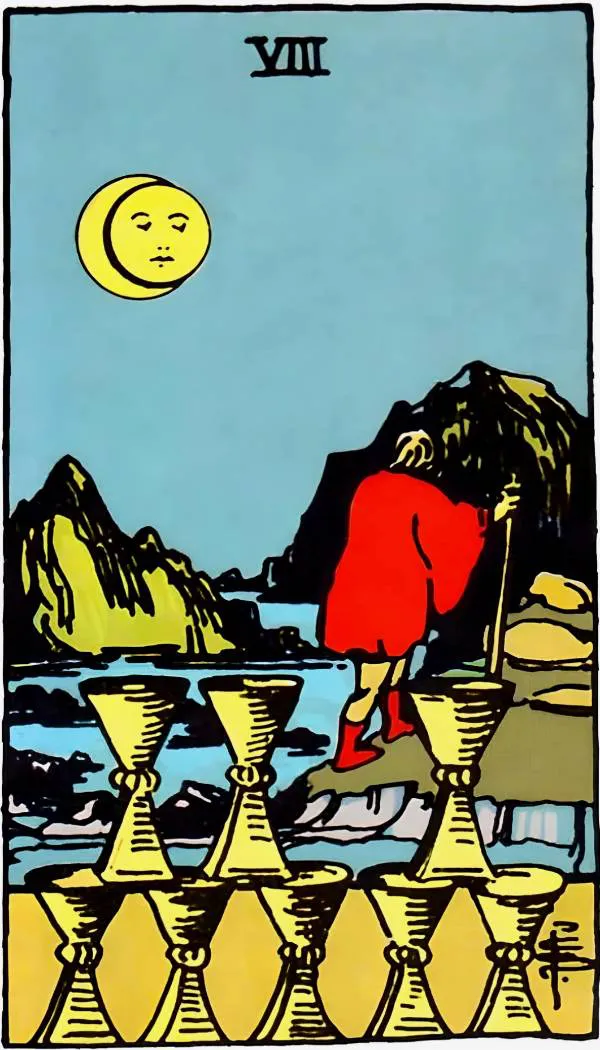
Eight of Cups Tarot Card Meaning

A man dressed in red, with red shoes, is walking away from eight cups he has painstakingly built, crossing the river at dusk, and turning his back. The surrounding swamps symbolize stagnant emotions, like a stagnant pool of water.

To build those eight cups, at least some hard work is needed, but he found a gap in the middle of the eight chalices, so he resolutely turned around and went to look for the ninth chalice, walking towards a higher place, and left these eight cups behind, which represent the opportunities for happiness and can still contain the past joyful things. His red clothes and shoes and the long staff symbolize his action, and now he has moved this energy from the joy and achievements he has built in the past, that is, the eight cups, and turned to look for the lost one, at this time, the moon covers the sun, urging a more thorough search.

For the sake of a lost chalice, and abandon the original eight chalices, is he stupid? It seems not stupid. Is he not stupid? It doesn't seem like it. This is a matter of personal opinion. He could actually take the original eight cups with him, but he chose not to, which shows the central theme of the eight cups of the chalice, "abandonment". The past joy, achievements, wealth, he doesn't want, he just wants the one that is missing. Sometimes we can meet such people in our daily life, some people think he is stubborn, some people think he is stubborn, but we have to admit that he really knows what he wants, and he is very brave. When you are in a stagnant situation like a swamp, the performance of the eight cups of the chalice is to break the old rules with action, pick up your stick, let go of the attachment, and go forward bravely.

You know, no matter what, it's time to leave what you have in order to pursue more things, which we can see from the space left on the card for another cup. The inner pursuit in the seven cups of the chalice makes people understand that there must be more things, and the eight cups of the chalice show that the physical pursuit has begun. This is the true meaning of the element of water. It gives you the ability to perceive that this situation is about to end before it dries up or collapses.

The person walking towards the high place implies progress, and may produce a better view. This card is similar to the hermit card - to reach a higher place or get a better view, you must put the ordinary things in daily life behind you.

The moon is passing over the sun, which implies two things: inner cognition is more important than external action, and this pursuit will be day and night (including in dreams and awake). And the state of "awake" can include reading books, healing, classes or chatting.

Stacked Cups

The eight cups stacked in the foreground represent emotional ties, relationships, or personal values that once held importance. Their organized placement suggests a structured life or established emotional state that the figure is leaving behind.

Mountainous Terrain

The mountainous terrain that lies ahead of the solitary figure symbolizes the challenges, personal growth, and soul-searching journey he is about to undertake. This rugged path points to the idea that sometimes we must leave the familiar behind to seek higher truths or deeper meaning.

Solitary Figure

The lone figure walking away from the cups embodies the idea of abandonment or departure. This person is choosing to walk away from what once held emotional significance, indicating a conscious decision to leave behind old feelings, relationships, or desires in pursuit of a higher calling or inner truth.

Moon

The moon in the sky carries dual meanings. It can represent uncertainty, illusion, and the subconscious. In this context, it implies that the journey ahead might be unclear, guided by intuition rather than logic. The moon’s waxing and waning also suggest cycles, indicating that this departure might be a necessary phase in one’s life.

River

The river running through the card’s landscape can symbolize emotional flow and the passage of time. As water often signifies emotions in the Tarot, this river might indicate that the figure’s decision to leave is based on deep emotional reasons, not taken lightly but deemed necessary for personal growth.

Psychological patterns in Eight of Cups
Emotional Cutoff
The figure's face is hidden, his back is fully turned, and the staff converts discomfort into forward motion before any exchange can happen with the cups behind him. The scene is quiet enough that the departure reads as physical, decisive, and unspoken. That visual chain mirrors a defensive exit that turns hurt into distance. In friendship, the cutoff can feel cleaner than explaining a boundary, especially when the bond has become emotionally swampy or when you expect your need to be minimized. You get protection from immediate conflict, but the pattern also makes absence carry the message. The cups remain standing in the foreground, which is exactly the unresolved emotional evidence that follows a friendship when leaving replaces naming.
Sunk Cost Fallacy
The eight cups stand upright in the foreground like proof of effort, time, and emotional construction. The figure's back is turned, but the visual weight of the cups remains heavy enough to make the departure look costly. Sunk Cost Fallacy appears when past investment starts masquerading as a reason to keep choosing the same option. In a decision spread, this card exposes the moment when what you built is being used as evidence against what you now know; the audit is not whether the cups were valuable, but whether they still answer the missing requirement.
Strategic Surrender
The staff in the figure's hand makes the departure look chosen, paced, and physically supported. He is not running from the cups in panic; he is moving through dusk with enough structure to keep walking. The cups remain upright behind him, which shows that surrender here is not collapse but a refusal to keep animating an incomplete emotional arrangement. Strategic Surrender appears when the psyche stops spending energy on a system that has no available space for repair. In a family context, this can look like ending the debate, not because the issue stopped mattering, but because the debate itself has become the mechanism that keeps You trapped. The card's higher path gives the pattern its precision. The movement is not passive resignation; it is the redirection of effort away from family approval, circular explanations, and inherited guilt toward a more coherent internal position.
Closure Chasing
The gap in the cups behaves like a visual hook. The figure is not only leaving what exists; he is moving under the pull of what is absent. In the reversed psychological texture, that search can become repetitive, as if the missing cup must be found before any emotional permission to move on is granted. Closure Chasing works by tying freedom to a future response from the family system. One apology, one admission, one clean explanation, or one emotionally mature conversation becomes the imagined key. The chase feels like healing, but it can keep the old structure central. The moon over the path makes the pursuit ambiguous. You may be following a real need for truth, but the pattern starts to distort when the family has to provide closure before You can reclaim your own emotional direction. The card shows the cost of making departure dependent on the missing piece.
Timing Discernment
The red-cloaked figure has turned away from eight upright cups, not because they are broken, but because the visible gap in the arrangement tells the body that the old container no longer matches the inner signal. The moon passing over the sun makes the departure feel timed by a subtler rhythm than ordinary daylight certainty, while the river marks a threshold that cannot be crossed halfway. That visual structure mirrors Timing Discernment: the capacity to notice when effort has completed a cycle and when further pushing would only stir stagnant water. You are not being asked to worship hesitation; the pattern names the precise moment when a pause, a departure, or a next step becomes psychologically coherent because the system has actually changed.
Boundary Discernment
The red-cloaked figure has already turned his back on the stacked cups, and his forward foot is committed to the higher path. The cups are not shattered, empty, or stolen; they remain standing behind him, which makes the departure feel less like panic and more like a boundary drawn around something that once mattered but no longer contains enough emotional truth. That physical distance turns the card into a map of discernment rather than rejection. In a relationship, this pattern appears when You can see the history, effort, and tenderness that were real, while also seeing the gap that keeps repeating underneath them. The defense mechanism is not emotional numbing; it is the capacity to separate attachment from alignment. Boundary Discernment is the psychological movement of leaving the emotional field without needing to make it worthless first. The card holds the difficult middle position: a bond can be meaningful, and still no longer be the place where Your emotional life can honestly grow.
Resource Alignment
The red-cloaked figure turns away from eight cups that remain upright, ordered, and capable of holding what they once held. He is not leaving rubble; he is leaving a system that still looks functional, which makes the choice psychologically sharper. That is the inner logic of Resource Alignment in lifestyle work: You notice when a routine, space, schedule, or identity container is consuming more energy than it returns. The gap in the cups becomes the audit point, showing where a polished daily structure no longer matches the life it is meant to support.
Comfort Zone Attachment
The cups sit in the foreground beside dark, stagnant water, while the mountain path ahead asks the figure to enter a less comfortable terrain. The familiar structure is close, visible, and already organized. The future is farther away and requires effort before it can offer perspective. Comfort Zone Attachment forms when familiarity becomes a substitute for direction. You may know the current landscape too well to call it alive, yet its predictability can still feel safer than the honest disorientation of change. In the reversed texture of the card, the swamp becomes psychologically persuasive because at least it is known. In direction work, this pattern identifies the difference between stability and stagnation. The card shows that the old cups can remain emotionally meaningful while also becoming too small for the next horizon.
Deficit Fixation
The stacked cups are not empty ruins; they are intact emotional vessels with one visible gap. The moonlit path pulls the eye away from what is present and toward what feels missing, as if absence has become the strongest object in the whole scene. That is the cognitive mechanism behind Deficit Fixation: attention contracts around the unmet need until existing care becomes background noise. In friendship, one missing form of attunement can start to outweigh years of reliability, humor, loyalty, or practical support. You may be sensing a real need, not inventing one. The psychological trap is that the missing cup becomes the only cup that counts, so the audit has to separate legitimate longing from a perceptual filter that keeps proving emptiness.
Fresh Start Fantasy
The solitary figure walks toward a higher, darker landscape while the eight cups remain orderly behind him, creating a sharp contrast between the known life and the imagined ninth cup. The moonlit ascent can feel meaningful, but the destination itself is still unseen. Fresh Start Fantasy appears when the unknown option starts carrying more emotional repair than any real option can hold. You may be projecting relief onto the next path because the current structure feels stagnant; the card asks for a cleaner distinction between genuine calling and the hope that a new choice will erase unfinished inner work.
Core Struggles in Eight of Cups
Threshold Disorientation
The figure is suspended in a crossing: behind him, the cups hold the completed foreground; ahead, the dark river and uneven ascent open into a route that is visible but not yet inhabitable. His body is not resting in the old structure and has not arrived in a new one. This is the physical language of a lifestyle threshold. You may have started clearing space, changing habits, questioning your work-sleep rhythm, or stepping away from a stale routine, but the new structure has not yet become reliable enough to carry your days. The card gives that in-between state a precise shape. Threshold Disorientation is the strain of being genuinely underway while still lacking a stable map, where every daily choice feels provisional because the old container has been loosened and the new one has not finished forming.
Routine Freefall
The figure is mid-stride between the cups and the rough path, with water and darkness interrupting any clean route forward. In the reversed state, that crossing can stop being a temporary passage and become the body's default environment. This is how a lifestyle system enters freefall. The old anchors are loosened, but sleep, food, work blocks, home care, recovery, and attention have not been rebuilt into a dependable pattern, so each day must be negotiated from scratch. The card names the danger of mistaking motion for structure. You may be changing, simplifying, or pushing through, but the reversed image shows why the nervous system cannot settle when departure has become continuous and arrival never gets designed.
Belonging-Authenticity Split
The red-cloaked figure has already turned the body away from the eight cups, even though the cups remain upright, ordered, and capable of holding what they once held. The visual tension is not between connection and loneliness; it is between a social structure that still functions on the outside and an inner orientation that can no longer stay inside it without losing direction. In a social field, this maps to the moment when belonging is available but authenticity has gone missing. You may still be invited, recognized, and included, yet the gap in the cup arrangement keeps exposing the part of you that has no container there, making participation feel like a split rather than a home.
Autonomy Guilt Bind
The solitary figure walks away from eight upright cups that still stand in an ordered formation. Nothing in the foreground has visibly collapsed, yet the body has already chosen the river path and the uphill terrain, making departure a physical act before it becomes an explanation others can accept. That is the shape of Autonomy Guilt Bind in a family system. You may be moving toward adult self-definition, privacy, and emotional breathing room, while the intact cups behind you keep representing everything that once counted as love, care, sacrifice, or belonging. The card does not frame the old structure as worthless, which is why the struggle has weight. It shows a boundary decision made under moonlight, where leaving the family pattern can feel necessary and disloyal at the same time, even when your body already knows the stagnant ground cannot hold you anymore.
Sunk Cost Paralysis
The stacked cups sit in the foreground as proof of arrangement, history, and effort, while the missing space refuses to disappear. In the reversed state, the intact cups become heavier than the path because they keep documenting everything already invested. In a social circle, that visual weight becomes the bind of staying because the history is real even when the fit is no longer alive. You are caught between honoring what was built and admitting that the structure cannot hold the missing cup, so leaving feels less like movement and more like wasting a whole version of your past.
Unseen Cost Bind
The cup structure looks nearly complete, but the missing space in the middle changes the whole equation. The card does not place the cost in the cups that are present; it places it in the absence that keeps the visible structure from becoming enough. You may be comparing options by what they visibly offer, but the image points to the price that does not show up until movement begins. The river, the dark path, and the abandoned cups together frame a choice where the safest-looking option can still carry a hidden charge against your future range.
Comfort Entrapment
The red-cloaked figure has already shifted his weight away from the eight cups, yet the cups remain upright, ordered, and visibly capable of holding value. Nothing in the foreground has shattered. The pressure comes from the fact that the existing structure still works enough to make departure feel irrational from the outside. That visual tension mirrors a lifestyle system that has become too familiar to question cleanly. You may have routines, possessions, work rhythms, or comfort loops that create stability on paper while quietly absorbing the energy that would let you move toward a more truthful daily architecture. The card locates the struggle at the exact point where comfort stops being nourishment and starts becoming containment. The staff, the river crossing, and the dim ascent show that clarity is not waiting inside the old setup; it begins when the body admits that a functional system can still be too small for the life it is meant to hold.
Value-Action Split
The figure's body moves toward the dark terrain while the eight cups stay intact behind him, arranged with visible care. The card does not show destruction; it shows a split between what has been built and what the body can no longer keep serving. In a lifestyle reading, that split often appears when the visible architecture of life still performs well: the calendar is full, the apartment is arranged, the health plan exists, the work rhythm is recognizable. Yet the movement of the figure shows that action has begun to point somewhere the old value system cannot follow. The missing space in the cups matters because it makes the mismatch concrete. The struggle is not that you lack effort, but that your daily actions and your deeper values are no longer being held by the same structure, so every attempt to maintain order also deepens the sense of misalignment.
Cycle-Action Desynchronization
The red-cloaked figure is already walking, but the card freezes that movement under a sky where the moon covers the sun and the landscape has not become fully readable. The staff, riverbank, mountain slope, and dusk light all set different measures for when motion should happen, so the body advances inside a field that has not given one clean timing signal. That is the exact shape of Cycle-Action Desynchronization in a timing reading. You are not simply failing to act or acting too soon; the visible body has entered one cycle while the surrounding field still belongs to another. The struggle is the friction of moving with real inner momentum while the outer season remains partially closed.
Reciprocity Deficit
The eight cups stand in a careful stack, but the visible gap breaks the promise that the arrangement can fully contain what has been poured into it. The figure's back is already turned, and the staff is aimed toward the hard path ahead, leaving the containers intact but incomplete behind him. In friendship, that image locates the ache of giving into a bond that can still look meaningful from the outside while failing to hold you in return. You are not reading the absence as petty accounting; you are noticing the structural place where mutual care should land and keeps going missing.
Inner Emotions in Eight of Cups
Independence Guilt
Turning his back on the eight cups makes the emotional charge of the card unusually precise. The figure is not fleeing ruins; he is leaving behind containers that still look usable, meaningful, and connected to a past version of happiness. That is the pressure point in family independence. When the bond still has value, distance can feel like an accusation against your own heart, as if becoming separate means denying every meal, memory, sacrifice, or shared language that shaped you. The river in the scene marks the threshold where emotional autonomy begins to feel like guilt because the old system cannot easily tell the difference between separation and rejection. Independence Guilt emerges here as the feeling of choosing your adult direction while carrying the invisible charge of family expectation. The card gives that guilt a structure: you are not cold for needing space; you are crossing from inherited emotional belonging into self-authored agency.
Comfort Numbness
The swamp water around the cup stack sits heavy, while the arranged chalices keep the foreground orderly enough to stay plausible. The gap in the stack stops being a doorway and becomes a blank place the eye keeps circling, surrounded by water that is present but not fully moving. In personal growth, this points to the numbness of staying inside routines, courses, plans, and familiar achievements that still look responsible from the outside. You can keep the structure intact and still feel almost no inner charge, because comfort has become a container for stagnation rather than renewal.
Hollow Abundance
The eight cups stand upright in the foreground, carefully arranged and still capable of holding what they were built to hold. Their visible gap makes the structure feel complete enough to keep and incomplete enough to keep bothering the body that walks away from it. That visual tension mirrors a lifestyle system that looks successful from the outside but fails to feed the part of you that needs contact, meaning, and aliveness. You may have the clean room, the calendar, the routines, and the proof of effort, while still feeling an oddly hollow space at the center of the whole design. The card links this emotion to the moment when abundance stops being convincing just because it is organized. It gives you an objective mirror for the difference between having enough pieces and feeling internally met by the life those pieces create.
Belonging Ambivalence
The stacked cups create a recognizable emotional home, yet the visible gap in the arrangement keeps the structure from feeling complete. The figure's back does not deny the cups; it marks the body pulling away from a container that still has shape. Belonging Ambivalence lives in that split signal. In social circles, you can crave the ease of being included and still feel your attention drawn toward the place where the group cannot meet you, and the image gives both impulses room to be true.
Stalled Momentum Dread
The uphill path is present, but the moonlit terrain offers no clean trail, and the waterlogged ground makes every step feel heavier than the intention behind it. The staff reads less like a banner of motion and more like something needed to keep balance. At work, this becomes the dread of watching your career require movement while your inner system keeps sinking into delay. The card exposes the friction between knowing the current role is too small and feeling unable to generate the next concrete step.
Bittersweet Release
The solitary figure walking away from the stacked cups gives the feeling a body before it gives it a theory: the cups are still upright, still capable of holding what mattered, while the red-clad figure has already begun moving into the dark terrain. In love, that image names the strange relief that can appear alongside ache when a relationship has stopped matching your deeper needs. You are not erasing the tenderness that existed; you are noticing that staying beside intact cups can still feel smaller than following the inner signal that something essential is missing.
Closure Dread
The upright cups remain close behind the walking figure, creating a scene where leaving has begun but the old structure is still intact enough to pull attention backward. In a relationship, Closure Dread is the tightening that appears when ending something would make the emotional truth irreversible. The card does not make the ending for you; it shows why the final step can feel heavier than all the steps that came before it.
Liminal Grief
The river, the dusk, and the mountain path place the figure in a threshold state rather than a clean ending. He has left the cups, but he has not yet arrived anywhere that can replace their emotional gravity. Family transitions often feel exactly like this: not fully belonging to the old role, not fully free from its pull, and not yet settled into the person you are becoming outside it. The grief is liminal because the relationship may still exist, the memories may still matter, and the future shape of contact may still be undefined. The Eight of Cups holds that in-between grief without rushing it into closure. You are allowed to mourn the family you wanted while still walking toward a version of yourself that can breathe beyond the old emotional arrangement.
Hollow Recognition
The cups are carefully arranged, yet the visible gap interrupts the display like a missing signal inside a polished result. The figure's back to the cups makes the achievement look less like a resting place and more like a shell that can no longer hold attention. At work, that translates into praise, metrics, or status that registers on paper while landing flat inside. You can see the recognition, but the card exposes the emptiness that appears when success confirms performance without restoring meaning.
False Closure Unease
The turned back, the intact cups, and the moon's half-light create a scene of departure without full illumination; something has been left, but the image refuses to look settled. In love, False Closure Unease is the unsettled feeling that appears when the story has been declared over before the body has actually released it. The card names the gap between performing finality and metabolizing what the relationship still holds inside you.
Outer Contexts in Eight of Cups
Strategic Exit Window
The river crossing at dusk turns departure into a timed movement across a real threshold. The cups remain standing behind the figure, while the staff and red shoes show that energy has been redirected toward terrain that will demand coordination rather than nostalgia. In personal growth, this points to a window where the old routine has not collapsed, yet its stagnant edge is already visible. You are not being pushed by disaster; the structure is showing that waiting too long would make the crossing heavier than it needs to be.
Sunk Cost Exit Dilemma
The stacked cups sit in the foreground as proof of effort, order, and prior nourishment, but the visible gap interrupts the structure. The red-clad figure does not knock them down; he turns his back and walks with a staff, leaving something functional because it cannot become complete in its current form. In personal growth, that is the texture of a self-improvement path you have already paid for with time, identity, and discipline. You may still be able to name what the old system gave you, but the card exposes the cost of keeping a plan only because it took work to build.
Social Circle Reset
The eight cups stand in the foreground as a complete-looking social architecture: built, orderly, and still capable of holding shared history. The figure does not knock them over; he turns his back and moves across the water, showing a clean withdrawal from a network that has value but no longer contains the missing place of belonging. In a social reading, that gap matters more than the visible abundance. You may be dealing with a friend group, community, or casual network that still has memories and access, yet the emotional circulation has gone stagnant. The card frames the reset as a boundary movement, not a rejection of every past connection.
Off-Script Academic Path
The solitary figure is not drifting in place; the red clothing, staff, and uphill route make departure visible as a chosen movement through difficult terrain. The path does not lead back into the cup structure, and the higher ground suggests a vantage point that cannot be reached by staying inside the old arrangement. For study, this maps onto the moment when the approved academic script stops matching the actual direction of growth. A conventional major sequence, prestige track, or expected postgraduate route may still look orderly, but the path that carries your attention has moved elsewhere. The card does not romanticize the alternative route. The landscape is dark, wet, and uneven, which makes the off-script path a real structural threshold rather than a clean rebrand. Its value lies in naming the difference between avoidance and a serious relocation of academic direction.
Family Estrangement Threshold
The lone figure walking away from eight intact cups gives family distance a physical shape: the structure behind him was real, organized, and once meaningful, but it still contains a visible gap. The river in front of him turns separation into a threshold rather than a passing mood. In a family system, this image maps the moment when contact itself becomes the terrain that has to be crossed. You are not looking at a clean rejection of the past; you are looking at the point where the old arrangement can no longer explain the missing piece. The uphill path matters because the card does not freeze the person beside the cups. It shows movement toward perspective, which makes Family Estrangement Threshold a context of boundary, grief, and adult relocation rather than simple abandonment.
Lifestyle System Overhaul
The figure does not rearrange the cups from the same patch of ground. He crosses water at dusk, staff in hand, moving from stagnant lowland toward harder terrain and a wider vantage point. That visual motion fits a lifestyle overhaul because the problem is not one broken habit. The whole environment has become misaligned: the schedule, the recovery cycle, the domestic setup, the energy budget, and the routines that once gave shape to the day. The card gives the overhaul a grounded structure. You are not being shown a fantasy of instant reinvention; you are being shown a body leaving a stale system by moving through a difficult threshold with only the support it can actually carry.
Wellness Optimization Trap
The missing cup space in an otherwise orderly stack is the visual engine of the trap. The structure looks close enough to complete that the next fix, next ritual, next method, or next purchase can feel like the one thing that will finally make the system whole. In lifestyle terms, this is where wellness becomes an external pressure system rather than support. The day fills with protocols, habit trackers, supplements, resets, content loops, and optimization language, while the body keeps walking farther from the ordinary life it was trying to improve. The card exposes the trap by showing pursuit as a physical journey through dim terrain. The useful question is no longer how to find the missing perfect routine, but how the search itself has started consuming the energy that the routine was supposed to protect.
Friendship Boundary Reset
The figure turning away from the eight cups gives the boundary a physical body: a back, a walking stick, and a route that does not return to the old arrangement. The cups are still intact, which matters because the departure is not framed as destruction; it is a deliberate change in access. In a friendship, that visual gap in the cup structure points to a support system that can look complete from the outside while failing to hold what the bond currently needs. You may still value the history, the inside jokes, and the emotional architecture you helped build, but the card shows a moment when staying available in the same way would keep the missing piece hidden. The river crossing turns the reset into a threshold rather than a punishment. You are not being asked to erase the friendship; the structure is revealing where contact, disclosure, and availability need new terms before the connection can keep functioning cleanly.
Post-Achievement Plateau
The eight cups are upright, intact, and carefully arranged, so the scene begins with evidence of completion rather than failure. The gap in the arrangement and the mountains beyond it show why a finished level can still become too small. In personal growth, this describes the plateau after goals, courses, habits, or identity milestones have produced visible progress. You can honor what worked while seeing that the next stage cannot be generated by maintaining the display of achievement.
Post-Breakup No Contact
The figure crosses the water with only a staff, leaving every cup behind in the foreground. Nothing is carried forward, which makes the boundary physical before it becomes emotional: the old containers remain visible, but they are no longer part of the movement ahead. After a breakup, no contact can function like that river crossing. It does not erase the relationship or pretend the cups were empty; it stops the exchange channel from reopening every time the past becomes accessible. The card's power is in the clean separation between what still exists and what no longer gets to travel with you. You are dealing with a boundary that protects motion, not a performance of indifference.