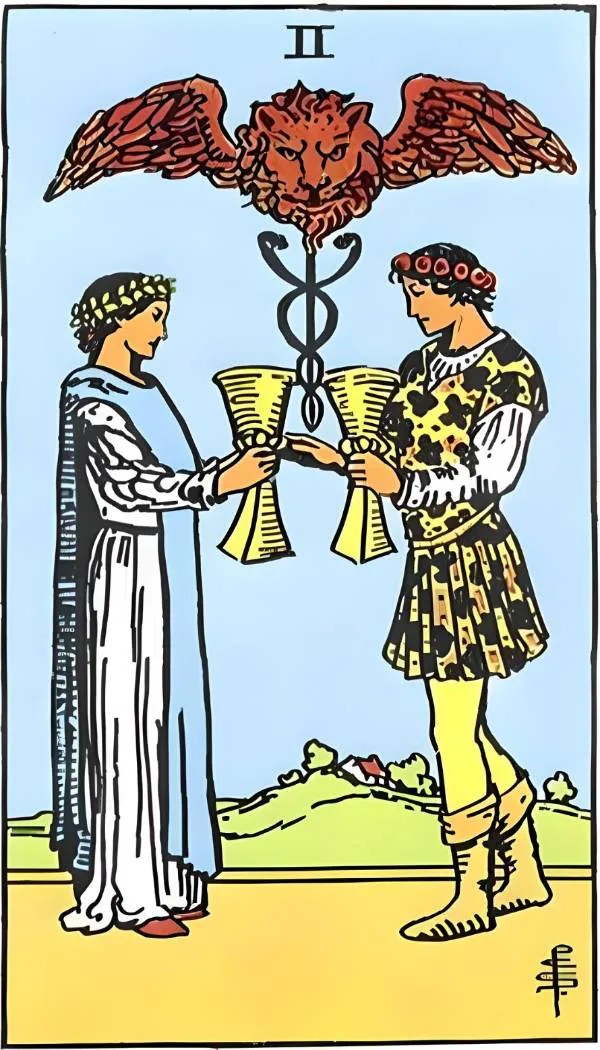
Two of Cups Tarot Card Meaning

A man and a woman face each other, offering cups to one another in a gesture of mutual respect. They hold the cups at the same height, symbolizing equality and trust, suggesting a relationship of equal love or business partnership, or any close team effort or favorable cooperation. Both wear garlands on their heads, with the man leaning slightly forward, stepping out with his left foot, and extending his right hand to the woman, while the woman stands still like a mountain. Floating between them is a staff with two entwined serpents, known as the 'Caduceus', a symbol of healing. The lion's head on the staff represents communication, and the two wings symbolize the Holy Spirit, reminiscent of the angel in the Lovers card.

The two serpents on the staff and the winged lion demonstrate a spiritual connection between the man and the woman. The staff also symbolizes the human spine, with the serpents representing the conduits for energy from the energy centers to the spine. For the man, this energy center is located at the base of the spine, while for the woman, it is between the two ovaries. The winged lion above the couple also represents the top of the energy center, filled with spiritual and sexual energy. It is this energy that guides the formation of various interpersonal relationships and provides a deeper understanding of love. The sky in the card is quite clear, with a town in the distance, and the houses suggest that this union can be stable.

Caduceus

The caduceus, a staff entwined with two snakes and topped with wings, is a symbol of commerce and negotiation. In the Two of Cups, it denotes the balance and equilibrium of forces, the coming together of opposites, and the potential for healing and harmony. It’s a symbol of harmonious union and partnership.

Lion’s Head

Atop the caduceus, a lion’s head is seen, which symbolizes passion, strength, and courage. In the context of this card, it represents the strength and power of a deep connection or partnership, as well as the courage it takes to commit to such a bond.

The Two Cups

Central to the card are the two cups being exchanged, representing emotional give and take, mutual understanding, and the sharing of feelings. This reciprocal exchange signifies the deep emotional connection and mutual affection present in a balanced relationship.

The Union of Figures

The man and woman stand facing each other, each holding a cup, indicating a mutual agreement or bond. Their connection denotes partnership, be it romantic, platonic, or business-related. Their mutual gaze and the gesture of offering their cups to one another suggest mutual respect and recognition of each other’s value.

The Wearing of Wreaths

The man and woman in the Two of Cups are adorned with wreaths upon their heads. These wreaths serve as symbols of success, honor, and mutual respect in their relationship. They signify that both parties in the union are valued and celebrated. This balanced reciprocity is at the heart of true partnership. Their mutual adornment implies a shared journey where both individuals contribute to and enhance the bond they share.

Psychological patterns in Two of Cups
Co-dependency
The Two of Cups is built around two separate cups, but the image also shows how close those cups can come to being treated as one shared container. When the central space collapses, the exchange no longer feels like two people meeting; it feels like one emotional system that both people must keep alive. That is the mechanism behind Co-dependency in a family context. The card's symbol of union becomes distorted when care is no longer chosen freely and instead becomes the condition for safety, belonging, or approval. You may start monitoring a parent's mood, absorbing a sibling's crisis, or shaping your decisions around how the family system will emotionally metabolize them. The caduceus between the figures makes the pattern sharper because it should represent balance and repair. Reversed, that same shared axis can become something both people orbit without separation. The audit is not whether you love your family; it is whether your nervous system believes their stability is your job.
Boundary Diffusion
The same central staff that organizes the exchange can become a magnet, pulling the cups, gazes, and gestures into one charged midpoint. The figures remain separate on the surface, but the emotional field starts behaving as if every signal must pass through the bond. In friendship, that is how blurred boundaries often feel: your friend's mood enters your body, their crisis becomes your schedule, and your own needs become hard to locate without feeling like betrayal. The reversed texture does not erase connection; it shows connection overloading the container until care and self-abandonment start to look the same.
Timing Discernment
The two figures do not rush into each other; they meet at a measured distance, each holding a cup at the same height. The visual weight of the card sits in the exact point where two separate rhythms become coordinated without either side overpowering the other. That posture turns timing into a relational intelligence rather than a solo act of willpower. You are not being asked to force the next move simply because desire is present; the card shows a field where action becomes clean only when response, readiness, and mutual signal appear together. Timing Discernment is the pattern of reading those signals without collapsing into passivity. In a timing question, this card points to the psychological skill of noticing when the outside world is actually meeting your effort, so momentum can be built where the field is receptive instead of spent against unnecessary resistance.
Emotional Reciprocity
The two figures in the Two of Cups hold their cups at the same height, facing each other across a clear middle space rather than one person bending down or reaching up. The caduceus rises between them like a shared axis, turning the exchange into a visible structure of balance instead of a private emotional guess. That symmetry is the visual root of Emotional Reciprocity. The card shows feeling being offered, received, and held in proportion, which matters sharply in family systems where care can become obligation and closeness can become a ledger. You are not being asked to reject connection; the pattern audit is about whether the exchange still contains two separate people. In family dynamics, this card points to the difference between mutual repair and emotional debt. When the cup is offered freely, connection becomes stabilizing; when the cup is demanded, inherited guilt can disguise itself as love. Emotional Reciprocity names the capacity to notice that difference before family loyalty pulls you into automatic self-erasure.
Family Role Regression
The Two of Cups shows a powerful face-to-face field: one person's presence immediately reflects back to the other. In a family context, that mirror can feel older than the present moment, pulling the body into a familiar posture before the adult mind has time to intervene. Family Role Regression names that slide back into an old relational position. The child who appeased, performed, stayed invisible, mediated, or absorbed tension can reappear during a simple phone call or visit, even when the person has built a more autonomous life elsewhere. The card's closeness becomes a container that activates memory through relationship, not logic. The cups matter because they show a ritual of recognition. Reversed, the ritual can recognize the old role instead of the current self. The audit is about catching the moment when the family system stops meeting you as an adult and starts summoning the version of you it knows how to manage.
Boundary Discernment
The Two of Cups places the figures close enough to exchange, but not close enough to merge. Each person keeps a separate body, a separate cup, and a visible space between them; the bond is intimate, but it is not physically fused. That middle space is the card's strongest anchor for Boundary Discernment. In a family system, love often arrives with old scripts about duty, loyalty, and guilt, so the nervous system may treat separation as danger. This card shows a different structure: contact can be real without requiring emotional absorption. You can read the image as an audit of where connection ends and compliance begins. The clear gap between the figures becomes a model for adult contact with family: enough openness to communicate, enough structure to keep your choices, limits, and self-definition intact.
Strategic Intimacy
The man's slight forward step and the woman's steady posture create contact without collapse. One body moves toward the exchange, the other holds the ground, and the caduceus between them keeps attention on a shared point rather than on private emotional projection. Strategic Intimacy appears when openness becomes structured instead of impulsive. The cups are offered, but not poured out; the gesture creates trust while preserving enough containment for both people to remain self-possessed. In career terms, this pattern is about knowing how much of your ambition, uncertainty, need, or leverage to reveal in a professional bond. You are not being asked to become guarded or exposed; the card shows the intelligence of calibrated disclosure, especially where mentorship, management, negotiation, or partnership is involved.
People-Pleasing
The offered cup can look generous, but in the reversed field the gesture becomes too fixed. The body keeps leaning into the exchange, holding up warmth and agreeability even when the inner signal has not had time to answer. That is the mechanism of People-Pleasing: connection is maintained through automatic accommodation. The cup becomes less like an authentic offering and more like a social reflex, a way to reduce tension by becoming easy to approve of. In social groups, this pattern can make belonging feel conditional on constant pleasantness. You may keep matching the room, laughing at the right moment, replying quickly, or absorbing others' needs, while the cost shows up later as emptiness, irritation, or the sense that nobody actually met you.
Strategic Surrender
The cup exchange is deliberate, almost ceremonial, and the central staff holds the space between the figures like a vertical pause. Nothing in the image suggests frantic pursuit; the scene is active, but the action is paced by contact, symmetry, and response. This creates a psychological structure where surrender is not collapse. It is the disciplined refusal to waste force before the field is ready to receive it, and the visual ritual of the cups shows how restraint can become a form of precision. Strategic Surrender appears when you stop treating every delay as a personal failure and start reading delay as data. In timing work, this card frames waiting as an active calibration process: energy is conserved until the external cycle offers a clean point of entry.
Secure Vulnerability
The man's open hand and the offered cups create a visible act of approach, but neither figure collapses into the other. The cups are lifted evenly, making emotional exposure look deliberate, paced, and mutual rather than desperate or forced. Secure Vulnerability connects to this card because the image gives feeling a boundary and a recipient at the same time. You can let something true rise into awareness without flooding the whole inner field, and that is the difference between exposure that clarifies you and exposure that leaves you feeling invaded.
Core Struggles in Two of Cups
Relational Boundary Drift
Turned inward, the same exchange can become a posture of compensation: one body leans, offers, adjusts, and keeps the ritual of mutuality from visibly falling apart. The cups still face each other, but the separate vessels reveal that no amount of offering can force a blocked receiving channel to become available. Relational Boundary Drift begins where love starts using overextension as maintenance. You may keep making small adjustments to preserve the connection, but the card shows how easily reciprocity can turn into self-erasure when one person becomes responsible for keeping the emotional circuit open. The reversed Two of Cups locates the problem at the edge between care and collapse. The bond may still matter, but the structure asks whether your boundaries are still participating in the relationship or quietly being dissolved to protect its image.
Performative Intimacy
The garlands, matched cups, and winged caduceus create a complete public grammar of closeness. In this state, the symbols can become heavier than the exchange itself: the cups are displayed, the figures face each other, and nothing visibly proves that emotional content has passed between them. That is the shape of performative intimacy in social life. You can be invited, tagged, replied to, and warmly included while the bond remains untested, leaving the surface of connection intact and the felt container strangely empty.
Reciprocity Deficit
Two cups are held at the same height, yet the bodies do not carry the same motion. One figure leans in and steps forward while the other stands like a fixed receiving point, so the image of equality contains a small but visible imbalance in who has to move to keep the bond alive. In family relationships, that imbalance can feel familiar: the ritual still looks mutual from the outside, but the actual effort of repair, reaching out, softening tone, and protecting the connection gathers on one side. You may not be refusing love; you may be noticing that the family exchange keeps asking one body to supply the motion while calling it harmony. The caduceus between them gives the bond a language of healing and agreement, but it also marks the central space where the unequal workload becomes hard to challenge. This struggle is the place where care stops feeling like shared flow and starts feeling like a duty to keep the cup lifted at the right height for everyone else.
Power-Connection Split
The winged lion and caduceus rise above the cups, placing strength, negotiation, and status directly inside a scene of connection. The bond is real, but it is not outside power; the symbol of union is also a symbol of mediation, leverage, and exchange. In career dynamics, this is the uneasy place where trust and strategy share the same doorway. You may need warmth to access opportunity and caution to protect your position, so every workplace friendship, sponsor relationship, or alliance carries both connection and political weight.
Vulnerability Containment Strain
Two figures hold their cups level with each other, close enough for exchange but still separated by a formal space. The man’s forward step and the woman’s still vertical stance make the encounter feel active and contained at the same time, as if contact is possible only while both sides keep the right distance. That structure mirrors the inner work of approaching material that needs contact but cannot be forced open. In introspection, You may sense that something inside is ready to be named, yet the same system also demands pacing, privacy, and emotional containment before it can be safely met. Vulnerability Containment Strain lives in that exact threshold. The card does not show a collapse into exposure; it shows a held exchange where honesty requires a vessel, a boundary, and enough mutual steadiness for the hidden feeling to survive being seen.
Soft Power Strain
The two figures hold their cups at matching height while one body leans forward and the other stays anchored. The exchange looks equal, but the mechanics are not passive: the extended arm, shared eye line, and caduceus between them turn rapport into a narrow channel where influence has to be carried without force. At work, this mirrors the strain of managing upward, building buy in, or negotiating support when formal authority is limited. You are not simply trying to be liked; you are holding a career move inside a relationship channel where the other person has to meet you voluntarily, and that makes every small signal feel structurally loaded.
Desire-Timing Bind
The two cups answer each other at the same height, and the figures meet through a gesture that is intimate but still measured. One body leans in while the other holds steady, so desire is present without becoming a unilateral rush. For timing questions, the card locates the ache of wanting something before the shared window has fully opened. You can feel the pull clearly, but the structure insists that the moment must be received as well as pursued.
Projection-Connection Split
The Two of Cups places a mirror-like encounter at the center of the image: two figures, two cups, two gazes, and a caduceus rising between them as the shared axis. The contact is real, but the geometry also makes each side visible through the other, so recognition and reflection are inseparable. In inner work, that mirrored structure can make a trigger feel deceptively clear. You may think You are seeing the truth of a feeling, a memory, or a part of yourself, while the psyche is also projecting unfinished material onto the nearest available inner image. Projection-Connection Split is the strain of not knowing whether the inner encounter is contact or reflection. The card holds that split without flattening it: connection is possible, but only when the mirrored surface is recognized as part of the structure rather than mistaken for the whole truth.
Agreement-Agency Split
The two figures stand face to face with cups held at the same height, but their bodies do not carry the exchange in the same way. One leans and steps forward while the other stays planted, and the staff between them turns a simple meeting into a negotiated axis of balance. In academic life, that image maps onto the moment when your idea must enter a seminar, supervisor meeting, or group project without losing its own center. The struggle is not whether connection is good; it is the pressure of needing agreement to keep the work moving while also needing enough agency to keep the work yours.
Connection-Repair Loop
The cups remain lifted, the bodies remain arranged for contact, and the central staff still promises repair. In reversal, the scene hardens into a maintained posture: the exchange keeps being performed even when nothing visibly moves through it. Family repair can take that exact shape. You reopen the conversation, soften the message, explain the feeling again, or try to make the next visit less loaded, yet the system absorbs the gesture as another round of maintenance rather than a real shift. This struggle lives in the loop between connection and repair. The bond does not fully break, but it also does not metabolize the repair you keep offering, leaving you suspended in a ritual that preserves contact while draining the part of you that hoped contact would finally change.
Inner Emotions in Two of Cups
Reciprocal Warmth
Two cups held at the same height make the emotional exchange visible before any words are spoken. Neither figure is reaching from above or below; the scene organizes affection as something passed across a shared center, not extracted from one side. The clear space between the bodies matters as much as the cups themselves. You can feel a bond forming without either person disappearing into it, which gives the connection its particular steadiness: closeness with proportion, warmth with mutual recognition. In a love reading, this becomes the inner weather of being met in kind. The feeling is not just attraction; it is the relief of sensing that care, attention, and emotional risk can move both ways.
Mutuality Hunger
Two cups held level with each other can feel almost painful when the friendship around you does not mirror that geometry. The image makes mutuality so clear that any missing return starts to register in the body as waiting. Mutuality Hunger is the ache for a friend to meet you with the same care you keep extending. You are not asking for perfection; you are feeling the absence of a matching gesture strongly enough that the friendship starts to feel emotionally underfed.
Cautious Trust
The woman stays planted while the man leans forward, and the cups remain lifted between them rather than collapsed into one person's possession. The scene does not erase distance; it organizes distance so that contact can be tested without surrendering the self. That is why the feeling is cautious rather than naive. In a workplace alliance, you may sense that a manager, peer, or collaborator is steady enough to receive more honesty, but the card keeps your agency intact by showing two people who approach through form, timing, and mutual recognition. Cautious Trust emerges when the body begins to lower its guard without abandoning discernment. The card's structure gives that feeling a clean shape: open enough to exchange, bounded enough to remain yourself.
Fairness Fatigue
The card's symmetry is almost too clear: cup to cup, face to face, gesture for gesture. In a friendship under strain, that clean balance can become exhausting because every kindness starts to appear beside its missing counterpart. Fairness Fatigue is the weariness of constantly checking whether the exchange is still equal. You are not being petty; you are tired from living inside a bond where care has to be audited before it can feel safe.
False Alignment Unease
The cups are held evenly, the bodies face each other, and the central staff organizes everything into a polished symmetry. When that neatness hardens, the image can feel too arranged, as if the picture knows how partnership should look before the bodies have fully agreed. For a direction question, False Alignment Unease appears when a plan, relationship, or life script looks balanced from the outside but does not settle inside you. The card's formal harmony becomes a mirror for the discomfort of confusing a well-composed future with a truly inhabited one. This emotion matters because the unease is not irrational resistance. It is the part of your inner compass noticing that a shared direction can be visually elegant and still not be internally alive.
Visibility Relief
The wreaths, lifted cups, and direct facing posture make recognition visible on both bodies. No one is hidden in the background, and the exchange happens at a height where each person can see the other's offering. For career questions, this becomes the relief of having your contribution recognized without having to distort yourself into constant performance. The card does not show applause from a crowd; it shows the quieter precision of one relevant person seeing the value in what you bring. Visibility Relief fits this card because the image turns recognition into an embodied exchange. You are not begging to be noticed from outside the frame; you are inside the exchange, holding something real, and being met there.
Integration Relief
The two cups are held at the same height, with one figure moving forward and the other standing steady, so the image does not force one side to dominate the other. The caduceus rising between them adds a vertical axis where two currents can meet without collapsing into sameness. For personal growth, that visual balance becomes the feeling of inner parts finally entering the same room. You are not choosing between discipline and tenderness, ambition and receptivity, or self-audit and self-acceptance; the card gives shape to the relief of seeing those forces cooperate instead of competing for the final word.
Synchronized Relief
Two cups held at the same height turn the meeting into a visible rhythm: neither vessel dominates, and the clear sky gives the exchange enough air to stay unforced. The forward step, the grounded stillness, and the distant town create a small model of coordinated movement rather than scattered effort. For lifestyle questions, that rhythm mirrors the inner shift that happens when work, rest, food, errands, and care stop fighting for the same bandwidth. You experience relief because the system is no longer asking every part of you to compensate for every other part.
Alignment Relief
Two raised cups, two facing bodies, and the paired serpents on the central staff make the image feel like separate currents finding one shared channel. Behind the exchange, the town remains visible, so the meeting point does not swallow the practical world beyond it. In direction work, Alignment Relief is the exhale that arrives when inner desire, external support, and a livable horizon stop fighting for separate maps. The card holds that relief in a concrete way: the route feels less like forcing an answer and more like recognizing where the parts already begin to move together. This emotion is not loud certainty. It is the nervous system noticing that a path can have connection, realism, and self-respect in the same frame.
Courageous Vulnerability
The man leans forward with a cup and an extended hand while the woman remains steady, and the lion above the caduceus gives the exchange a visible backbone. The scene is gentle, but it is not passive; it shows an exposed gesture held inside a stable frame. For inner work, that gesture mirrors the risk of bringing private material into conscious view. You may be telling yourself the truth without turning it into a performance or a confession. Courageous Vulnerability is the feeling of opening a protected part of the psyche while still keeping your footing.
Outer Contexts in Two of Cups
Situationship Ambiguity
The cups are close, but the image does not show a sealed agreement. One figure moves forward while the other remains still, creating a charged exchange where intimacy is present but the relational container has not fully arrived. The distant town sharpens the ambiguity. Stability is visible in the background, yet the couple remains in the open field, still negotiating whether this connection belongs inside a defined social form or stays suspended as private chemistry. You are looking at a bond with enough mutual signal to feel real and enough missing structure to stay unclear. The reversed texture of the card links to situationship ambiguity because the exchange exists, but the shared name, pace, and commitment terms remain unresolved.
Unspoken Expectations Gap
The two cups look matched from the outside, but the image never shows what each vessel contains. The equal height can create the appearance of agreement while the real terms of the exchange remain unspoken. Direction becomes unstable when everyone appears aligned but no one has named the actual expectations. You may be building decisions around assumed commitment, assumed support, assumed timing, or assumed values, while the structure underneath remains undefined. The central staff intensifies the problem because it formalizes the space between the figures. The scene reveals how vague agreements can start acting like rules, quietly steering your path before the terms have been made visible.
Care Reciprocity Test
Two intact cups, one in each hand, make the exchange measurable without reducing it to a transaction. Each person is visibly equipped to offer something back, which turns care into circulation rather than a private supply hidden inside one person. You are looking at a daily-life system where support has to return through real channels: rest, errands, meals, emotional bandwidth, practical help, and protected time. The card points to the test of whether care is genuinely reciprocal or only symbolically acknowledged.
Values Alignment Crossroads
The two cups meet at the same height, with both figures facing each other inside a clear open field. The image makes reciprocity visible before any route is chosen: neither person's cup sits above the other's, and the central staff turns the encounter into a formal point of alignment rather than a private impulse. For a long-range direction question, that symmetry points to a future that cannot be stabilized by momentum alone. You are looking at whether the people, offers, or commitments around you actually share the same values, or whether the path only looks clear because everyone is using the same language. The distant town matters because it shows a possible stable destination beyond the exchange. The card does not reduce the question to romance; it frames direction as a negotiation between mutual recognition, visible terms, and the kind of life structure you are trying to build.
Academic Collaboration Trial
Two cups raised at the same height turn the card into a visible contract of mutual recognition. Neither figure is collapsed into the other; the work of connection happens through a deliberate exchange across the space between them. In an academic setting, that image maps directly onto group projects, peer review, lab partnerships, and seminar collaboration. You are not just managing a task; you are testing whether another person can meet your effort with equal clarity, shared standards, and real contribution. The caduceus standing between the pair gives the exchange structure rather than sentiment. It shows why the collaboration matters for learning: the academic output becomes stronger only when the channel between people is stable enough to carry feedback, accountability, and correction.
Scorekeeping Relationship
Two identical cups held at the same height can become a measuring device when the exchange stops flowing. The central caduceus adds a standard of balance, making the scene feel like it is being assessed as much as shared. In friendship, that pressure shows up when replies, rides, gifts, invitations and emotional support start being counted. You are not looking at simple fairness; you are looking at a bond where the need for equal value has hardened into a ledger that can crowd out warmth.
Premature Commitment Pressure
The lion-headed staff rises between the pair before the cups have actually met. Formal symbols of courage, union, and recognition occupy the center while the real exchange is still suspended between two hands. This creates a timing field where commitment can become louder than readiness. You may be facing pressure to define, launch, sign on, or lock in because the symbols are already visible, even though the underlying exchange has not yet proven it can hold. The open space around the figures leaves little cover for slow negotiation. The card clarifies the difference between a commitment that has matured and a commitment being accelerated by the need to make the moment official.
Readiness Mismatch Cycle
The offered cups hover close enough to imply agreement, yet no liquid crosses and no hand fully receives. One body is already moving into the next beat while the other remains fixed, making the mismatch physical before it becomes verbal. This is a timing structure where the problem is not absence of interest or total obstruction. You can see the counterpart, the offer, and the shared symbol, but the moment keeps failing to land because the two rhythms do not arrive together. The distant town intensifies the cycle because a stable outcome is visible but not yet reachable. The card gives the stuckness a clean outline: repeated near-readiness, repeated partial alignment, repeated delay at the exact point where reciprocity has to become real.
Emotional Labor Imbalance
The man's forward lean and the woman's fixed stance make the exchange look equal while the bodies tell a more complicated story. One figure supplies motion, the other supplies the checkpoint, and the relationship can start to run on invisible labor rather than mutual flow. In personal growth, this shows up when a friend, partner, peer, or accountability buddy becomes the place where every realization has to be processed. The bond may still look caring, but the structure begins to rely on one person holding the other person's reflection, reassurance, and repair work. The card gives the imbalance a visible outline. You can see where support has become an unspoken job, and where a growth relationship needs cleaner boundaries before it can become reciprocal again.
Strings Attached Offer
The cups are offered, but the exchange has not actually closed. The caduceus between the figures carries the language of negotiation, and in a reversed context that central symbol can hold conditions, obligations, or expectations that are not spoken out loud. This is the decision-stage pressure of an option that looks generous from the outside. You can see the offer, the charm, and the apparent mutuality, but the card draws attention to what the yes may quietly require from you later.