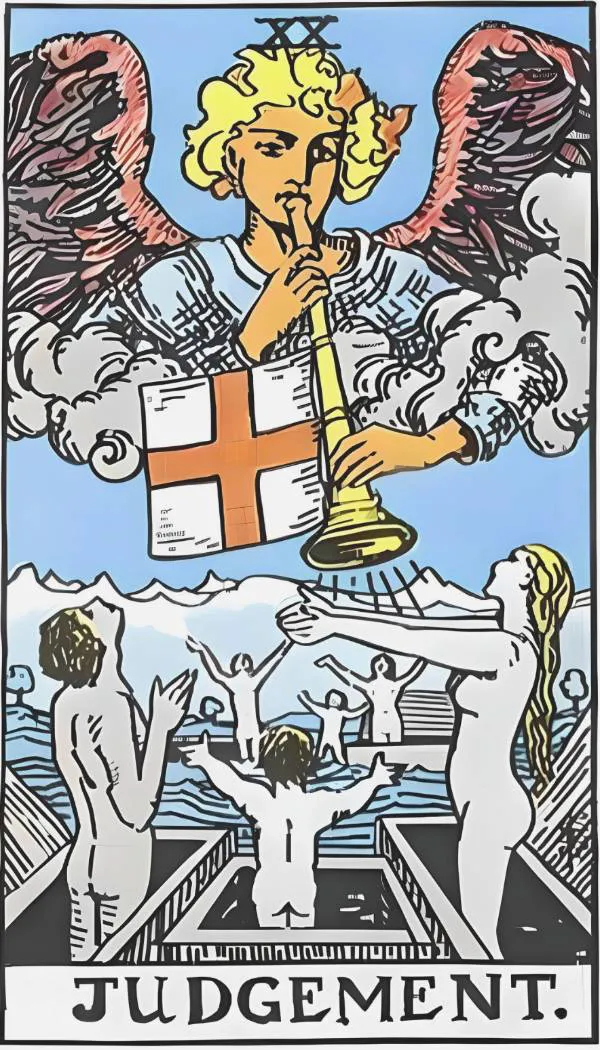
Judgement Tarot Card Meaning

This card is inspired by the biblical story of the Last Judgment, a deeply rooted religious concept in the Western tradition, and almost all Tarot cards have a consistent theme and imagery. Western religious beliefs hold that there will be a judgment after death, but it is an inevitable time, not a unique situation for individuals. Judgment is something that every soul encounters together, often depicted in grand scenes. The angel blowing the trumpet is a biblical scene, announcing the arrival of the end times and the descent of divine judgment. People are resurrected from their graves, a picture from the Book of Revelation.

The angel blowing the trumpet in the image is likely Gabriel, who is considered the leader among angels and possesses great power akin to that of God. He was originally responsible for guarding the Garden of Eden, with a focus on guiding souls through life and death, and both conception and death souls are subject to his influence. In the Last Judgment, Gabriel's role is even more significant, responsible for sounding the trumpet to awaken the resurrection of the dead. Gabriel is an important angel associated with the sound of awakening and music, as well as the transmission of the gospel, and is also seen as the angel of fulfillment and the angel of good news. However, the angel responsible for blowing the trumpet in the Last Judgment sometimes also merges with the image of Michael, as both are related to guiding souls and have responsibilities related to the duty of just judgment.

This angel has fiery red wings and a flame-like hairstyle, similar to the angel in the Lovers card, but the two images are slightly different. Although the hair is in the shape of flames, it is golden, lacking emotional color. However, the angel's wings are still fiery red, indicating strong activity and echoing the red cross on the flag, representing the action and spirit of redemption. The entire image and background colors are monotonous and cold, with the only colorful parts being the red cross and the red wings. The angel appears in the clouds, shrouded by them, creating a distance from the ground, signifying loftiness and remoteness, with only the sound of the trumpet able to reach the soul. The white clouds in the sky symbolize mystery and spiritual vision. The angel in the clouds is playing the trumpet, with the right hand closer to the handle of the trumpet and the left hand on the outer side near the mouth of the trumpet, with a flag hanging between the two hands.

Beneath the trumpet hangs a white flag with a red cross symbol. The cross itself has many symbolic meanings, especially in the West, where it is an important religious symbol, representing the union of spirit and body, mind and matter. The cross flag itself represents the meaning of redemption, and different colored flags and crosses have different connotations of redemption, as the situations of suffering and hope are different, requiring different paths of redemption. The red cross is a symbol of immediate physical salvation for people, and the white background with a red cross represents the suffering of redemption or assistance, echoing the theme of judgment. Of course, the appearance of both red and white colors is also related to the theme of the Golden Dawn. Additionally, the cross in the West has multiple meanings, such as the intersection of mind and matter, and it also represents the meaning of intersection, overlap, and choice, symbolizing a turning point in life.

The trumpet, as an instrument, originally has a warning function, and playing the trumpet is one of the scenes of the Last Judgment in the Book of Revelation, also representing a voice of admonition, and various religions use the sound of musical instruments to symbolize spiritual or spiritual awakening. The trumpet also symbolizes the proclamation of the 'gospel', which is an essential element in religion.

There is an implied symbol that cannot be directly and clearly expressed, which is that this card carries sound. In front of the trumpet edge, there are several radiating lines, implying the emission of sound, and further, it represents the performance of music. In addition to looking at the graphic with our eyes, we must understand and imagine, experience and create this sound. And we can freely assign this music, or judge the scene as a religious piece of music - 'Requiem'. Such a form of music is from religious music, including drama, chorus, etc., created based on the plot of the Last Judgment, and there will often be a trumpet sound to simulate the scene of the Last Judgment in the Book of Revelation. And the music here is the most primitive, the 'Requiem' from heaven, and its connotation is the gospel that enters the heart.

The many people standing up from the coffins on the ground, with pale bodies without blood color, are the dead who were originally lying in the coffins. At this time, they rise from their tombs, called to salvation and resurrection. Each person's coffin is open, and although they stand up, they still stay inside, not leaving their original habitat, as if they are eager to receive the call.

The people waking up from the tombs are divided into two groups, each consisting of a man, a woman, and a child, and they should be a family. Therefore, there are a total of two families here, living opposite each other, each with parents and children. The closer family, the woman is on the right side of the picture, the man stands on the left side, and the child in the middle is facing away from the picture, and the family opposite in the distance, the standing position is the same, like a mirror. And these three groups each form a triangle, and the two groups interweave into a hexagram pattern, representing the interweaving of spirit and matter and all phenomena. It is also a subtle depiction of the two directions of the soul, up and down.

Each of these people has different gestures, but they are all welcoming the arrival of the angel: the woman's straight hands directly receive the 'gospel', the man's bent elbow is moved, and the child is facing away from us, with both hands up in a V-shape, which is originally a gesture of soul call. And the people opposite all face the picture, and their postures are roughly the same as the child facing away. They may respond to the gospel or participate in the chorus calling them the 'Requiem', at this time the Requiem is no longer a judgment, nor is it just comfort and rest, but a hope of redemption and joy.

The place where these people are located is actually a cemetery, surrounded by a continuous undulating mountain range, surrounding the entire area. The color of the foothills and the ground is gray-blue, and the white peaks seem to be covered with snow, and the sky is also a low-key deep blue, only the white light around the angel's trumpet. It seems to be a world of ice and snow, and the cold air is a symbol of death. The ground is uneven and seems to be muddy, but it is like the ripples of the water surface, making these coffins seem to float on the water surface, and the confusion of land and water, the coexistence of solidification and floating, is like the stream of consciousness mixed with thought and emotion, spirit and desire.

The Angel

The angel depicted in the Judgement card is the archangel Gabriel, known as the messenger of God. Gabriel’s trumpet symbolizes the call to resurrection, awakening, and new beginnings. The flag adorning the trumpet bears the cross, linking the imagery to divine intervention and spiritual rebirth.

Rising Figures

The people rising from the graves represent humanity, and their ascending stance signifies awakening, rebirth, and renewal. These souls are answering the divine call, signifying a moment of self-realization, personal growth, and transformation.

Mountains

The distant mountains, often a symbol in the Tarot, represent challenges, obstacles, and milestones in our journey. In the Judgement card, they emphasize the long journey of the soul and the ascent towards spiritual enlightenment after overcoming trials.

Open Coffins

The coffins from which the people arise symbolize the end of something and the beginning of a new phase. It’s a reminder that we must let go of the past to embrace new opportunities and growth. These coffins signify release, renewal, and the cycle of death and rebirth.

The Ocean

The expansive body of water below suggests the collective unconscious, the deep reservoir of our experiences, memories, and inner wisdom. The water’s presence indicates the emotional depth and intuition required during times of significant transformation and introspection.

Psychological patterns in Judgement
Fresh Start Fantasy
The open coffins make the scene look like a dramatic rebirth, but the figures are still standing inside the same boxes that held them. The visual tension is not between death and life in the abstract; it is between the image of transformation and the embodied act of walking out. Fresh Start Fantasy forms when the psyche waits for a total reset to do the work that only repeated choices can do. You may crave the clean break, the new identity, or the big awakening because the spectacle of beginning again feels safer than the slower accountability of continuing differently.
Sunk Cost Fallacy
The coffins in Judgement are open, but the figures are still inside them. The image makes the old container visible at the exact moment it has stopped being sealed, which gives the past a physical shape even as the call to renewal arrives. That physical contradiction maps directly onto Sunk Cost Fallacy in decision work. The old path has become a box with history, investment, identity, and proof of endurance built into it, so leaving can feel like invalidating the self who stayed so long. The defense turns past effort into evidence for future commitment, even when the current reality is asking for a fresh valuation. This card does not erase what the old container held. It separates respect for what has been lived from the cognitive trap of making every previous cost pay for itself through continued attachment.
Permission Seeking
The trumpet in Judgement summons the bodies upward before they have moved anywhere else. The sound arrives first, and the figures respond from inside containers that still define their position. In a distorted relational field, that image becomes permission seeking. The inner knowing is present, but it waits for an outside signal to validate whether it is allowed to want, leave, return, ask, refuse, or change. In love, this pattern can make a partner, an ex, or the relationship story feel like the authority over your own threshold. The card shows the cost of outsourcing the call: the self rises, but only after something external has announced that rising is allowed.
Inner Critic
The trumpet in Judgement is not soft background sound; it is a commanding signal that reaches every open coffin at once. In the reversed psychological field, that sound can be internalized as a relentless evaluative voice, especially when the red cross and cold landscape make the scene feel stark and absolute. Inner Critic fits because the card's call can become less about awakening and more about being placed under review. You may experience a small lifestyle lapse as if it proves something final about who you are, while the actual data is much narrower: a routine failed, a system needs adjustment, and the verdict voice is adding unnecessary weight.
Closure Chasing
The coffins in Judgement are open, but the bodies have not fully stepped out. They rise toward the trumpet while still standing inside the old container, suspended between ending and release. That suspended posture is the visual logic of closure chasing. A final message, final talk, final explanation, or final emotional verdict promises liberation, but the repeated reaching keeps the nervous system oriented toward the same unfinished bond. In love, the pattern often feels like a search for truth, yet it can function as a ritual that keeps the old relationship psychologically alive. The card shows why one more call can feel sacred and urgent while still leaving you inside the very structure you are trying to exit.
Forced Progress
The bodies in Judgement rise with intensity, but the scene does not yet show them walking on stable ground. They are vertical, exposed, and awakened, while the coffins and cold water-like field still hold the base of the image. That tension is the exact visual engine of Forced Progress. A call has arrived, but the surrounding container has not fully converted into usable support. In timing questions, this pattern appears when urgency turns partial readiness into a command to launch, decide, commit, or break through before the conditions can actually carry the move. The cost is friction disguised as ambition. You may be using effort to compensate for a missing season, missing resources, or missing integration, and the more you push, the more the field pushes back.
Decision Deferral
The people in Judgement are awakened by the trumpet, yet they are still standing inside the coffins. Their arms are raised toward the call, but the image freezes them at the exact point where recognition has happened and embodied movement has not. That frozen interval is the visual core of Decision Deferral. In a decision reading, the trumpet can become another signal to wait for rather than the signal to act; the mind keeps listening for a clearer summons while the body remains inside the old container. The defense protects you from the exposure of agency by making more confirmation feel like responsible discernment. The cost is that the decision field starts to narrow around the next cue instead of the real tradeoff. You may feel busy, reflective, and spiritually engaged, while the actual choice continues to sit untouched in the coffin-shaped space of the life you have already outgrown.
Achievement Fusion
The pale bodies rise unclothed from the boxes that used to contain them, while the red cross hangs beneath the trumpet as if body, spirit, consequence, and renewal have been compressed into one symbol. Nothing in the image separates the exposed self from the signal calling it upward. That compression is the psychological core of Achievement Fusion. A result stops being a result and becomes a statement about identity, capability, future, and worth all at once. In academic life, this is why a mark, a supervisor's tone, or an exam outcome can feel far larger than the task itself. You are not simply receiving feedback; the nervous system is reading the academic outcome as a verdict on the whole self, which makes learning harder precisely when clarity is most needed.
Timing Discernment
The trumpet in Judgement does not show ordinary noise; it shows a call that organizes the whole scene. The angel is distant in the clouds, the figures are still in their coffins, and the sound lines form a narrow bridge between an external signal and an internal awakening. That visual structure mirrors Timing Discernment because the bodies do not appear to be forcing their way upward at random. They rise when the signal reaches them, which turns action into response rather than panic. In timing work, this pattern reveals the difference between pressure that makes you move and a threshold that is actually ready to open. You are not being asked to obey a deadline just because it is loud. The card's psychology points to a cleaner audit: what part of the field is calling, what part of you is genuinely awake, and what part is only reacting to the fear of being late.
Threshold Tolerance
The open coffins hold the rising figures halfway between burial and departure; their arms lift, but their feet remain inside the old containers. That physical pause is not failure. It is a liminal posture where the psyche has heard a larger call before the rest of the system has reorganized. Threshold Tolerance names the capacity to stay conscious inside the in-between without forcing a premature answer. In questions about long-range direction, the card shows a container wide enough for an old identity to loosen before a new path becomes embodied. You are not being asked to worship uncertainty. The image simply shows that some transitions require a protected threshold before movement becomes clean, chosen, and real.
Core Struggles in Judgement
Threshold Disorientation
The open coffins in Judgement show bodies already upright, yet still held by the containers that belonged to the previous state. The trumpet creates a vertical pull, while the ground below remains ambiguous, half solid and half waterlike, so the scene is not simple movement but a suspended threshold. That structure mirrors the moment when your old direction has clearly expired, but the new direction has not yet become a usable map. You can feel the summons to rise, yet the body of the life you are leaving still defines the space around you. Threshold Disorientation names the strain of being awake before being oriented. The card does not flatten that into indecision; it locates the struggle at the exact crossing point where an ending has opened, but a future has not yet become ground.
Belonging-Authenticity Split
The rising figures answer the trumpet with exposed arms, but their bodies are still held by the open coffins beneath them. The card does not show private awakening in a sealed room; it shows emergence under a collective signal, where becoming visible happens at the same time as being drawn into a shared field. In a social context, that image gives Belonging-Authenticity Split a precise shape. You may want the relief of being part of a circle, group chat, creative scene, or professional network, while also feeling how quickly that belonging can ask you to present a version of yourself that fits the call. The open coffin matters because it is both exit and frame. It shows the tension of entering community before your whole self has fully arrived, where connection is possible but the terms of visibility still feel too narrow to hold your actual shape.
Inherited Role Lock
The raised figures look awake, but their bodies still occupy the exact rectangular spaces that held them before the trumpet sounded. Their arms answer the call while their lower bodies remain organized by the coffin’s frame, making emergence look active without becoming fully free. In a family system, that is the shape of an inherited role becoming mistaken for identity. You may seem capable, independent, and responsive on the surface, yet one family message can put you back into the responsible one, the difficult one, the peacekeeper, the proof of success, or the person who must absorb everyone else’s feelings. The reversed structure intensifies the problem by making the container feel normal. The card locates the struggle at the point where awakening has happened, but the body still knows where it was assigned to stand.
Autonomy Guilt Bind
The angel’s trumpet descends from a distant cloud layer while the bodies below rise from open coffins without fully leaving them. The call is unmistakable, public, and larger than any one figure, but the ground-level bodies still answer from inside the old containers that held them. That structure mirrors the family bind where independence and obligation arrive through the same emotional channel. You may be trying to stand as an adult while the family summons you through guilt, loyalty, crisis, or the fear of being judged as uncaring. Judgement gives this struggle a visible shape: a person can genuinely be waking up and still feel pulled by the sound that named them before they had a separate life. The card does not frame the family call as automatically sacred or automatically false; it shows the exact pressure point where answering it may cost you your own direction.
Readiness Loop
The people have awakened, but the picture does not show them walking away from the coffins. Their arms are raised, the trumpet is sounding, and the old containers are open, yet the bodies remain staged inside the exact structures that were meant to be temporary. Readiness Loop appears here as preparation that keeps receiving the call without crossing into a new embodied pattern. In personal growth, that can feel like reading, reflecting, planning, and self-auditing until readiness itself becomes the place where change gets stored. The card does not shame the waiting. It gives the loop a visible boundary: the signal is real, the opening is real, and the repeated pause at the edge is the structure that needs to be seen before growth can become movement.
Social Energy Drain
The same raised arms that look receptive can also become a locked posture when the body below remains boxed in. In the reversed texture of Judgement, the call keeps arriving, but the figures do not gain more ground; responsiveness itself becomes the position they are stuck holding. Social Energy Drain takes that image into the ecology of groups, chats, circles, and loose networks. You may keep answering the signal, showing up, reacting, checking in, and staying visible, while the deeper body never gets the space to complete recovery or choose its level of contact. The card's pressure is cumulative because the trumpet is collective and the containers are individual. It shows how social participation can keep looking like aliveness from the outside while quietly turning into a one-way expenditure of energy.
Intergenerational Control Loop
The figures do not rise as one isolated seeker; they appear in mirrored family units, repeated across the cold graveyard. The same arrangement returns at a different distance, as if the scene is showing a pattern moving through more than one generation. That visual repetition fits the family control loop: comparison, silence, guilt, emotional withdrawal, approval tests, and authority habits can be inherited as choreography before anyone consciously chooses them. You may be trying to make a different move, but the family field keeps reorganizing everyone back into the familiar formation. Judgement gives the loop a hard edge because the awakening is collective. The card shows that breaking a pattern is not only about seeing yourself clearly; it is also about noticing the repeated structure that keeps calling each person back to their assigned place.
Borrowed Purpose Lock
The trumpet in Judgement descends from a remote angelic height, and the figures below answer with raised arms before any individual path appears. The signal is powerful, public, and visually above them; the human bodies receive it before they can test whether it fits their own direction. Borrowed Purpose Lock forms when a future arrives with the authority of a calling but carries the shape of someone else's script. In a direction reading, the danger is not that outside voices exist; it is that praise, family expectation, social timing, and respectable milestones can sound almost identical to inner truth. The card makes that confusion visible through a collective response to one high signal. You are not being reduced to rebellion or compliance; the struggle is the structural difficulty of separating a true summons from a command that has learned to sound sacred.
Cycle-Action Desynchronization
The trumpet releases a visible call from the clouds while the figures below are only beginning to rise from their open coffins. The signal is unmistakable, but the bodies are still low, pale, and boxed into the old frame, so the card shows a moment when activation arrives before full mobility is available. That visual tension mirrors the timing problem of pushing at the wrong point in a cycle. You may hear an opening, deadline, urge, or life signal clearly, yet the material route for action has not fully formed, which makes extra effort feel like it creates more resistance instead of more movement. Cycle-Action Desynchronization names the gap between the call and the workable step. Judgement does not flatten that gap into failure; it locates the friction in a mismatch between the rhythm of awakening and the mechanics of emergence.
Internal Authority Collapse
The clouded angel, the ambiguous water-ground, and the coffin platforms create a scene where the highest signal is easier to locate than the ground beneath the body. The figures orient upward before the local surface has become trustworthy, so the outside call becomes the clearest reference point in the whole composition. In academic life, that structure appears when rubrics, grades, supervisor reactions, and institutional standards become the only way to know whether work has value. You are not simply seeking feedback; the internal scale for judging your own thinking has lost its footing, so every assignment has to borrow gravity from somewhere else.
Inner Emotions in Judgement
Timeline Panic
The trumpet sounds over whole groups at once, and the bodies rise in response before they have actually left their boxes. The image has the scale of a collective alarm: everyone is upright, exposed, and oriented toward the same sudden signal. Timeline Panic is the inner jolt that says life has reached a checkpoint before you feel prepared. In a direction reading, Judgement reflects the pressure of measuring your path against an invisible schedule, while the deeper work is to separate a real inner call from the noise of being late.
Generational Sadness
Pale bodies rising from open coffins turn Judgement into a scene where the past is no longer silent. The figures are awake, but they are still standing inside the containers that held them, which makes renewal feel inseparable from the old architecture beneath it. In a family reading, that image names the ache of seeing inherited patterns with new eyes. You may recognize that a parent’s fear, a grandparent’s scarcity, or an old household rule has been moving through the system longer than you have been alive, and that recognition can feel both clarifying and heavy. Generational Sadness belongs here because the card does not show one isolated person escaping a private problem. It shows whole family formations rising together, suggesting the sorrow of realizing that your emotional life has been shaped by a larger lineage while still giving you enough clarity to decide what no longer has to be repeated.
Stalled Momentum Dread
The figures have risen, but the open coffins still frame them from below. Around them, the ground looks uncertain, almost waterlike, while the mountains hold the scene inside a cold perimeter rather than offering an easy path outward. For personal growth, that creates the dread of being awake to the next step while still physically and emotionally stuck in the previous structure. The insight has arrived, the signal is loud, and the threshold is visible, but the body cannot yet translate recognition into momentum. Stalled Momentum Dread fits because Judgement shows movement that has not fully become departure. The card gives shape to the specific fear that knowing more about yourself will not automatically make you able to move differently.
Self-Audit Anxiety
The scene of Judgement is built around response. A trumpet sounds from above, the red-winged angel becomes the only active color in a cold landscape, and every figure rises inside an open coffin as if private history has become visible evidence. Self-Audit Anxiety emerges when that image moves into academic life. Your mind starts reviewing the semester like a ledger: the unread chapters, the half-formed arguments, the weak citations, the emails delayed too long, the habits that looked manageable until the deadline made them visible. The card links this emotion to awakening because the anxiety contains information. It is not merely panic about performance; it is the discomfort of seeing your actual academic system clearly enough that avoidance loses its cover.
Accountability Dread
The trumpet in Judgement does not arrive as background noise; it dominates the scene, and every exposed body is oriented toward it. The open coffins remove privacy from what was buried, making the image feel like a call that cannot be delayed or negotiated away. In love, this becomes the dread before the conversation that names what both people have been organizing around but avoiding. The raised arms suggest readiness, yet the pale bodies show how exposed it feels to admit the truth of a pattern, an apology, a withdrawal, or a repeated wound. Accountability Dread fits Judgement because the card turns hidden relational material into something audible. The fear is not about being condemned; it is the pressure of realizing that clarity now asks for emotional ownership.
Bittersweet Release
The open coffins on Judgement do not show a clean escape; the figures are rising, but they are still standing inside the containers that held them. That suspended posture captures the emotional texture of releasing an old friendship role while still feeling the history of it around your body. In friendship, this can feel like relief braided with sadness. You may know the old dynamic has become too narrow, yet the bond still contains real memories, loyalty, and tenderness that cannot be dismissed without flattening what it meant. Bittersweet Release fits the card because Judgement marks a threshold rather than a simple ending. The image gives you permission to acknowledge both movements at once: the lift toward something cleaner and the ache of leaving a familiar emotional shape behind.
Missed Window Grief
The sound has already left the trumpet, the coffins are already open, and the mountain ring closes around a scene that cannot be rewound. The figures respond, but the image carries the ache of a signal arriving with enormous finality. Missed Window Grief names the feeling of looking back at a timing point and sensing that the old opening has changed shape. The card holds that ache without turning it into blame, showing where the present is still crowded by the moment you believe you should have moved.
Finality Dread
The hard edges of the coffins remain around the bodies even as they rise, making every emergence look like a point of no return held in plain sight. That is why this card can mirror the dread of a decision becoming final. You can sense that one option will close differently once you move, and the emotional weight comes from the irreversible shape of the threshold.
Performance Freeze
The figures in Judgement have clearly heard the trumpet, yet their feet remain inside the coffins. Their arms answer the call before their bodies can leave the old frame, creating a strange stillness inside an image of awakening. That is the academic texture of Performance Freeze. The essay prompt is open, the deadline is real, the feedback is waiting, and some part of you knows exactly that movement is required, but the body stays locked at the threshold of action. Judgement connects to this emotion because the card shows response without full release. You are not empty of awareness; you are caught in the charged gap between hearing what must be done and feeling physically able to begin.
Liminal Grief
Judgement places the figures in the exact middle of emergence: they are no longer lying down, but they are still inside the coffins. The cold open field around them gives the moment space, yet that space feels transitional rather than settled. In love, Liminal Grief appears when the relationship has changed before your inner world has found its new coordinates. You may be separated, redefining the bond, or trying to become someone different within it, while part of you still stands in the old emotional container. This feeling belongs to Judgement because the card’s awakening is inseparable from what has ended. The grief is not a failure to move forward; it is the weather of crossing a relational threshold with memory still attached to your body.
Outer Contexts in Judgement
Life Reset Phase
The open coffins are no longer sealed, yet the figures have only just risen. The scene captures the first exposed seconds after an old state stops holding, while the cold water-like ground and surrounding mountains make the reset real but not yet settled. For a major decision, this maps to the stage where a previous identity, plan, or commitment has expired in practice before the logistics have caught up. You are not looking for novelty for its own sake; the structure shows a threshold where staying inside the old container may cost more than building the next one.
Routine Collapse
The figures are upright, but their feet remain inside the coffins. The scene carries movement without relocation: the call has been heard, the lids are open, and yet the bodies are still held by the same compartments. That is the texture of routine collapse in daily life. Tasks may still happen, alarms may still ring, and obligations may still be answered, but the sequence that turns a day into a livable structure has lost its floor. You are not looking at laziness in this image. You are looking at a system where the signal to rise is louder than the available pathway, and the first act of agency is recognizing which container has stopped functioning as support.
Sunk Cost Exit Dilemma
The bodies rise from coffins that are open but still physically around them. The old container has lost its seal, yet it continues to define where each person stands and how much movement is available. For a difficult choice, that visual structure mirrors the sunk cost problem: past effort is no longer the same as present fit. You can treat the years, money, loyalty, or identity already invested as evidence, but not as a command to keep living inside a container that no longer supports the next phase.
Lifestyle System Overhaul
The trumpet above the open coffins turns the whole scene into a systems audit: one signal reaches the body, the household unit, and the surrounding landscape at once. Nothing in the image changes through a single isolated tweak; the figures rise because the entire field has been summoned into review. That is the logic of a lifestyle overhaul. Work hours, sleep windows, chores, food, digital noise, recovery, and physical space stop behaving like separate problems and start revealing themselves as one connected architecture. You are not looking at a minor habit adjustment here. The card frames the moment when an old daily operating system has become too small for the life trying to stand up inside it, and the useful move is to map the structure before forcing another performance of discipline.
Waiting Room Limbo
The figures are awake, upright, and exposed, but their feet remain inside the coffins. Around them, the blue-white field and enclosing mountains suspend the scene between movement and immobility. In a choice context, this is decision limbo after insight has already arrived. You may know that something has to change, yet the external exit route, timing, or permission structure has not been built, so clarity becomes a waiting room rather than a doorway.
Old Friend Role Lock-In
The figures in Judgement are upright, awake, and visible, but their feet are still inside the old coffins. The image carries movement and containment at the same time: the body has changed position, while the original box still defines its location. That is the social structure of old friend role lock-in. People who knew you in an earlier phase may keep offering the same jokes, expectations, emotional jobs, or group position because the container is familiar to them, even when your current self is already standing somewhere else. The card makes the trap precise. You are not failing to evolve; the network may be reading you through outdated architecture. The useful question becomes which connections can update their image of you, and which ones only know how to relate to the version that stayed inside the box.
On Again Off Again Relationship
Open coffins become repeat entry points: the figures rise, but the containers that held the ending still define the scene. The ground around them is unstable, half solid and half fluid. That is the architecture of an on again off again relationship. The bond keeps reviving, yet each revival happens inside the same unresolved conditions, so reunion becomes movement without relocation. You can read the card as a map of the loop itself. It reveals how a relationship can repeatedly wake up without building the structure needed to stay alive differently.
Accountability Reckoning
The trumpet, flag, and exposed rising figures create a scene of review that is public, structured, and impossible to ignore. The bodies are not wandering through vague possibility; they are being called into visibility before a standard that makes the past legible. In a direction reading, this becomes the external moment when previous choices, abandoned commitments, and unfinished chapters demand an audit before the next horizon can be trusted. You are not being asked to punish yourself; the structure is asking what can be carried forward with clean evidence. Judgement holds accountability as a clarifying force. The long-range path sharpens when the old record is named accurately, because direction becomes unstable when it is built on avoided facts.
Accountability Evasion Cycle
The trumpet sounds across the cemetery while the figures remain held inside the coffin frames. Their arms respond, yet their bodies do not cross into new ground. In a relationship, that image captures the cycle where accountability is acknowledged in form but not carried into repair. Words, apologies, or dramatic moments may appear, while the actual movement that would change the pattern never arrives. You can see the stuck point more clearly when the card separates signal from transition. The relationship may know exactly what needs to be answered, and still keep replaying the same suspended response.
Group Chat Tribunal
The trumpet in Judgement does not whisper to one person in private. It broadcasts over the whole field, and the figures below become visible together under one dominating signal. In a social network, that structure mirrors the moment when a conflict leaves the one-to-one space and becomes a group-facing evaluation. Screenshots, side threads, indirect callouts, and collective silence can turn a messy interpersonal issue into a public tribunal where the fastest narrative starts organizing the room. The card's pressure comes from exposure without dialogue. It asks you to separate accountability from spectacle: which part of the situation genuinely needs repair, and which part has been inflated by the group's need for a clean verdict.