Four of Wands Tarot Card Meaning

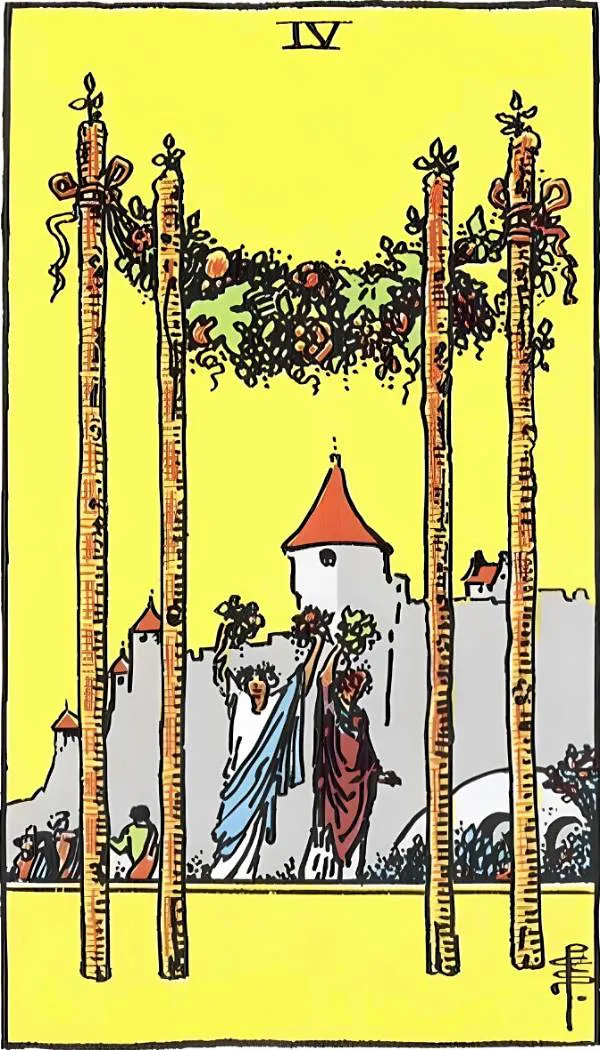
Four wands stand upright on the ground, unheld, yet they stand firmly, a force of nature. The four massive wands are neatly arranged in a square, forming four sturdy pillars that can erect a solid tent, offering consolidated protection and a sense of security.

The four pillars stand in the foreground with garlands and ribbons hanging in the middle. The garlands are very colorful, with flowers and fruits, hanging from the outer ends of the pillars and draped over the inner two pillars.

Behind the four wands, two women stand, holding garlands in their hands, waving them up and cheering towards the front. The joyful scene of the couple symbolizes the joy of a new home being completed. Both women are dressed in Greek style, wrapped in white robes, symbolizing inner purity and elegance. The one on the left wears a blue outer garment, and the one on the right wears a reddish-brown outer garment, contrasting tranquility with passion.

In the background, there is a house painted, a castle-style building, continuous and sprawling, with its foundation seemingly connected to the mountains. The ancient manor is some distance from them, separated by a bridge located to the right of the picture on their left hand, above the river, which must be crossed to reach this house. The castle's red roofs are mostly pointed. The largest building is in the center of the picture, indicating the importance of this card's towers and buildings, but it does not surpass the garland on the top of the wands. This also indicates that this building is more low-key than the 'Tower' card and is blessed with joy, so it can have true stability.

In the lower left corner of the picture, there are other figures in the distance, several children playing, holding hands and leaping in circles. These scenes weave a harmonious atmosphere and also have the warmth of home.

Wands and Garland

The four wands adorned with garlands represent a stable foundation and a celebratory atmosphere. The garlands, often made of flowers or fruit, symbolize abundance, joy, and the fruition of one’s labors.

Castle in the Background

The castle depicted at the distance symbolizes long-term security, prosperity, and a sense of belonging. This structure serves as a reminder that the happiness experienced in the moment has deep roots and is part of a larger, stable environment.

Two Figures

The two figures in the foreground, often dressed in celebratory attire, symbolize partnership and shared happiness. Whether they are dancing, celebrating, or merely standing, their presence underscores the theme of community and the joy of collective achievement.

Other Figures in the Background

The additional figures seen in the background, often portrayed as a gathering or crowd, amplify the sense of community and shared joy. They may be seen as family members, friends, or fellow community members celebrating alongside you, further emphasizing the card’s theme of collective happiness and societal harmony.

Clear Sky

The clear sky overhead signifies clarity, freedom, and endless possibilities. It acts as an ethereal backdrop that encourages openness to new experiences and a sense of limitlessness.

Psychological patterns in Four of Wands
Social Clock Compliance
The raised garlands and public celebration can become a mirror when the image is read through pressure rather than grounded readiness. The threshold is still beautiful, but the visible applause can start to dominate the quieter signals of the body, the resources, and the actual path ahead. Social Clock Compliance forms when the psyche borrows timing from the surrounding crowd. Instead of asking whether the bridge is Yours to cross now, the system treats public milestones, peer comparison, and visible approval as evidence that the moment must be correct. In timing questions, this pattern makes urgency feel socially certified. You may push a launch, commitment, move, or life-stage decision because the scene looks ready from the outside, while the inner timing system is still trying to catch up.
Threshold Tolerance
The garlanded wands form a ceremonial doorway while the castle remains at a distance, reachable only by crossing the bridge. The image is less about arrival than about standing at the threshold where celebration, commitment, and the next structure of life begin to meet. Threshold Tolerance is the capacity to stay awake in that doorway. You can feel the weight of a relationship becoming more defined without turning the milestone into a test, an escape route, or a demand for immediate certainty.
Milestone Idealization
The garlands hang high in the foreground, almost louder than the castle itself, and the raised arms turn arrival into a visible public signal. When reversed, the same celebratory posture can harden into a performance of completion before the psyche has actually integrated what changed. That is the mechanism behind Milestone Idealization: the mind starts treating the visible marker as proof that the self has finally become secure, upgraded, or complete. The milestone becomes a mirror that promises final arrival, even though the deeper structure is still being built in the distance. In personal growth, this pattern can make a course, launch, streak, body change, or breakthrough feel like the finish line for identity itself. The Four of Wands exposes the trap gently: celebration is real, but when the symbol of arrival replaces integration, the next ordinary day can feel like failure.
Peer Co-regulation
The two figures raise their garlands in a mirrored rhythm, while the children and distant home extend the scene into a wider field of shared safety. No one figure is carrying the whole emotional atmosphere alone; the image distributes joy across bodies, space, and structure. Peer Co-regulation emerges from that distribution. The nervous system sometimes reads itself more clearly when another grounded presence reflects back steadiness without taking over the experience. The point is not dependence, but relational calibration. In introspection, the Four of Wands challenges the idea that depth work must happen only in isolation. You may need a safe witness, a regulated conversation, or a trusted mirror before certain feelings become organized enough to understand.
Fresh Start Fantasy
The garlanded gateway sits in the foreground, while the more permanent home stands beyond a bridge. In reverse, the image can freeze at the threshold: the beginning feels emotionally charged, but the crossing into maintenance remains postponed. Fresh Start Fantasy lives in that gap between ceremony and habitation. The mind gets relief from declaring a new era, buying the tools, resetting the room, or designing the ideal routine because the start provides identity before the system demands consistency. You feel the emotional signal of change before your daily architecture has actually changed. In lifestyle terms, the pattern is not laziness. It is a reward loop attached to initiation rather than integration, where the setup phase becomes more compelling than the ordinary repetition that would make the new life real.
Achievement Fusion
The garlands announce completion so vividly that the decorated frame can begin to outshine the people standing beneath it. The milestone is beautiful, but in a reversed reading the ritual of celebration starts to become the container for identity. Achievement Fusion shows up when a career win, title, or promotion has to prove that you are allowed to feel solid. The card’s stable pillars reveal the trap: if the structure of achievement becomes the only thing holding worth in place, every quiet stretch between milestones can feel like the ground disappearing.
Emotional Reciprocity
The two foreground figures raise garlands together under the same open frame, and neither one is shown holding up the four wands alone. The structure stands before the celebration begins, so the joy is shared rather than extracted from one body. This is the clean visual logic behind Emotional Reciprocity in family life. You can notice whether warmth is being exchanged or whether one person is assigned to regulate the whole room. The card ties belonging to mutual participation, not to silent emotional labor.
Family Role Regression
The distant children play near the home while the foreground figures perform a formal welcome at the threshold. The image holds adulthood, childhood, ceremony, and home in the same frame, so time feels layered rather than linear. That layering is why Family Role Regression fits the card so closely. You can walk into a family setting as an adult and still feel pulled into an older posture, voice, or compliance reflex. The Four of Wands makes the trigger visible because the home field can reactivate roles before conscious choice has time to arrive.
Boundary Discernment
The four wands form a clear square in the foreground, creating a threshold that is open but still defined. The figures can celebrate inside the frame without gripping the structure, which means the boundary holds without becoming a wall. Boundary Discernment is the psychological equivalent of that open frame. It allows the inner world to decide what can be expressed, what needs containment, and what requires more private processing before it is brought into contact with others. For introspection, this card points to the difference between hiding and pacing disclosure. You are not less authentic because every feeling is not immediately visible; a stable inner life often begins with knowing which doorway each feeling is ready to cross.
Resource Alignment
The four wands stand unheld in a square, stable enough to carry garlands without collapsing. Behind them, the distant home is present but not yet physically reached, which makes the foreground less like an ending and more like a prepared base camp. That structure gives Resource Alignment its psychological logic. The card does not glamorize motion for its own sake; it shows support, protection, and shared readiness forming before the next phase becomes sustainable. In timing questions, this pattern asks whether the conditions around a move can actually hold the weight of it. You are not only asking whether You want to begin, but whether the visible supports, emotional bandwidth, practical resources, and social field are aligned enough for the timing to carry You.
Core Struggles in Four of Wands
Threshold Disorientation
The garlanded wands create an entrance more than a room: open, bright, and clearly marked, but not yet the castle in the distance. The figures stand at the front of the threshold, suspended in a moment of arrival while the actual long-term shelter remains across the bridge. Threshold Disorientation emerges from that in-between geometry. You can sense that something has changed internally, yet the next stable version of the self has not become a place you can occupy without thinking about it. The card holds the exact midpoint where a transition is real but not yet metabolized. For inner work, this is the confusion that follows a breakthrough, release, or self-audit. The old psychic room is no longer convincing, but the new one is still distant, so the mind keeps asking whether it has arrived, whether it is leaving, or whether it is only standing under a beautiful sign of change.
Social Clock Entrapment
The garlanded pillars, waving figures, distant crowd, and home in the background compress private timing into a public milestone scene. The foreground celebration becomes the visual ruler, larger and closer than the actual long-term structure behind it. When this structure turns inward, your sense of timing starts being measured by visible rites of passage: who is settling down, who is launching, who looks complete. The card locates the pressure in the scene's scale distortion, where the ceremony takes up more space than the lived path that would make the milestone truly yours.
Wholeness Performance Trap
The four wands stand like a completed frame, and the garlands turn that frame into something publicly beautiful before the distant house has become the immediate place of rest. The bodies beneath it lift their arms toward the front, making the scene readable as joy from the outside while the deeper shelter remains behind them, across water and distance. That arrangement gives Wholeness Performance Trap its exact shape: the visible structure of completion arrives before inner integration has fully settled. You may know how to look open, grateful, recovered, or socially intact, yet the card shows a gap between the celebratory surface and the private foundation that would let that state be lived without effort. In introspection, this is the place where the psyche confuses being seen as whole with actually feeling whole. The card does not deny the beauty of the milestone; it names the strain of using beauty, coherence, and public warmth to hold together material that still needs private integration.
Performative Harmony
The garlands, raised arms, and open square create a flawless image of togetherness, but the frame itself is not a house. It has pillars and decoration, yet no roof, walls, storage, or private interior where life can be messy without being watched. When this structure turns inward, the pressure falls on keeping your lifestyle visibly composed while the actual infrastructure remains unfinished. You can appear balanced, social, aesthetic, or on top of everything, while your real bandwidth is being spent holding the display in place instead of building a system that can hold you in return.
Commitment Threshold Strain
The four wands stand like a finished gate, garlanded before the castle has actually been reached. The celebration is physically placed at a threshold, with the home still set back across water and bridge. In love, that layout gives shape to the moment when a relationship looks ready for a shared-home milestone, engagement talk, or public next step before your inner timing has fully crossed with it. You are not outside the bond; you are inside the gate, testing whether the structure ahead can carry everyday life, not just the beauty of arrival.
Rest-Permission Split
The four wands hold a garlanded threshold in the foreground, and the figures raise their wreaths as if the work has reached a point of arrival. The structure is stable enough to mark completion, but it is still open to the sky, with the deeper house sitting farther back across the landscape. That physical gap gives the struggle its academic shape: your milestone is visible, but your body may not register it as permission to stop proving. The card holds the tension between a finished exam, paper, or semester and the unfinished need to feel safe inside the result.
Victory-Compass Split
The garlanded wands stand like a finished framework, and the raised figures make the moment of arrival visible before the eye reaches the castle behind them. The card does not show a body in motion toward the next horizon; it shows a completed threshold carrying the weight of celebration. You may have reached a point that looks coherent from the outside, yet the structure around the achievement is louder than the signal of what comes next. The struggle is not failure after success; it is the split between a milestone that proves something has been built and an inner compass that still has to decide whether that built life is your true direction.
Visibility-Connection Split
Two figures lift their garlands beneath four standing wands, but the long-term structure sits behind the celebration, across a separate spatial plane. The card holds visibility and belonging in the same frame without letting them become the same thing. That is the exact pressure of being publicly acknowledged at work while still feeling outside the rooms where trust, sponsorship, and real access are built. You can be applauded in the foreground and still sense that the deeper professional home remains behind a threshold. The Four of Wands gives this split a physical shape: an open canopy that welcomes the eye, a garland that binds the posts, and a castle that remains separate. The struggle is not whether your work is seen; it is whether being seen has actually turned into connection that can hold you.
Recognition-Progress Split
The wands form a decorated gateway, and the figures raise their garlands in a gesture of arrival, yet the bridge to the castle sits to the side. The scene celebrates completion while quietly showing that the path to the larger structure has not been walked yet. This is the career friction where recognition rises faster than actual mobility. You may receive praise, a public thank-you, or a visible milestone, while the bridge to authority, budget, title movement, or strategic ownership remains indirect. The card does not flatten the celebration into emptiness; it shows why the celebration can feel incomplete. The body is lifted into acknowledgment, but the route forward is still spatially separate, so the struggle takes the shape of being recognized without being moved.
Milestone-Foundation Split
The garlanded wands create a visible arch of completion before the true home in the distance has been reached. The celebration is real, but it is positioned in front of the longer structure, with a bridge still separating the ceremonial threshold from the place that would have to hold daily life. Milestone-Foundation Split is the shape of a decision where the signal of progress arrives before the support system has proven itself. You may be looking at an option that carries approval, arrival, or a clean next step, while the deeper foundation that would sustain the choice over time remains partly untested. The card does not dismiss the milestone. It shows why the milestone cannot be allowed to do the whole job of proof when you are trying to decide where to place your weight.
Inner Emotions in Four of Wands
Integration Relief
The garland does not hang from a single wand; it is carried across all four posts, making separate vertical lines behave as one visible structure. Behind it, figures, children, bridge, river, and house all occupy different depths without tearing the scene apart. Integration Relief grows from that organized layering. In self-reflection, you are not erasing complexity; you are seeing where each piece belongs, and the relief comes from realizing your inner life can hold multiple parts without collapsing into noise.
Hollow Celebration
The raised garlands, white robes, and square threshold create a public ritual of arrival, but the structure remains more decorative than inhabited. The bodies face forward while the actual home sits behind them across water, so the scene can hold ceremony before it holds inner landing. In academic life, that split appears after a result, award, offer, graduation, or finished semester that everyone else reads as a clear win. The outside has a language for the achievement, but the inside may still feel flat, delayed, or strangely untouched. Hollow Celebration names the emotional gap between being congratulated and actually feeling met by the milestone. The card does not shame the numbness; it shows that a public threshold can be real and still fail to reach the private place where meaning has to settle.
Grounded Belonging
The four wands form a threshold before the distant house, with garlands tying the upright pillars into one stable frame. A bridge and castle sit further back, so the foreground does not feel isolated; it connects the present celebration to a wider architecture of settlement. Grounded Belonging emerges when that structure is translated into career weather. A role, team, or professional track begins to feel less like a temporary audition and more like a place where your contribution has edges, witnesses, and continuity. The feeling is not blind loyalty to a workplace; it is the internal steadiness that comes when your value has a defined place. This card does not erase ambition or strategic assessment. It shows the emotional importance of belonging that does not dissolve your agency, where being part of something gives you more ground to stand on rather than less.
Synchronized Relief
The square of wands, the draped garlands, the bridge, the distant home, and the circling figures all point in the same direction without crowding one another. The scene has rhythm because each part has a place and none of the parts has to dominate the whole. Synchronized Relief is the emotional weather of a life system that briefly stops glitching. You feel it when sleep, meals, work, errands, home maintenance, and recovery fall into a shared tempo, allowing your attention to move through the day without constant internal traffic.
Earned Satisfaction
The lifted garlands, upright figures, and flowered canopy turn the foreground into a visible threshold of completion. Nothing in the scene is being forced by hand; the four wands stand on their own, letting the celebration gather around a structure that already holds. In career terms, that image gives Earned Satisfaction a physical body. The work has moved from effort into evidence, from private strain into something others can see and name. You are not trying to convince the room that the milestone matters; the scene itself has enough shape to hold the result. This emotion is not loud triumph for its own sake. It is the quieter satisfaction of seeing skill, timing, and persistence become a stable professional marker, even if the next bridge still waits in the distance.
Grounded Agency
Four wands stand upright on their own, forming a stable square before any person touches them. The bridge and distant house extend the scene beyond the celebration, giving the eye both a present foundation and a future path. For personal growth, this turns agency into something embodied rather than motivational. You are not pushing from panic; the card mirrors an inner structure that can support choice, follow-through, and the next stretch without collapsing into scattered effort.
Guilt-Free Rest
Garlands of flowers and fruit hang from the wands as visible markers of work reaching a point of fullness, while the figures lift their arms instead of carrying more weight. The open foreground gives the scene permission to stop at the threshold and register what has already been built. In a timing question, this turns rest into part of the cycle rather than a failure of momentum. You are allowed to let the nervous push settle, because the card's structure shows a completed interval where pausing helps the next phase become legible.
Visibility Relief
The two figures stand behind the four wands, lifting garlands toward the open foreground as if the scene has made room for witness. The square frame does not hide the celebration; it organizes it, giving the moment a clean edge and a visible center. Visibility Relief grows from that exact arrangement. In a career context, the pressure of being overlooked eases when your work is not only completed but placed where it can be recognized without constant self-advocacy. The open space beneath the garland becomes a professional stage that does not feel hostile. You may still be aware of hierarchy, timing, and the longer road toward security, but the immediate emotional shift is clear: the contribution has crossed into view. The card gives that relief a structure, so it can be felt as evidence rather than a fluke.
Quiet Readiness
The four wands stand unheld, steady enough to carry garlands while the open sky leaves space around the frame. Nothing in the foreground looks rushed into position; the structure is already upright before the figures raise their hands. In a timing spread, that steadiness translates into a calm internal readiness that does not need adrenaline to prove itself. You can sense that the next move has a place to land, so the feeling is quieter than excitement and more reliable than pressure.
Inner Child Relief
Children playing in the corner, figures cheering in the foreground, and a clear sky above the wands give the Four of Wands an unusually unguarded emotional texture. The scene is not only stable; it lets play exist inside that stability. In family territory, this visual field points to the part of you that learned to monitor the room before enjoying it. Here, the body has enough shelter to soften, and the younger emotional self no longer has to earn every moment of ease through hyper-awareness. Inner Child Relief is the quiet release that comes when family contact stops pulling you back into pure defense. The card mirrors a space where joy can be spontaneous again, not because the past is erased, but because the present has enough structure for the younger self to breathe.
Outer Contexts in Four of Wands
Premature Launch Pressure
The garlanded wands can look complete from the outside even when the deeper structure has not been tested by use. The raised arms, ribbons, and public celebration create a powerful surface signal that the moment has arrived, while the actual long-term building still sits at a distance. This is how premature launch pressure forms. The visible ceremony begins to outrun the slower work of readiness, and the social field rewards announcement before the underlying container has proved it can hold the next phase. In a timing reading, this context names the friction that appears when you move because the scene looks ready, not because the infrastructure is ready. The card asks for a clear distinction between public momentum and structural capacity, so your agency is not swallowed by hype.
Launch Window Readiness
The four upright wands form a temporary but solid threshold, and the garlands of flowers and fruit show that preparation has moved into visible fruition. Nothing in the foreground has to be held up by force; the structure is standing, decorated, and socially legible as a place where a next step can be witnessed. That makes this card a strong image of timing readiness rather than raw ambition. You are not being pushed into motion by panic or scarcity; the scene shows external scaffolding, public support, and material signs that the season has ripened enough for movement. For a launch, announcement, relocation, proposal, or major life step, this context names the moment when action is no longer just a private desire. The environment has begun to hold the step with you, which changes the question from whether to force momentum into whether the available structure is strong enough to enter deliberately.
Strategic Timing Window
The square of four wands creates a clean frame in the foreground, while the bridge and distant house give the scene a route beyond the celebration itself. The card does not show frantic movement; it shows a threshold where order, passage, and support are all visible at once. This is the logic of a strategic timing window. The environment is not merely permissive; it is organized enough that a decision can move through it without excessive friction. The garlands mark the point where preparation has become socially and materially visible. In a timing reading, this context points to the narrow but usable opening where action can carry more weight than usual. You are reading the architecture of the moment: what is stable, who can witness it, and which bridge is actually available to cross.
Premature Academic Harvest
The fruit and flowers hang in full display while the house remains across the bridge, making the scene feel like a harvest staged before the final crossing. The foreground looks complete, but the long-term structure is still separated by distance, water, and an unfinished route. In study, this becomes the pressure to present readiness before the academic foundation has truly settled. A draft may be praised before it is rigorous, a research idea may be announced before it has evidence, or a student may be pushed toward submission, graduation, or public confidence before the work can carry that weight. This context is not about laziness or lack of talent. It names a timing mismatch between visible achievement and actual consolidation, giving you a clearer view of where the ceremony has arrived too early and where the bridge still needs to be crossed.
Post-Achievement Plateau
The garlands show that a stage of work has produced fruit, but the bridge and castle still sit beyond the celebration. The card holds a completed milestone in the foreground while a larger structure quietly remains unfinished in the background. For personal growth, that is the plateau after success: the win is real, but the next container has not formed yet. You may have evidence of progress, recognition, or a completed phase, while the system that would carry the next level is still waiting to be built.
Readiness Mismatch Cycle
The foreground is ready to celebrate, but the house still sits beyond a bridge. Flowers and fruit hang on the wands as signs of completion, while the actual crossing into long-term stability remains a separate physical step. That split is the structure of a readiness mismatch. One layer of life may be ripe, visible, and socially affirmed, while another layer still requires access, coordination, or transition support. The card shows why timing can feel confusing when different systems mature at different speeds. In timing work, this context helps you stop treating mixed signals as personal failure. The task is to identify which part of the structure is truly ready, which part is only decorated, and which bridge still needs to be crossed before action becomes clean.
Party Scene Burnout
Flower and fruit garlands hang across the wands, and the figures hold their arms up in a visible posture of celebration. The structure is built for gathering, but the body still has to supply the signal that the occasion is fun, communal, and worth attending. That becomes draining when every social plan turns into another performance of being available, upbeat, and easy to include. You may be surrounded by invitations and still experience the scene as a calendar system that consumes energy faster than it restores connection.
Life Script Pressure
The square of wands, the garlands, the public cheering, and the castle-like home all create a scene that is immediately readable as socially approved arrival. The structure is beautiful, but it also has a script: build the home, reach the milestone, stand where people can recognize the achievement. When this pattern becomes pressurized, the celebration turns into an external template for how life is supposed to look. You may be surrounded by signals that say your path should now be obvious, settled, and legible to others, even while your actual energy is pulling toward a different shape. For direction work, this card exposes the difference between a stable life and a life performed to satisfy a milestone sequence. It helps name the outside pressure so your next move can be measured against your real trajectory rather than against the most photogenic version of being on track.
Happy Family Performance
White robes, raised garlands, children circling in the distance, and the castle-like home create a composed image of social harmony. The scene is arranged to be seen, with celebration placed in front of the deeper household structure. When that arrangement hardens, closeness becomes something to display rather than something people actually practice. You may be asked to look grateful, united, or easygoing at gatherings where the surface image of warmth matters more than honest boundaries, real repair, or emotional bandwidth.
Safe Visibility Trial
Two robed figures raising garlands beneath a four-wand threshold create a scene where being seen happens inside a frame, not in an exposed void. The support is visible, but it is bounded by pillars, ritual, and shared timing. For introspective work, this maps onto the moment when You test whether a private layer of yourself can enter a trusted space without being turned into entertainment or evaluation. The card links safety with visibility, showing an outer container strong enough for disclosure to happen in measured doses.