Ace of Cups Tarot Card Meaning

Overall Visual Structure

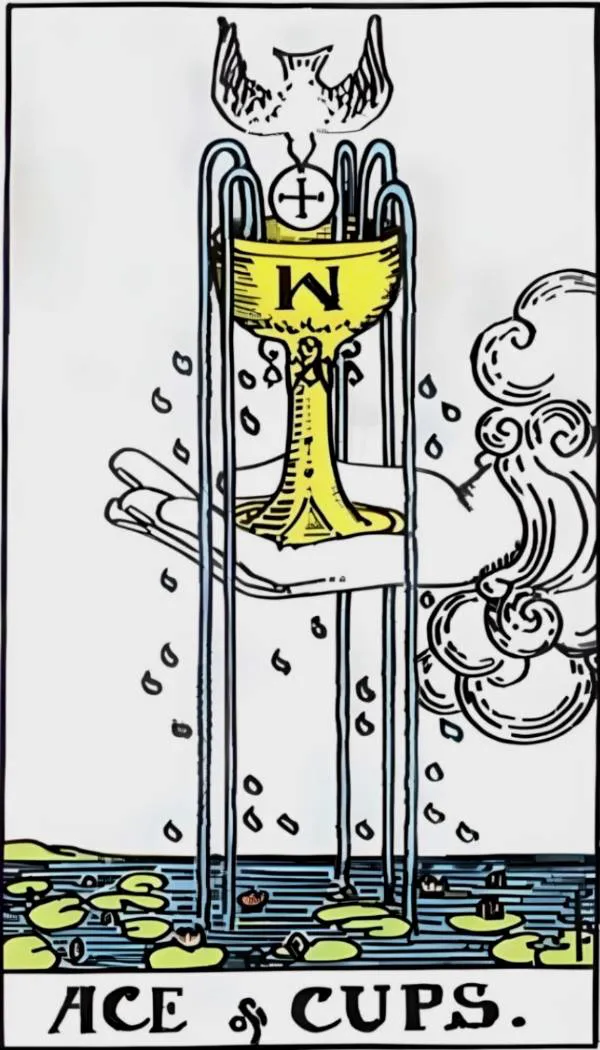
A magnificent golden chalice, situated at the center of the scene, adorned with jewels and engraved with an inverted M.

From the symmetrical clouds on the right side of the image, a delicate hand extends to cradle the chalice at the very heart of the scene.

Above the chalice appears a white dove, beak carrying a disc with a cross inscribed in the center, and it's heading towards the heart of the cup.

From the chalice, five streams of water surge upwards, then turn to form a downward column of water, surrounded by blue droplets. These blue streams pour into the pool below, which is covered with lotus flowers and leaves.

Detailed Pattern Explanation

This ornate goblet is meticulously crafted, with a few bead-like treasures hanging where the body meets the stem. It is clear that this is not an ordinary cup used in daily life, but rather a sacred chalice used in rituals to honor the divine. The diameter at the base of the cup is equal to that of the rim, and the body is not very deep, further indicating that the focus of this cup is not on how much water it can hold, but on its role in receiving and communicating. The chalice represents emotions and feelings, as well as the spiritual and mental aspects, and as a vessel of humility, it symbolizes the human body that carries any intangible emotions and spiritual forces.

The inverted M mark on the cup can represent both the English letters M and W, and can symbolize multiple meanings through abbreviation and letter transformation. In terms of English abbreviations, we can first take W as an abbreviation for Waite, indicating his signature in this deck. Of course, W mainly represents the element symbolized by the chalice - water, the abbreviation for water. And when W is turned upside down to become M, it is a symbol of motherhood and an abbreviation for the Virgin Mary. In addition, in religious legends, there is a figure 'Mary Magdalene', who is often depicted in paintings with an inverted M as her mark, or a chalice with an inverted M to imply revelations related to her. She is the representative of the chalice, and this revelation is related to the religious heritage of women. Also, because she once released the dove of the Holy Spirit, she is also related to the dove of the chalice.

Corresponding to the Hebrew alphabet, the transformation method is very diverse. M can be transformed into Mem - מ, which means the water element, echoing the English W's water again. And W can be transformed into ~ש(Shin), representing the fire element, as well as judgment and awareness awakening. The inverted M mark cleverly expresses the combination of water and fire elements, and explains the role of the mind. In the 'Golden Dawn', W is often used to represent many different symbols, often used to represent vav, which is the Hebrew letter ~ו(vav), meaning light and enlightenment, and the card with this letter configuration is 'The Hierophant'. And the antenna-like pattern at the top of the Hierophant's crown is also in the shape of W. The spiritual call, mental inspiration, and religious relevance of this card are all related to 'The Hierophant'.

The shape of W is similar to two people holding hands and raising them upwards, while the image of M is similar to being attached downwards, both representing reception or absorption. The combination of W and M is a perfect fusion, the overlapping shape of the two letters is a perfect containment. And the pronunciation of the phonetic spelling is like the 'om' that includes all vowels, and also like the abbreviation of 'womb', symbolizing the source of feminine and maternal life.

Holding the chalice with a hand to maintain its upright position seems not to be an easy task, it requires careful care to achieve. The hand in the picture is slender and delicate, which indicates carefulness and sensitivity, and even the posture of holding the cup is so light, which matches the noble chalice. Above and below the hand, around the water column around the chalice, there are some blue droplets, the shape once again shows the meaning of 'the finger of God'. There are a total of 26 droplets, representing the 22 major arcana and the four elements.

There is a white dove at the top of the picture, flying downwards, as if it is about to dive into the chalice, but in fact, it is to put the object in its beak into the chalice. The dove symbolizes peace and tranquility, white represents purity and cleanliness, and the white dove often represents the incarnation of the Holy Spirit. What the dove carries is a disc-shaped object with a cross symbol on it. This is a symbol of the body of God, and also the appearance of the Eucharistic bread, which here represents the gift of God, is equivalent to the role of divine revelation and grace, and is also a source of inspiration.

The important meaning in this picture needs to be viewed dynamically, the white dove brings the Eucharist and puts it into the water, because of the injection of this Eucharist into the cup, it causes the water in the cup to surge out, and connects with the vast mother body of water. This dynamic is a very important key, metaphorically touching the heart and triggering the opportunity to move. It also represents the connection and pulse of water, which requires a driving force, and this driving force is a kind of emotion from the spiritual depth, such emotion can make the water ripple.

The chalice pours out water, which is a dynamic representation of the emergence and flow of emotions. There are five water columns, representing the five basic emotions, five senses, and five interpersonal relationships, and also representing the five suits of tarot cards, corresponding to the five streams of water on the ground of 'The Star' card. The water column flows down to the pond, connecting and circulating all these water molecules, representing that people's emotions are interconnected and integrated. The vast mother body at the bottom of the picture symbolizes the deepest connection between people, the integration of collective consciousness, and explains that everyone's emotions and emotions all come from a common root. There are many lotus leaves and lotus flowers growing on the water surface, which is a symbol of pure mind, representing a sincere and devout heart and noble sentiments that are not contaminated, and it is also the result of emotions cultivated.

The Hand from the Clouds

In the Ace of Cups, a divine hand emerges from the clouds, presenting the cup to the seeker. This hand symbolizes the offering or gift from the Divine or the Universe. It’s a representation of spiritual blessings and the abundance of the universe being bestowed upon the querent.

The Cup or Chalice

The central focus of the card is the cup itself, overflowing with water. The cup, in Tarot tradition, is associated with emotions, intuition, and the subconscious mind. Its overflowing state in this card signifies an abundance of feelings, spiritual awakenings, and possibly the beginning of a new relationship or deepening of an existing one.

The Dove

Descending upon the cup is a dove, which is clutching a wafer or small disc in its beak. The dove is a universal symbol of peace, love, and purity. Its presence in this card signifies divine approval and spiritual blessings. The wafer it holds is reminiscent of spiritual communion, indicating a new spiritual insight or the beginning of a spiritual journey.

The Five Streams

From the overflowing cup, five streams of water spill out into the pool below. Water, as a symbol, is associated with emotions and intuition. The five streams represent the five senses, suggesting a pouring out or expression of emotion and love through every aspect of one’s being. It can also hint at the abundance of spiritual gifts and graces flowing into one’s life.

Lily Pads and Water Lilies

The pool at the bottom of the card is adorned with lily pads and water lilies. These plants are symbols of peace, purity, and transformation. Their roots are in the murky waters below, yet they rise to blossom beautifully above the surface. This imagery suggests spiritual growth and enlightenment emerging from the depths of one’s subconscious.

Psychological patterns in Ace of Cups
Strategic Surrender
The hand from the cloud does not seize the chalice; it presents and steadies it. The cup stays open, suspended between the descending dove and the pool below, as if its power depends on being receptive enough to let the sequence unfold. That visual logic anchors Strategic Surrender. The defense here is not collapse or avoidance; it is the disciplined refusal to convert every pressure signal into immediate action. The psyche allows the right current to carry the next move instead of trying to manufacture momentum from tension. In timing work, this pattern becomes useful when You are tempted to force a breakthrough just because waiting feels exposed. The Ace of Cups shows a different kind of agency: holding the vessel steady until the moment has something real to pour through it.
Secure Vulnerability
The hand from the cloud holds the chalice lightly, and the dove lowers its offering into the center rather than forcing it in. The water rises because the vessel is receptive, but the cup remains intact and visible. That is the body of Secure Vulnerability: openness supported by a container. In friendship, you can reveal real feeling without using disclosure as a test, a plea, or a shortcut to instant closeness. The card links this pattern to the moment when you let a friend see something tender while still staying grounded in your own pace. You are not closing the cup; you are making sure it can hold what enters.
Emotional Flooding
Water bursts from the chalice in multiple streams while blue droplets fill the air around it. The delicate hand still holds the vessel, but the amount of movement exceeds the quiet simplicity of the grip. Emotional Flooding is the state where affect moves faster than the container can sort it. In social environments, this can happen after absorbing tone shifts, micro-expressions, group tension, excitement, or mixed signals until the body is still processing the room long after you have left it. The cup is not empty; it is overactivated. The reversed Ace of Cups makes the mechanism concrete through overflow. Feeling deeply is not the issue, but without enough pacing and edges, the whole social field can pour through at once.
Fresh Start Fantasy
The dove descends toward the heart of the cup, and the entire image gathers around that charged instant of arrival. The water does not begin as a quiet maintenance system; it erupts after a dramatic symbolic deposit, as if movement depends on a special moment of activation. That is why the Ace of Cups can expose Fresh Start Fantasy in lifestyle work. The psyche waits for a feeling of purity, inspiration, or emotional readiness before it allows the next version of life to begin. The reset becomes seductive because it promises a clean emotional threshold without asking the system to metabolize ordinary repetition. You may keep looking for the morning, apartment, planner, routine, or mood that finally feels untouched enough to start from. The card shows the trap clearly: inspiration can open the vessel, but it cannot replace the architecture that keeps water moving after the first surge.
Overfunctioning
The hand keeps the cup upright while water continues to pour, and the dove aims its offering into the same central vessel. Reversed, the image can feel less like abundance and more like constant maintenance: everything must pass through the cup so the emotional field can keep looking peaceful. That is the behavioral loop of Overfunctioning. The defense is organized competence under emotional pressure, where your body moves into fixing, translating, smoothing, and anticipating before anyone has named a need. It looks helpful from the outside, but the inner mechanism is often a fear that the whole system will spill if you stop holding it. In a family setting, this pattern appears when you arrange the conversation, soften the conflict, remember everyone's sensitivities, and carry the invisible admin of emotional stability. The Ace of Cups reversed makes the cost visible: a vessel designed for flow becomes a tool for endless containment, and your own needs disappear into the pool below.
Parentification
The cloud-born hand holds the chalice with exquisite care while water keeps surging through it. In the reversed psychological texture, that careful support can stop looking like a gift and start looking like a role: the vessel must remain steady no matter how much feeling pours into it. That is the mechanism of Parentification. The image turns receptivity into emotional labor, where the cup is valuable because it can hold what arrives from above and keep the larger field flowing. In a family system, this becomes the child or younger family member who learns to stabilize adult emotion before they learn to ask what they need. You may recognize this when a parent's mood, conflict, or disappointment becomes something your body tries to manage automatically. The Ace of Cups reversed does not frame your care as the problem; it reveals the hidden cost of being trained to become the family's emotional container before your own boundaries had time to form.
Boundary Diffusion
Water links the cloud, the cup, the falling droplets, and the pool into one continuous emotional circuit. The hand is present, but it almost disappears behind the function of keeping the vessel available. That is the visual anatomy of Boundary Diffusion. In career environments, the pattern shows up when a manager's anxiety, a team's morale, or an organization's urgency enters You as if it were Your own internal state. The boundary between empathy and ownership becomes difficult to locate. The Ace of Cups supports this pattern because its beauty comes from permeability. Reversed into workplace pressure, that permeability can turn emotional intelligence into over-absorption, making You responsible for feelings, fires, and expectations that actually belong to the system.
Timing Discernment
The dove descends toward the open chalice before the water spills into the pool below. The image is not built around muscular force; it is built around sequence, reception, and circulation. Something arrives first, the vessel receives it, and only then does the overflow become movement. That structure mirrors the psychological mechanics of Timing Discernment. The pattern is not passive waiting; it is the ability to separate a real opening from the nervous urge to push. The cup has to be positioned, the signal has to land, and the surrounding pool has to be able to receive what follows. In timing decisions, this pattern helps You read whether a moment is actually supported by emotional clarity, resource availability, and external flow. The Ace of Cups links this to the body-level experience of readiness: a felt sense that the next step can be held, not just desired.
Emotional Reciprocity
The five streams do not stay trapped inside the chalice; they move outward and downward into a pool that can receive them. The cup is central, but the image is not a closed system. It shows a flow that becomes meaningful because there is somewhere for it to go. That is the psychological logic of reciprocity. Feeling, care, mentorship, feedback, and recognition are not meant to disappear into one person. In work, You can often sense the pattern by asking whether effort circulates back as trust, credit, growth, or access, or whether the organization simply drinks from the cup. Emotional Reciprocity belongs here because the Ace of Cups is not only about having emotion; it is about whether emotion can move through a field without becoming exploitation. The card's water makes visible the difference between mutual exchange and one-way extraction.
Emotional Reasoning
The water in the Ace of Cups does not sit quietly inside the chalice; it surges upward, spills downward, and fills the space with motion. When that movement becomes the only thing the eye can follow, feeling starts to look like evidence simply because it is so vivid. Emotional Reasoning emerges when intensity is mistaken for direction. In long-range decisions, You may read relief, longing, or a sudden pull as proof that a path is true, while the image shows a more precise mechanism: emotional volume has taken over the role of orientation before the vessel has tested what it can actually hold.
Core Struggles in Ace of Cups
Capacity Misalignment
The shallow golden chalice overflows the moment it receives the dove's offering, sending more water outward than the vessel can hold. In a career spread, that image makes the problem visible: your work system may be receiving your ideas, care, and potential without having a role structure deep enough to contain them. You are not short on value; the friction sits where value enters a container that turns volume into spillover instead of advancement.
Relational Pacing Collapse
The dove descends with a small disc, and the entire water system responds as if one point of contact has activated every channel at once. The cup does not receive slowly; it erupts, splits into five streams, and sends feeling downward before the image has any grounded pause. In a relationship, this is the structure of pacing collapse. One message, one confession, one intense date, or one moment of chemistry can start carrying the symbolic weight of the whole bond, making the connection feel urgent before mutual trust has had time to form.
Intuition-Reality Split
The dove descends with a small disc toward the chalice, while the cup is already alive with water rising, falling, and spilling into the pool below. The image does not show a quiet answer being placed into an empty vessel; it shows a signal entering a system that is already full of movement. That is the exact friction inside Intuition-Reality Split. You may feel a clear pull toward one option, but the emotional signal arrives before the practical container has translated it into cost, timing, consequence, and commitment. The cup can receive the sign, yet receiving is not the same as deciding. In choice work, this card locates the struggle at the crossing point between inner knowing and usable structure. The signal may be meaningful, but it still has to pass through the vessel of reality before it becomes a choice you can stand inside.
Abundance Overload
The hand in the card has to hold a jeweled vessel steady while the water keeps arriving, rising, and spilling in several streams. The cup remains beautiful, but the flow passing through it is larger than any ordinary grip could manage. Reversed, that structure becomes Abundance Overload: the gift itself turns into pressure because the receiving system never gets a pause. More insight, more inspiration, more emotional access, and more possibility keep entering before the previous wave has settled. For personal growth, this is the trap of being surrounded by growth material while losing the ability to digest it. You may keep opening new doors inside yourself, but the constant intake makes the self feel less integrated, not more clear.
Cycle-Action Desynchronization
The chalice does not simply hold water; it receives from above, overflows at the rim, and feeds the pool below through a visible sequence of movement. The dove, the cup, the streams, and the lotus-covered water each occupy a different phase of the same cycle, so the card frames timing as a question of phase alignment rather than force. You may feel the impulse to move because something has clearly begun to flow, but the image shows that flow is not the same as readiness for action. The cup must receive before it can overflow, and the overflow must find a pool that can take it in; without that sequence, action becomes a leak in the system rather than a clean release. Cycle-Action Desynchronization names the strain of pushing at the wrong point in the cycle while mistaking motion for permission. In timing work, this card locates the real pressure point in the gap between inner activation and external receptivity, giving shape to the moment where effort starts creating more resistance than movement.
Vulnerability Without Containment
The cup's open rim is the center of every movement: the dove descends, water rises and spills, droplets scatter, and the pool waits below. When the holding function weakens, openness stops feeling like connection and starts behaving like exposure. In inner work, that is the moment honesty leaves you raw instead of clear. The card does not shame the opening; it shows that vulnerability needs a bank, a rim, and a place to land before it can become relief.
Vulnerability Containment Strain
The cloud-born hand supports an ornate cup with a touch light enough to keep the vessel open, while the dove and five streams converge on the same exposed center. The image does not show a sealed container; it shows a living threshold that must receive, release, and remain upright at once. In introspective work, that is the exact strain of becoming available to buried feeling without letting the whole inner system flood. You are not simply being sensitive; the struggle has a shape: openness requires a container strong enough to hold what arrives before it pours through every channel.
Nurture Deficit
The hand still presents the chalice, the dove still approaches, and the cup still has the form of a receiver, but the orientation turns receiving into a failed landing. The gift is visible before the system can actually take it in. In inner work, that becomes the ache of needing care, softness, or reassurance while being unable to absorb it once it arrives. You are not empty because nothing is offered; the structure shows a receiving channel that has lost trust in its own capacity to be filled.
Inner Compass Overload
Turned upside down, the same cup, dove, and water system no longer reads as a clean descent into overflow. The signal, vessel, and stream still exist, but their directional relationship becomes harder to trust as a guide. Inner Compass Overload is the state where every internal cue starts competing for authority. One part of you reads desire as truth, another reads fear as protection, another reads guilt as duty, and another reads relief as escape. The card's reversed structure captures that saturation: the water is active, but the system no longer knows which movement is the compass. For a choice spread, this struggle matters because more introspection may not immediately create more clarity. The card names the point where the inner field is too crowded to function as a clean signal, and the first act of agency is recognizing that not every feeling deserves the same voting power.
Knowledge-Output Gap
The chalice does not simply hold water; it receives a concentrated offering from the dove and immediately sends five streams outward into the pool below. The vessel is full of movement, but its structure is built for transmission more than storage, so insight passes through before it becomes something stable. That is the academic shape of Knowledge-Output Gap. You may absorb a lecture, feel a thesis idea forming, or recognize the emotional truth of a subject, yet the moment it has to become a paragraph, proof, revision plan, or exam answer, the flow disperses into too many channels. The hand holding the cup gives the struggle its pressure. Something real is being offered and something real is moving, but the container has to convert overflow into usable form. This card names the point where learning is alive inside you, while academic output still has not found a stable vessel.
Inner Emotions in Ace of Cups
Courageous Vulnerability
The slender hand does not grab the chalice; it keeps the vessel upright with a careful, almost reverent hold. That physical restraint matters because growth here is not armored confidence, but the capacity to let something sensitive remain visible without turning it into a performance. For personal growth, this maps onto the moment when feedback, honest self-reflection, or a new identity edge touches a soft place. You are not being asked to harden the feeling; the image shows vulnerability becoming usable because it is held with enough structure to stay present.
Emotional Flooding
The water does not stay neatly inside the chalice; it erupts upward, splits into streams, scatters as droplets, and pours into a pond with no visible edge. The same symbol of flow becomes a system with more movement than containment. In personal growth, this is the feeling of being hit by too much insight, emotional release, and self-improvement pressure at once. You may be searching for clarity, but the image shows a flooded channel where everything meaningful arrives together and the next usable signal gets hard to separate.
Reciprocal Warmth
Water rises from the golden chalice and returns in five streams to a pool of lilies, while the delicate hand keeps the vessel open rather than shut. The image turns connection into circulation: what enters the cup does not get hoarded, and what leaves it does not disappear. In social life, Reciprocal Warmth is the feeling that contact can move both ways without becoming a performance. You can let a group affect you, respond from the heart, and still feel the exchange coming back as nourishment rather than demand.
Cautious Hope
The ornate chalice sits upright in a cloud-borne hand while the dove descends toward its open center. Nothing in the image is rushed; the hand is delicate, the cup is centered, and the streams emerge only once the vessel has become steady enough to receive. For timing questions, that visual structure gives Cautious Hope a precise shape. You can sense an opening forming, but the card keeps that hope inside a careful container rather than letting it become a scramble for immediate action. The five streams show that movement is possible when the inner vessel and the outer moment meet. The hope here is not empty positivity; it is the first usable sign that resistance may be softening and that the next step needs pacing, not force.
Clarity Shock
The dove drops the marked disc into the cup and the water surges beyond the rim, turning one small point of contact into a full cascade. The image does not show slow persuasion; it shows a precise impact that releases what was already gathered inside the vessel. In a decision reading, that is the jolt of seeing the real motive under the pros and cons. Clarity Shock feels destabilizing because the old debate loses its cover all at once, leaving you with a truth that is simple, emotionally charged, and hard to unknow.
Quiet Knowing
The slender hand presents the chalice without gripping it, while the dove, disc, rim, and streams all aim toward one center. Nothing in the image argues for control; the scene organizes attention around reception, flow, and a single inner point of contact. For a choice, that visual order mirrors the moment when a decision stops needing more noise and starts registering as felt alignment. You may still have tradeoffs to audit, but Quiet Knowing is the inner weather where one option carries a clean bodily resonance before the explanation is fully built.
Creative Fullness
The overflowing chalice does not store its water like a resource to be guarded. It receives, rises, spills, and reconnects with the pool below, turning feeling into visible movement through the whole scene. In career terms, this image gives shape to the moment when work stops feeling like pure extraction and starts feeling like a channel. Ideas, care, instinct, and skill move together, and your contribution feels alive because it is no longer split away from what matters to you. Creative Fullness belongs here because the cup is full without becoming closed. You are not simply producing more; you are sensing that the work has enough emotional current to meet you back.
Sensory Fullness
The five streams pouring from the chalice do not stay abstract; they fall into a living pool covered with lotus leaves and open flowers. The card turns water into a full-body circuit, with sight, touch, rhythm, and environment all moving together. In a lifestyle reading, Sensory Fullness is the feeling of your physical world becoming nourishing again. You are not just organizing tasks; you are noticing that a room, a meal, a shower, or a morning ritual can return color and texture to your inner life.
Limerent Rush
The five streams burst from the chalice with more movement than a still cup should contain. Water rises, falls, scatters into blue droplets, and keeps the whole scene vibrating around one charged center. The dove’s descent intensifies that vertical pull, as if a single point of contact has activated the entire emotional field. Limerent Rush lives inside that sudden overflow. In love, attraction can make every small signal feel magnified, as though the system has found a direct channel from longing to meaning. The feeling is bright and immersive, but its intensity can arrive before there is enough relational evidence to hold it. This card links the rush to the beginning of emotional flow rather than to certainty about another person. You may be feeling the force of possibility, the body’s quick recognition of desire, and the intoxicating sense that something has opened before the relationship has fully taken shape.
Mutuality Hunger
The chalice overflows into the pool below, creating a visible path between contained feeling and shared water. The card’s movement is not a one-way drain; it is an exchange between vessel and field, between what is held privately and what can be met outside the self. Mutuality Hunger emerges when love has awakened the need for that return current. You may not simply want romance, reassurance, or attention. You want the specific relief of feeling that your care has somewhere to go and that care can also come back toward you. The Ace of Cups gives this hunger a clean image: water is meant to move, not remain trapped at the rim. In a relationship, the ache becomes sharper when affection keeps pouring from one side while the shared pool never visibly answers.
Outer Contexts in Ace of Cups
Emotional Dumping Friendship
The chalice is full beyond containment, and the hand must keep supporting it while water keeps moving. The vessel is beautiful, but the scene also shows what happens when flow exceeds the structure built to hold it. In an emotional dumping friendship, You become the receiving cup for another person's repeated overflow. The issue is not that care exists; the issue is that timing, consent, and capacity are missing from the exchange. The reversed Ace of Cups makes this outer context visible because the central symbol of emotional offering becomes a strained container. The water is no longer shared circulation; it is spillover that asks one relationship to absorb more than its boundaries can reasonably carry.
Care Reciprocity Test
The five streams pour from the chalice into the pool, but the cup is still being held by a hand that must keep the whole exchange steady. The abundance is real, yet it depends on a maintained channel rather than appearing from nowhere. Inside family life, that visual logic points to support that needs to be tested for mutuality. You can receive or offer care, but the structure asks whether the flow returns, whether terms are clear, and whether one person has quietly become the vessel everyone relies on.
Insight Integration Window
The marked disc is about to enter the cup, and the water responds by rising and pouring into the pool. The scene does not jump straight from cue to outcome; it passes through a vessel first. That middle stage is the insight integration window. You may have received a clear signal, realization, message, or opening, but the card shows that timing depends on metabolizing it before turning it into a public move or irreversible decision.
Bad Timing Loop
The chalice still overflows, but the image is suspended in a vertical column with no road, shore, or grounded exit. The hand has to stabilize the vessel while the dove descends and the water keeps moving, so every part of the scene is active at once. In a bad timing loop, movement is real but sequencing is broken. You may be acting, reacting, preparing, and waiting all at the same time, which turns effort into spillover instead of progress.
Love Bombing Pace
The overflowing chalice is beautiful, but in reversal the water outruns the container that is supposed to hold it. The same abundance that looks romantic can become pressure when pace replaces trust-building. You may be inside a relationship that accelerates through constant attention, big declarations, or instant intimacy before ordinary stability has appeared. The card links the situation to a mismatch between volume and capacity: the issue is not whether the affection is exciting, but whether the structure gives you room to stay oriented.
Friendship Boundary Creep
The hand presents the chalice openly, while the water moves into a pool with no hard edge. The image is soft, receptive, and continuous, which is exactly why boundaries can become hard to locate. Friendship boundary creep often begins with warmth rather than conflict. A few extra messages, favors, check-ins, and emotional openings slowly turn availability into assumed access. The reversed Ace of Cups fits because the vessel remains open after the flow should have been shaped. You are not dealing with a lack of connection; You are dealing with connection that has expanded past the point where the container still protects your time, attention, and social energy.
Resource Readiness Check
The golden chalice is not empty, cracked, or improvised; it is intact, centered, and already connected to the pool below. Even the overflow is contained by a larger receiving field, so the image is not just about abundance but about whether abundance has a structure. That makes this card a precise mirror for a readiness check. You may be close to a move, launch, conversation, or commitment, but the relevant question is whether the current support system can hold what the timing is about to release.
Strategic Timing Window
At the center, the cloud-borne hand holds the chalice exactly as the dove descends and the water moves into the pool below. The image is built as a sequence: signal, vessel, overflow, and receiving basin. That sequence mirrors a timing window where action becomes cleaner because the cue and the container are finally aligned. You are not being asked to overpower resistance; the structure points to the moment when flow has somewhere to go and a move can land without unnecessary friction.
Chemistry to Commitment Test
The golden chalice sits at the center while water rises, turns, and pours back into a living pool. The image is not static romance; it is a test of whether a sudden emotional opening can move through a real container without losing shape. For you, that maps to the stage where chemistry has already made contact, but commitment has not yet proven its pacing, rhythm, and repeatability. The question is not whether the spark is meaningful; it is whether the connection can become a structure that both people can keep receiving without being flooded.
Values Alignment Crossroads
The chalice stands at the center, open at the rim but held within a precise frame by the hand, the dove, the falling disc, and the streams below. Everything in the scene is arranged around the question of what the vessel is actually able to receive and transmit. For a direction reading, that arrangement mirrors a crossroads where the choice is not only between external options but between value systems. A path can look impressive, efficient, or socially approved, yet still fail to carry the water that gives it meaning over time. You are being shown the difference between a route that merely contains your life and a route that can circulate through it. The card makes the long-term question concrete: which option creates a living exchange between your inner priorities and the real structures you will have to inhabit every day?