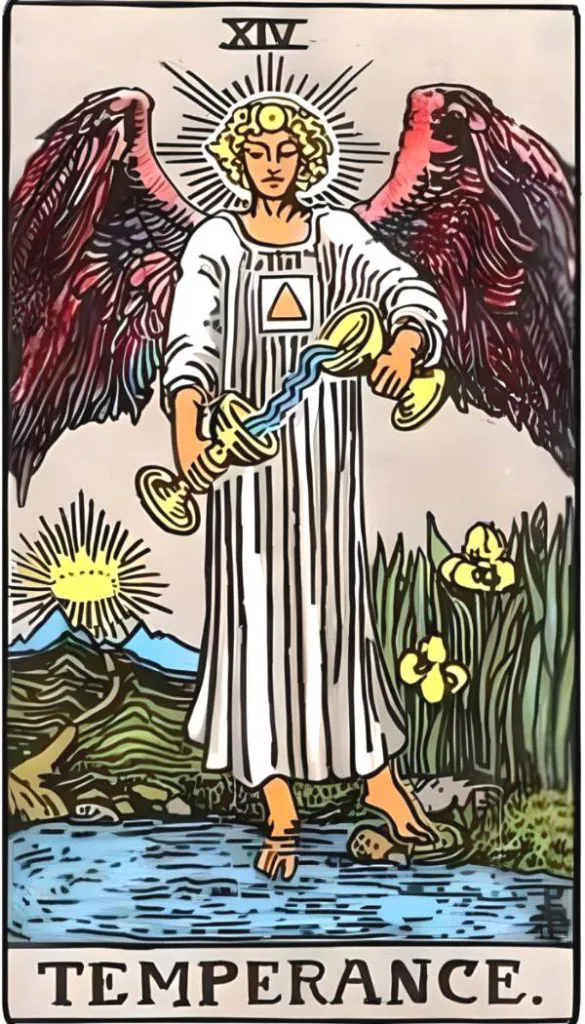
Temperance Tarot Card Meaning

The imagery of this card is typically peaceful yet rich, featuring a figure performing a special action. The figure is an angel, dressed in a pure white robe, holding a cup in each hand, pouring a magical liquid from one to the other.

Regarding the angelic figure, this card corresponds to Raphael, an angel whose original legends and origins are complex, overlapping with the duties and images of many other angels, such as guarding the Garden of Eden, assisting in the creation of the world and humanity, guiding souls, and protecting the Virgin Mary. His rank remains confusing even later. However, his most unique and important role and image is that of a "healing angel," possessing the great power to heal physical and spiritual wounds and suffering. He radiates a light of charity and love, with many magical abilities to perform rescue and healing. Thus, he is related to medical and therapeutic systems or arts, and can be considered the guardian or progenitor of these fields, naturally also associated with the medical symbol of the caduceus, and also related to alchemy.

Therefore, the angel's image is pure and spotless, dressed in a clean white robe in the picture, representing a gentle soft light. This healing angel will cleanse your soul. The wings added to the figure represent the potential for transformation and change, indicating that finding the sunshine in life is imminent. The fiery red wings signify a passionate nature and active action. The angel's expression is focused and devoted, with a radiant light emanating from the head.

This winged angel, with a male appearance and a female expression, is neither male nor female, transcending gender, as angels are genderless. He does not quite fit into the established angelic hierarchy and is usually assigned to the order of ministering spirits in this card. Sometimes he is also considered the sun god or the sun spirit. We can transcend religious issues, whether the angel is a spirit of a specific religion. He can even not be an angel but a state of human cultivation or any kind of spiritual entity, always bringing healing and comfort. We can give a temporary name "healing angel."

On the forehead of the "angel," there is a golden sun-shaped symbol, like his third eye, which is a very important part, representing the pineal gland and the forehead chakra of humans, indicating the maturity of wisdom. The golden sun symbol represents light, clarity, and wisdom, and its position on the forehead is the great power of the third eye, the force of insight and directness, detection, and diagnosis. The third eye has already been revealed, and there must be extraordinary abilities to be displayed, as well as the light of wisdom, which is a state of success achieved through long-term careful and serious cultivation.

The white robe has neat straight pleats, without other decorations, except for the triangular and square symbols on his chest at the heart chakra. In addition to the square, there is a triangle, indicating the harmony of matter and spirit, the harmony of the two levels of the world. The entire symbol has seven corners, commanding the seven chakras, and drawing on the energy of the seven stars. This symbol is located at the heart chakra, representing the openness and tolerance of the heart, accommodating the symbolic objects of this symbol.

This healing angel holds a chalice in each hand, pouring the liquid from one chalice into another, and he seems to keep pouring back and forth. Carefully observe the posture of the angel's hands and the way the chalice is held, and this picture is paused at a certain moment in between, showing the right hand down and the left hand up. The two chalices in the hands are communicating with each other through the liquid.

And in this series of operations, not a single drop of water is spilled, which is extremely successful and perfect. The angel's expression is focused, and the eyes are peacefully looking down at the magical instrument in the hands. The cup holder is practicing high-level alchemy, which is a picture of practice, but not a hard practice method, it is a voluntary and leisurely practice method, so it has a peaceful expression.

The liquid in the two cups is mixed in this operation. We can regard it as ordinary practice and preview, but we can also consider it as alchemical operation. Even more mysteriously, his posture is also a kind of exercise, the cups can be a symbol of the body's organ containers, and the water flow between the cups can be considered as the guidance of the body's "qi" or "magnetic field". And the liquid in it is the mystery, which must not be ordinary water, but must be the healing holy water, the refined elixir, the essence of life. The water in the cup is a symbol of infinity, what you think it contains is what it is, what kind of practice is actually the content in the bottle.

Next, observe the posture of the healing angel's body: the left foot is on the stone on the shore, and the right foot is extended into the water, and the center of gravity seems to be between the two. Stepping on the land indicates contact with the actual level, the level of consciousness. Going deep into the water indicates touching the emotional and spiritual level, the subconscious level. The angel stepping into the water is the first card to touch the water and explore the subconscious level, and can directly feel emotions and deep consciousness.

On the clear water surface, there are slight ripples, and in the ripples, there is a vague reflection, which is a kind of projection, a reflection of the soul. You can wash or observe yourself through this water surface. This ground water is connected to the water in the cup through the angel's toe touch. This water area is interconnected with the water areas of other cards, and the angel's touch is a global connection. We analyze the entire picture to have so many dual signs, and the focus is on the integration of dualism, and it is integrated under a harmonious state.

On the right side of the angel's right hand, a road starts from the shore, climbs up the slope, and goes to the distant mountains at the edge of the horizon. The double peaks of the distant mountains also bloom with bright light. This double-peak shape is also that mysterious Egyptian symbol ~ Djew and Akhet.

And this light is the rising sun from the horizon, a piece of gold, a crown. This pattern has a deep meaning, it is the unity of three golden colors, symbolizing the body, mind, and spirit of humans. The crown is the focus of alchemy, the highest success, the material refined at a high level, the material transformed into gold sun. The nobility of matter is called gold, and the nobility of spirit is called a crown, which is the so-called "Golden Dawn" mystery. The sun and the angel of temperance have an interaction, and through the sun on the forehead of the angel of temperance, the energy of the "Golden Dawn" can be mobilized, so there is light on the head and body. "Golden Dawn" is at the end of the long road, representing that it takes a long time to cultivate to achieve. So we know that this card reveals the way of cultivation of the Golden Dawn, which is in harmony with the liquid in the angel's chalice, and is also a part of the secret of eternal life.

On the other side of the background, behind the angel on the left, there are several irises growing on the ground, representing peace and tranquility. There are two yellow flowers, matched with green leaves, and they also echo all the yellow parts in the picture. The overall color matching is so pure, all are healing colors. This is the baptism and purification that temperance wants to bring to you, as well as the preparation for redemption, this is your spiritual gift.

The Angel

The central figure of the Temperance card is an androgynous angel, representing a higher spiritual force that brings about healing and harmony. This angel is often associated with Archangel Michael or the “Guardian of Fire”. The angel’s presence is a symbol of divine intervention and spiritual guidance.

The Two Cups

The angel is shown pouring water between two cups, symbolizing the transmutation of energies and the alchemical process of turning the base into the sublime. This act is one of balance and moderation, merging opposites into a unified, harmonious whole.

The Iridescent Triangle on the Angel’s Robe

This triangle, placed upon the chest of the angel, is an emblem of fire and points upwards, symbolizing spirit. When combined with the square (which represents earth and matter) beneath it, it forms a symbol of the integration of spirit and matter, the merging of above and below.

One Foot on Land, One in Water

The angel stands with one foot on the earth and one in a pool of water, indicating a balance between intuition and reality, emotion and practicality. This suggests the blending of the conscious and unconscious, and the importance of integrating both aspects of oneself for true inner harmony.

The Path and the Crown

Behind the angel is a luminous, narrow pathway that leads to a distant mountain crowned by the golden light. This path signifies the middle way, the path of moderation and balance that leads to enlightenment.

The Sun

The rising sun in the background symbolizes hope, clarity, and the dawn of a new day. As with many cards in the tarot, the presence of the sun suggests illumination, clarity, and divine energy.

Psychological patterns in Temperance
Spiritual Bypassing
The angel's white robe, radiant head, and serene face can become too clean when the card is read through its reversed psychological tension. The image still contains water, body, and feeling, but the attention is pulled upward toward light, purity, and the distant golden path. That is the structure of Spiritual Bypassing. The psyche uses healing language, higher perspective, or idealized calm to move away from the specific emotional material that would disturb the image of being balanced. In introspection, You may sound compassionate, wise, and self-aware while quietly skipping the anger, grief, envy, shame, or resentment that carries the real data. The bypass is not a failure of depth; it is a defense that turns depth into a place where pain is not allowed to be inconvenient.
Rescuer Identity
The angel’s lowered gaze, steady hands, white robe, and measured pouring place the whole body in the role of a healer. Nothing spills, nothing shakes, and the chest symbol visually turns care into a central identity rather than a passing action. That visual structure mirrors a friendship pattern where being useful becomes the safest way to belong. You may become the person who translates everyone’s feelings, absorbs the tension, mediates the group chat, and quietly believes the bond will hold as long as you keep repairing it. Rescuer Identity is anchored in Temperance because the card’s healing function can become a self-concept when it hardens. The gift is emotional steadiness; the trap is needing someone else’s disorder to prove that your place in the friendship is secure.
Cognitive Dissonance
The triangle and square on the angel's chest compress two different orders into one emblem: spirit above, matter below, held at the heart as if they can be made coherent. Around that symbol, the card places water, land, cups, road, and sunlight into one carefully regulated field. This is the visual architecture of two truths trying to occupy the same inner system. One option may satisfy the practical self while another answers the emotional or aspirational self, and the mind keeps searching for a story that makes both motives feel morally clean. In choice tarot, Cognitive Dissonance appears when You are not confused because You know nothing, but because You know too much in opposite directions. The card exposes the pressure to harmonize competing truths before admitting that every serious choice rearranges the self.
Boundary Diffusion
The angel's body bridges shore and pool, with one foot grounded and the other immersed. The boundary is visible, but the figure's posture turns that boundary into a living threshold rather than a hard wall. In a lifestyle system, that same bridging can become a coping pattern where every category of life starts leaking into the next. Work enters rest, emotional processing enters errands, health goals enter self-worth, and the day loses clean edges even when everything looks calm from the outside. Boundary Diffusion is not shown here as chaos; it is shown as over-blending. The card reveals how a beautiful desire for integration can quietly erase the separations that let a nervous system recover.
Strategic Surrender
The angel stands with one foot on solid ground and one foot in water, holding the body between practicality and feeling without collapsing into either side. The cups are active, but the movement is measured; the liquid transfers without force, spill, or panic. That visual structure maps to a coping style where control is not abandoned, but softened into pacing. Instead of pushing the whole lifestyle system through willpower, the psyche tries to regulate through sequencing, gradual adjustment, and a tolerance for partial progress. Strategic Surrender appears here because the card does not show passivity; it shows intelligent non-force. In your daily architecture, the pattern reveals where a more sustainable rhythm may come from reducing pressure rather than adding another layer of optimization.
Strategic Intimacy
One foot stands on solid ground while the other touches the water, and the angel does not collapse into either element. The shore remains visible as a boundary, but the body is skilled enough to contact both the practical surface and the emotional depth. Strategic Intimacy uses that same divided stance as a social pattern. It does not reject connection, and it does not surrender completely to it; it regulates closeness by choosing how much access each circle receives. In social ecosystems, this can become a mature form of selective availability when it is conscious. Temperance connects to the pattern because the card's balance is not withdrawal from the group, but calibrated participation: You stay connected without letting every space become entitled to the whole of You.
Avoidance Coping
The cups can keep exchanging liquid forever, especially when the eye becomes absorbed by the flawless stream between them. In the reversed texture, the ritual no longer integrates energy; it circulates it inside a closed system. Avoidance Coping appears when the academic task is replaced by a safer adjacent task. Notes can be reorganized, folders renamed, readings reread, and study plans rebuilt while the exposed act of writing, testing, or asking for feedback remains untouched. The card's image is precise because avoidance here does not look like doing nothing. It looks calm, busy, and almost sacred, which is why the pattern can hide inside productivity until the deadline reveals what was never actually confronted.
Social Overextension
The angel's action is suspended in a continuous transfer, with liquid moving from one cup to another as the body remains split between land and water. In reversal, that poised exchange can feel less like balance and more like endless redistribution. Social Overextension forms when connection becomes a system of constant energetic transfers. Every circle receives a little attention, every invitation gets considered, every group thread asks for a response, and the self keeps pouring without a true recovery point. In social life, this pattern can make You mistake availability for belonging. Temperance links to it because the card's central ritual depends on proportion; when proportion collapses, the same gift of blending becomes the quiet exhaustion of being spread across too many containers.
Analysis Paralysis
The angel's stance is balanced between water and land, but when the image is read through strain, that balance becomes suspension. The body can hold both options, yet it does not fully transfer weight into either the emotional field or the practical ground. That suspended posture mirrors a mental loop where planning replaces contact with the real day. The mind keeps comparing systems, weighing routines, and testing frameworks because choosing one would expose the plan to imperfection, friction, and feedback. Analysis Paralysis emerges from the card's threshold geometry. The same capacity to blend perspectives can become an endless pre-action state, where lifestyle redesign remains clean in the mind because it never has to meet the mess of execution.
Overfunctioning
The liquid in Temperance moves continuously between two cups, but the scene is frozen at the moment where the figure must keep the flow clean, controlled, and uninterrupted. One foot touches water while the other stays on land, placing the body itself between emotional depth and practical stability. When this mechanism turns inward, the person becomes the bridge everyone else relies on. You may organize the plans, manage the moods, soften the arguments, remember the obligations, and anticipate what will go wrong before anyone else has to engage. The family appears balanced because your nervous system is doing the balancing. Overfunctioning is not the same as being capable. It is the loop where capability becomes the reason no one else has to develop capacity. Temperance reversed exposes the hidden exhaustion of keeping the system harmonious by becoming its operating system.
Core Struggles in Temperance
Capacity Misalignment
The cups are small, defined vessels, and the stream between them only works because the amount, speed, and angle are compatible. Even a calm image depends on capacity limits; the liquid cannot be received well if the vessel, hand, or stance is carrying more than it can stabilize. Academic exhaustion often begins at that same mismatch point. The card does not reduce the problem to motivation; it shows a learning system being asked to receive more material, pressure, or complexity than its current container can transform into retained knowledge.
Relational Pacing Collapse
The pouring action can become a closed circuit when the same stream keeps moving between the same two cups without reaching the road behind the figure. The body stays fixed at the water's edge, maintaining the transfer while the wider path waits unused. In love, that locked structure names the moment when closeness loses rhythm. You may rush toward intimacy, freeze after contact, reopen the same repair conversation, and still feel no forward movement because the relationship is cycling energy inside the channel instead of carrying it onward.
Inner Compass Overload
Waterline, stone, diagonal stream, upright body, and distant road all create orientation cues in the same frame. None of them is meaningless, but each asks the body to trust a different kind of information. In a future-direction reading, that density becomes Inner Compass Overload. You are not lost because there are no signals; you are overloaded because every signal feels potentially important, and the system has not decided which one deserves authority. The card contains the overload by making it visible. The compass is not broken; it is crowded by competing inputs that need to be separated before a real bearing can emerge.
Resource Integration Strain
The liquid in Temperance is not stored; it is being transferred, tested, and blended. The two cups, the land-water stance, and the triangle within the square all show separate elements being brought into workable relationship rather than pushed into instant completion. Resource Integration Strain appears when the pieces of readiness exist but have not yet become a single usable capacity. You may have energy in one place, information in another, emotional consent somewhere else, and an external window that seems to be approaching before the mixture has settled. For timing work, the card does not glorify delay. It shows the exact pressure of needing the ingredients to become load-bearing before the next move can hold.
Intuition-Reality Split
The angel's body bridges stone and water, with one support fixed and the other responsive to ripple. The stance is not casual decoration; it requires the body to accept two different kinds of footing at once. When the question is your long-range path, that image becomes Intuition-Reality Split. One signal asks for evidence, stability, and usable ground; the other asks you to take seriously what moves under the surface before it can be proven. The card does not flatten the conflict into a simple choice. It shows why a future can look practical and still feel wrong, or feel deeply right while still lacking the ground that would let you step into it.
Caretaker Role Lock
The angel's hands are both occupied, and the whole scene depends on that steady exchange between the cups. The path in the background is present, but the foreground task absorbs the figure's attention and defines the body's position. In a family system, that arrangement becomes the role of the emotional regulator. You may be treated as the one who can translate, soften, absorb, or fix the flow between people who do not manage their own cups. Caretaker Role Lock names the structure where being useful becomes a form of containment. The card's healing posture shows why the role can feel meaningful and exhausting at the same time: the family stays more stable when you keep pouring, but your own movement toward the path is delayed by the work of holding everyone else's balance.
Timing Control Strain
The liquid crosses open air only because the angle, height, and pace of the cups are held with precision. Behind the angel, the path to the bright horizon is visible but not rushed; the image makes timing part of the structure, not a delay outside the decision. When you are trying to choose, pressure can turn every pause into a threat and every movement into a potential spill. The card frames your struggle as the difficulty of finding the pace that keeps agency alive, so the decision is neither avoided nor forced before the inner mixture has stabilized.
Cycle-Action Desynchronization
The same stream that can refine a mixture can also become a closed circuit when it never reaches a new stage. The cups keep exchanging liquid, the body remains at the shore, and the road to the distant light stays outside the active line of movement. Cycle-Action Desynchronization is the struggle of moving with effort but not with the actual cycle. You may be pushing during the wrong season, waiting after the signal has passed, or repeating the same adjustment while the usable window shifts elsewhere. In its reversed pressure, Temperance shows how motion can stop being progress when timing falls out of phase. The card gives the loop a boundary: the problem is not that nothing is happening, but that what is happening is not synchronized with the moment that would let it land.
Shadow Integration Strain
The two cups stay separate, yet the liquid makes them part of one exchange. The angel's body mirrors that structure at the shoreline, touching water without leaving land, crossing a boundary without erasing it. That is the visual grammar of Shadow Integration Strain. In introspection, the disowned part cannot be healed by pushing it away, but it also cannot be allowed to swallow the whole identity; it has to be brought into relation while its edges remain visible. The card's gentleness should not be mistaken for ease. It shows the exact pressure of letting an old wound, hidden motive, shame residue, or rejected desire enter awareness without turning it into the total story of who you are.
Boundary Control Strain
The liquid moves only because the angel holds both cups with exact distance, angle, and pace. Too much tilt would spill it; too little would stop the exchange, so contact depends on a boundary that is constantly being managed. Socially, that is the strain of staying open while measuring how much access people get to your time, attention, and emotional bandwidth. You are not closed off, but the connection requires continuous micro-adjustment just to keep it from becoming too much. The card places the struggle in the hands: the social boundary is not a wall, it is a controlled pour. The exhaustion comes from having to be the regulator every time the group asks for flow.
Inner Emotions in Temperance
Grounded Agency
The angel’s stance is physically divided but not unstable: one foot on stone, one foot in water, with the chest emblem centered over the body. Temperance turns the meeting point between feeling and practicality into a posture of choice rather than a scene of collapse. Grounded Agency emerges from that posture. In family life, it names the inner state where you can register guilt, love, pressure, and old conditioning without letting those forces automatically choose your next move. This card connects the emotional field to a stable center. You can remain aware of the family’s pull while returning to your own footing, and that return is the difference between being emotionally moved and being emotionally governed.
Mutuality Hunger
The two cups are not decorative objects; they are in active exchange. Liquid moves from one vessel to another while the angel's body keeps the rhythm stable, making reciprocity the central physical event of the card. Inside social life, that image can sharpen the ache for connection that is not one-sided. You may be surrounded by people and still feel the absence of a clean return flow, especially when you are always the one adapting, smoothing, inviting, or carrying the emotional tone. Mutuality Hunger emerges when the psyche recognizes that contact alone is not nourishment. Temperance points to the missing quality: exchange that moves both ways without forcing you to become the whole container for everyone else's comfort.
Cautious Trust
The angel's eyes are lowered toward the cups, giving trust a careful focal point. The figure is not rushing into the whole landscape at once; attention stays on the small exchange that can be observed, adjusted, and kept from spilling. In a social field, this becomes the feeling of letting connection approach in measured doses. You are not demanding certainty from everyone around you, but you are also not handing your openness to a room before it has shown it can hold the exchange. Cautious Trust fits Temperance because the card treats openness as a practiced calibration. The pool, shore, cups, and path all stay intact, giving the feeling a quiet architecture: enough contact to soften, enough boundary to remain clear.
Boundary Guilt
The angel's body is divided between land and water while the hands keep the cups connected. The image makes boundary work look delicate: separate zones exist, but the stream between them keeps asking to be maintained. In social life, that becomes the guilt of needing distance while still caring about the connection. You may know where your ground is, yet feel pulled back into the emotional water whenever a group, friend, or network expects your availability. Boundary Guilt belongs to Temperance because the card is about measured contact, not total withdrawal. Reversed, the measurement starts to feel morally loaded, as if every adjustment of access has to be justified before you are allowed to protect your energy.
Hard-Won Composure
The unspilled stream between the cups is not loose relaxation; it is precision held gently enough to keep the flow alive. The angel's hands carry the work, while the torso stays open, giving the whole scene the feeling of balance that has been practiced into the body. Hard-Won Composure fits the inner state that comes after you have met difficult material and are still standing. You may feel calm, but it is a calm with memory in it, a steadiness that knows exactly how much effort it took to keep the inner contents from scattering.
Analysis Paralysis
The angel balances between land and water while the liquid moves from cup to cup in a perfectly controlled loop. The road beyond the figure is clear enough to see, yet the body remains absorbed in the transfer, as if the next step has been delayed by the need to keep refining the mixture. Analysis Paralysis grows from that suspended precision. In a decision spread, the card can mirror the state where every option is repeatedly reprocessed, every tradeoff is remeasured, and the actual movement toward the path keeps being postponed. You may be calling it being responsible, but the image shows how responsibility can become a closed circuit when no amount of additional comparison is allowed to become a choice. Temperance here names the exhaustion of trying to reach perfect inner proportion before granting yourself permission to act.
Control Fatigue
The no-spill pour can read as a body locked around precision, with the cups held at angles that allow no margin for error. The robe’s clean geometry and the perfectly intact vessels make the whole scene feel like a system that must keep proving its own order. Control Fatigue comes from that over-calibrated structure. In lifestyle terms, it is the drained inner state of holding every routine, purchase, task, meal, bedtime, and reset plan so tightly that balance starts costing more energy than the imbalance it was meant to fix.
Reciprocal Warmth
The two cups in Temperance do not hoard or drain; liquid moves between them in a measured stream, held by hands that keep the exchange steady. One foot remains on land while the other touches water, so the card shows emotional contact without total merger, care without collapse. In friendship, that image maps directly onto the feeling of being met rather than used. You can give support, receive it back, and still remain yourself inside the bond. Reciprocal Warmth belongs here because the card’s central action is not intensity, rescue, or self-sacrifice. It is a visible rhythm of mutual flow, where closeness becomes safer precisely because the exchange has proportion.
Quiet Certainty
The angel's lowered gaze stays with the measured stream between the two cups, and nothing in the image is chasing a dramatic sign. The road behind the figure is visible, but the card's center of gravity remains in the steady act of blending, testing, and keeping the flow intact. For a decision spread, that visual quiet becomes a precise emotional signal. Quiet Certainty is the feeling that clarity does not need to arrive as a loud breakthrough; it can arrive as the option that still feels coherent after your practical facts and inner pull have been allowed to mix. You are not being pushed toward blind confidence. The card mirrors the moment when your attention stops scattering across every possible outcome and begins to recognize the choice that can hold both risk and self-respect without forcing either one to disappear.
Disciplined Calm
The two cups are held at different heights, and the stream between them stays clean, narrow, and unspilled. Nothing in the image suggests rushing; the discipline is in the exactness of the exchange, not in pressure or force. Disciplined Calm emerges from that controlled flow. In a direction question, it describes the emotional state where you stop trying to solve the entire future at once and begin regulating energy well enough to make the next phase sustainable. This is not passive peace. It is a trained steadiness that can keep desire, timing, fatigue, and practical reality in circulation without letting any single force flood the whole system.
Outer Contexts in Temperance
Routine Collapse
The cups, waterline, path, and horizon depend on one central act of coordination. A small break in the stream would affect the whole picture, because the scene has almost no visible buffer between balanced flow and spill. That is the lived shape of routine collapse. You may have a daily structure that works only when every variable behaves, so one late night, work spike, messy room, or missed errand can knock the entire sequence out of order.
Third Path Search
The two cups are not displayed as rivals. They are linked by a stream that creates a third condition: neither cup alone, but a blended state that only exists through careful transfer. For a direction question, that matters because the external world often hands you pre-labeled routes and calls them the only realistic options. The card's geometry shows a different structure: You can be standing between categories because the viable route has not been named by the existing menu. The road in the background does not start from a place of purity or certainty. It starts after the mixing, which makes the search for a third path less like indecision and more like the work of building a future that can survive contact with real life.
Premature Launch Pressure
The cups are mid-transfer, the figure is still calibrating, and the road to the light has not yet been entered. In reverse, that unfinished exchange becomes the key pressure point: something wants to be shown, launched, or moved before the mixture is stable. Premature Launch Pressure is the outer demand to make a private process visible too soon. The card’s symbols make the risk concrete, because a forced pour can spill what careful timing would have preserved. For timing questions, this is a warning against confusing visibility with readiness. The next step may be real, but the structure underneath it needs enough integration to survive being carried into the open.
Bad Timing Loop
The motion between the cups can become a closed circuit when the card is reversed. Instead of a clean exchange that prepares the way forward, the stream repeats itself while the road in the background stays distant. That visual structure maps directly onto a Bad Timing Loop. You keep encountering openings, starts, delays, and near-moves, but the sequence does not resolve into forward passage because action and receptivity keep missing each other. The card does not frame the loop as permanent. It makes the mechanics visible: the rhythm is off, the receiving point is unstable, and the path becomes usable only when the transfer stops repeating the same mistimed pattern.
Situationship Ambiguity
The shoreline stance leaves the figure between water and land, close to both zones but settled in neither. The distant road offers an endpoint, yet the body remains at the threshold rather than moving into a defined path. That is the structure of a no-label connection with real intimacy and unstable status. You may have access, chemistry, and routine, but the card shows how ambiguity keeps the relationship suspended where emotional investment is present and commitment architecture is missing.
Friendship Boundary Creep
The angel stands on the edge between land and water, with an open body and no enclosing wall around the scene. Reversed, that exposed threshold becomes a place where access keeps widening because the line is visible only after it has been crossed. Friendship boundary creep is the slow expansion of what a friend assumes they can ask from you. The card surfaces the pressure around constant replies, emotional availability, and private disclosures, giving you a way to name the structure before it becomes the default terms of the relationship.
Lifestyle System Overhaul
The angel is not handling a single object; cups, water, land, path, robe symbols, and distant light all have to align. The image is a whole operating system, not a single habit, and every part of the scene depends on measured coordination. That is why this card maps cleanly onto a lifestyle system overhaul. You are dealing with the architecture that sits underneath sleep, meals, work blocks, home order, attention, and recovery time; changing one module without redesigning the flow between modules keeps the same old friction in place.
Wellness Optimization Trap
The precise no-spill pour can become an unforgiving performance of balance, with the clean robe, forehead mark, and geometric symbol turning order into a visible standard. The figure must keep everything aligned without showing strain, and the whole scene becomes a diagram of flawless regulation. That is the core of a wellness optimization trap. You may be surrounded by habits, trackers, routines, wellness rules, and self-improvement inputs that were supposed to support your life, while the actual structure now demands constant compliance to look balanced at all.
Resource Readiness Check
The two cups are intact, the liquid is usable, and the figure stands with one foot in water and one foot on land. Nothing in the scene suggests scarcity; the pressure is about whether the containers, the footing, and the path can work together. That makes the card especially precise for a Resource Readiness Check. In timing terms, the issue is not whether you want the next step enough, but whether the external supports around it are stable enough to keep the move from becoming wasteful friction. The triangle and square on the robe reinforce this as a structural question. You are looking at a stage where ambition has to pass through practical containment before it becomes a sustainable action.
Strategic Timing Window
The angel pours liquid between two cups without spilling a drop, and the road behind the figure rises toward the distant light. The image is not frozen hesitation; it is controlled movement, where one stream finds the right channel before the path ahead becomes usable. For timing questions, that visual structure points to an external window that opens through calibration. You are not being shown raw speed or passive waiting, but a stage where several conditions have to move together before action carries cleanly. A Strategic Timing Window appears when pressure, readiness, and available direction briefly align. The card gives that window a physical shape: the hands are steady, the stream is continuous, and the path is visible enough for a measured next step.