

The Chariot Tarot Card Meaning
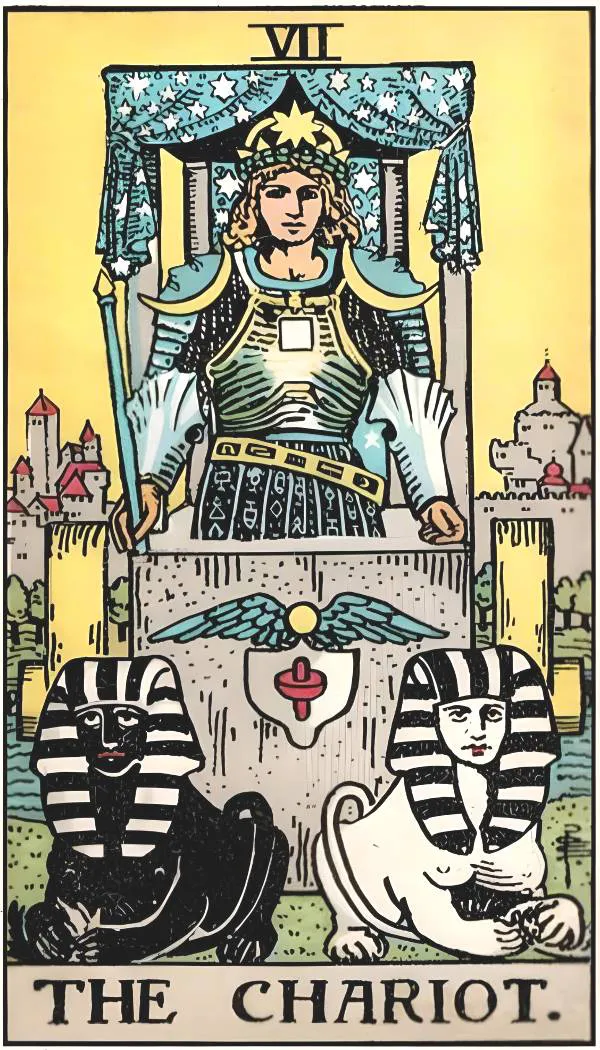
Mysterious man, like a prince from a foreign land, stands on a chariot that is parked on the land by the riverbank, with two sphinxes in front. Behind this chariot is a city across the moat, with a city wall on the opposite bank, and a row of low trees as a dike in front of the wall. Inside the city wall is a bustling scene with castles and other buildings. The yellow background represents a bright and positive mood.
The driver of this chariot is a young talent. From his heroic posture, it can be seen that he has a strong combat power. Although he is young and vigorous, he is not an ordinary soldier, but a general or commander level, but he is not a noble by birth, but has won today's status by his own strength. The mountains and rivers behind the chariot may be his original home, or the place he has conquered, but it is the place he has left, and he is about to start exploring new fields. He has come to this place to stop and look forward, and he is about to go on a new journey.
The warrior is wearing a shining golden crown and a garland of laurel, wearing battle armor, and holding a command spear in his right hand. There is an eight-pointed star in the middle of the crown on his head, which represents the warrior's ideals, goals, and guidance, and is also related to the ideal hope of the "Star" card. The whole body armor has several layers, each part has protective things: shoulder guards, elbow guards, and chest armor. There are crescent moons on both shoulder guards, showing human faces, and the expressions on both sides are different. The right shoulder is a crying face, and the left shoulder is a smiling face. This group of Yin and Yang face patterns represents two different emotions in the heart, which the warrior must control and reconcile, and cannot be swayed by them.
As for this warrior, the chest armor hanging on the shoulder and worn outside the battle clothes is a magical chest armor, named "Urim and Thummum". These two terms come from Hebrew, which means "light" and "perfect", and are treasures given by God. The usual appearance is twelve precious shining gems that have been carved and cast, and they are arranged and inlaid on the chest armor through a series of sacred rituals. The twelve gems symbolize the twelve tribes in front of the temple of Jehovah, and the ritual is to show the glory of God pouring into it, and the law of God is also cast and branded in it. Ancient Jewish priests or senior warriors often wear this kind of colorful chest pocket. In a kind of test-like ritual, the mystery is solved, or before the war and journey, it is given by the will of God. When the priest enters the inner hall of the temple, he must wear it, and it is used as a tool to inquire and interpret the oracle, and to understand it by looking at the light of these stones. "Urim and Thummum" can also be a more hidden form, and later it was quoted as a magical treasure that can solve the oracle in a magical way. The shining chest armor worn by this warrior does not show the shape of the gems, and there is only a square light piece in the middle, located in the heart position, which affects the energy of the heart chakra and also means to feel and feel the direction of the future with the heart.
The lower body of the black battle robe has many straight stripes, and there are many ancient symbols between the stripes, all of which are white. It inherits the ancient and mysterious wisdom, becoming his life knowledge, and is used in the battlefield of life. There is a sword belt around the waist, and the yellow belt represents the ecliptic. There are many squares and figures on it, which are star palace symbols. The belt is inclined at about 23 degrees, which is also consistent with the angle between the equator and the ecliptic. The battle and command spear held in his hand represents combat power and lethality, and the condensation of strong will. The command spear is also used to lead the military ceremony and subordinates, leadership and layout of the formation.
The chariot is an open shed, supported by four pillars, which symbolizes the space composed of the four elements. The curtain in front of the shed and the curtain behind are all decorated with many star patterns. The blue cloth and white stars, the light of each star is different, there are five-pointed, six-pointed, seven-pointed, eight-pointed stars, symbolizing the twinkling of the stars in the sky, and also representing the final direction to go. The driver stands in front of the open shed, and the front half of the chariot is a cube, and the upper body of the prince is on it. The cube has a mysterious meaning, and here the cube is solidified, showing a solidified effect, and the lower body of a person is embedded in the cube, which represents the desire that is imprisoned. The four pillars are erected from the cube, representing that the structure is very stable, and the star shed and the cube below also constitute the symbol of heaven and earth. The warrior is in the middle of the two, indicating that he stands on the top of the sky and the earth.
In front of this chariot is the main body of the car body - one side of the cube, which is also flat gray, but there are special and noble signs on it, indicating that this is not an ordinary chariot. There are two sets of signs in front of the chariot, the upper set is a disc with a pair of wings, which is the eagle-winged sun disc from Egypt, representing an image of the Egyptian ruling god Horus. The disc in Egypt has always represented the sun, and the wings are a symbol of this eagle-headed god. The combination of the two is "the midday sun - Horus" Horus Behudety. In mythology, the winged disc represents the power from the sky, which is the "god of magic and wisdom" - Thoth, using magic to turn Horus into this form. The combination of the entire pattern can also add other incarnations of gods (such as snakes) to enhance higher magic and combat power. Horus transformed into this image, mainly to fight against the evil god Seth, so this mark also represents the victory of the heroic new king's campaign.
Below the disc is a shield with a mark that looks like a red cross, which is the mysterious symbol from India - Lingam-yoni, representing the combination of Yin and Yang and the reconciliation of opposing forces, and can also be seen as a direction indicator. The combination of Indian Yin and Yang and Egyptian eagle-winged disc represents the combination of Yin and Yang forces as navigation, leading this force to rise and move with wings.
There are two sphinxes in front of the chariot, also known as Sphinx, which is a combination of wisdom and courage, and also represents the riddle of life and the search for answers. Since the warrior solved the riddle of the Sphinx, he was able to drive the chariot pulled by the Sphinx, and the chariot driven by this magical animal showed that the level of this chariot was beyond the general material world. There is no rein between the Sphinx and the chariot, which means that the direction of the future is driven and controlled by spiritual power.
The Sphinx is stationed in front of the car, judging the road with wisdom, leading the direction of life. Therefore, it can be known that the direction of the chariot is an action that has been thought and planned. The two lions sit in front, and there is also a symbol of guarding and defending, just like the chariot and the warrior's front guard. The Sphinx is actually the image of "Horus on the horizon", and the eagle-winged sun disc in front of the car is also the image of the god Horus, representing the arrival of the young new ruler to reorganize the world, which is a form of resurrection of Osiris (the god of the Egyptian underworld, a symbol of the old ruler), and the victory of the new king brings new life and new order.
Each of the two sphinxes has contrasting colors, with black and white stripes on the mane, but the colors are still opposite to each other, and the eyes and posture are also divergent. The black one on the right side of the chariot represents darkness and tribulation; the white one on the left side represents light and redemption. The two animals lead the way forward, representing hesitation and choice in the direction of progress. Black and white side by side also represent the choice of opposing ideas and positions, and there is a meaning of reconciling the two ends. So in the middle of the two sphinxes, you can clearly see the signs that symbolize the convergence and reconciliation. Black and white also represent the two directions of life and death. The Sphinx on the horizon originally faces the east, representing the rise of life, but the two sphinxes here face two different directions, showing that a true direction of life must be integrated.
The chariot and the warrior carry so many mysterious and fateful messages, which can be said to represent the richness inside, the pursuit and exploration of the spirit. This chariot has two large wheels on the side, which are yellow and not very different from the background, and only the front edge of the wheel is seen, which is easy to be overlooked. The two wheels can make the chariot run, and also represent the changing life, the endless changes of the world, just like the role of the wheel of fate. The four pillars on the car, the two forces in front of the car, and the driver who represents control, are a manifestation of the connotation of the number seven, representing the will to control actions and energy. It is not necessarily a land journey, this chariot is actually a flying vehicle.
The Charioteer
The central figure of the Charioteer represents willpower, control, and victory. He stands tall in his chariot, holding the reins of two sphinxes, indicating his mastery over duality and his ability to harness opposing forces to move in a desired direction.
Sphinxes
The black and white sphinxes symbolize duality – positive and negative, yin and yang, conscious and subconscious. Their stationary position implies that the Charioteer is in control, but it is a delicate balance of power and restraint.
Armor and Starry Canopy
The Charioteer wears armor, denoting protection, readiness for battle, and strength. The starry canopy overhead suggests divine protection and the influence of cosmic forces, hinting at the idea that his victory is supported by the universe.
The City Walls
Behind him are the walls of a city, symbolizing the confines of the physical world. His journey on the chariot signifies moving beyond these limitations, driven by ambition, focus, and determination.
The Winged Emblem
The shield or emblem on the chariot, adorned with wings and a disc, is a representation of spiritual enlightenment and the transformative power of the spirit. The wings symbolize aspiration, while the disc signifies the divine world.
The Lingam and Yoni
The rod or scepter in the Charioteer’s hand is a reference to the lingam from Hindu tradition, while the square on his chest relates to the yoni. Together, they represent the union of opposite forces and the creative power of the universe.
The Chariot’s Wheels
The wheels of the chariot symbolize motion, progress, and the cyclical nature of life’s journey. They remind us that while we can steer our direction and make choices, there are always external forces and life’s inherent motion that we must navigate and work with.

Two Browser Tabs, One 20-Minute Inquiry, and a Route Beyond Campus

One More Stop Took the Errand Window; Leaving at Four Returned Choice

Three Job Tabs Closed at 10:45; Six Days Later, She Pressed Send

Open Tabs at 10:32 p.m.: From Research to a Twenty-Minute Draft

When "Whatever Works" Means Waiting: Making One Preference Visible
