

The Hanged Man Tarot Card Meaning
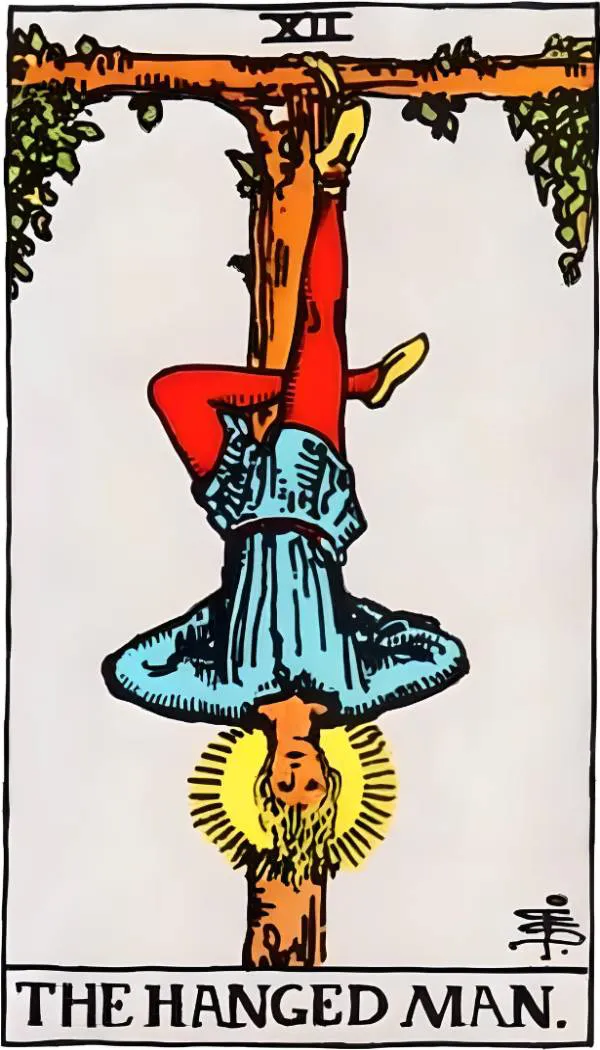
This card has a very unique image, unlike any other cards, and only the figure of the Hanged Man can display the most distinctive effects. In this important position of the 12th order, which is neither at the beginning nor the end or in the middle, it shows the characteristics of the Tarot cards in this way. However, not every Tarot's Hanged Man is hanged upside down, but since it was painted as a figure hanging upside down, it has a unique and profound meaning, and has become a representative card of the Tarot, as if it was specially placed for the 12th position.
In the picture, this man is tied by the ankles and hanged upside down, hanging in the middle of the horizontal bar. The upright and horizontal trunks of the tree are upright and centered, and the horizontal bar crosses a trunk in the center. A man is hanged upside down on this tree, and the man hanging is leaning against this trunk. The tree-like object where the man is hanged is similar to an ancient gallows, but it seems to have the function of sacrifice. What exactly is this tree?
Let's first look at its shape: these wooden sticks are in the shape of a T-shaped cross, and they are living trees with leaves growing on them. This type of tree presents a T-shape, which can be called the Tree of Existence. There are many legends and sources of the Tree of Life, and there are also different distinctions. To be precise, this tree should be called the Tree of Existence. The Tree of Existence represents a consciousness of life, a persistence in life, and the energy of life. The Hanged Man leans against the upright trunk, which is an interaction with the energy of the trunk.
Some people believe that this tree is called the Tarot Tree, and it is the shape of the letter ~ T, representing the Jewish Tree of TAU. You can even directly think that the appearance of the T-shape represents the Tarot TARO. The TARO shape is hidden in the picture, so it is deliberately drawn as the Hanged Man, and the person is a R, indicating that the way of Tarot is to practice slowly. Sacrifice and dedication are the spirit of practice. Perhaps Waite's Hanged Man is not really related to Odin, but to the letter. Waite deliberately put the letter on it. People are Tarot, Tarot is people, the combination of people and the Tree of Life, to experience Tarot knowledge in person, can be experienced in the city, and can also go their own way.
This man's hanging posture easily reminds us of the ancient Nordic people's belief in the great god "Odin". Barbara Walker believes that this card is the most anti-Christian card. Waite combines Christianity with paganism, presenting a special state of practice, but also draws the expression of Christ's suffering. At least it is a kind of sacrifice, the lamb of God, the prey to be slaughtered, or the "sacrifice" offered to the gods. Since ancient times, many religions have been closely related to the belief in trees, and this card especially combines trees and human bodies to symbolize the mysterious realm of the unity of man and tree.
Regarding the posture of the Hanged Man: there is a rope tied to his right ankle, hanging on the horizontal branch of the tree. His hands are placed behind his back, bending his elbows. The posture of his feet is that the left foot is bent and extended behind the right foot, presenting a triangular shape. The shape of the magic hexagram is also the shape of the Tree of Life. The posture of the whole body also presents a "swastika" shape. The hair of the Hanged Man hangs down, presenting a downward flame shape, and there is a bright yellow halo surrounding his head, which is more like a saint.
However, the halo on the top of the head, does it represent a holy mind? Or is it a halo of martyrs? Or is it a representation of the phenomenon of cerebral congestion due to hanging upside down for too long? Is he a martyr? This man is a mysterious person, where he comes from and who he is, is really a mystery. Therefore, why this hanged man is hanged here is a more intriguing part to explore. The posture of the hanged man is like a posture of sacrifice, and it seems to be tied up and hanged up by himself.
The most intriguing is that his face shows a deep immersion in God, and it is not a painful expression, he does not feel suffering. Some people even think that this is also a posture of dance, just a bit different. The posture of dance indicates that his heart is a state of leisure and freedom, although the body is restricted and tied up, the spiritual level is independent. He has ideals and goals in his heart, and he can live differently from ordinary people.
More mystics believe that this posture is actually a kind of spiritual practice, and the spirit of the Golden Dawn is placed in it. The posture is a posture of practice. What is the difference between the posture of hanging upside down and the posture of standing upside down? The posture of the hanged man and the posture of falling head over heels are not entirely the same, because the hanged man has no fulcrum and support point, he must trust completely, this is the practice of the body, and it is also the practice of the spirit, and it is also a test of the soul.
This picture has also been considered a posture of divination, because in the Tarot cards passed down by the ancient Gypsies, this card depicts a semi-female young man wearing a male sleeveless tight short top, standing calmly on one foot, and easily relying on a short stake that is driven into the ground. Even in the posture of hanging upside down, which is the way of prophecy or gimmick that these fortune tellers in the 18th century like.
This man who is hanged upside down is wearing a blue shirt and red pants. The red and blue clothes are a set of contrasting colors, and the calm and quiet blue and the vigorous red are coordinated. The dark blue belt is a link to the deep realm, and the hanged man must go through it. The shoes on his feet are yellow, and the hair hanging down is golden yellow, and the colors are very close, both indicating a kind of light and energy, and they are also a response to each other in these two positions. The three primary colors of red, blue, and yellow are all presented in the picture, indicating that he is still living in the world, has not left, and is still tied up and connected, indicating that he will return to the world.
This protagonist, like the overall picture expressed, symbolizes life hanging in the air, but this is life, not death. The background of the sky is white, colorless, expressing a state of nothingness, and this is also a description of the state of consciousness of the hanged man.
The Gallows
The gallows from which the man is suspended symbolizes the world tree, a representation of the universe in Norse mythology. This tree is an ancient motif that connects the heavens, the terrestrial world, and the underworld. The Hanged Man’s suspension from the tree suggests a voluntary sacrifice for the sake of a greater understanding or purpose.
The Inverted Pose
The man’s upside-down hanging indicates a perspective shift or a reversal of one’s usual way of thinking. This inversion can be seen as surrendering to a higher power or knowledge, embracing a different viewpoint, or undergoing a personal transformation. The surrender is not one of suffering but a conscious choice to let go for a greater spiritual gain.
The Halo
The bright halo around the Hanged Man’s head signifies enlightenment, spiritual realization, and an awakening to new truths. Even in his suspended state, there is a sense of peace and acceptance, indicating that he has reached a higher level of understanding and is at peace with his current state.
The Crossed Legs
The position of the Hanged Man’s legs forms an inverted number four. The number four is associated with stability and a strong foundation, but here it is turned on its head, emphasizing disruption and a need to see things from a new angle. This position also mirrors the tarot’s Empress card, suggesting fertility and the creation of new ideas through sacrifice.
The Serene Expression
Despite his seemingly uncomfortable position, the Hanged Man’s face is calm and serene. This peaceful expression indicates that his sacrifice is not one of physical pain or distress but rather a spiritual or emotional surrender. It’s a testament to the inner tranquility that can be achieved when one releases material or worldly concerns and seeks a deeper understanding.

From Approval Limbo to Visible Authorship: A Reversible Next Step

Tomorrow's Alarm Kept Moving, Then One Reply Waited Until Breakfast

The Same Tab Glowed at 4:37—Then One Rough Sentence Moved the Day

Practical or Obedient? Tarot Separates Family Support from Authority

The Default Designated Driver Gives Way to a Shared Transport Plan
