

Death Tarot Card Meaning
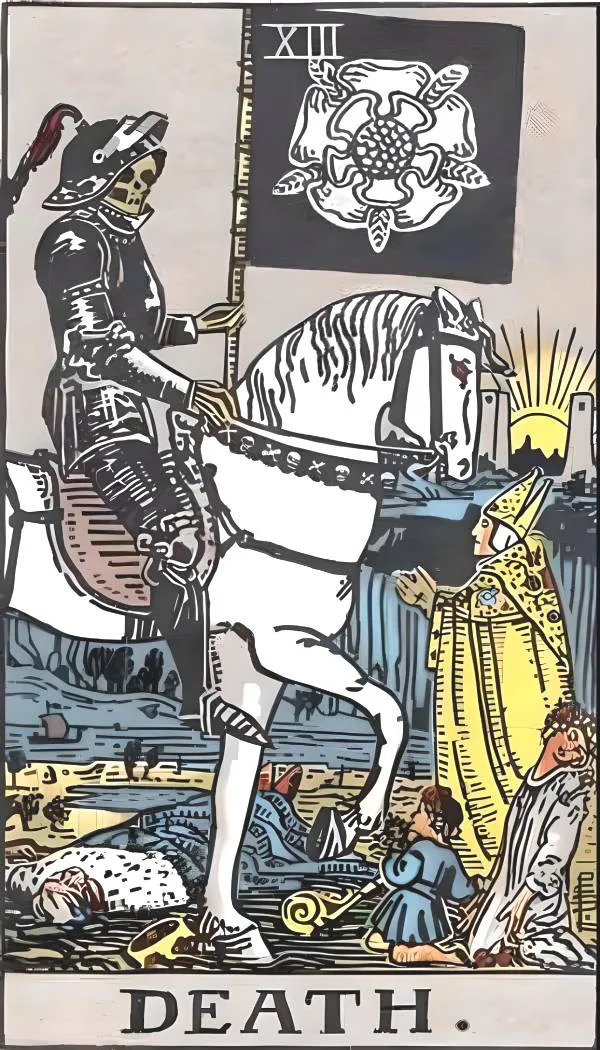
This card symbolizes death, hence the imagery primarily focuses on the figure of the Grim Reaper. The Grim Reaper is typically depicted as a skeleton, traditionally wielding a scythe. The skeleton is a symbol of lifelessness, and when cloaked in a hooded robe, concealing its form, and holding a scythe meant for reaping heads, it is an image deeply ingrained in the Western psyche, embodying the figure of death.
Regarding the Grim Reaper's image: In Europe, since the Middle Ages, there has been a ritual known as the 'Dance of Death' or Danse macabre, associated with death. This dance is strongly connected to everyday life, and 'dancing with death' was a common occurrence during many festivals. After the ravages of plague and war in the Middle Ages, they engaged in such ceremonies to coexist peacefully with death, hoping not to receive such harsh news. However, people also understood that death is a constant in life and came to terms with the inevitability of death and what the Grim Reaper brings.
The depiction of the Grim Reaper in the Waite Tarot is modeled after scenes from the 'Revelation' to convey the meaning of death, integrating the skeleton into the imagery, adding more significance than the original expression of 'reaping skeletons.' Here, the skeleton rides a massive white horse and is clad in black armor, with only the head and face exposed. Under the iron helmet, the skull is clearly visible, its hollow gaze seemingly staring at you. Clad in black armor from head to toe, including iron boots, the fully armored knight is undoubtedly invincible. This is akin to the 'Revelation' depiction of the Pale Horseman, bringing an invisible weapon akin to a plague.
The mysterious knight's massive steed symbolizes immense and powerful energy, with the white horse representing pure light energy. The armor is strong and rigid, and the black armor further displays a heavy and solemn atmosphere. The contrast between the black armor and the white horse suggests the serious side of life and is also the representative color of death. The black reins and bridle are embroidered with skull patterns, another set of black and white contrasts. The only prominent color is a red feather in the 'Grim Reaper's' helmet, indicating that it still possesses energy; the Grim Reaper actually has a powerful spiritual force.
The 'Grim Reaper' rides the white horse, trampling with iron hooves, and raises a black flag with white roses, sweeping towards this place. The black flag condenses a solemn and heavy atmosphere, with contrasting white roses embroidered on it, symbolizing the purity of death and the cleansing of the soul. It is still a black and white contrast, the color of death, the flag of death. A black flag bearing the symbol of life, the 'Mystic Rose,' connects on many levels.
The rose pattern on the flag has two layers; the outer layer consists of two sets of five petals, and the inner layer is another esoteric symbol. The outer layer, composed of five petals, is in the form of the Tudor Rose, symbolizing noble spiritual power and praising the splendor of death. The five main petals form an inverted pentagram, representing the downward flow of material life energy. Between the petals are five pointed shapes resembling the iron boots worn by the Grim Reaper, and the five 'iron boots' form an upright pentagram, representing the power of spiritual life.
Inside the rose's central part, there are twenty-two petals, each representing one of the twenty-two Hebrew letters, corresponding to the twenty-two paths of the Kabbalistic 'Tree of Life,' the twenty-two chapters of Revelation, and naturally connecting to the twenty-two Major Arcana of the Tarot. This pattern is the so-called 'Mystic Rose' pattern, indicating the relative relationships and positions of the Hebrew letters, as well as the connotations and symbols of each letter and its correspondence to other systems—elements, astrology, Tarot, etc. It is a microcosm of the cosmic archetype and a presentation of mystical principles.
The traditional skull Grim Reaper with a scythe to remove the heads from the ground, while the mysterious knight here does not carry any visible weapons, only raising a flag, yet it still brings immense lethality. Because the plot of 'Revelation' is hidden within, implying his power and the implications and functions behind it. The mysterious power of death leaves the ground ravaged, and people are completely defeated in the face of death, and almost everyone on this ground is hard to escape the disaster.
The secular ruler, the Emperor, is now lying flat under the horse of death, facing down to the left and closing his eyes, covered with a piece of blue peaceful cloth. His crown has fallen to the ground, and the spiral-shaped scepter is also left aside. The Emperor is the first to face the end of death, and his iron boots are not as strong as those of the death knight. The woman kneels in front of death, helplessly lowering her hands, giving up the fight, but she turns her head to one side, unwilling to see this scene, as if unwilling to face the fact of the coming of death. The child stands innocently and ignorantly, seemingly the least disturbed, even curiously watching the arrival of death!
The woman is like the 'Strength' card, and the child is like the child in the 'Sun' card. The two most energetic lives are also facing the danger of 'Death,' the difficulty of 'Death.' It seems that the Pope can resist, is negotiating with death, facing and dealing with death, always religious people. Although he can face death more calmly, he is still waiting for the moment when life ends, his hands are folded and held in front of his chest, praying before death, or calling for God's salvation.
What exactly follows behind the 'Death' and what it will bring is a very important issue. The influence of death seems not only to be aimed at individuals, but it may also bring the effect of changing the whole world behind it.
In the background, the lower land is a canyon adjacent to the cliffs in the distance, which is a piece of yellow land, a pool of water, and a few green trees. Further behind the canyon, there is a river, and a sailboat is sailing towards the right side of the picture, indicating that it can be far away from all this, and some people say that this river is the river of death, flowing to the realm of death. The color of the cliffs is blue and gray, symbolizing a bleak prospect, and there is still a sense of life on the green grass on the riverbank.
On the far right, the distant double towers can be seen, with another river or road leading to the double towers passing through. Between the two pillars on the edge of the horizon, there is a distant mountain, and the eternal sun is shining on the edge of the mountain. This beam of sunlight, is it about to fall or rise? The rise represents that the light will rise again after death. The fall indicates that it will be dark. This turning point is left to be decided by the following cards.
The primitive image of the sun rising and falling between the double towers comes from a mysterious Egyptian symbol - Djew and Akhet.
Djew: The meaning of this symbol is two adjacent twin peaks. The mountain on the west is called Manu, and the one on the east is called Bakhu, which is the mountain that supports the sky, and the middle is a low valley symbolizing the Nile Valley. This place is to ensure the rise and fall of the sun, and it is also a symbol of tombstones or the afterlife, because the cemetery is usually located on the west bank of the Nile Valley.
Akhet: It is the Djew symbol plus the sun disc, symbolizing the rise and fall of the sun on the horizon. After the New Kingdom, it is related to Horus on the horizon, connecting to the Sphinx.
And in the Tarot cards, many pictures will appear similar to this group of patterns, used to symbolize rich meanings.
The Rider on the White Horse
The central figure of the Death card is a skeletal rider on a white horse, representing the inevitability of death. The rider is not a symbol of an ending but rather a force of transformation and change. The white horse is symbolic of purity, suggesting that this transformation is both necessary and purifying.
The Black Standard with the Mystic Rose
The flag carried by the skeletal rider features a white, five-petal rose on a black background. The rose, in its whiteness, signifies life, purification, and immortality. The juxtaposition with the black background represents the cycle of birth, death, and rebirth.
The Sun on the Horizon
At the bottom of the card, between two pillars, the sun appears to be setting or rising. This speaks to the cyclical nature of life and death. Just as the sun sets, it also rises again, symbolizing hope, rebirth, and the continuity of life.
The Fallen Figures
Below the rider, various figures are shown in the path of the advancing horse. These figures represent all walks of life, reminding us that death and transformation come for all, regardless of status or position. Their presence emphasizes the universality of the transformation process.
The River
A flowing river can be seen in the background, symbolizing the River of Life. Rivers often denote passage and the fluidity of time, signifying life’s constant movement towards the inevitable, but also the continuity of life and the cyclical nature of existence.
The Tower
In the distant background, a boat is seen floating towards a tower. The tower is an emblem of the material and temporal structures we construct in life, and the boat’s journey towards it suggests the idea of transitioning to another state or plane of existence.

When an Old Post Feels Like a Verdict: Choose What Counts Now

Waiting for Divorced Parents to Reunite, Then Booking Sunday Dinner

Chasing a Slow Fade on Line 1—And a Saturday Plan of Their Own

Moving the Archived Chat: From Guarding Evidence to Guarding Attention

Ghosting After Intimacy: A Boundary Without One More Message
