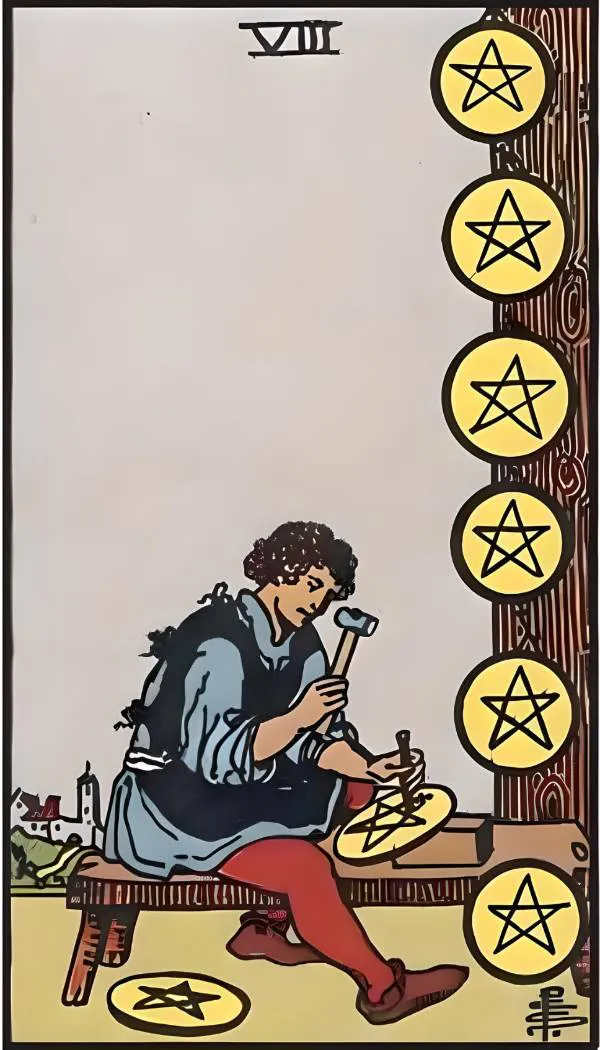
Study Life Boundary CreepThe seated craftsperson works inches from a bench while completed pentacles occupy the wall and another piece remains in hand. That concentrated workshop turns boundary creep into a visible daily system: each task is finite, but the production line is not, so study can expand into any physical space where the next piece might be completed. Because the work is upright and ordered, sequence, skill, and a visible workflow remain accessible to you; the image does not reduce the problem to insufficient effort. The friction appears when an efficient academic loop colonises meals, transit, and home, making competent participation look indistinguishable from permanent availability.
Premature Launch PressureOne pentacle is still under the chisel, yet several finished coins are already hanging where they can be counted. The worksite sits in public air, close enough to the town for output to become visible before the whole process is complete. In this timing context, the pressure comes from mistaking evidence of progress for permission to force exposure. You may have enough to show that the work exists, but the card's active center is still the unfinished coin, not the marketplace beyond the path. The reversed pattern warns against letting the visible row set an artificial deadline. The structure asks for a sharper distinction between a real launch window and the social pressure to convert partial readiness into an announcement, submission, commitment, or public promise too soon.
Family Crisis SpilloverThe seated craftsperson and carefully repeated pentacles depict learning built through protected attention and cumulative practice. Reversed, the sequence is continually broken: family updates enter reading sessions, assignments, and revision blocks, leaving you to restart material before it can settle into usable knowledge. You can be spending long hours at a desk without receiving the benefit of uninterrupted study. The missing resource is continuity, which explains why effort remains high while retention, completion, or confidence fails to grow at the expected rate.
Quantified Self BurnoutThe repeated pentacles, the worker focused narrowly on the next unit, and the distant town show a practice becoming increasingly absorbed in its own production process. Reversed, refinement turns into optimization without integration: the score improves, the streak grows, or the log becomes more complete, but the person is no clearer about what the activity is ultimately for. You may become highly skilled at maintaining the tracking system while feeling less able to recognize rest, nourishment, focus, or movement without its confirmation. The growth gap lies between technical consistency and lived wisdom. The card distinguishes practicing a supportive behavior from perfecting the record of that behavior.
Career Changer ReskillingThe craftsman bent over the seventh coin, hammer in one hand and chisel in the other, anchors work in repeatable practice rather than sudden status. Five coins already hang in a clean line, while one piece is still under construction and another waits near the bench, so progress is visible but not finished. In a career context, that layout maps onto reskilling: the external world is asking for proof, repetition, and usable artifacts before a new path becomes credible. You are not positioned at the castle yet; the card places you at the bench where transferable skill has to become demonstrable evidence.
Grad Application Reentry WindowThe craftsperson sits at a bench producing pentacles one at a time, with completed pieces displayed separately from the one currently under revision. This is the texture of rebuilding graduate applications program by program: revising one statement, verifying one prerequisite list, resending one transcript, and checking one portal rather than completing a universal form. The upright bench provides a workable production environment, and the repeated pentacles make progress countable. You can recognise that repetition does not make the outputs identical; each application requires another calibrated version of the same academic history. The card names the labour as skilled adaptation to institutional specifications rather than meaningless duplication.
Launch Window ReadinessThe row of completed pentacles gives the image a visible record of work already done, while the path to the distant town suggests a route from private production into a wider field. The craftsperson is not starting from zero; the card shows accumulated proof, remaining refinement, and a reachable external arena in the same frame. That combination makes this card a strong marker for launch readiness as a timing question. You are not being asked to move because the calendar is loud; the structure asks whether the work, the route, and the receiving environment have enough alignment to support the next stage. The unfinished coin keeps the reading precise. Readiness here does not mean flawless completion. It means there is enough real craft on the wall, enough process under your hands, and enough connection to the outer field for the next threshold to be assessed without confusing impulse with timing.
Delayed Reward Discipline DriftThe seventh coin is still being shaped while another piece waits nearby and the town remains at a distance. The scene shows effort before arrival, repetition before recognition, and work before the wider system gives anything back. In reversal, that interval becomes the pressure point. Discipline starts to drift when the routine keeps asking for output but does not return enough visible progress, relief, or life improvement to stabilize the loop. The card does not frame the drift as laziness. It shows a feedback problem inside the daily architecture: the body keeps paying into the system, while the reward, exchange, or completed stage remains too far away to renew the effort.
Rental Maintenance UncertaintyThe worker at the bench repeats the same craft task while completed pentacles are displayed in an orderly sequence. Reversed, the sequence loses its link to reliable workmanship and finished output, reflecting inspections that produce no fix, patches that fail, or outsourced visits that close the ticket without restoring the apartment. You remain inside the consequences of each incomplete attempt, repeating access arrangements and explaining the same defect when it returns. The inverted workshop names a quality-and-completion failure: labor may have occurred, but the maintenance system has not converted that activity into a durable, usable result for the home.
Skill Underutilization TrapThe pentacles prove that skill exists, yet the worker remains at the bench while the town sits at a distance. The card's space separates competence from wider placement, making the gap between ability and use physically visible. Skill Underutilization Trap belongs to the reversed texture of this image because the craft is active but contained. You may have built capacity, experience, or creative range, while the current option keeps that capacity in a narrow lane where it cannot produce mobility. For decision work, the card makes the hidden cost sharper. Staying may preserve routine and competence, but it may also keep your strongest tools from reaching the environment where they can actually change your position.