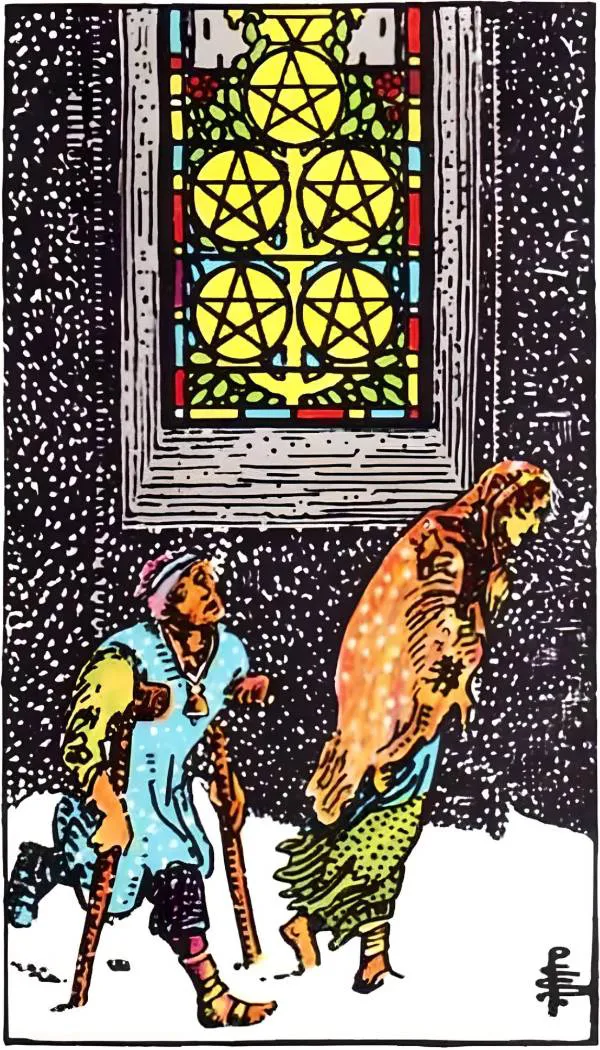
Conditional Belonging PressureTwo people move beneath a glowing window that displays shelter while withholding any obvious point of entry. In friendship, the image resembles being invited often enough to remain attached to the circle while emotional closeness, dependable support, and the right to make mistakes stay behind an invisible threshold. The pair outside the window also preserves companionship beyond the gatekeeping structure. The scene helps you measure friendship through usable access rather than visible affiliation: who follows up privately, who makes room for a boundary, and who remains connected when you are not entertaining, helpful, or immediately available.
Advisor Outreach ParalysisTwo figures move through snow outside a lit stained-glass window, placing visible institutional resources on one side of a hard environmental divide. The image resembles being able to see a professor, lab, funding stream, or graduate program online while lacking the relationship, script, or insider introduction that would make those resources feel reachable. The illuminated window matters because the opportunity is real, but visibility is not the same as access. You are positioned outside an academic support structure that expects you to initiate contact correctly before support becomes available, and the card makes the resulting exclusion legible as an access barrier rather than evidence that you do not belong in the field.
Compensation Comparison SpiralThe two figures move through snow beneath a bright stained-glass window marked by five pentacles, making material constraint and social distance visible at once. You may experience that distance when friends' weddings, trips, restaurants, neighbourhoods, or apartment choices assume a compensation level your current pay cannot support. The illuminated window keeps a form of social resource inside the upright frame even while access feels uncertain. The scene separates a real participation gap from total personal exclusion, showing how unequal financial settings can narrow where you can join the group without defining the whole of your belonging.
Family Resource GatekeepingThe pentacles are arranged in a bright, orderly pattern high in the window, while the people who need material support remain below in the street. The image is not simple lack; it is controlled visibility, where value is displayed but not distributed. Family Resource Gatekeeping emerges when money, housing, information, inheritance expectations, or emotional access are held by one part of the family and released only under certain conditions. The hierarchy may look respectable from the outside, but the lived experience is being kept near enough to know support exists and far enough to have no real say. The Five of Pentacles makes that power structure concrete. You can begin to separate personal worth from resource access, and resource access from family approval, so the gate can be named instead of internalized as failure.
Shared Decision ExclusionTwo figures huddle in the snow beneath a lit window, close enough to see shared shelter but still moving outside its threshold. The window, crutch, and narrow path make access itself the visible structure: someone controls when the room opens and what is decided inside. You are then left to rearrange meals, calendars, money, or travel around a settled choice while the result is still described as mutual. The material cost is not simply inconvenience; it is the repeated conversion of your time and resources into compliance with a process you could not enter. That scene keeps the audit factual. The problem is where participation sits in the sequence, not whether you can adapt after the fact.
DEI Trust GapThe two figures moving through snow, the illuminated stained-glass pentacles, and the inaccessible warmth behind the wall directly depict belonging that can be seen but not entered. Upright, the institution's symbols remain bright and close, which makes exclusion more legible rather than less real. You may appear inside the organization's diversity story while still remaining outside the informal network where support, context, and credibility circulate. The Five of Pentacles anchors the social trust gap in access: the promise is publicly visible, but the route into practical belonging is missing or obscured.
Unscaffolded Learning EnvironmentThe crutch, torn clothing, bare winter road, and hidden architecture create a scene where the body must keep moving without enough external support. The tool in hand is not a full system; it is a substitute for what the environment fails to provide. In study, this describes the class, thesis process, lab, or self-directed program that demands output while offering too little pacing, feedback, or usable structure. You may be working hard, but the card shows how much of that effort is being spent inventing the scaffolding that should already be there.
Emotional Dumping FriendshipThe injured figure leaning on a crutch and the huddled companion move through a storm without real shelter. Their closeness offers some human warmth, but the environment around them gives no replenishment; the bond is being asked to function while both bodies are already exposed. That visual pressure maps cleanly onto emotional dumping inside friendship. You become the person walking beside someone through every crisis, every late-night spiral, every repeated collapse, while the wider support structure remains unused or unavailable. The friendship still looks intimate, but its operating condition has become scarcity. Five of Pentacles does not shame care. It shows what happens when care has no container, no rotation, and no recovery space. The card makes visible the point where being a loyal friend turns into being the only shelter someone keeps returning to.
Resource Gatekeeping RoleThe five pentacles are not missing; they are arranged in a formal window above the street. Their order and brightness matter because the resource exists, but it is positioned behind a boundary that the figures cannot cross. Resource Gatekeeping Role appears when access to information, sponsorship, budget, training, or visibility depends on someone else’s control of the doorway. You can see what would help your work, but you are made to operate from outside the circle where allocation happens. The Five of Pentacles links this directly to career power. The hardship is not only that resources are limited; it is that the system displays legitimacy while quietly deciding who gets warmth, entry, and usable support.
Friendship Boundary CreepThe two figures do not collapse in place; they keep moving through the snow. That continued motion is important, because the hardship becomes normalized as a route, not a single event. Friendship boundary creep works the same way. One extra favor, one late reply, one crisis call, one exception after another gradually turns the path itself into exposure. There is no clear moment where the boundary breaks; the friendship simply trains you to keep walking in conditions that give you less and less room. Five of Pentacles makes that slow erosion visible. The card shows how a bond can remain active while becoming physically and socially unsustainable, and it invites you to locate where care stopped having a threshold.