Queen of Swords Tarot Card Meaning

Overall Composition

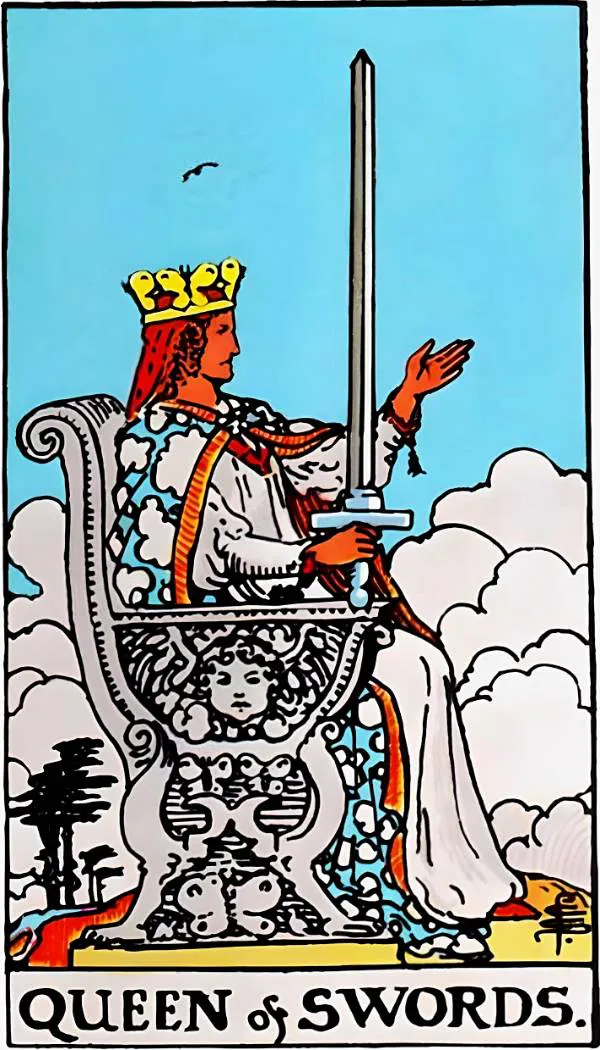
This stern-faced woman stands sideways to us, her face turned to the right side of the scene, holding a sword aloft with her right hand. Her left arm is extended high, making the XXXX gesture, with a serious and solemn expression.

The Queen wears a golden crown on her head, dressed in a white robe, and draped in a cloak with a cloud pattern on a blue background. The top of the chair back rolls backward, and there is an angel's head on the armrest, with the chair legs carved with butterflies.

The woman's seat is located in the wilderness, and you can see a few trees in the distance behind her.

The clouds hang low over the ground, and in the desolate sky above, a solitary bird can be seen flying in the distance.

She is the Queen of Swords.

Detailed Pattern Description

The Queen of Swords has a mature face with closely spaced features, indicating that she is accustomed to immersing herself in her thoughts and is not very outgoing. Her facial contours are not very prominent, but her nose seems to be hooked inward, reflecting a meticulous and restrained personality. At the moment, her eyes and mouth corners are drooping, showing a deep and heavy expression, which is a manifestation of a negative emotion. The Queen in the picture is sitting sideways, holding a sword in her right hand, and her left hand is extended, making a determined gesture. The Queen's posture is upright, indicating her persistence and endurance, and of course, she is serious and not easy to approach.

The Queen holding the sword is not gentle and kind, but may be punishing others. The sword in the Queen's hand is very long, and she holds the hilt close to the armrest of the seat, indicating a strong defensive mentality. The Queen's upright long sword indicates her reliance on the power of the sword. Her expression shows an understanding of sorrow, and her overall posture presents a calm observation of the world and maintains a distance and defense.

The Queen wears a golden crown with a round edge, on which two red flowers are seen, indicating that there is still a passionate side on the spiritual level. The red hood covers her brown hair, indicating that she tries hard to hide her thoughts. The white robe signifies purity and nobility, and also implies a sense of distance from others. Her shawl is blue with white clouds, and the shawl falls to her feet, symbolizing that she wears the sky on her shoulders.

The Queen sits on a stone chair, the top of the chair back rolls backward, and the entire seat is such an elegant shape. From the side, it is also engraved with many patterns, with an angel face and wings under the armrest, indicating the loving aspect of being a woman. Below the angel are two small butterfly patterns, and at the bottom is a large butterfly. Butterflies are the symbolic objects of the Sword Court cards, indicating the interweaving of emotions and reason and transformation.

The Queen's seat is located on a hill higher than the clouds, and the clouds around the Queen are very thick, seemingly wrapped around her. This is a portrayal of her mood, but the sky above her head is clear, indicating that her mind is still clear and rational. The background seen from behind the seat has a few trees, and under the trees is a small section of water flow, vaguely showing the Queen's emotional expression and her cherishing of life. There is a lone bird flying in the distance in the sky, and the bird is also a symbolic object of the Sword Court cards, indicating that the Queen's thoughts and imagination can still travel freely in the vast space.

The Figure of the Queen

The Queen in the card represents mature wisdom, intellectual clarity, and a keen sense of justice. Often perceived as a widow or someone who has undergone deep sorrow, she embodies strength, independence, and rationality. With a demeanor that may appear cold or distant, she advises cutting through emotional fog to make clear, reasoned decisions.

Sword

The sword she wields is a symbol of her intellect, clarity, and decisiveness. It also serves as a tool of discernment, cutting away falsehoods and unnecessary distractions.

Throne

The Queen sits upon a throne, signifying her authority and sovereignty. The throne itself is adorned with clouds and butterflies, indicating her dominion over both thought and transformation.

Butterflies on the Throne

The butterflies that decorate her throne are symbols of transformation, embodying the notion that wisdom and understanding come through life experiences and the process of change.

Severed Head on the Throne

Some depictions feature a carving of a severed head on her throne, indicating her capacity to sever ties when necessary and make hard but just decisions.

Cloudy Sky

The sky behind the Queen is cloudy but not stormy, symbolizing the trials and tribulations she has experienced and mastered. The clouds also denote her realm of thought and intellectual pursuits.

Hand Position

Her hand is often extended as if offering wisdom or perhaps a warning. This symbolizes her openness to sharing knowledge but also her unwavering commitment to truth, even when it is harsh.

Psychological patterns in Queen of Swords
Emotional Cutoff
The same upright sword that can clarify a boundary can also become a frozen wall when the Queen's body remains rigid on the stone throne. Her open hand no longer reads as contact; it reads as a stop sign held at the exact place where someone might get close. In a social circle, the cutoff loop turns disappointment, awkwardness, or perceived judgment into immediate withdrawal. You regain control by going silent, leaving the group chat, or deciding people are not worth the effort, but the pattern closes the door before repair has enough evidence to appear.
Boundary Discernment
The Queen's upright sword and extended left hand form a visible gate: one part of her holds a clean line, while the other decides what may enter the field. Her throne, robe, and sideways posture keep the outer landscape at a deliberate distance, so access is filtered before action begins. Boundary Discernment grows from that physical gatekeeping. When timing pressure builds, the psyche can confuse other people's urgency with a real opening; this pattern gives you a way to separate a true signal from borrowed momentum before you spend your energy.
Intellectualization
The sword rises as a precise vertical line through the air, while the Queen sits composed above the cloud layer. The scene does not erase emotional weather; it places it below a disciplined field of thought. That is the architecture of Intellectualization. Feeling is translated into analysis, categories, rules, and systems so it can be handled without flooding the body. In lifestyle questions, this can create genuinely useful clarity, but it can also turn burnout into another planning project. The card asks you to notice when the spreadsheet, routine, or reset plan is solving the structure, and when it is keeping the emotional truth at a distance.
Truth Weaponization
The sword is held high rather than resting, and the Queen's extended hand carries the force of warning as much as invitation. The throne, crown, and blade combine into an elevated structure of judgment, with little softness in the surrounding sky. This is the moment where truth can stop being a tool of clarity and become a weapon against the softer parts of the self. You may call the attack honesty because the language sounds precise, but the effect is still cutting. Truth Weaponization shows up in introspection when insight is used to punish desire, uncertainty, tenderness, or old hurt before those parts can speak. The card does not remove the value of truth; it reveals the cost of aiming truth at the wound instead of the confusion around it.
Analysis Paralysis
The sword is held perfectly upright, and the Queen's extended hand makes the scene feel paused at the moment before a verdict. Nothing in the card is casual; even the body seems arranged around evaluation, precision, and the right to decide. That stillness can become a mental bottleneck in academic work. You may keep searching for the cleanest thesis, the safest citation, or the most defensible structure because action feels premature until every possible objection has been neutralized. Analysis Paralysis belongs to this card because the visual intelligence is real, but it is also immobilizing. The sword can cut through confusion, yet in this pattern it keeps hovering above the page, turning preparation into a substitute for contact with the work itself.
Perfectionism
The crown, throne, and upright sword create a visual architecture of exacting standards. The Queen does not lean into experiment or mess; she sits above the cloud line as if the mind must stay clean, elevated, and formally defensible. In academic life, that image maps onto a system where work is not allowed to be rough before it becomes refined. You may treat a first draft like a final defense, making every imperfect sentence feel like evidence against your competence. Perfectionism is anchored here because the card's strength becomes rigid when the standard becomes the self. The same clarity that can support excellent scholarship can also turn learning into surveillance, where producing anything unfinished feels like stepping down from the throne.
Black-and-White Thinking
The upright sword divides the open air into a single line of judgment, while the Queen's solemn face offers little softness around the verdict. The scene favors clean separation over blended terrain. Black-and-White Thinking turns a crossroads into a courtroom: one path becomes right, the other wrong, and nuance feels like weakness. In a choice reading, this pattern shows where the mind is using sharpness to escape ambiguity. The blade can clarify, but it can also erase the third option before you are calm enough to see it.
Certainty Seeking
The single vertical sword draws a clean line through a sky that is not fully clear below. Around the throne, cloud and air coexist, but the blade tries to make one truth stand above the mixed field. Certainty Seeking grows from that split: the mind wants a final sign, a verdict clean enough to remove responsibility from the choice. In a crossroads reading, this pattern reveals the hidden bargain of waiting for perfect proof: it protects you from regret, but it also keeps the decision outside your own authority.
Emotional Gatekeeping
The Queen's open hand is not fully soft and not fully closed; it hovers like a gate. The upright sword stays beside it, making any approach pass through discernment, language, and proof before it reaches the person seated behind the boundary. That guarded threshold is the logic of Emotional Gatekeeping. In friendship, this pattern makes intimacy feel like something friends must qualify for, so You may test their self-awareness, consistency, or truthfulness before letting them see the vulnerable material underneath the composed exterior.
Inner Critic
The Queen's stern expression, high seat, and upright blade create the image of a mind that can evaluate with precision. In reversal, that evaluating function turns into a private court where ordinary human limits are judged as character flaws. The Inner Critic sharpens discernment into accusation. It does not simply notice a missed routine, an untidy room, or an exhausted morning; it converts the evidence into a verdict about worth. In lifestyle readings, this card reveals where the problem is not a lack of discipline but a punitive interpretive system. You may need clearer structure, but the deeper audit begins with the voice that turns every maintenance task into a moral trial.
Core Struggles in Queen of Swords
Timing Control Strain
The raised sword becomes a rigid measuring line when the card is turned inward: one vertical standard trying to organize clouds, distance, and moving signals. The throne holds the body in place while the surrounding field refuses to become a timetable. You may be trying to remove uncertainty by tightening the clock inside your head. The struggle sits where discernment hardens into control, and timing becomes something to dominate rather than something to read.
Boundary Rigidity
The sword stands close to the Queen's body while her seat rises above the low clouds, separating her from the ground-level world. The open hand can read less like invitation and more like a controlled perimeter that determines what may approach. In self-development, that structure shows protection hardening into a growth ceiling. The boundary that once helped you think clearly now filters out challenge, feedback, and uncertainty, so your evolution stays safe but increasingly airless.
Boundary Control Strain
The Queen’s sword is not swung; it is held upright as a boundary line beside a body that remains composed and seated. Her other hand reaches outward, but the throne, the height, and the blade keep every approach measured. This is the physical grammar of wanting to remain fair without becoming endlessly available. You can care about a friend and still feel the need to regulate access, tone, timing, and emotional load before the exchange overwhelms your private space. The struggle appears when every boundary has to be calibrated so precisely that connection starts to feel like a controlled entry point. The card locates the pressure in that narrow band between protection and openness, where one more exception can turn generosity into self-erasure.
Life Audit Exhaustion
The Queen holds the sword like a measuring edge above clouds that never fully clear around the seat. Her posture is precise, but the scene also shows the cost of staying in review mode: the hand keeps signaling, the blade keeps defining, and the body remains in a formal position of judgment. When the daily life audit becomes endless, every routine starts to feel like evidence. The card names the exhaustion of being both the person trying to live better and the evaluator constantly deciding whether that life has been improved enough.
Truth-Connection Split
The Queen's sword rises in a straight vertical line while her open hand reaches outward, so the card holds speech and contact in two different channels. The blade can clarify, name, and separate; the hand can invite, warn, or ask for a response, but neither gesture fully becomes the other. In love, that split becomes the moment before a hard conversation when truth feels clean in the mind and dangerous in the bond. You are not simply deciding whether to speak; you are standing inside a structure where honesty seems to protect your integrity while threatening the warmth you still want to keep.
Inner Tribunal Lock
The throne, crown, and sword assemble a private court before any outside opponent appears. The Queen's raised blade does not merely separate options; it creates a standard that every option must survive. In a choice reading, that structure becomes an inner tribunal. You may not be waiting for more information as much as you are waiting for a verdict pure enough to silence self-blame, and that courtroom keeps the decision under review long after the real evidence has arrived.
Clarity-Exposure Split
The throne is set above the thick cloud layer in open wilderness, with the sword raised into clean air and very little shelter around the Queen. The same elevation that gives her a clear line of sight also leaves the figure exposed on a high, spare ridge. Clarity-Exposure Split emerges when seeing the truth of your inner life also removes the fog that was protecting you from it. The card does not frame truth as simple relief; it shows truth as a height where you can finally see, but where hiding from what is seen becomes impossible.
Truth-Compass Split
The Queen holds the sword upright while her gaze travels sideways into open air. The blade gives a clean vertical axis, but the road itself is missing; the hand that reaches outward does not become a step. The struggle forms where truth and orientation stop being the same thing. You may know which narratives are false, which expectations are borrowed, and which compromises no longer fit, yet that knowledge still does not tell the body where to go next. Queen of Swords names a direction crisis built from too much precision around truth and too little conversion into trajectory. The card does not blur the future; it shows the painful gap between seeing clearly and feeling pointed.
Pain-Logic Fusion
The sword rises from a face that has learned to hold a lot of weather without spilling it. Clouds sit on the Queen's cloak, butterflies are carved into stone, and the small signs of water and life remain distant behind the throne. This is not raw emotion overruling reason; it is reason built around what once had to be survived. You can start using past pain as the instrument that measures every future path, until the route that feels safest also becomes the route least alive. The Queen of Swords gives this struggle a precise shape: sorrow has not disappeared, it has been converted into judgment. Direction becomes difficult because the mind keeps mistaking protection for orientation.
Strategy-Integrity Split
The Queen sits on a stone throne with a raised sword in one hand and an open, warning hand in the other. The blade is vertical, clean, and public, while the open hand reaches toward the social field without giving up the right to separate truth from noise. That posture mirrors the career pressure of knowing what is accurate while also knowing that accuracy alone does not move through workplace power untouched. You may see the obvious flaw in a process, the political reason a decision is being delayed, or the difference between a real strategy and a polished story, but naming it directly can change how safe your position feels. Strategy-Integrity Split appears here because the card holds tactical awareness and inner truth in the same body. The struggle is not whether you know what is true; it is how to keep your professional line intact while moving through systems where truth has to survive timing, framing, hierarchy, and consequences.
Inner Emotions in Queen of Swords
Hard-Won Composure
The upright spine, steady sword hand, and extended palm create a body that has learned to stay still inside weather. The clouds hang low, but the blade remains vertical and the throne remains intact, turning composure into a held structure rather than a soft mood. In the work of self-development, this points to the kind of steadiness that only appears after repeated inner corrections. You are not drifting into calm; you are maintaining it with discernment, restraint, and a clear refusal to let old mental static set the terms again.
Solitary Clarity
The Queen's face turns away from the viewer while the sword rises in a clean vertical line, and the single bird moves through a wide sky without company. The scene does not blur; it separates, orders, and gives distance to what would otherwise stay tangled. That visual structure mirrors the moment when a friendship dynamic becomes painfully readable. You can see who is avoiding honesty, who is overgiving, and where the connection has stopped being mutual, but the clarity itself places you slightly apart from the group story everyone else is still performing. Solitary Clarity belongs here because the Queen of Swords holds truth without making it socially comfortable. The feeling is not coldness for its own sake; it is the quiet isolation of seeing clearly before the relationship has caught up to what you already know.
Intellectual Loneliness
The Queen sits above the low clouds with a lone bird crossing the distant air. Her gaze is fixed away from the viewer, and the space around her mind appears wide, clear, and sparsely populated. In a relationship, that visual distance becomes the inner experience of understanding the pattern without feeling accompanied inside it. You may be able to name the mismatch, the subtext, and the exact point where communication breaks down, yet still feel alone because the other person cannot or will not meet you at that level of honesty. The sword gives language to the truth, but the hilltop keeps the body separate from the warmer ground below. Intellectual Loneliness is the ache of having accurate perception without shared emotional presence.
Protective Indifference
The sword is clean, the throne is stone, and the Queen's white robe keeps the body visually separate from the surrounding clouds. The whole image is built from edges, surfaces, and distance rather than softness. Protective Indifference appears when not caring becomes the only way to keep family contact from taking over your inner room. The card frames that coldness as a boundary layer: not the full truth of your heart, but a temporary structure that stops old expectations from walking straight through you.
Sterile Clarity
The upright sword, the white robe, and the Queen's severe sideways profile create a scene where thought has been cleaned of noise, softness, and distraction. Her body does not lean toward the world; it holds a vertical line of judgment from the throne, as if every excess feeling has been cleared away so the decision can be inspected without distortion. In a choice reading, that visual coldness becomes the emotional weather of Sterile Clarity. You may be able to name the logical answer with unusual precision, yet feel strangely removed from the living parts of the decision: desire, grief, attachment, and the quiet pull of what you actually want. This card does not turn clarity into comfort. It reveals a state where the mind has become sharp enough to cut through the fog, but the cut itself leaves the atmosphere bare, exposing the cost of choosing with clean eyes.
Truth Relief
The upright blade cuts a clean line through the air, and the Queen's gaze turns toward the open side of the scene. Above the low clouds, the space around her crown is clear enough for a single thought to stand without distortion. That visual order carries the emotional release of naming what is real about your direction. A goal can be impressive and still not belong to you; a path can be praised by others and still feel misaligned when the inner evidence is finally allowed to speak. Truth Relief comes from the moment the sword stops being only defensive and becomes clarifying. You are not being pushed into a dramatic answer; the card reflects the quiet exhale that arrives when the unnecessary path can finally be set down.
Defensive Loneliness
The sword rises close to the armrest while the clouded cloak falls around the body like weather worn as armor. The angel face and butterflies are carved into stone, protective in outline but fixed, silent, and unable to move toward anyone. That structure shows a direction crisis where distance becomes the only available way to protect the inner signal. You may pull back from advice, feedback, or emotional input because too many voices have started to feel like interference rather than support. Defensive Loneliness forms when the boundary does its job too well. The card reflects the private cost of staying untouched: the future feels safer to examine alone, but the solitude also starts to harden around the very clarity it was meant to protect.
Disciplined Calm
The Queen's upright spine, raised sword, and settled throne create a body that is not relaxed in a soft way, but organized. Every line in the card is held with intention: the sword goes straight up, the left hand sets a clear signal, and the seated posture refuses to spill into the surrounding clouds. That visual structure maps directly onto a lifestyle system that finally has edges. You are not being asked to feel endlessly motivated; the card reflects the quieter state that appears when your day has enough order to stop negotiating with every demand. Disciplined Calm belongs here because the Queen's clarity is embodied rather than decorative. Her composure is built through boundaries, clean decisions, and a refusal to let daily noise run the room.
Boundary Guilt
The Queen's sword rises in a clean vertical line while her other hand extends outward, making the boundary visible before any explanation begins. Her body is upright, controlled, and slightly turned away, as if contact is allowed only through a clear line of discernment. In a family system, that line can feel costly because closeness has often been mixed with obligation. Boundary Guilt grows where you can see the necessary limit, yet part of you still registers the limit as emotional disloyalty. The card gives that guilt a shape: not proof that the boundary is wrong, but evidence that the old family script is still pressing against your autonomy.
Suppressed Resentment
The tight mouth, compressed grip, and red hood under the crown give the figure a sealed quality. The water and trees remain distant while the butterflies are fixed in stone, so movement and softness appear present but locked outside the Queen's immediate reach. In social life, this is the feeling of saying yes while an inner no hardens behind the face. The card gives that hidden pressure a shape: the resentment is not random hostility, but stored boundary information from too many moments where access was granted before capacity was checked.
Outer Contexts in Queen of Swords
Strategic Exit Window
The queen's blade is upright, but her other hand is extended as a boundary rather than an invitation. The throne holds her steady in open terrain, creating a visual chamber where a clean line can be drawn before the surrounding weather closes in. That image maps onto an exit window because leaving well is rarely just about wanting out. It involves timing, evidence, communication, and the ability to stop renegotiating with a structure that has already shown its cost. The card gives the exit a strategic shape. You are not being pushed into impulsive escape; the scene points to a controlled separation where the decision becomes stronger when it is made before exhaustion, guilt, or outside pressure starts making it for you.
Critique Panel Pressure
Sideways on the stone throne, the Queen holds a vertical sword while her other hand marks a controlled opening. The image is built like an academic defense room: one figure has the criteria, the blade, and the right to ask for precision while the work must survive contact with formal judgment. For You, this maps to the pressure of critique panels, seminar presentations, thesis defenses, or supervisor meetings where thought has to become publicly defensible. The card does not frame the pressure as personal inadequacy; it reveals an external assessment structure that demands clarity, evidence, and composure before it grants recognition.
Rigid Life Script Lock-In
The raised sword can become a rigid rule line, and the throne can become a public role that must be performed correctly. In this reversed structure, the Queen's composure hardens into a posture of constant evaluation rather than flexible judgment. That is the reality of a life script that once looked legitimate but now keeps your direction locked inside one approved shape. The card exposes the external architecture around the script: status, scrutiny, and inherited criteria all working together to make revision feel socially expensive.
Emotional Dumping Friendship
The cloud-patterned cloak falls over the Queen’s body as if the atmosphere itself has become something she has to carry. Her hand is open, but the sword beside it shows that unlimited access would turn that openness into a burden. In a friendship, this is the shape of repeated emotional unloading without consent, timing, or return. You are placed in the role of processor, interpreter, and stabilizer while the other person treats closeness as permission to pour everything into the same channel. Emotional Dumping Friendship is anchored in the reversed pressure of this card because the Queen’s clarity becomes trapped under social weather that is not hers to manage. The card makes the imbalance visible so the friendship can be judged by reciprocity, not by how much one person can absorb.
Friendship Boundary Reset
The Queen sits sideways with a sword held straight up and one hand extended, creating a visible threshold rather than an open embrace. In a friendship context, that posture turns closeness into something that has to pass through a named boundary, not an automatic right of access. The clouded cloak, elevated throne, and clear sky above her head show a person separating social weather from clear judgment. You are not looking at a friendship that needs more vague patience; you are looking at one where the terms of access, response time, emotional labor, and privacy have to be made explicit. This is why the card fits a Friendship Boundary Reset. The friendship may still matter, but the old access pattern has stopped working, and the real task is to redraw the perimeter without pretending the previous arrangement was sustainable.
Harsh Honesty Fallout
The sword rises cleanly, but it rises above a severe face and a high stone throne. In the reversed texture, truth is still present, yet it arrives from a height and lands with the edge of judgment. In love, this fits the fallout after someone says the technically accurate thing in a way the relationship cannot absorb. The content may name a real issue, but the delivery turns the moment into a hierarchy where one person becomes the evaluator and the other becomes the subject under review. The card's structure helps separate honesty from impact. It shows that clarity can expose what is real while still damaging the conditions needed for closeness, repair, and future speech.
Decision Criteria Black Box
The sword promises clean judgment, yet the low clouds and mixed hand signal create a field where the rules are hard to read. One gesture appears to invite contact while the blade keeps evaluation suspended over the scene. This connects directly to a Decision Criteria Black Box in direction work. You are being asked to choose a future-facing route, but the standards for a good choice keep shifting behind the clouds, making the real blockage the hidden rule system rather than your ability to decide.
Boundary Backlash
The side-facing throne, extended hand, and defensive sword create a narrow point of entry around the Queen's body. The image shows a boundary that is visible enough to be challenged, not a private preference hidden inside the figure. Boundary Backlash forms when a group treats your limit as a disruption to its old access pattern. The hard stone seat and raised blade give the conflict shape: the pressure is coming from a social system that wants the old doorway reopened, while the boundary is trying to make access explicit.
Silent Evaluation Period
The Queen's face remains sealed while the sword stays upright, and the clouds sit low beneath her elevated seat. Nothing in the scene rushes forward; the whole composition holds judgement in suspension. For You, that becomes the academic waiting room after a submitted essay, exam, portfolio, or application has left your hands. The silence is not empty; it is a controlled institutional pause where grades, comments, or acceptance signals have not yet returned, leaving your mind pressed against an unseen standard.
Strategic Social Exit
The Queen of Swords sits side-on above the low clouds, sword raised and one hand extended as if controlling the terms of approach. The image makes social access selective: contact is possible, but only after the boundary has been named and the room has been assessed. For a draining social circle, that visual structure maps onto a strategic exit rather than a reactive disappearance. You are not dealing with a simple preference for solitude; the throne, blade, and clear upper sky show a moment where distance becomes the only way to recover clean judgment about who gets your time.