Knight of Wands Tarot Card Meaning

Overall Picture Structure

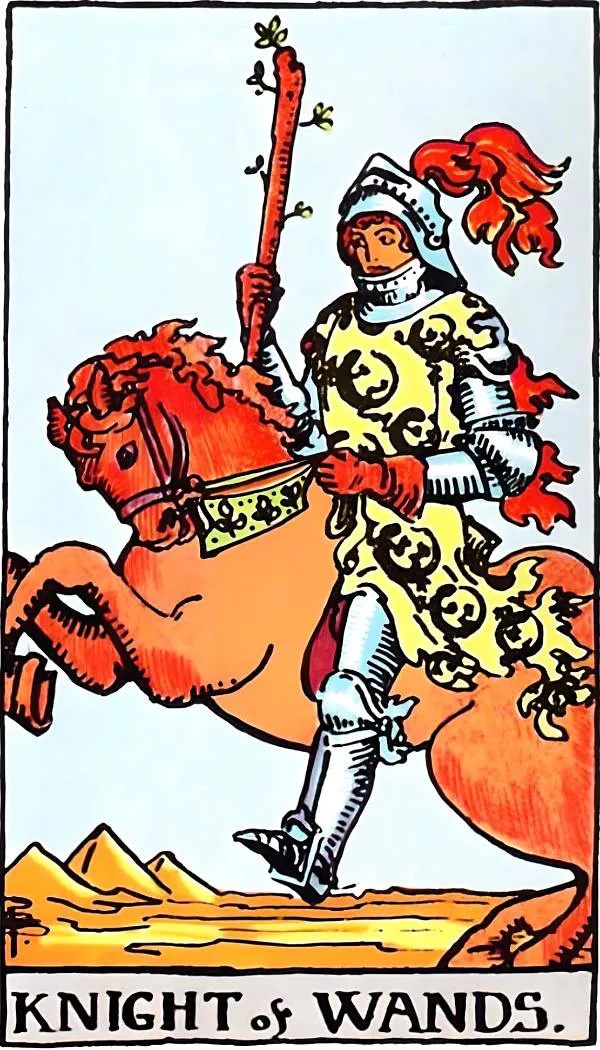
The scene features a vigorous young man showcasing his valor and martial prowess as he stands his red horse on its hind legs. This is the Knight of Wands.

Holding the wand in his right hand and the reins with his left to control the horse, the Knight of Wands is highly skilled. He is about to embark on a journey with his steed, which might be the starting point or a moment of reining in after a temporary halt.

The horse is equipped with only a simple bridle and saddle, with no extra gear. However, the knight himself is dressed meticulously, wearing full armor and a yellow tunic marked with a salamander emblem, with a red plume hanging down from the top of his helmet.

The setting is in a desert land with pyramids and small dunes in the distance, visible from the bottom left corner of the picture beneath the horse's front hooves.

They are about to set off on a journey.

He carries a purpose in his heart and a mission on his shoulders, with a clear destination in mind.

Details and Symbolism

The Knight of Wands has a clear facial outline and features, with an expression full of pride and confidence. His demeanor is upright and imposing, and his red hair often signifies a passionate and direct nature. The red horse's posture of lifting its front leg is the initial movement before a run, indicating the start of a journey. This posture vividly illustrates the Knight's character, his eager and urgent mood, and reveals his active and energetic side.

The knight holds the wand upright, close to his side and raised forward, signifying the importance he places on honor and glory, and not neglecting to display it before others. Although fully armed and carrying this shorter wand, he is not on a military mission (combat), but rather has a task at hand. The tunic embroidered with the salamander pattern indicates his origin and pride. Although carrying a wand, he is not about to fight, but rather seems to be proclaiming glory and his own position. The salamander emblem on the yellow tunic is a symbol of the fire element and also signifies that he is the master of the desert. The red plumes on the top and back of the knight's helmet further highlight his fervor and enthusiasm, with boiling passion in his heart.

With his left hand, he pulls the reins, standing his red horse, while he remains upright and stable on the horse, indicating his exceptional skill and full confidence. The red horse represents a dynamic vitality, containing abundant power and energy.

The card's imagery is a bright and fiery red, with the knight's hair, gloves, and the hanging tassels of his helmet, the orange-yellow garment over his armor, and both the wand and the horse being red or brown. Even the setting is no exception, a yellow earth. These bright and cheerful hues all describe energy, power, and heat.

In the distant background, the three great pyramids appear, indicating that the Knight of Wands is traversing the desert, but there may be valuable content to explore within. The pyramids are positioned beneath the horse's hooves, which belong to the realm of the fire element wand court cards, and this ancient civilization's desert is the land he is about to step on and conquer.

The Fiery Steed

The horse that the Knight rides is a symbol of fiery passion, exuding an energy that is both restless and directed. This creature embodies the emotional and spirited aspects of the journey the Knight is on, urging us to consider the nature of our own pursuits and the force that drives them.

The Wand

The wand held by the Knight is aflame, further emphasising the fiery element associated with this card. The wand acts as a tool of will, showing that the Knight is a person of action, not just talk. It represents ambition, initiative, and the creative drive to manifest one’s desires.

Desert Background

The barren landscape behind the Knight suggests a willingness to cross unfriendly terrain in pursuit of his passion or goal. It implies that the task may not be easy, but the vigor and enthusiasm that the Knight possesses make the challenge surmountable. It also calls attention to the focus and determination required to pursue one’s objectives, despite obstacles.

The Knight’s Armor

The armor worn by the Knight indicates a preparedness for whatever challenges may come his way, but also a form of restraint. Even as he is driven by his passions, he is not entirely without defenses or caution. The armor symbolizes the balance between impulsivity and protection, hinting at the need to act decisively but also wisely.

The Salamanders

Small salamander-like shapes adorn his cloak, signifying transformation and adaptability. Salamanders are creatures of fire in alchemical symbolism, indicating the Knight’s affinity with this element. Their inclusion suggests that the Knight, while impulsive, also has the ability to adapt and evolve, which is essential for any journey of significance.

Psychological patterns in Knight of Wands
Action Bias
The red horse lifts into the instant before motion while the knight keeps the wand upright and the reins tight. The whole body is organized around launch: heat is gathered, attention is narrowed, and uncertainty is converted into a visible readiness to move. Action Bias appears when that launch posture becomes the default answer to career pressure. You may respond to a blocked promotion, vague feedback, or under-recognized skill by doing something immediately, because movement feels cleaner than sitting with the strategic ambiguity of the terrain. The card ties the pattern to a specific psychological mechanism: action becomes a defense against waiting, mapping, and negotiating. In a career field, the audit is not whether ambition exists; it is whether speed is serving strategy or protecting you from the discomfort of not yet knowing the smartest route.
Reactive Overcorrection
The reins pull back, but the horse's body is still committed to the surge. The whole posture is a stop-go mechanism, trying to correct momentum after it has already gathered force. In friendship, that mechanics can appear after a long period of quiet tolerance. You may absorb too much, say nothing, keep showing up, and then suddenly cut off, cancel, confront, or draw a boundary with far more force than the immediate moment explains. Reactive Overcorrection is not the presence of a boundary; it is the delayed release of a boundary that was never allowed to arrive in time. The image shows why the correction feels powerful but can still miss the precise point of repair.
Conflict Escalation
The knight's raised wand, bright armor, and rearing red horse create a scene where energy goes upward before it goes anywhere useful. The body is ready, visible, and charged, but the first message of the image is intensity. Conflict Escalation takes family contact and converts it into a contest of force, tone, or moral certainty. You may enter a conversation wanting clarity and find yourself defending territory, attacking the premise, or matching the family's volume. The card links this pattern to heat without enough grounding: the will is strong, but the exchange becomes a battlefield before the actual need is named.
Urgency Bias
The red horse is already lifting off the ground, while the knight keeps his wand upright and his body set toward departure. Nothing in the scene is built for waiting; the open desert makes movement feel like the most available container for all that heat. That visual pressure maps onto a mind that treats uncertainty as a command to act. In friendship, You may send the text, force the conversation, name the boundary, or demand clarity before the relationship has had enough space to process what actually happened. The pattern is not simply initiative. It is the nervous system outsourcing safety to velocity, where moving fast starts to feel like being honest, and pacing begins to operate as a covert pressure on the friendship.
Fresh Start Fantasy
The horse is caught at the charged instant before movement becomes a sustained journey. The wand, plume, and bright desert heat all intensify the feeling of a beginning, while the actual road ahead remains largely empty and untested. Fresh Start Fantasy turns the launch moment into emotional relief. A new plan, new identity, or new system promises a clean break from friction, but the psyche is often trying to skip the less glamorous work of repairing the old pattern that will travel with you anyway. In personal growth, this shows up as repeated self-reinvention that feels profound at the start and strangely familiar a few weeks later. The card links the fantasy to the suspended horse: the system loves the lift-off because lift-off has not yet demanded consistency.
Novelty Seeking
The knight is not shown arriving; he is shown at the edge of departure. His wand is raised, the horse is energized, and the desert opens into a wide field where movement, heat, and possibility dominate the frame. This is how Novelty Seeking enters a decision. The new option gathers emotional brightness because it promises aliveness, expansion, and a refreshed sense of self. The risk is not desire itself; the risk is that novelty becomes a cognitive shortcut, making the unfamiliar path feel more honest simply because it is not the old one. The minimal gear on the horse sharpens the audit. The image has plenty of fire, but not much evidence of long-range provisioning. In a choice spread, the pattern asks whether the exciting option still holds its shape after the first surge fades and the real maintenance costs begin.
Commitment Avoidance
The red horse is suspended between launch and restraint, with the Knight high above a barren open field and no settled structure around him. The image has motion, heat, and confidence, but almost no sign of staying power or shared shelter. When reversed through a relationship lens, the same force can turn closeness into a pressure to flee. You may begin with intensity because movement feels alive, then pull back when the relationship asks for rhythm, repetition, and emotional availability rather than pursuit.
Social Overextension
The red horse is already rearing before the journey has truly begun, and the knight holds the wand and reins as if the next social move is already decided. The card is full of ignition: plume, horse, desert heat, raised wand, and a body organized around departure rather than rest. That visual charge maps onto a coping mechanism where movement becomes regulation. In social life, You may use constant invitations, group chats, events, introductions, and collaborations to avoid the quieter question of which connections actually fit Your nervous system. Social Overextension is not simple popularity or enthusiasm. It is the moment when visibility, motion, and availability become a defense against the fear of being outside the circle, leaving You surrounded by contact but short on real replenishment.
Forced Progress
The red horse rises while the knight pulls the reins, so acceleration and restraint occupy the same body. The rider is not simply moving forward; he is holding an unstable surge in place. The image captures effort that looks heroic while remaining mechanically tense. Forced Progress emerges when forward motion becomes compulsory even after the system has stopped absorbing it. In lifestyle terms, the body may be asking for recovery, the home may be asking for simplification, and the schedule may be asking for fewer commitments, yet the inner command still demands another reset, another push, another proof of discipline. This card's reversed pressure is not passive failure; it is overactivated willpower. The audit point is the difference between momentum that carries You and momentum You must constantly force through tension, guilt, and fear of falling behind.
Timing Discernment
The red horse rises with its front legs suspended, but the knight does not spill forward with it. His armor, upright spine, taut reins, and raised wand show a body holding heat at the exact edge of movement, where impulse has not yet become action. That suspended posture is the psychological core of Timing Discernment. The card does not remove desire; it organizes desire through restraint, sensory reading, and moment-to-moment control. You can feel the urge to move without treating the urge itself as evidence that the timing is right. In timing work, this pattern names the difference between momentum and readiness. The knight's fire is real, but the reins show that fire still needs a rhythm, a terrain reading, and a launch point that matches the field ahead.
Core Struggles in Knight of Wands
Relational Pacing Collapse
The horse's front legs hang off the ground while the reins hold tension across its mouth. If that posture becomes the whole ride, movement turns vertical and repetitive: energy keeps firing, but the path never stabilizes. In a relationship, the same structure appears as bursts, checks, resets, and another burst. You can feel the bond generating heat, but the system cannot convert that heat into a pace both people can actually live inside.
Cycle-Action Desynchronization
The red horse rises at the exact instant before forward motion, while the knight keeps one hand on the reins and the other on the wand. The card does not show clean travel yet; it shows ignition, restraint, and direction all trying to occupy the same second. That is the structure of Cycle-Action Desynchronization in timing work. You may feel the internal surge to move before the surrounding cycle has actually become passable, so every attempt to launch creates more friction than clarity. The desert widens the problem because it gives the eye a route without giving the body much margin. The card locates the struggle in the gap between inner acceleration and external timing, where drive is real but the opening has not fully formed.
Willpower Dependence Trap
When the image folds inward, all power concentrates into fire: the red horse, raised wand, plume, armor, and hot desert create a system with ignition but little reserve. The horse can surge, but the scene offers few visible recovery points, and the knight's protection becomes another layer of heat to carry. In personal growth, that structure names the cost of using intensity as the only engine. You may be able to force change through pressure, hype, or a crisis surge, but the card shows why the same engine keeps draining the system that is supposed to evolve.
Inherited Rage Containment
The image is saturated with heat: red horse, red plume, yellow ground, and a figure sealed inside armor. The reins do not erase the force in the horse; they compress it into a held posture where power is visible but not yet released. In family contact, that compression can become the body of inherited anger. You may carry heat that did not begin with you, holding it behind composure until the same old triggers make containment feel like the only available structure.
Urgency-Compass Fusion
The whole scene is built from heat: the red horse, the raised wand, the salamander tunic, the plumes, and the dry desert all push the eye toward acceleration. Direction is suggested by intensity before the path is actually defined. In career pressure, that heat can make urgency feel like guidance. You may start reading every fire drill, fast pivot, or sudden opportunity as proof of where you should go, even when the larger route remains untested. The struggle forms when speed becomes the compass. The card gives that state a shape: motion is available, but the inner marker that should choose the destination has been fused with the adrenaline of moving.
High-Speed Stagnation
The rearing horse is full of launch power, but the body is still almost in place. The rider can keep producing the image of motion without the scene showing actual distance across the desert. In a career cycle, that structure looks like constant urgency, constant projects, constant pivots, and very little advancement. You may be moving fast enough to feel consumed, yet the promotion path or long-term direction remains strangely fixed. The struggle is a loop of acceleration without translation. The card does not call the movement fake; it shows how real kinetic energy can be trapped in a posture that never becomes progress.
Social Acceleration Strain
The red horse rises on its hind legs while the Knight holds both the wand of forward drive and the reins that keep that drive from spilling out of control. The body of the card is not relaxed movement; it is contained acceleration, a launch held in check at the exact point where force becomes visible. That is the social shape of acceleration strain: You are pulled toward rooms, invites, chats, circles, and opportunities, but the same system that wants movement is also trying to protect your bandwidth. The card gives that friction a body, showing how social momentum can become physically expensive when belonging is pursued at the speed of constant availability. In a group ecosystem, the open desert does not soften the pressure. It widens the field while removing guardrails, so every new connection can feel like a chance to expand and another demand to stay in motion before you have fully landed in yourself.
Family Conflict Acceleration
The red horse is caught at the instant before a charge, forelegs lifted while the knight keeps one hand on the reins and one hand on the raised wand. The whole image is momentum under partial control: heat is visible, direction is declared, but the body has not yet found a stable path across the dry ground. When this structure enters family contact, a small remark can act like pressure on an already compressed spring. You are not just reacting to a comment; you are standing inside a system where speed, pride, and old role triggers convert contact into escalation before choice has time to catch up.
Accelerated Intimacy Trap
The red horse is already lifting into motion while the knight holds the reins and raises the wand, so the scene carries ignition and display before the journey has actually found a path. The desert is open, bright, and under-equipped; there is heat everywhere, but little containment. In love, that structure mirrors the moment chemistry starts acting like proof. You are not only moving toward someone; the pace itself begins to carry the relationship, and the body reads intensity as certainty before trust, timing, and mutual capacity have had time to form.
Momentum-Readiness Split
The rider looks prepared from the waist up: armor, plume, emblem, wand, posture. Underneath that display, the horse carries only simple tack into a dry route with no visible support system, so readiness is partly real and partly symbolic. That mismatch is the friction this struggle names in love. You may feel genuine drive toward someone, but the structure needed to stay steady after the chase is thinner than the initial confidence suggests, turning pursuit into a test of capacity rather than proof of commitment.
Inner Emotions in Knight of Wands
Limerent Rush
The red horse lifting onto its hind legs, the raised wand, and the red plume all stack the body into a single vertical flare before movement. The knight is not drifting; every line points outward, as if chemistry has found a direction before the terrain has been tested. In romance, that image holds the private weather of being carried by heat faster than relational knowledge can catch up. You feel the pull of pursuit in your chest and attention, with each message or glance becoming evidence that the connection might become more than it has actually had time to become.
Directionless Urgency
The Knight appears aimed, but the horse is still suspended and the desert between rider and pyramids remains largely undefined. The wand signals purpose, yet the immediate ground offers very little detail about the next practical step. In lifestyle tarot, that visual contradiction becomes Directionless Urgency: the inner demand to move fast without a trustworthy sequence for the day. You may feel pressure to reset sleep, fix meals, clean the space, answer messages, exercise, and reorganize work, while none of those modules has been ranked by real capacity. The card gives this state a precise mirror. It is not lack of desire; it is desire arriving faster than structure, producing the feeling of acceleration without navigation.
Stalled Momentum Dread
The image arrests the instant before travel: the horse is elevated, the rider is equipped, the wand is ready, and the desert road still has not begun. The distant pyramids make the journey visible while the raised forelegs keep the first step from touching ground. Stalled Momentum Dread is the fear that your potential will remain permanently theatrical, always about to start and never actually translating into lived change. In personal growth, it is the painful almost of feeling charged, prepared, and visible while the real movement keeps failing to land.
Relational Whiplash
The same raised horse and tightened reins can become a snapped rhythm: body surging upward, hand pulling back, wand announcing forward motion while the actual path stalls. The image contains a split between display and direction. In a relationship, that split becomes the felt aftershock of hot-cold movement, sudden advances, sudden retreats, and chemistry that keeps changing speed. You are left trying to locate solid ground inside a connection that keeps converting heat into confusion.
Caged Restlessness
The reins draw the red horse into a contained rear while armor holds the rider's body inside a hard shell. Heat is everywhere in the palette, but the force is kept close, compressed between metal, leather, hand, and muscle. Caged Restlessness is the feeling of having enough drive to change and too many internal controls to release it cleanly. In personal growth, your own standards, self-protection, and fear of messy movement can become the container that keeps your energy pacing inside itself.
Relational Urgency
The horse is suspended in the instant before it runs, while the rider's hand keeps the reins tight and the wand forward. The picture holds motion in a narrow hinge: already activated, not yet released. That is why the card fits the pressure to define, confess, text, chase, or force momentum before the relationship has settled into a real rhythm. You are not simply excited; your whole inner system is leaning into the next move, trying to turn uncertainty into movement before your boundaries have caught up.
Restless Momentum
The red horse rising under a fully armored rider makes the body of the card feel like motion before motion. The Knight is not resting, but he is also not yet disappearing into the distance; the image holds the charged second when force gathers and demands a route. That suspended launch becomes Restless Momentum when your inner drive has outrun your long-range map. In direction work, the issue is not a lack of energy. It is the pressure of carrying enough heat to move while still needing a clearer horizon to keep that movement from scattering. The distant pyramids and bare desert give the charge somewhere to aim, but they also expose the distance between impulse and arrival. You are not being shown a finished path; you are being shown the raw engine of movement asking to be audited before it becomes a life direction.
Playful Courage
The red horse lifting into motion, the upright wand, and the knight's bright plume create a body that is visibly ready to enter the field rather than wait at the edge. The figure is armed, but the scene is not a battle scene; the heat is social, kinetic, and expressive, carried by posture, color, and forward direction. In friendship, that visual structure translates into the charged but clean feeling of reaching out first, saying the honest thing, or bringing warmth back into a bond without overexplaining yourself. You are not dissolving into the group or hiding behind politeness; the card gives shape to a courage that can be direct, playful, and alive while still holding its own reins.
Scattered Overwhelm
The image is saturated with red, yellow, armor shine, plume, wand, horse, and dry earth. There is almost no cooling element, no soft enclosure, and very little visual rest around the figure. Scattered Overwhelm appears when every possible direction starts to feel lit up at once. In direction work, the problem is not emptiness but overactivation: too many impulses, too many imagined futures, too much heat in the system to distinguish a true signal from a passing flare. The lifted horse intensifies the overload because all that energy is suspended instead of released into a chosen route. The card gives you a mirror for the moment when ambition, instinct, and future pressure stop feeling inspiring and start flooding the inner dashboard.
Suppressed Rage
The reins pull against the red horse's surge while metal armor seals the rider into a controlled outline. Fire symbols cover the scene, but the force is held in the hands, jawline, and upright posture instead of released into movement. Inside your psychological audit, that containment can become anger kept below the level of acceptable presentation. The card does not frame the heat as a flaw; it shows a pressurized signal that has been made too polished to speak plainly.
Outer Contexts in Knight of Wands
Impulsive Life Pivot
The reversed Knight sits ready to depart across open terrain with little visible provision beyond what supports immediate motion. The scene holds the appeal of distance and reinvention, but not the evidence of a grounded landing place. That is the structure behind an impulsive life pivot. A sudden move, schedule overhaul, room reset, spending decision, new identity project, or total routine shift can look like liberation while skipping the slower work of testing fit. The card brings the pivot back into concrete terms: what is being carried, what has been planned, and what part of the current system is being outrun rather than redesigned. It restores agency by making speed visible as a choice point, not an automatic command.
Premature Launch Pressure
The rearing red horse carries enormous force, but the desert has barely been entered and the equipment is minimal. The knight's armor creates an image of readiness, yet the scene also shows how a public posture of confidence can arrive before the environment has been fully tested. Under pressure, that becomes premature launch energy. You may be pushed toward announcing, moving, quitting, scaling, committing, or confronting because the heat is visible and others can feel it. The card shows the risk of mistaking first ignition for sustainable timing. This context asks for a colder read of the structure around the impulse. The issue is not whether the desire is real; it is whether the support system, route, stamina, and external conditions can carry the speed being demanded right now.
Premature Social Launch Pressure
The red horse is already lifting into motion while the knight holds the wand forward, creating a picture of social momentum that begins before the terrain has been fully tested. In friendship, that same visual pressure shows up when a friend turns a spark into a launch: a sudden trip, a public reveal, a new group identity, or an accelerated level of closeness before everyone has consented to the pace. The armor and reins show that some control exists, but the whole scene still leans toward forward propulsion. You are not looking at a settled bond; you are looking at a friendship structure being pushed into visibility before the support system underneath it has had time to form. The desert matters because the route is open but demanding. This context asks you to name the gap between genuine enthusiasm and social pressure, so the friendship can be examined as a pacing problem rather than treated as a simple test of loyalty.
Launch Window Readiness
The horse is caught at the first movement before a run, while the knight carries only the gear needed to ride, signal, and stay protected. The picture creates a threshold rather than a finished achievement: enough preparation exists, but the journey has not yet proven itself. For personal growth, this is the outer stage where a new routine, challenge, or identity experiment has crossed from fantasy into practical readiness. The armor, reins, saddle, and wand suggest that the setup does not need to be perfect to be usable. The open desert keeps the scene honest. You can see the direction, but not every obstacle, which is why this context is not about certainty. It is about recognizing the moment when further preparation becomes a delay tactic and the next phase requires controlled contact with the road.
Strategic Timing Window
Mounted above a red horse caught between halt and launch, the knight holds the reins with one hand and the wand with the other. The image is controlled acceleration: energy is available, the route is visible, and the moment of release matters as much as the direction itself. This structure mirrors a decision window where the option is no longer abstract, yet the timing still carries leverage. You are facing a threshold where movement can create momentum, but a rushed release could scatter the force that the reins are still organizing.
Networking Launch Window
The upright wand, the plume, and the salamander tunic make the knight's identity legible before he reaches the distant structures. He is carrying a signal into an exposed landscape, using controlled visibility as the first bridge toward contact. In a networking context, that describes the brief period when showing up, following a lead, or letting people know what you are building can open a new social route. The card does not flatten this into hustle; it shows a launch window where visibility has power only when it is tied to a clear route and not just performance.
Point of No Return Moment
The horse is caught at the charged instant before forward motion, with the knight lifted high and fully visible against the desert. Nothing in the composition feels private or half-formed; the body, animal, and wand have already entered the posture of departure. In a timing reading, this marks the moment when delay begins to have its own consequences. A submission, announcement, booking, move, conversation, or commitment may be approaching the line where staying uncommitted is no longer neutral. The card gives that threshold a physical shape: weight shifted, vehicle engaged, public signal raised. This context does not pressure action for its own sake. It names the structural moment when the cost of remaining suspended needs to be counted alongside the risk of moving, because the scene has already gathered enough force to change once released.
Strategic Momentum Window
The reins, wand, saddle, and rearing horse are all active at once, yet the knight remains upright. The image is not passive motivation; it is force being briefly coordinated through a body that knows where the next stretch begins. For lifestyle work, this points to a strategic momentum window: a period when energy, timing, and direction line up enough to move a stuck daily system. You can see the route, the power source, and the control mechanism at the same time. The value of the card is in naming momentum as a limited resource, not a permanent personality trait. When the window opens, the leverage is to place that force into the part of your routine that will keep transmitting movement after the first rush fades.
Thesis Launch Window
The red horse rising under a steady rider, the wand held upright, and the pyramids fixed across the desert create a picture of motion gathering at the exact point before departure. Nothing in the image is settled, but the elements are aligned enough for a demanding route to begin. For a thesis, capstone, or independent study, this becomes the moment when an idea stops being private potential and starts asking for structure. You are not being shown guaranteed success; you are being shown a launch window where energy, direction, and visible commitment can finally be organized into academic movement.
Strategic Family Exit Window
The red horse is already rearing, but the knight's left hand keeps the reins active instead of letting the momentum bolt. The body is prepared for departure, yet the launch is still being timed through control, balance, and a limited set of tools. That is the exact texture of a family exit window: the need for distance is no longer theoretical, but the conditions around timing, contact, housing, money, and emotional fallout still matter. You are standing inside a narrow interval where moving too slowly keeps the family system in charge, while moving too fast can create avoidable exposure. The card connects to Strategic Family Exit Window because it shows motion before full release. Its power is not escape fantasy; it is the recognition that autonomy becomes safer when the exit is paced, named, and separated from the family's demand for immediate emotional compliance.