Five of Swords Tarot Card Meaning

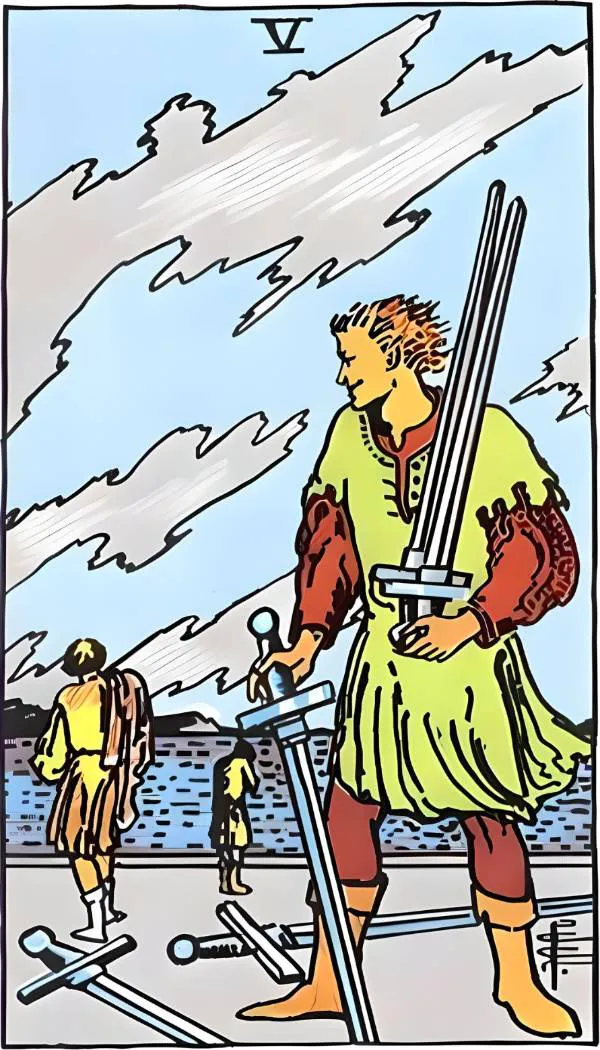
Five swords are scattered in disarray, each pointing in a different direction. The central figure in the scene holds three swords, while two others lie on the ground next to two other figures. The dynamic movement of the swords suggests a fierce battle has taken place, and a truce is currently in effect.

The protagonist in the foreground holds two sword hilts in his left hand, pressed together against his chest with the points upward. His right hand grasps the hilt of another sword, which stands upright with its tip planted on the ground, extending beyond the frame.

This figure stands with legs apart, looking back at those he has defeated, a smug smile on his face. He is dressed in a red garment over a green coat, with orange-red boots on his feet.

The two distant figures with their backs turned are the sword-abandoners, both with their heads bowed and faces covered, seemingly unwilling to face the situation. Their swords have fallen to the ground, conveniently isolating the central figure. The figure on the left wears a green sleeved brown coat with a cloak draped over his right shoulder. The figure on the right is further away, his silhouette more blurred, dressed in a brown garment. All three figures face away from each other, with the two fallen swords separating the victor from the vanquished.

The setting is on the shore by the water, with waves lapping at the shore, suggesting the possibility of defeat leading to a fall into the water. The opposite bank is faintly visible, a distant realm that might offer refuge. The clouds in the sky take on an eerie shape, surrounding the protagonist, much like the serrated pattern of his hair. It is also evident that the wind blows from left to right, aligning with the direction of the protagonist's hair and the 'movement' of the clouds. The sky, clouds, sea, and distant mountains across the shore are all depicted in a bleak, grayish hue, painting a desolate scene.

Swords on the Ground

The swords scattered on the ground symbolize the aftermath of a battle or conflict. They can represent ideas, words, or actions that have caused separation or discord. The scattered swords suggest a lack of unity and a situation where there might be a winner, but at a cost.

Figure Holding Swords

The figure holding three swords while looking back at two other figures indicates a sense of conquest but also isolation. It serves as a warning that victory achieved through dubious means may lead to a hollow, lonely success.

Two Figures Walking Away

The two figures in the background, walking away defeated and forlorn, represent the losing parties. Their bowed heads and defeated posture symbolize the emotional and psychological toll of the conflict. It serves as a cautionary tale about the consequences of engaging in zero-sum confrontations.

Water in the Background

The water represents the emotional context in which this conflict has unfolded. Turbulent waters suggest emotional upheaval and instability, indicating that the battle has emotional underpinnings that may not be fully resolved even after the apparent conclusion of the conflict.

Cloudy Sky

The sky, particularly if it appears cloudy or stormy, symbolizes the mental or intellectual climate surrounding the situation. Like the water, it suggests turbulence, but in this case, it pertains to thoughts, beliefs, and attitudes that have contributed to the conflict.

Psychological patterns in Five of Swords
Self-Sabotage
The wide stance tries to claim the foreground, but the body is still turned back toward the people leaving. The apparent victory has no forward movement, only a defended position beside the water and a distant refuge that remains out of reach. In its reversed psychological texture, the defense collapses into a loop where short-term control damages long-term evolution. You may sabotage progress by choosing the move that lets you feel right, protected, or untouched in the moment, even when it quietly blocks the next version of your life.
Forced Progress
The foreground figure grips three swords after the clash has already ended, standing wide on the shore while the wind, clouds, and waves keep moving across the scene. His body still behaves as if pressure can settle the field, even though the battlefield has gone quiet and the emotional weather remains unsettled. That posture turns timing into a contest of force. The more the environment signals friction, aftermath, and unresolved cost, the more the body tightens around possession and proof. The card shows a mind trying to convert resistance into evidence that it should push harder. Forced Progress forms when action becomes a defense against the humiliation of delay. You may be reading pause, seasonal constraint, or missing resources as personal defeat, then spending extra energy to overpower a cycle that is not ready to open. The psychological audit here is not whether you can win the next move, but whether the win is being purchased by ignoring the field itself.
Shadow Projection
The foreground figure's smile depends on the sight of the others walking away. His certainty is not generated in a warm relational space; it is reflected back through their defeat, their lowered heads, and the distance opening between them. That is the visual seed of Shadow Projection. In friendship, the traits You cannot comfortably own, envy, neediness, insecurity, competitiveness, or fear of being replaced, may get assigned to another friend so the conflict feels simpler than it really is. The card's gray water and unsettled sky keep the projection from feeling clean. They show that the emotional material has not disappeared; it has been displaced onto someone else, where it can be attacked without being recognized as part of the inner system.
Shadow Possession
The foreground figure expands into the scene while the others withdraw, and his backward glance seems to feed on their defeat as confirmation of his position. The fallen swords do not merely mark a boundary; they isolate him inside the aftermath of his own victory. In this reversed state, the disowned aggressive part of the psyche is no longer just being projected outward; it is steering the internal field. The need to dominate, punish, expose, or win can temporarily take over the self-reflective process, making the mind mistake attack for truth. Shadow Possession appears when an exiled inner force speaks through you before you can witness it. In introspection, this can feel like brutal clarity, but the card shows the cost: the part of you holding the swords may be defeating the very vulnerability that needs integration. The work is not to shame that force, but to see how much power it has gained by being kept outside conscious ownership.
Exclusion Spiral
The fallen swords isolate the foreground figure as much as they separate him from the defeated figures. He appears to have control of the scene, but the geometry of the card leaves him alone with the weapons while everyone else moves out of reach. Exclusion Spiral forms when defense against rejection begins to create the very distance it fears. You may become cold first, sharpen your tone first, or leave before the group can leave you, and then read the resulting distance as proof that you never belonged. The card makes the loop visible: the more the figure secures the win, the less social field remains around him.
Truth Weaponization
The upright sword planted in the ground reads like a point that refuses to soften, while the two hilts pressed to the chest make the foreground figure look armed even after the fight has ended. The weapon is not only held outward; it is held close to identity. That is the psychological architecture of Truth Weaponization. In friendship, accurate facts, sharp observations, saved messages, or therapeutic language can become tools for dominance when the goal shifts from being clear to making the other person submit. The Five of Swords does not deny that something real may have happened. It exposes the moment when truth stops functioning as a bridge and starts functioning as a blade, leaving You with clarity that cannot create closeness because it was used to defeat rather than repair.
Zero-Sum Coping
The foreground figure stands with his legs apart, three swords gathered into his hands, while the other two figures walk away with their heads bowed. The visual field has a winner, but it also has no remaining face-to-face contact; the swords create proof of victory and a barrier at the same time. In a love reading, that posture maps onto a relationship system where being right starts to feel safer than being connected. You may not be trying to harm the bond; the pattern is using domination, evidence, or last-word energy to avoid the vulnerability of mutual repair.
Zero-Sum Thinking
The foreground figure holds three swords while the two others walk away with bowed heads, and the ground itself is marked by abandoned blades. The image does not show a shared resolution; it shows a tally after a fight, with steel marking who claimed ground and who had to retreat. Zero-Sum Thinking grows from that tally logic. When social belonging is filtered through winning and losing, every disagreement can start to feel like a ranking contest, and you may protect your position by treating compromise as defeat. The cost is visible in the empty space around the victor: the argument is won, but the social field is thinned out.
Cognitive Dissonance
The swords point in different directions across the shore, but one sword is planted upright and held as if it can stabilize the whole scene. Behind that rigid mental posture, the gray water and bleak sky keep the emotional atmosphere unsettled. The image holds two incompatible truths at once. One part of the psyche wants a firm story that protects the self from ambiguity, while another part registers the cost, the loneliness, and the emotional disturbance that the story cannot fully explain. The tension does not disappear; it gets stored in the gap between the planted blade and the moving water. Cognitive Dissonance appears when your inner narrative has to work too hard to keep itself intact. You may know the official explanation, but another layer of you keeps producing discomfort because the emotional evidence does not fit. The reversed card exposes the strain of that split: the mind keeps defending a version of clarity that the deeper system no longer fully believes.
Outcome Bias
The figure in the foreground has the visible result: three swords in hand, two opponents retreating, the battlefield apparently settled. Yet the image surrounds that result with bleak water, scattered weapons, and social distance, making the outcome look successful and contaminated at the same time. Outcome Bias enters when the mind treats the visible result as proof that the decision was right. In a crossroads, You may overvalue the option that appears to produce control, status, or immediate advantage, while under-auditing the process that created it. Five of Swords is especially sharp here because it separates winning from wisdom. The card shows that a result can be measurable, defensible, and still psychologically expensive, which is exactly the blind spot Outcome Bias creates when the final score replaces the full decision audit.
Core Struggles in Five of Swords
Control Lock
The central figure grips the swords as if control of the scene has been secured, yet his head is turned back toward the people leaving. The blades divide the shoreline into winners, losers, and abandoned ground, so the apparent victory is held inside a narrow field of separation. In a lifestyle reading, this points to the cost of building a daily system around control as the main proof of stability. You can win the calendar, win the checklist, win the tidy surface, and still feel the day becoming smaller because every part of life has to submit to the same rigid command structure. The card gives Control Lock a precise shape: control keeps the system standing, but it also traps attention in the aftermath of what had to be suppressed, cut off, or overmanaged to make the day look handled.
Intergenerational Control Loop
The scene holds a truce that still looks armed: one figure keeps the swords, two figures leave, and the bleak weather presses the whole shoreline into the same direction. Nothing in the image suggests a new pattern has arrived; the field has only reorganized around the last conflict. In an intergenerational family system, that is how control survives. A parent, elder, sibling, or inherited role may not need to announce authority every time, because the room has already learned where the blades are kept and which direction people are expected to move. The reversed Five of Swords gives this loop a precise boundary. It shows a family climate where control is not a single incident but a repeated choreography of dominance, retreat, silence, and return, leaving you to fight for autonomy inside rules you did not design.
Unseen Cost Bind
The smile in the foreground sits inside a divided field: the others have turned away, fallen swords cut through the middle ground, and the open shore offers space without connection. The image shows a result that can be counted as a win while the field around it becomes colder, emptier, and harder to re-enter. For timing questions, this card marks the hidden cost of forcing the moment because it appears available. You may get the result, the reply, the launch, the advantage, or the visible progress, but the structure asks whether the timing has damaged the conditions needed for the next move.
Power-Intimacy Split
The foreground figure holds three swords while the other two figures walk away, so the visible victory leaves him with the objects of the fight rather than the people inside the relationship. His stance is wide and controlled, but every blade he keeps also widens the distance between his body and the departing figures. In love, this image gives shape to the split between having power and having intimacy. You may be able to secure the last word, the proof, or the upper hand, while the bond itself becomes harder to touch because the tools that protected your position have become the boundary around it.
Power-Belonging Split
The three bodies face away from each other, and the two fallen swords create a hard line between the foreground figure and the people leaving the shore. The scene is open, but no one can occupy the same relational space anymore. At work, that geometry gives Power-Belonging Split its career shape. You may gain leverage, authority, or proof of competence, while the social field that made work survivable quietly thins out; the card does not condemn the power, it locates the cost of having to stand apart to keep it.
Power-Connection Split
The foreground figure stands armed after the conflict, holding more swords than one body can use while the other two figures turn away across the shore. The visual victory is unmistakable, but the same weapons that mark advantage also build the distance between him and the people he has defeated. In friendship, this is the structure of winning in a way that makes closeness harder to return to. You may have the stronger argument, the receipts, or the cleaner version of events, but the field around the friendship becomes organized by separation rather than repair. Power-Connection Split names the moment when control and connection stop moving in the same direction. The card does not frame the issue as being right or wrong; it shows the cost of needing a relational bond to survive a victory posture that keeps everyone facing away.
Power-Choice Split
The foreground figure braces himself with one sword planted in the ground while pressing two more against his chest, and his gaze does not move toward a future path but back toward the defeated figures. The body is stabilized by possession, so the card's conflict is not only about a choice being made; it is about agency being confused with control over the outcome. In a decision reading, that visual field maps directly onto Power-Choice Split. You may be trying to choose, but the choice has been pulled into a contest where one option feels like proof of strength and the other feels like humiliation, surrender, or loss of leverage. The scattered swords show why clarity cannot arrive through domination. When every option is measured by whether it lets you win, the real question beneath the decision is no longer what fits your life, but what protects you from feeling defeated.
Achievement-Meaning Collapse
The foreground figure grips three swords while the two people behind him turn away, leaving the beach divided by the weapons that ended the fight. The scene contains an outcome, but it does not contain a shared future; the body has proof of victory while the surrounding field has gone cold, grey, and directionless. Achievement-Meaning Collapse appears where reaching the point that was supposed to settle everything exposes a deeper absence of orientation. You may have secured the result, passed the test, or outlasted the conflict, yet the card shows a win that cannot become a compass. The distant shore matters because it gives the image a future beyond the fight, but no one in the scene is moving toward it. The struggle is not that nothing happened; it is that what happened consumed the meaning that was supposed to carry you forward.
Visibility-Isolation Split
The foreground figure is the most visible body in the scene, but that visibility is framed by retreat, bleak weather, and a shoreline that separates rather than gathers. The swords draw attention toward him while also confirming that no one is standing with him. Visibility-Isolation Split takes shape when being seen does not create closeness. In the reversed structure of this card, visibility hardens into a position to maintain, while the social field quietly empties around it. In social tarot, You may be recognized, watched, admired, or even feared in a circle, yet still feel untouched by real belonging. The struggle is the painful mismatch between occupying a noticeable place in the group and having no safe place to soften inside it.
Consequence Lock
The scene is not the middle of the fight; it is the moment after the blades have already landed, when the ground itself is marked by what happened. The upright sword, the abandoned weapons, and the departing figures turn the space into a record of consequences. In a decision reading, that record becomes Consequence Lock. You are not only weighing what to do next; you are trying to move inside a field where prior choices, spoken words, or already-paid costs seem to restrict every route forward. The card's pressure comes from the fact that nothing is visually neutral anymore. Clarity has to pass through the fallout, which is why the decision can feel irreversible even when some agency still remains.
Inner Emotions in Five of Swords
Hollow Control
Three swords gathered against the foreground figure’s chest while two blades lie between him and the figures walking away turn control into a physically isolated posture. The hands are full, the stance is braced, and the grey shore gives the scene no softness to absorb what was cut away. In a lifestyle reading, that image mirrors the feeling of keeping your system intact by making every choice sharper than it should be. You may get through the day, close the tabs, clear the tasks, and still register the win as thin because the order was purchased through pressure rather than ease. Hollow Control names the emotional residue of holding everything together while feeling strangely untouched by the result. The card does not frame control as failure; it shows where control has become the only remaining language your life system knows how to speak.
Ethical Unease
Three swords are held close to the chest while two more lie on the ground between separated figures. The body has collected the blades, but the field around it shows division rather than integration. In a direction reading, this links to ambition that no longer feels clean. You may see a path that works strategically, yet the image keeps the cost in view: the sharpness held against the body, the people turned away, and the grey atmosphere around the result. Ethical Unease names the inner audit that begins when a future looks effective but does not fully feel aligned.
Intellectual Loneliness
The three figures facing away from one another make the shoreline look less like a shared field and more like three separate islands. Swords divide the ground, and the distant bank offers space without contact. For study and research, this image captures the loneliness of being mentally sharp but relationally unheld. You may have the argument, the evidence, or the insight, while still feeling that no one is actually meeting you inside the work.
Suppressed Resentment
The truce-like spacing of the figures leaves the conflict unfinished in the body of the image. The water keeps moving beside the shore, while the swords on the ground show that the argument has been put down without being absorbed. In study life, this becomes the swallowed heat after unfair grading, a group project imbalance, or feedback that felt more cutting than useful. The card gives that buried charge a visible outline, so the resentment can be recognized as residue rather than treated as a private defect.
Betrayal Ache
The two figures in the distance have turned their backs, their heads bowed and faces hidden, while the fallen swords lie between them and the figure in front. The blades do not simply mark conflict; they mark the place where trust has been cut into separate territories. In a romantic context, this visual field carries the ache of intimacy being used sharply. The gray shore, exposed metal, and averted bodies create a scene where no one is reaching, no one is softening, and the emotional injury is registered through distance rather than open collapse. Betrayal Ache belongs here because the card shows the body language of people who cannot immediately face what happened. You may still care, still want answers, or still feel attached, but the inner sensation is a cold sting around the moment love stopped feeling protected.
Self-Betrayal Ache
The sword hilts are pressed close to the chest, and the face looks back with a smile that does not meet the covered faces beyond it. The image concentrates sharpness around the body while keeping the human consequence at a distance. In a decision, that combination can mirror the ache of protecting the winning move while feeling a private value get bruised. You may be able to justify the choice, explain the advantage, and defend the logic, but the body still registers where the decision scraped against self-respect. Self-Betrayal Ache is not about being wrong for choosing yourself. It is the card's way of marking the difference between taking agency and abandoning the inner standard that lets agency feel like yours.
Hollow Victory
Three swords gathered against the foreground figure while two lie abandoned on the ground create a win that has no shared table, no return path, and no one left to meet the victor's eyes. The smile is visible, but the space around it is empty of contact. For introspection, this image names the moment when one part of you gets control, proves the point, or keeps the upper hand, while another part is left behind at the shoreline. Hollow Victory is the inner weather of realizing that being right did not make you feel whole; it only made the split easier to see.
Conflict Hangover
The shore is quiet only on the surface: the swords are still present, the figures are still turned away, and the water continues moving behind the aftermath. Nothing in the image suggests an easy return to normal; the conflict has stopped, but the environment still carries its residue. In personal growth, this visual field mirrors the body after a hard internal confrontation. You may have named the limiting belief, made the decision, or pushed through the uncomfortable truth, yet the system remains keyed to the battle that just ended. Conflict Hangover captures that post-breakthrough depletion where clarity and tiredness arrive together. The card does not treat the exhaustion as failure; it shows the emotional weather that lingers when growth has required a fight before it can become integration.
Academic Humiliation
The bowed figures with covered faces turn away from the foreground as the fallen swords mark what has been lost in public. Their bodies remove eye contact from the scene, making exposure feel physical before it becomes verbal. In academic spaces, that structure can mirror the aftermath of harsh feedback, a failed presentation, or a correction that felt publicly defining. The card does not turn the moment into a verdict on your capacity; it shows the specific place where visibility became too sharp to hold.
Quiet Shame
The two figures in the distance move away with bowed heads and covered faces while the foreground figure remains visually separate. Their bodies do not argue, defend, or reach back; they reduce their presence and exit through the gray shore. In a career environment, that posture captures the private collapse that can follow being corrected, outplayed, excluded, or publicly misread. You may continue functioning, but internally the body wants less visibility, less contact, and fewer witnesses. Quiet Shame names the low-volume contraction that happens when a workplace moment makes you feel smaller than your actual capacity. The card holds that feeling as an emotional weather pattern, not an identity statement, so it can be examined without letting the room's power dynamic define your whole self.
Outer Contexts in Five of Swords
Strategic Exit Window
The two distant figures have already turned their backs, and the far bank sits faintly across the water. The card places an exit route inside a bleak aftermath, where remaining in the center of the field may keep status intact but does not restore movement. In a timing question, the shore matters as much as the swords. You are looking at a moment when disengagement can be more strategic than another attempt to prove the point. Strategic Exit Window appears when the next intelligent action is not escalation but withdrawal with awareness. The card shows that leaving at the right moment can preserve agency before the conflict converts every remaining option into reputation damage, wasted effort, or another round of contest.
Scorekeeping Friendship
Three swords gathered in one pair of hands and two left on the ground create an uneven inventory of the conflict. The foreground figure is not simply standing after a fight; he is holding the proof, the leverage, and the visible record of who came out ahead. In friendship, that becomes a ledger of favors, apologies, invitations, emotional labor, and past mistakes. The card exposes the moment reciprocity stops being a living exchange and turns into an accounting system where closeness is measured through debt.
Sunk Cost Exit Dilemma
The swords are split between what has been seized, what has been dropped, and what is still planted in the ground. The distant bank suggests that another direction exists, but the immediate scene is crowded with proof of how much has already been spent. A sunk cost exit dilemma forms when leaving would mean admitting that the old fight consumed real time, effort, status, or social capital without producing a usable future. The planted sword shows why the body stays: it gives the aftermath a point of stability, even when that stability keeps the person attached to a field that no longer opens forward. Five of Swords makes the directional problem concrete. The issue is not whether the past mattered; it is whether the cost already paid is being allowed to choose the next route for you.
Bad Timing Loop
The planted sword fixes the foreground figure in place while the remaining swords point in scattered directions around him. The image has force, but not sequence; it shows energy being applied inside a field that is not arranged for clean movement. For timing, this is the pattern where every push creates another point of resistance. You may be trying to move because delay feels intolerable, yet the available conditions keep turning action into cleanup. Bad Timing Loop fits the card because the problem is not lack of effort. The structure reveals effort landing in the wrong part of the cycle, where more pressure produces more fragmentation instead of progress.
Relationship Power Play
The foreground figure stands wide, armed, and visually dominant while the others move away with their heads lowered. The scene has the geometry of a relationship exchange where one person has seized the upper position and the others have lost both voice and leverage. This is why the card maps cleanly onto a relationship power play. In introspection, the outer context is not only the argument itself, but the social arrangement that follows: who gets to define what happened, who must absorb the shame, and who has to retreat to keep the situation from getting sharper. The Five of Swords makes that hierarchy physical. You can examine the power move without collapsing into self-blame or moral superiority, because the card keeps attention on the structure of control, withdrawal, and the cost of winning contact by overpowering it.
Harsh Honesty Fallout
The upright sword planted into the ground feels like the final sentence in a conversation that has already gone too far. Around it, the other swords lie scattered, and the two distant figures have stopped participating in the exchange. This is harsh honesty fallout: the external aftermath of a truth delivered with enough force to change the social field. The issue is not whether the statement contained truth, but whether its delivery left people with any usable bridge back to understanding. The Five of Swords makes the cost visible through the empty space between the figures. In introspection, this context asks you to examine the difference between clarity and cutting, because both can feel powerful in the moment but only one leaves room for integration.
No-Win Decision
The shoreline offers a distant bank, but the immediate ground is cluttered with swords and separated figures. Movement is possible, yet every direction is marked by conflict, exposure, or loss of position. That is the career shape of a no-win decision. Staying may mean tolerating a damaging power dynamic, confronting may escalate the conflict, and leaving may cost momentum, income, status, or access. The Five of Swords helps name the trap without pretending there is a clean route. It shows that the real work is locating which cost is structural, which cost is temporary, and which choice gives you the most agency after the fallout.
Post-Conflict Cooling Off
Three bodies face away from one another while fallen swords make a hard line across the shore. The scene is not an active fight; it is the exposed pause after the sharpest part of the exchange, when every object in the space still proves that the system has been damaged. In a lifestyle reading, that pause maps onto the period after a fight over chores, sleep, shared space, planning, or invisible effort. You are not looking at a clean reset yet; you are looking at the cooling zone where the daily architecture has to stop pretending it can immediately resume. The card connects to Post-Conflict Cooling Off because the structure protects clarity by holding movement still long enough for the sharp pieces to be named.
Premature Confrontation Fallout
Three swords are concentrated in one person's hands while the others have already abandoned theirs. The scene shows a confrontation that moved faster than the shared field could process, leaving separation as the most visible result. In a timing spread, this points to action taken before the conditions were ready to carry it. The issue may be a message sent too soon, a boundary set without enough support, a launch made before stakeholder alignment, or a confrontation that arrived before the room had enough structure to hold it. Premature Confrontation Fallout names the aftermath of acting before the window was mature. The card does not condemn the need to act; it maps the cost of forcing contact before the timing could sustain resolution.
Household Chore Cold War
Two figures walk away with their backs turned while the swords on the ground split the shore into social zones. No one is touching the same tool, and no one is looking toward the same next step. Inside a home system, that arrangement becomes Household Chore Cold War. You may be dealing with dishes, laundry, cleaning standards, noise, groceries, or sleep schedules, but the object on the surface is carrying a larger fight about respect and control. The card links this context to the moment when practical tasks stop being neutral and start marking who gets space, who absorbs friction, and who retreats.