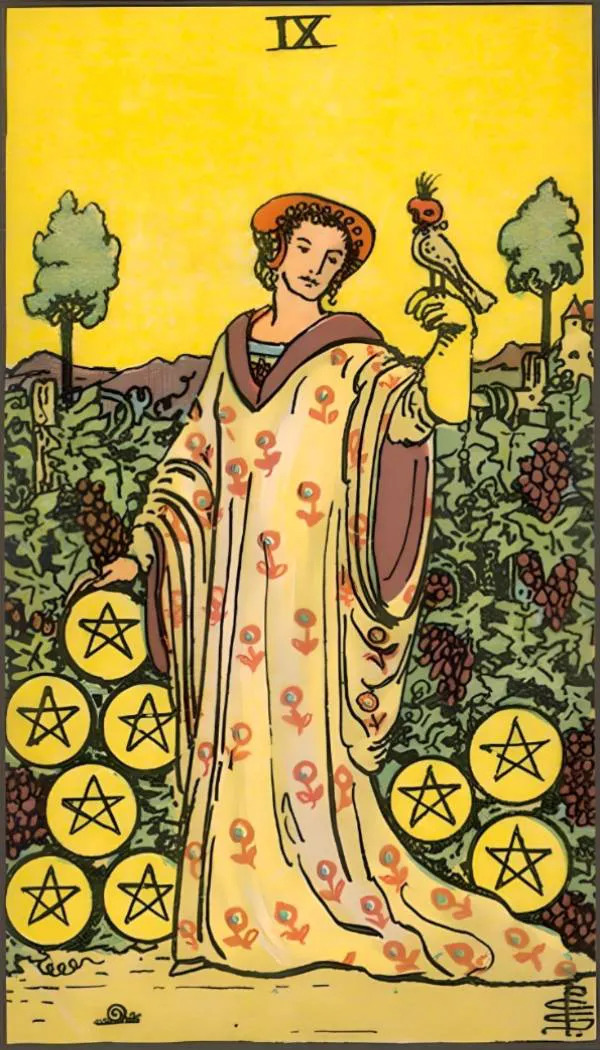
Nine of Pentacles Tarot Card Meaning

The arrangement of the nine pentacles in this card is similar to that in the Seven of Pentacles, both appearing as fruits growing on a plant, but in this case, it is a more luxurious crop - a grapevine. Of course, what is more different is that in addition to the pentacles, there are also real clusters of grapes in this scene.

The main character is a wealthy and luxurious woman, who is stroking the pentacles with her right hand. Her attire is elegant and luxurious, and her clothes are the most beautiful, both in terms of material and pattern. Embroidered on it are red floral patterns, which are similar to the symbol of Venus when upright, and the symbol of Mars when inverted. The fusion of Venus and Mars signifies enjoying love and enjoying all that is beautiful.

On the back of the lady's left hand, a bird perches, with a glove to prevent injury from the bird's claws. The pet bird has a hood over its head, so it cannot see and cannot flap its wings to fly away from its owner.

Behind the garden, there are two trees, like landmarks, distributed on both sides. A house can also be seen at the far right of the scene, which is the home of the wealthy woman. This vast expanse of land belongs to her manor, her bountiful garden and the fruits of her labor. The distant hills in the background are red soil, and the sky is also very beautiful.

At the bottom left of the picture, there is a snail slowly moving on the ground. The spiral shape of the snail represents the cycle of life and the continuous renewal, symbolizing the passage of time. The snail in front of the woman's feet indicates that the prosperity in the garden is not only for the plants but also for the entire ecosystem, and the owner coexists with the ecosystem without harming these lives.

The wealthy woman has become one with all that she possesses, cherishing and caring for the things around her, whether animals or plants, as if they are one with herself.

The Nine of Pentacles is often depicted as a woman standing alone in a vineyard or garden, surrounded by ripe grapevines and nine golden pentacles. She holds a falcon on her gloved hand, and she is elegantly dressed, often wearing a robe embroidered with flowers and grapes. Each of these symbols conveys specific meanings.

The Woman

The woman at the center of the card symbolizes self-sufficiency, independence, and well-being. She is an embodiment of the successful conclusion of a material venture and represents the ‘fruits of one’s labor’.

The Garden or Vineyard

The surrounding garden or vineyard represents the fruits of one’s own hard work and discipline. This is a symbol of prosperity, wealth, and material success that has been carefully cultivated over time.

The Nine Pentacles

The nine pentacles that are often displayed around her or in the vines signify material wealth and financial independence. They represent the rewards gained from hard work, investment, and prudent management of resources.

The Falcon

The falcon symbolizes not only material wealth but intellectual and spiritual wealth. Falcons are birds of prey, and their inclusion suggests that the woman’s success is born of her intelligence and spirit, as well as her material efforts. The trained falcon also indicates control over one’s environment.

Her Robe

The intricately decorated robe the woman wears often includes floral and grape motifs, underscoring the connection to the Earth and the fruitful results of diligent work and attention to detail.

Psychological patterns in Nine of Pentacles
Hyper-Independence
The woman stands alone inside a cultivated vineyard, dressed in costly fabric, with the estate behind her and the trained falcon resting on a protected hand. Nothing in the scene looks chaotic; the garden is owned, tended, and buffered from intrusion, and even the bird of prey is kept close without direct exposure to its claws. That visual order turns self-sufficiency into a psychological defense. The inner system learns to preserve clarity by reducing dependence, filtering access, and making privacy feel safer than emotional reliance. The glove is important because it shows contact without full vulnerability: connection is allowed only when it has been made manageable. In introspection, Hyper-Independence often feels like strength from the outside and isolation from the inside. You may be extremely good at processing things alone, keeping your emotional world elegant and contained, while the deeper need to be met, witnessed, or supported remains outside the garden wall.
Illusion of Control
The hooded falcon rests on a gloved hand: power is present, but sight and flight are controlled. Around it, the vineyard and pentacles are arranged as if the environment can be trained into predictability through careful handling. In career, the same mechanism appears when attention locks onto manager reactions, status signals, and office optics. The pattern tries to reduce uncertainty by monitoring everything, but it blurs the line between what you can influence and what belongs to the wider power field.
Achievement Fusion
The woman's robe repeats the garden's floral language while her hand rests on pentacles grown into the vine. Her body, clothing, property, and visible rewards blend into one coherent image, as if the self and the output have been woven together. In career, that fusion can make metrics, titles, praise, and portfolio polish feel like identity supports rather than external results. You may begin to read a plateau, missed promotion, or quiet project not as information about the system, but as a threat to the self that has learned to live inside achievement.
Boundary Discernment
The woman's gloved hand holds the falcon close without letting its claws pierce her skin, while the garden and distant manor draw a clean perimeter around what is hers. The image makes contact possible without collapse, turning boundary into a decision tool rather than a wall. When You face a choice, Boundary Discernment appears as the capacity to separate owned desire from borrowed pressure. The pattern asks which option belongs inside your cultivated life, which option only looks impressive from outside, and where a protective boundary is needed so the real signal can be heard.
Comfort Zone Attachment
The manor, vineyard, grapes, and golden pentacles create a beautiful protected container, while the hooded bird remains close to the hand instead of flying. The scene is comfortable, cultivated, and quietly restrictive at the same time. Comfort Zone Attachment appears when You confuse the safety of a known option with evidence that it is still alive. In a choice reading, the pattern reveals where a polished life may be preserving stability while muting the desire that would risk movement.
Emotional Cutoff
The woman's composure is striking because the scene contains instinct, abundance, and living movement, yet everything is held in stillness. The hooded falcon sits close but cannot fully engage the field, and the estate boundary keeps the scene sealed inside its own order. In reversed love dynamics, that sealed quality becomes Emotional Cutoff. You may still feel the relationship intensely, but when conflict or vulnerability rises, the system protects itself by removing visible emotion from the exchange. The card's controlled beauty explains why this pattern can be hard to name from the outside. It may look calm, mature, or self-contained, while underneath the contact has been interrupted: feeling is present, but it is held behind a boundary that the partner cannot cross.
Timing Discernment
The hooded falcon rests on the woman’s gloved hand while the snail moves slowly across the foreground, placing sharp instinct and slow organic time in the same frame. The image does not rush the bird into flight or the garden into harvest; it holds potential inside a controlled field until the conditions can be read with precision. Timing Discernment emerges from that controlled pause. You are not being asked to freeze forever, but to notice whether the next move is being prompted by ripeness, pressure, fear of missing out, or the need for visible progress. The card turns timing into an audit of readiness rather than a demand for immediate certainty.
Self-Accountability
The woman stands inside a garden that clearly belongs to a maintained system: vines, pentacles, home, trees, and visible borders all hold their place. Nothing in the image suggests frantic rescue from outside; the scene is organized around what has been tended, claimed, and kept in order. That visual containment maps directly onto Self-Accountability. The psychological mechanism is not harsh self-blame, but the capacity to recognize which parts of the system are yours to steward: attention, habits, resources, standards, and follow-through. In personal growth, that is the difference between wanting transformation and building the conditions that make transformation repeatable. You are not being asked to perform perfection. The card shows a grounded form of agency where ownership becomes clarifying rather than punitive, allowing the growth process to move from aspiration into structure.
Resource Alignment
The vineyard, pentacles, falcon, snail, trees, and distant house do not appear as isolated symbols; they operate as a whole estate. Each element holds a different kind of resource: money, discipline, instinct, time, shelter, and ecological stability. Resource Alignment is the psychological mechanism that reads whether those parts are working together before a major move. You may feel blocked when one resource is abundant but another is missing, such as energy without support, vision without recovery, or opportunity without enough internal bandwidth. The card frames timing as coordination, not just courage.
Delayed Gratification
The woman’s hand rests near the pentacles as if acknowledging the crop rather than tearing it down early. The snail at her feet makes the pace explicit: growth is present, but it moves by accumulation, not by force. Delayed Gratification is not passive waiting here; it is the capacity to let a process finish becoming usable. You may be caught between the need to act and the evidence that the season is still building its reserve. The card reveals the difference between disciplined patience and fear-based postponement by showing a harvest that exists because time was allowed to do its work.
Core Struggles in Nine of Pentacles
Unseen Cost Bind
The garden is rich, ordered, and beautiful, yet its containment makes the cost of that beauty difficult to measure. The falcon's hood, the glove, and the estate's enclosure all protect the surface of the scene from showing how much restriction and maintenance are built into it. In friendship, Unseen Cost Bind appears when the emotional price of keeping the bond intact cannot be easily named. You may lose time, energy, privacy, honesty, or self-trust, but the friendship still looks stable enough that questioning it feels excessive. The reversed Nine of Pentacles makes the hidden bill visible without turning the relationship into a villain. It shows a cultivated connection whose benefits are obvious and whose costs are absorbed quietly, which is why the bind can last long after your body has started keeping score.
Abundance Overload
The vineyard does not lack fruit; it produces grapes, pentacles, beauty, land, and visible proof of cultivation all at once. The abundance is real, but it gathers so densely around one figure that value itself becomes hard to separate into clear paths. In a decision spread, this structure mirrors the moment when the problem is not scarcity but too many convincing forms of upside. You can see reasons to choose each path, yet every visible reward adds another layer of weight to the choice instead of making it simpler. The stillness of the woman inside a ripening garden locates the struggle precisely: movement pauses because the field is overfull with meaning. Abundance Overload names the pressure of trying to choose while every option looks like it has already grown roots in your future.
Reciprocity Deficit
The woman stands inside a private vineyard where grapes and pentacles have ripened around her, yet the scene gives no visible channel for that abundance to circulate beyond the estate. One hand rests near the pentacles while the other supports a trained falcon, splitting her contact between what she has cultivated and what she must keep under control. In friendship, that visual split becomes the architecture of unequal exchange. You may be holding the emotional resources, the stable presence, the advice, the spare room, the introductions, or the patience, while the return path stays narrow and ceremonial. The card does not flatten this into generosity or selfishness. It shows a beautiful system where supply is visible, containment is elegant, and imbalance can hide inside refinement until the friendship starts asking one person to be the garden, the host, and the fence at once.
Boundary Rigidity
The falcon is close to the woman's body, yet its sight and flight are blocked so the scene can remain calm. In the reversed structure, the boundary is no longer just protection; it becomes the condition under which closeness is allowed to exist at all. Boundary Rigidity in love shows up when self-possession hardens into emotional non-negotiability. You may keep your standards, space, and independence intact, but the relationship has little room to influence you, inconvenience you, or reveal needs that cannot be managed cleanly. The card's private garden carries the cost of that rigidity. It preserves beauty and safety, but it also narrows the forms of love that are permitted to enter.
Boundary Control Strain
The falcon rests on a gloved hand, hooded and close enough to be intimate but equipped with barriers. The bird is not thrown away, and it is not allowed unfiltered movement; contact is made possible through restraint, distance, and careful handling. Boundary Control Strain appears in family systems when closeness cannot happen casually. You may still want contact, but every visit, reply, disclosure, or refusal has to be measured so the old family pattern does not get its claws back into your nervous system. The card does not frame the boundary as coldness. It shows a living relationship that requires protective equipment because unprotected closeness has become too costly to hold.
Soft Power Strain
The woman stands inside a cultivated garden with one hand grazing the pentacles and the other carrying a hooded falcon. The bird is powerful, alert by nature, and built for flight, yet its access to movement is mediated through the glove, the hood, and the woman's controlled arm. That visual structure mirrors social influence that works through refinement rather than direct reach. You may have access, taste, reputation, or a carefully built circle, but the card shows how those advantages require constant handling so they do not become distance, dominance, or performance. In a social field, Soft Power Strain appears when connection depends on staying composed enough to be accepted and restrained enough not to unsettle the room. The card does not frame this as weakness; it locates the pressure in the managed space between genuine social power and the cost of keeping that power elegant.
Golden Handcuff Bind
The manor, vineyard, pentacles, robe, and trained bird form a closed map of comfort. The scene has space, but the space is organized around what must be maintained, protected, and kept visually intact. Inside a major decision, this becomes the bind of a rewarding path that has started to narrow your agency. You can recognize the benefits clearly, which makes leaving feel almost unreasonable, yet the very structure that rewards you also determines where you are allowed to move. Golden Handcuff Bind names the point where success becomes a containment field. The card holds the contradiction without flattening it: the comfort is real, and so is the cost of letting comfort become the boundary of your future.
Perfect Readiness Trap
The right hand rests on the pentacles as if checking the proof of readiness, while the vineyard already shows a cultivated result. The falcon is powerful but hooded, and the elegant stillness of the figure turns preparation into a controlled display rather than an active threshold. You may be reading readiness as a condition that must become visually complete before movement is allowed. Perfect Readiness Trap names the point where timing stops being sensed through the cycle and starts being audited through endless signs that everything is finally safe enough.
Recognition-Containment Split
The falcon rests on the woman's gloved hand with its hood still on, a living force displayed as proof of control while its sight and release are restricted. The pentacles and garden confirm achievement, but the sharpest symbol of agency is held in a managed, ornamental state. In career terms, this is the tension of being recognized without being fully authorized. You may receive praise, compensation, or visible status, yet the decision-making channel remains hooded, and the role keeps your capability present without letting it move at full range. The struggle sits in that split between external validation and internal containment. The card gives shape to the moment when workplace recognition stops feeling like expansion and starts feeling like a controlled display of what you have already proven.
Pleasure-Structure Split
The grapes, floral robe, and polished pentacles create a scene of sensory pleasure, but the falcon's hood and glove show that pleasure is being held inside a disciplined control system. The card's beauty is real, yet it is not loose; it is trained, arranged, and guarded. This is the lifestyle tension of wanting rest, comfort, and beauty while only trusting them when they are structured, optimized, or visibly earned. You may be surrounded by things meant to feel good, but the system keeps converting enjoyment into another standard to maintain.
Inner Emotions in Nine of Pentacles
Grounded Agency
The woman stands inside a cultivated vineyard, touching the pentacles as if taking inventory of what has already become stable. The house, trees, grapes, and gloved bird create a field where resources are visible, boundaries are clear, and the body does not have to lunge toward the next answer. For a decision, this becomes the feeling of choosing from an owned center rather than from pressure. You can examine A, B, or a third path without treating uncertainty as a threat to your worth, because the card's visual logic places your agency inside what you have already learned, earned, and protected.
Guilt-Free Rest
The woman stands inside a vineyard that is already bearing fruit, her hand resting on the pentacles rather than reaching for more. The snail at her feet and the open estate around her give the scene a slow tempo, where value does not have to be proven through constant motion. In friendship, that image turns rest into a boundary with emotional weight. You are not withdrawing from care; you are noticing that real connection can survive pauses, delayed replies, and private space that no one else gets to audit.
Hollow Abundance
The vineyard is full, the robe is ornate, the house is visible, and the pentacles shine, but the figure remains solitary within the display. The card concentrates success into visible objects while leaving the inner atmosphere unusually quiet. For a major choice, this maps to Hollow Abundance: the ache of seeing that an option can look complete from the outside while feeling under-inhabited from within. The card does not attack the comfort; it exposes the emotional gap between having enough and feeling meaningfully connected to what you have.
Abundance Guilt
The Nine of Pentacles is full of visible enoughness: grapes, coins, embroidered fabric, land, and a home beyond the garden. Nothing in the scene is scarce, and that fullness is placed directly around one solitary body. In family systems, Abundance Guilt emerges when having enough starts to feel morally exposed. The card mirrors the pressure of being seen with comfort while old family needs, comparisons, or resentments make your peace feel like something you must defend.
Disciplined Calm
The perched falcon requires a steady arm, the garden requires long tending, and the snail at the woman's feet marks time as slow rather than urgent. Nothing in the scene is frantic, yet everything visible has been shaped by repeated care. That is why the emotional tone is disciplined rather than passive. You are encountering a version of growth where calm is not escape from effort; it is what effort feels like when it has found a sustainable rhythm and no longer needs to perform panic as proof of seriousness.
Earned Satisfaction
The woman standing among ripened vines touches the pentacles as if they are living fruit, not abstract trophies. Her still posture, ornate robe, and cultivated garden all point to effort that has crossed from striving into embodiment. For direction questions, this image gives Earned Satisfaction a concrete shape: You are not only looking at what you achieved, but feeling whether it can actually hold you. The emotion belongs to the moment when the next path does not need to be forced because the body is still registering the reality of arrival.
Solitary Clarity
The woman stands alone, but the scene is not empty. The open sky, framed trees, visible house, and cultivated vines give her solitude a defined environment, separating her inner field from the noise beyond the garden. For growth work, this becomes the feeling of hearing yourself again. You are not withdrawing from life; you are stepping into enough quiet to sort signal from performance, so the next version of you can be chosen from clarity rather than comparison.
Quiet Readiness
Her gloved hand holding the falcon steady while the other rests on the pentacles creates a scene of contained power rather than immediate launch. The grapes are ripe, the manor is visible, and the snail keeps the ground-level tempo slow, so the image holds preparation as a lived condition rather than an emergency. For timing questions, that visual arrangement maps onto the feeling of knowing the pieces are almost in place without needing to push every door open at once. You can feel the next move forming because your resources, attention, and body pace are beginning to line up.
Embodied Ease
The woman stands in the garden without reaching, rushing, or bracing, and the open sky gives her body room to remain still. Her robe, the grapes, and the warm surface of the scene make ease physical rather than conceptual. You can feel Embodied Ease when your daily structure stops living only in planners and apps and starts landing in your muscles. The card reflects a lifestyle rhythm where space, pace, and sensory detail give your nervous system room to settle into the life you are maintaining.
Sensory Fullness
The card is crowded with tactile evidence: embroidered fabric, ripe grapes, golden pentacles, warm earth, and a cultivated garden that feels physically inhabited. The pleasure here is not abstract; it has surface, weight, scent, color, and season. Even the distant house gives the scene a sense of lived-in continuity. In a love reading, this visual richness becomes the inner weather of feeling present enough to receive affection through the body, not just through promises or analysis. Sensory Fullness is the feeling of romance becoming textured: a meal, a touch, a shared room, a slow afternoon, a life that feels pleasant to inhabit together. The card ties love back to the tangible world, where desire becomes real because it can be felt.
Outer Contexts in Nine of Pentacles
Family Resource Gatekeeping
The pentacles grow on a private vine, not in a public field, and the manor in the background marks the resources as belonging inside a defined property system. Abundance is present, but it is organized by ownership, access, and proximity. That is the concrete logic behind family resource gatekeeping. You may be dealing with money, housing, introductions, tuition, or practical help that exists in the family system but can only be reached through a particular gatekeeper, approval ritual, or unspoken hierarchy.
Resource Readiness Check
The ripe grapes, ordered pentacles, trained bird, and glove all point to resources that are not merely present but managed. The scene shows preparation, containment, and a working relationship between wealth, skill, and environment. In a choice reading, this becomes a readiness audit. The appealing option may be real, but the card asks whether the practical supports are actually mature enough to carry the next step: money, time, boundaries, tools, allies, and personal capacity. This context is useful when desire is ahead of infrastructure. The card does not block movement; it reveals the gap between wanting the outcome and having the operating system that can sustain it.
Delayed Reward Discipline
The snail at the woman's feet and the ripe vineyard slow the whole image down. Pentacles appear as fruit, which makes the reward visible only after repeated tending rather than sudden effort. For study, this is the long middle of exam prep, language learning, dissertation work, or cumulative coursework. You are dealing with a structure where effort compounds before it proves itself, so the real audit is whether your routine can hold long enough for delayed evidence to appear.
Premature Harvest Pressure
The pentacles hang like fruit among grapes, close enough to touch but still part of the vine. The image makes availability visually seductive, because the reward is visible before the whole living system has necessarily completed its cycle. In the reversed timing field, that visibility creates pressure to extract, launch, decide, or prove results too early. The hand reaching toward the pentacles becomes a picture of contact with resources that may still need time inside the structure that grew them. This card maps the cost of confusing visibility with readiness. You are being shown where an external demand for proof may be pushing the harvest before the environment can regenerate after it.
Relationship Autonomy Negotiation
The solitary woman in the vineyard stands inside a life that has already been built, ordered, and protected. The pentacles are not lying loose on the ground; they are integrated into the vines, which makes her independence look less like isolation and more like a structure she has cultivated over time. In a love reading, that visual order points to the real negotiation between closeness and personal territory. You may be dealing with a relationship where intimacy is possible only if the garden is not treated as public property: time, space, money, routines, friendships, and privacy all need explicit boundaries. The card does not frame independence as coldness. It reveals a partnership stage where the pressure comes from access: who gets to enter, how much they can claim, and whether love can respect a self-contained life instead of trying to absorb it.
Post-Achievement Plateau
The woman stands inside a vineyard where the pentacles have already become fruit on the vine, and her hand rests on them as something completed rather than something still being chased. The manor, the ordered garden, and the ripened grapes show a life stage where effort has produced visible, defensible results. That completed structure can create a specific kind of directional silence. When the old goal has materialized, the environment no longer pushes the body forward with the same urgency; it asks what comes after proof, after recognition, after the harvest has stopped being hypothetical. Post-Achievement Plateau names the moment when success becomes a static room instead of a road. You are not dealing with a lack of capacity; the card reveals a mature external structure that now requires a new horizon, not another repetition of the same achievement logic.
Golden Cage Comfort
The vineyard is beautiful, the robe is ornate, and the estate is secure, but the falcon is hooded on a gloved hand. The scene holds comfort and restriction in the same frame: protection, status, and cultivated ease are present, while free movement is quietly managed. In love, this becomes the structure of a comfortable relationship that is hard to question because the surface looks good. You may be dealing with a bond where shared lifestyle, housing, social image, money, or routine makes the relationship feel safer than it is spacious. The card does not reduce comfort to a trap. It reveals the exact pressure point: when the benefits of staying are real enough to matter, but the cost is a shrinking field of choice, visibility, and independent movement.
Golden Cage
The vineyard is lush, the robe is expensive, and the house is close enough to signal security, but the falcon on the glove is hooded. Comfort is not empty here; it is beautifully built, maintained, and still capable of limiting movement. In a family context, that becomes the golden cage: a setup where staying inside the family's resources feels materially sensible while your autonomy keeps shrinking. The card makes the tradeoff visible, so the issue can be examined as a structure of comfort, access, and control rather than as personal ingratitude.
Family Boundary Negotiation
Standing alone in a cultivated vineyard, the woman touches the pentacles lightly while the house remains visible in the distance. The scene is not crowded by other people; it is organized around a private field, a protected glove, and a body that occupies space without apology. That visual structure maps cleanly onto family boundary negotiation because the issue is access management. You are trying to keep a relationship functional while deciding what parts of your time, home, money, and emotional bandwidth remain inside your own garden.
Golden Handcuffs
The pentacles are not loose coins that can be picked up and carried elsewhere; they are grown into the vine of the estate. The falcon is close, trained, and protected, but its hood turns ownership and restraint into the same visual fact. Reversed, the card’s abundance hardens into a structure that makes departure expensive. Money, status, comfort, or visible success become the very reasons movement feels blocked, because changing direction would require loosening the identity built around being secure. Golden Handcuffs fits this card when the future is not blocked by lack, but by reward. You are looking at a path where the benefits are real and the constraint is also real, which means clarity has to begin by naming what the current security is asking You to keep paying.