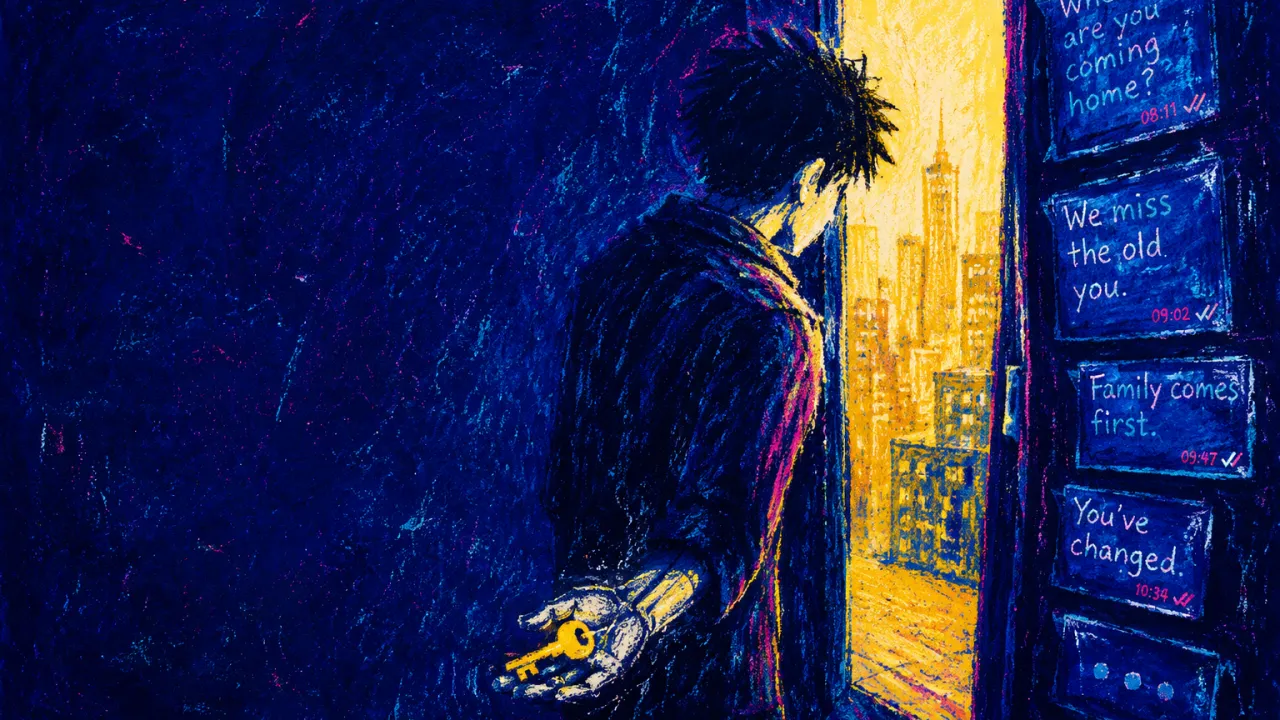
Autonomy Guilt Bind is the moment your own direction starts to feel like a withdrawal of love, even when the choice is ordinary. It shows up in the tight throat before a simple no, the cold fingers before sending a boundary, and the reflex to reassure before anyone has asked. From an existential perspective, the structural framework here is the friction between self-direction and belonging when connection has learned to measure distance as harm. The Tarot Cards below make that outline visible through bodies at thresholds, gates, collars, and open roads.
The Fool UprightThe white rose opens outward, the dog calls from the heel, and the cliff edge narrows the space where the next step can happen. The card holds innocence, attachment, and risk inside one small zone, so movement is never only movement. In family life, autonomy can become bound to guilt when stepping toward yourself is interpreted as withdrawing love. The body wants the open sky, but the close relational signal makes separation feel like an injury to the bond. The Fool gives that bind a precise shape. The struggle is not whether you care about your family; it is the knot that forms when caring is made to depend on staying within reach.
The Magician UprightThe raised wand and the downward-pointing hand turn the Magician's body into a living conduit, with one force reaching upward and another discharging toward the ground. The table in front of him creates a firm boundary, but it also fixes him in place while the whole image asks one body to connect two levels at once. In family tarot, that visual split mirrors the pressure of trying to become your own person while still routing every choice through loyalty, guilt, and inherited obligation. You are not simply hesitating; the card locates a structure where independence has to pass through the family ground before it feels allowed to exist. The red-white polarity of the clothing and flowers keeps sincerity and desire in the same frame without letting either disappear. That is the shape of Autonomy Guilt Bind: wanting a life that belongs to you while feeling the old family circuit tighten whenever your choice changes the role they expect you to hold.
The High Priestess UprightThe High Priestess sits at the entrance rather than moving through it, held between two pillars that turn passage into a charged border. The veil behind her makes the interior visible as a possibility but unavailable as an easy route. That physical arrangement mirrors the family bind where becoming your own person still feels like passing through an old gate of permission. You may know that distance, privacy, or a different choice belongs to you, yet the body still reads the family threshold as a place where love, guilt, and belonging are tested together. The struggle is not simple indecision. It is the pressure of carrying an internal family checkpoint, where autonomy feels real but every step toward it activates the old cost of being seen as disloyal.
The Empress UprightThe Empress sits inside a field of wheat with a heart-shaped Venus shield at her side, so the symbols of care, protection, and attachment are physically grouped around the same seated place. The garden is open to the eye, yet her body is not walking through it; the safe field also forms the boundary she would have to cross. That layout gives form to the family bind where movement toward adulthood feels like a departure from the source of care itself. You are not simply choosing between closeness and independence; you are carrying a structure where love, safety, and permission to move have been wired into the same gate.
The Emperor ReversedThe throne fills the frame until the river can only appear at the lower edges. Armor, crown, robe, and stone hold the body in a fixed shape, and no alternate path is visible around the seat of power. When family loyalty has been built around one central authority, autonomy can start to feel like leaving the only safe platform. You may want a separate life, a private boundary, or a simple no, while another part of the system reads that movement as disloyalty. The bind is not ordinary indecision. It is the pressure of an internalized family map where self-protection and betrayal have been drawn on top of each other, making freedom feel morally dangerous even when it is emotionally necessary.
The Hierophant UprightThe Hierophant sits above two kneeling figures, holding the staff of doctrine while the crossed keys remain at his feet. Access, legitimacy, and belonging are visible in the image, but they do not sit in the hands of the people who need them; they are mediated through the authority figure and the ritual structure around him. That arrangement mirrors the family bind where independence is technically possible, yet emotionally routed through approval. You may have the adult capacity to choose, leave, refuse, or redefine yourself, but the internalized family order still makes autonomy feel like a breach of belonging. The struggle is carried by the split between the raised hand and the grounded keys: permission descends from above while your life has to be lived from within. The card names the pressure point where loyalty, guilt, and self-direction become fused so tightly that choosing yourself can feel like breaking a sacred rule instead of claiming a normal boundary.
ReversedThe kneeling acolytes hold their position at the threshold, close to the keys but still below the seated authority. Their bodies are arranged for reception, not departure, and the path toward the inner space is framed as something reached through approved posture. That geometry gives autonomy a cost before any choice is made. In introspection, You may recognize a private truth and immediately feel the weight of betraying a rule, a group, an image, or an old moral contract. The card does not make independence reckless; it shows the guilt structure that appears when inner movement has been trained to request permission from the very system it is trying to outgrow.
The Lovers UprightThe two naked figures stand in a garden built for union, yet their hands never meet. The man looks toward the woman, the woman looks upward, and the angel holds the highest point of the scene, so choice is visibly routed through attachment and authority at the same time. In a family system, that same geometry becomes the pressure of trying to choose your own life while still feeling exposed to parental judgment, loyalty guilt, and the fear of being cast outside the safe garden. The card locates the struggle in the space between the open body and the withheld step: autonomy is available, but every move seems to carry the cost of belonging.
The Chariot UprightThe charioteer stands at the edge of departure with the city behind him, the riverbank marking a clean boundary, and the vehicle facing outward. His upper body is crowned, armored, and ready, while the lower body is visually absorbed into the square chariot, as if the part meant to move forward is still held inside the structure that made him. That is the shape of Autonomy Guilt Bind in a family system. You can see the direction of your adult life, but the old field still has weight in the body: one part is already leaving, while another part remains embedded in the emotional architecture of origin. The card does not frame independence as cold separation. It shows the precise friction point where movement becomes morally overcharged, where choosing your own route can feel like betraying the place that once defined your coordinates.
Strength UprightThe woman does not create safety by stepping away from the lion. She leans closer, placing her body inside the field of its force, as if the only way to prevent rupture is to remain near enough to guide the mouth directly. That is the shape of autonomy when family guilt is attached to separation. You may be trying to choose your own life while still managing how that choice lands in the family body, so independence becomes paired with soothing, explaining, and proving that you are not abandoning anyone. The card's tension is not between love and selfishness. It is between a real need for self-direction and a family system that makes distance feel like harm, forcing every move toward freedom to pass through the lion's mouth first.
The Hermit UprightThe hooded figure stands apart on the ice, but the lantern is not kept close to his chest; it is lifted outward into the dark. His body has chosen distance, while his light still creates a line of service between the peak and whatever lies below. Inside a family system, that split maps onto the moment when separation feels physically necessary and emotionally charged at the same time. You may know that leaving the argument, moving out, or refusing the inherited role is the only way to recover your own center, yet the old network reads your distance as a failure of care. The card does not make autonomy selfish or loyalty sacred. It shows the exact pressure point: your self-direction is trying to stand on its own ground while a family field keeps using guilt as the cord that pulls the lantern back toward them.
Wheel of Fortune UprightThe card shows an open sky around a closed wheel. The space looks vast, but the main path of motion is circular, and the figures attached to the wheel keep the system turning from positions they do not freely choose. That visual pressure maps closely onto family autonomy guilt. You can see a larger life outside the old orbit, yet the family structure can make every outward movement feel like it carries a cost for everyone else. The struggle is not a lack of courage or care. The wheel names the bind: autonomy moves toward open space, while guilt pulls the movement back into the family mechanism and asks you to treat separation as damage.
Justice ReversedThe scales hang from one hand, balanced only because the figure keeps the instrument suspended in the center of the chamber. Nothing in the scene moves freely; equilibrium depends on a fixed posture and repeated correction. In family life, independence can enter that scale as a debt before it becomes a desire. Choosing distance, privacy, a partner, a city, a career, or a different rhythm of contact may immediately summon the invisible weights of sacrifice, loyalty, guilt, and disappointment. Reversed Justice shows autonomy caught inside a moral accounting system. The card does not accuse You of selfishness; it reveals the structure that keeps turning self-direction into a case that must be defended.
The Hanged Man UprightThe Hanged Man is surrounded by white space, yet his body cannot use that openness because the ankle rope defines the real boundary. The tree is alive, upright, and centered, so the restraint does not look like a random trap; it looks like a bond attached to something that has been treated as essential. That is the exact shape of autonomy guilt inside family systems. You can see the outside world, adulthood, distance, privacy, and your own choices, but the attachment point turns movement into a moral charge before it becomes a practical decision. The card does not reduce this to simple rebellion or simple loyalty. It shows a body held between openness and attachment, which is where Autonomy Guilt Bind lives: the point where choosing your own direction feels less like freedom and more like pulling against the root of belonging.
Death UprightThe rider moves forward while the figures below remain bound to the path: one fallen, one kneeling, one praying, one watching. The card's tension is not only that change arrives, but that change arrives through a field of faces and roles that make forward motion feel physically consequential. In family life, this is the shape of autonomy when separation is not treated as growth but as an injury to the group. You can feel the adult self moving, yet the family field frames that movement as stepping over loyalty, tradition, or someone else's need to keep you in place. Autonomy Guilt Bind belongs to this card because the horse's movement and the bodies' resistance occupy the same path. The struggle is not whether you care about your family; it is whether your life is allowed to continue without every step being converted into guilt.
Temperance UprightOne foot rests on solid ground while the other touches the water, placing the angel across two different surfaces instead of fully committing to either one. The cups repeat the same split in the hands: one vessel lifted, one lowered, with the whole body organized around keeping the exchange steady. In family life, that structure mirrors the pressure to stay emotionally reachable while also trying to stand as a separate adult. You are not simply hesitating; the card shows a system where separation and connection are being held in the same posture, so every move toward independence can feel like it disturbs the emotional water behind you. The visible path toward the mountains matters because it is available, but the figure is still stationed at the shoreline. Autonomy Guilt Bind names the place where family loyalty turns movement into a balance test, making adult self-direction feel inseparable from the fear of causing relational spillover.
The Devil UprightThe collars around the two figures are not drawn as tight restraints, yet both bodies remain stationed before the altar. The space in front of them looks open, but any movement away from the Devil still begins by feeling the chain at the throat. That looseness is what makes Autonomy Guilt Bind so precise in a family reading. You may technically be free to leave, say no, move out, choose a partner, or build your own life, while the emotional structure still makes independence feel like a wound inflicted on the family system. The struggle lives in the gap between available movement and permitted movement. The card gives that gap a shape, showing how guilt can function like a collar even when no one is physically holding you in place.
ReversedThe collars around the two figures are visibly loose, creating one of the card's sharpest physical contradictions. Nothing in the metal fully prevents removal, yet the bodies remain in place beneath the Devil's raised hand and downward torch. That is the anatomy of a friendship where autonomy exists in theory but carries a moral charge in practice. You may be able to decline, mute, leave the chat, or step back, but the anticipated guilt pulls at the throat before any outward movement can happen. The struggle is not a lack of choice. It is the bind created when choosing yourself feels like injuring the friendship, so freedom and betrayal occupy the same doorway.
The Tower UprightThe falling figures are outside the tower, but they are not shown walking away through a chosen exit. The only visible route out is a violent drop through open air, with the crown and stones falling around them as if separation and structural collapse have become fused. Autonomy Guilt Bind emerges when family independence has no acknowledged doorway. You may want ordinary adult space, but the inherited system translates distance into betrayal, injury, or abandonment. The card's visual logic is precise: the need to leave is real, yet the available path has been made to feel like falling from the family structure rather than stepping out of it.
The Star UprightThe woman anchors one knee on earth while one foot rests in the pool, and both hands keep separate streams moving at once. Her body is not walking away from the water or surrendering fully to it; it has to hold a threshold position while the flow continues. In a family system, that threshold becomes the place where autonomy is negotiated through guilt. You may be trying to keep emotional contact with parents or relatives while also claiming adult separation, so every movement toward yourself can feel like it might dry out one of the streams. The Star carries hope here, but it is not a soft escape from the bind. It shows the shape of a self learning to remain connected without making family attachment the only proof of love.
The Moon UprightA small crustacean breaks the waterline at the exact beginning of the road, with its rear still tied to the pool while the route ahead passes the barking dog and wolf. The Moon offers light, but it is reflected light, so the first movement out of the water is exposed without becoming fully clear. Inside family questions, that threshold mirrors the moment autonomy starts to feel like a violation of an inherited emotional field. You may be making an adult move, but the card shows why the body can register it as crossing a guarded border, where guilt rises not as proof of wrongdoing but as pressure from the system you are leaving.
The Sun ReversedTurned inward, the child on the white horse no longer reads as effortless freedom. The open limbs become a way of staying balanced while being carried forward, and the missing reins make the movement feel exposed to the force of the surrounding field. In a family system, independence can take this form when leaving the old wall does not remove the family gaze from the body. You may make your own choices, move out, set limits, or build a separate life, while still feeling every step measured against loyalty, gratitude, and the fear of being seen as the one who broke the emotional contract. The reversed Sun holds autonomy as motion under surveillance. The struggle is not whether you are allowed to grow; it is whether growth can belong to you without being converted back into guilt.
Judgement UprightThe angel’s trumpet descends from a distant cloud layer while the bodies below rise from open coffins without fully leaving them. The call is unmistakable, public, and larger than any one figure, but the ground-level bodies still answer from inside the old containers that held them. That structure mirrors the family bind where independence and obligation arrive through the same emotional channel. You may be trying to stand as an adult while the family summons you through guilt, loyalty, crisis, or the fear of being judged as uncaring. Judgement gives this struggle a visible shape: a person can genuinely be waking up and still feel pulled by the sound that named them before they had a separate life. The card does not frame the family call as automatically sacred or automatically false; it shows the exact pressure point where answering it may cost you your own direction.
The World UprightThe dancer stands exposed at the center of a laurel wreath that reads as both completion and enclosure. Her arms stretch outward with two balanced wands, but every line of movement remains held inside the same oval boundary. In family dynamics, that visual structure mirrors the pressure of becoming independent while still being measured by the family's emotional idea of wholeness. You can move, grow, and claim your adult life, yet the system keeps asking your freedom to prove it has not betrayed belonging. Autonomy Guilt Bind lives in that exact friction: the body is dancing, but the frame still decides what counts as a complete dance. The card does not reduce the struggle to rebellion or loyalty; it shows the cost of trying to become yourself without being emotionally cast outside the family circle.
Ace of Cups ReversedThe cup hangs in open space, held upright by a hand that has adapted to suspension as if it were a stable surface. Above it, the dove descends; below it, the water returns to the pool, making one vertical channel feel like the only available orientation. Autonomy Guilt Bind forms when a family system trains that same vertical dependence into the body. Choosing privacy, distance, or a separate rhythm can feel like dropping the cup, even when the adult self knows that independence is not abandonment. The card's emotional beauty matters here because guilt often travels through love, not open hostility. Ace of Cups shows how a bond can be real and still become the axis that makes self-direction feel dangerous.
Two of Cups ReversedThe two cups are still separate, but the shared symbol between them can become too strong in reversal. The union begins to outweigh the vessels, and the narrow corridor of contact starts to feel like the only legitimate way to move. In family life, autonomy can become emotionally expensive when togetherness has been treated as proof of love. A boundary, a different choice, a delayed reply, or a private desire may feel less like normal adulthood and more like a rupture in the family bond. This card gives that guilt a structure. It shows a connection so symbolically charged that separation is not experienced as movement; it is experienced as threat, even when the movement is simply your own life trying to take up space.
Three of Cups UprightThe cups rise above the harvest, turning fruit at the ground into a shared gesture of recognition. What could belong to one person's labor or season becomes part of a collective toast, held high enough for everyone to witness. In family life, that structure can turn autonomy into an emotional withdrawal from the group. A decision that should belong to your adult life can be treated as if you are taking something away from the circle: attention, loyalty, access, reassurance, or the version of you the family has been using to stabilize itself. Autonomy Guilt Bind is carried by the gap between the private body holding the cup and the group ritual demanding it stay raised. The card shows why independence can feel physically simple but emotionally loaded when the family has learned to celebrate your life as shared property.
Four of Cups ReversedThe figure remains rooted beneath the tree while the offered cup arrives from outside the stable shaded zone. To receive it, the body would have to uncross, reach out, and leave the posture that keeps it contained. Family pressure often makes independence feel like that exact movement: not a simple choice, but a departure from the emotional perimeter that once defined safety and belonging. The card's structure shows why choosing yourself can trigger guilt before the choice is even examined, because the body reads movement away from the family field as a break in the old coordinate system.
Five of Cups UprightThe bridge and distant dwelling offer a clear line toward stability, but the figure's body is turned toward the cups that have fallen. Movement toward the far bank would require a physical turn away from the visible loss in the foreground. That is the exact pressure point of Autonomy Guilt Bind inside family life. You may see the outline of your own independent stability, yet the act of moving toward it can feel like leaving family pain, family expectation, or family disappointment unattended. The card's structure does not frame autonomy as coldness. It shows the body caught between a reachable future and a loyalty field organized around what has already spilled, where choosing yourself first has to fight through the weight of inherited guilt.
Six of Cups UprightThe boy extends a flower-filled cup inside a protected manor, and the gesture looks gentle precisely because nothing in the scene is openly forceful. The gift crosses a small distance, yet the walls, patrol, and childhood scale hold the exchange inside an old family territory. That is the shape of Autonomy Guilt Bind in family life: You can feel the warmth of care while also sensing the invisible claim attached to receiving it. The card locates the struggle in the cup itself, where affection and obligation share one container, making independence feel like a refusal of love rather than a movement toward adulthood.
Seven of Cups UprightThe castle and the shrouded figure sit among the same floating cups, turning home and self-recognition into competing visual claims. The body faces them all at once, close enough to be summoned, too far to hold any one option without losing sight of the rest. That is the physical shape of autonomy under family guilt: movement toward your own life is immediately measured against belonging, approval, and the fear of being seen as disloyal. The card does not frame the guilt as a moral verdict; it shows the structural bind that appears when family has been made the container for safety and permission.
Eight of Cups UprightThe solitary figure walks away from eight upright cups that still stand in an ordered formation. Nothing in the foreground has visibly collapsed, yet the body has already chosen the river path and the uphill terrain, making departure a physical act before it becomes an explanation others can accept. That is the shape of Autonomy Guilt Bind in a family system. You may be moving toward adult self-definition, privacy, and emotional breathing room, while the intact cups behind you keep representing everything that once counted as love, care, sacrifice, or belonging. The card does not frame the old structure as worthless, which is why the struggle has weight. It shows a boundary decision made under moonlight, where leaving the family pattern can feel necessary and disloyal at the same time, even when your body already knows the stagnant ground cannot hold you anymore.
Nine of Cups UprightThe man sits in front of nine cups with his arms crossed, so the emotional abundance is visible but not freely transferable. The cups are high enough to be displayed, while his body stays low, planted, and closed, turning satisfaction into something he must guard. Inside family dynamics, that image carries the bind of having your own life and then being made responsible for how accessible it is to the family. You can have built real happiness, yet every request for disclosure, gratitude, or availability turns it into a loyalty test; the card locates the struggle at the point where self-possession is mistaken for rejection.
Ten of Cups ReversedThe embracing couple helps stabilize the Ten of Cups image, anchoring the family beneath the rainbow as one emotionally unified unit. The scene is open, but its openness is organized around a shared domestic frame rather than separate paths. Reversed, the stabilizing embrace can become a pressure to keep the unit intact at the cost of individual motion. You may sense that choosing distance, privacy, or a different life rhythm will be received not as adulthood, but as damage to the family's emotional picture. Autonomy Guilt Bind names the point where separation is loaded with guilt because the family system treats unity as proof of love. The card shows why the bind can feel so hard to argue with: the demand is wrapped in the language of warmth, home, and togetherness.
Page of Cups UprightThe fish rises from the chalice while the sea remains visible behind the Page, placing containment and release inside the same line of sight. The platform creates a threshold: the creature's wider habitat is close, but the hand still holds the small vessel that has kept it near. Family autonomy often feels exactly like that threshold. You may know that distance, privacy, or a separate life is necessary for your own growth, yet the emotional system treats release as loss, making independence feel like harm instead of movement toward a wider habitat.
Knight of Cups UprightThe Knight of Cups moves forward, but the movement is deliberately slowed by the cup he carries and the rein he holds. His body is not charging into the future; it is trying to approach a threshold without spilling the emotional object that gives the journey its meaning. That structure mirrors the family bind where independence has to be presented as reassurance. You may be trying to cross into adult autonomy, but the old family field keeps asking for proof that leaving, changing, or choosing differently does not mean withdrawing love. The cup is not a weakness in this image; it is the load that changes the speed of the horse. Autonomy Guilt Bind names the place where your forward motion remains real, but every step is filtered through the fear of hurting, disappointing, or emotionally abandoning the family system that shaped you.
Queen of Cups UprightThe throne rests on a thin piece of shore surrounded by water, with a distant wall marking another boundary beyond the Queen's immediate reach. The scene offers openness, but not simple movement; leaving the seat means entering an emotional field with no clear dry path. In a family system, that shoreline becomes the place where independence and loyalty pressure meet. You can see the wider life beyond the family role, yet each step toward it may feel like abandoning the protected island that taught you how to belong. Autonomy Guilt Bind is the structure where self-direction carries an immediate charge of betrayal. The card does not frame separation as selfish; it shows how the family terrain makes even ordinary adult movement feel like crossing water with the whole throne watching.
King of Cups UprightHis right foot nearly reaches the water, but his weight remains on the throne. The card keeps contact and separation in the same frame: close enough to feel the sea, distant enough not to dissolve into it. In family life, that geometry names the guilt around individuation. You can want love, history, and contact while also needing a separate center; the struggle begins when the family system treats that separate center as rejection.
Ace of Pentacles UprightThe coin hovers between sky and earth, close enough to be seen as a gift but not yet grounded in the garden below. The path into the fertile space runs through a single arch, so movement toward security is already shaped by a boundary. Family autonomy often tightens at exactly that threshold. You may be building a life of your own, yet the memory of care, shelter, money, or emotional reliance can make every step outward feel like a debt being broken. The card gives that guilt a physical shape: a resource held above you, a garden that once promised safety, and a doorway that asks whether leaving the family field means losing the right to have been cared for.
Two of Pentacles UprightThe two pentacles are separate objects, yet the infinity cord makes each movement of one coin disturb the other. The figure’s raised foot and spread arms show a body trying to keep both sides alive without letting either side fall, turning balance into a constant act of compensation. In family dynamics, that same loop becomes the felt structure of guilt. You can move toward adult independence, but the family system still registers your movement as a shift in its own balance, so every personal choice carries the pressure of repair, reassurance, or emotional accounting. The struggle named here is not simple indecision. It is the bind where autonomy and loyalty are forced to travel through the same cord, making freedom feel like harm and connection feel like self-erasure until the loop itself becomes visible.
Four of Pentacles UprightThe figure sits with one coin held against the chest, two trapped under the feet, and another balanced on the crown. Every possible route of movement is tied to something that might fall, be lost, or expose the body once the clamp loosens. In a family system, that posture mirrors the bind where choosing yourself does not feel like a clean adult decision. It feels as if one step away from the inherited arrangement could make approval, access, or emotional stability drop first. Autonomy Guilt Bind lives in that exact pressure point. You are not simply reluctant to leave the old pattern; you are carrying a structure where movement has been made to resemble betrayal, and clarity begins when that structure is seen as a bind rather than a moral failure.
Five of Pentacles ReversedThe injured pair keep walking through the snow, close enough to share the hardship but not free enough to stop and separate their needs. The lit window intensifies the question of who gets warmth and who gets left outside. In family conflict, that visual pressure maps onto autonomy tangled with guilt. You may move toward your own life and still feel the pull of those who taught you that survival must be shared, even when sharing it keeps everyone cold. The reversed strain is a guilt circuit that makes independence feel like abandonment. The card's harsh path gives that circuit a shape: every step away from the family weather can feel like leaving someone behind in it.
Six of Pentacles ReversedThe kneeling route has become the available path toward the coins, and the suspended scale keeps the exchange psychologically unfinished. The bodies below can receive, but the scene does not show them standing afterward with equal ground restored. In family systems, this reversed pressure turns support into a debt signal that follows the adult self into choices, distance, and independence. You may try to leave, choose differently, or build your own life, while the remembered structure of receiving keeps asking whether separation is a form of nonpayment. Autonomy Guilt Bind is not simple guilt; it is guilt attached to the architecture of help. The card makes that architecture visible through repeated transfer without restored agency: the resource arrives, but the right to move freely still feels weighed.
Seven of Pentacles UprightThe lone pentacle on the ground sits between the figure's boots while the other six remain bound to the vine. The body is placed between taking one real yield and returning attention to the crop that still asks to be tended. Inside family decisions, that split gives guilt a physical shape. You are not choosing between love and abandonment; the card locates the bind between a harvested piece of your own life and the old system that keeps treating reinvestment as proof of belonging.
Eight of Pentacles UprightThe path to the distant town remains open behind the bench, but the craftsman's weight stays folded into the worksite. One foot is drawn up, the other extends forward between loose coins, and the body holds movement and staying in the same compressed posture. That geometry captures the family bind where separation is technically possible but emotionally loaded. You can see the route toward your own adult life, yet unfinished conversations, expected roles, and the memory of what the family still wants from you keep acting like tools left around your feet. The struggle is not a lack of independence. The card shows autonomy becoming fused with the fear of abandoning the family bench, so choosing yourself feels less like movement and more like leaving a visible obligation unfinished.
Nine of Pentacles UprightThe woman stands alone inside a cultivated estate, touching the pentacle-fruit while the house remains distant but visible. Her independence is real, but it is not floating in empty space; it is still inside a bounded field of ownership, memory, and cultivated reward. That is the structure of Autonomy Guilt Bind in family work. You may have built an adult life, but contact with parents or relatives can make independence feel like a departure that must be justified, paid for, or softened. The card locates the strain at the edge between self-sufficiency and inherited belonging. The question is not whether you are allowed to be separate; it is why separation still carries the weight of owing the old system proof that you have not abandoned it.
Ten of Pentacles UprightThe arch in the Ten of Pentacles is a threshold, but the figures do not move through it as free individuals. The adult couple pauses inside the household scene, while the staff points downward and the family structure surrounds the available path. That visual tension gives shape to the guilt of individuation. You can sense a route toward your own life, but the family field turns that route into a moral crossing: leaving, choosing, or disagreeing starts to feel like betrayal instead of adulthood. The pentacles above the scene intensify the bind because inheritance appears complete, orderly, and already decided. The struggle is not a lack of love for family; it is the structural collision between loyalty and self-direction when the doorway out is still framed by the people you came from.
Page of Pentacles UprightThe Page's right foot hovers back on tiptoe while the raised pentacle captures his gaze, leaving the open field available but not yet usable. His body contains travel-readiness and visual obedience to the object in the same suspended posture. Family autonomy often feels exactly like that: the path is technically open, but the inherited symbol stays at eye level and keeps asking to be considered first. You can see movement, adulthood, and distance, yet every step forward has to pass through the pressure of what your family will interpret, need, or accuse you of abandoning.
Knight of Pentacles UprightThe knight looks past the pentacle toward the open field, but his hand still holds the object in front of him like a charge he cannot simply put down. The horse does not move, even though the horizon is available, so the image becomes a body suspended between personal direction and guarded obligation. In family dynamics, that is the shape of autonomy guilt: the life ahead is visible, but movement feels like abandoning something the family taught you to protect. The card does not make the guilt sacred; it shows its mechanics, so you can see how separation became fused with the fear of failing the family system.
Queen of Pentacles UprightThe Queen is seated inside protection: stone throne, shade, roses, cloak, and fertile ground. Beyond that enclosure, the hills and water remain visible, so the card does not erase the outside world; it shows a body held in safety while another path stays in sight. That spatial split becomes the shape of autonomy guilt in family life. You can see the direction of your own adulthood, boundaries, or chosen life, but moving toward it means leaving the emotional architecture that once offered stability. The struggle is not a lack of independence. The card shows independence becoming fused with guilt because the family enclosure has taught the body to experience separation as withdrawal from care.
Two of Swords UprightThe woman sits at the edge of the sea with both swords crossed over her heart, her body making a choice-shaped barricade before any path is taken. The blindfold keeps the decision from being solved by facts alone, while the tide behind her keeps moving through a rhythm she cannot fully control. In a family system, that posture becomes the bind between self-direction and belonging. You are not simply choosing between two options; you are holding the possibility that choosing yourself may expose you to guilt, withdrawal, or being recast as disloyal, while staying compliant keeps the heart guarded and still.
Three of Swords UprightThe red heart is pinned by blades that arrive from above and both sides, leaving no clean edge from which it can simply pull away. Any attempt to move would tug against more than one embedded point, so separation carries the sensation of tearing rather than release. Inside family autonomy struggles, that geometry gives guilt a structure. You are not just choosing distance; you are moving against a bond that has been taught to read independence as injury, which is why a normal boundary can feel emotionally loaded before anything has even happened.
Six of Swords UprightThe ferryman’s body is braced between two directions: one foot set forward, one foot held back, the long oar dragging against the water as the boat begins to leave the bank. The card does not show a clean escape; it shows movement that must be generated through resistance, with the old shore still close enough to define the crossing. In a family system, that physical split becomes the shape of autonomy under emotional debt. You may be trying to build an adult life, set contact limits, or stop reacting like the child in the boat, while guilt keeps acting like drag in the water. The tension is not a lack of courage; it is the structural bind of needing distance from the family field while still feeling morally pulled by it. The swords make the crossing more precise and more burdened at the same time. They give the boat order, but they also add weight, naming the family struggle as a transition where clarity does not remove guilt and leaving does not instantly feel like freedom.
Seven of Swords UprightThe figure in the Seven of Swords moves away from the camp with five swords in his hands, yet his head turns back toward the place he is leaving. His whole body forms a split line: the feet commit to departure while the eyes remain accountable to the old field behind him. That split is the shape of Autonomy Guilt Bind inside a family system. You may be building your own life, setting limits, or choosing privacy, but part of your attention is still braced for the family's reaction, disappointment, or silent judgment. The card does not frame independence as clean escape. It shows autonomy being carried like sharp metal, useful but hard to hold, while the exposed path forces every step to be cautious. The struggle is the cost of leaving emotionally before your nervous system has stopped checking whether you are allowed to go.
Eight of Swords UprightThe blindfolded woman stands upright among swords that do not touch her, with her hands tied behind her back and one foot testing unstable ground. The body has room to move, but every route is framed by blades and by the pressure of keeping the red, living self contained under white bands. In a family system, that image names the place where independence feels available and disloyal at the same time. You are not simply refusing freedom; the card locates the guilt bind that makes a normal step toward adult agency feel like a threat to the bonds that raised you.
ReversedThe bindings sit on the body like a rule that no longer needs a guard. The sword enclosure is open enough to leave, but the figure's posture has adapted to stillness as if movement itself would violate the terms of safety. In friendship, this becomes the bind where choosing yourself feels emotionally charged before anyone even reacts. You may need space, changed access, slower replies, or a cleaner limit, yet the bond has trained autonomy to feel like harm. The card places guilt inside the mechanics of restraint rather than treating it as a passing mood. It shows how a friendship can become so morally loaded that ordinary self-direction feels like disloyalty, even when the path out is already present.
Ten of Swords UprightThe river in the Ten of Swords is calm enough to cross, and the far mountains hold a quieter line beyond the scene. The tragedy is spatial: the exit is visible, but the body collapses at the threshold before it can make the crossing. That threshold becomes the shape of autonomy inside a family system. You may be able to imagine the apartment, the boundary, the different life, or the version of yourself that is not constantly pulled back into family gravity, yet the moment of choosing it activates guilt as a stopping force. The small hand gesture deepens the bind because it keeps faith and loyalty present even at the point of collapse. The card names a struggle where leaving is not only practical movement; it is felt as a moral charge against the family bond, even when staying costs you your own center.
Page of Swords UprightThe figure has climbed to a higher ridge, yet his torso remains turned back toward the ground behind him. The open sky suggests room to move, but the posture keeps the past path inside the present action. Autonomy Guilt Bind appears when separation from family is not experienced as a clean step forward. You can want your own apartment, schedule, values, relationships, or boundaries while still feeling the backward pull to explain why your independence is not an attack. The Page's stance makes the bind visible without moralizing it. Growth is present, but it is braced; the forward body and backward glance show how family guilt can turn individuation into a constant act of self-defense.
Knight of Swords UprightThe wilderness appears open, but the card's motion is not open-ended. Horse, rider, wind, and sword compress the available space into one urgent forward line, as if freedom exists only while it is being defended. In family life, autonomy can carry that same compression. You may technically be free to choose your home, work, partner, beliefs, or distance, while the emotional field narrows every choice into a question of loyalty, gratitude, or betrayal. The card gives the bind a precise outline: movement is possible, but it must push through a family atmosphere that converts independence into guilt. The struggle is not a lack of will; it is the cost placed on agency when attachment has been made conditional.
Queen of Swords UprightThe Queen is elevated above the low clouds, seated alone on her own ground, with symbols of care and transformation carved into the throne rather than surrounding her as living contact. Her sovereignty is real, but it is spatially isolated. In family systems built around loyalty tests, that elevation becomes a charged form of separation. You may be trying to claim an adult life, a private decision, or a different emotional climate, yet the old family field translates distance into betrayal. The struggle is the bind where autonomy does not feel neutral. It feels like standing on higher ground while the clouds of obligation gather below, making self-direction carry the weight of guilt.
King of Swords UprightThe King sits as a complete adult authority, crowned, upright, and holding the sword high, yet his body is still physically fixed to the inherited stone seat beneath him. The image gives him command, but that command is not free-floating; it is anchored to a throne, a mound, and a formal position that carries weight before he even moves. That structure mirrors the family bind where independence does not feel like a clean exit. You may be capable of making your own call, but the moment you do, the old emotional architecture of loyalty, guilt, and inherited expectation starts pressing against the decision. The struggle is not a lack of autonomy. It is the cost of occupying your own authority while a family system still treats separation as betrayal, selfishness, or proof that you have stopped caring.
Ace of Wands UprightThe wand rises from a hand in the clouds while the river below keeps moving across the landscape, separating emotional flow from the seized vertical spark. The scene is fertile, but the strongest point of contact is still a fist around the source of initiative. In a family spread, that split gives Autonomy Guilt Bind its shape: movement toward your own life still passes through an older emotional channel. The struggle is not simple indecision; it is the pressure of feeling that choosing yourself somehow interrupts the family's supply of warmth, approval, or belonging.
Two of Wands UprightThe man stands above his lands with a globe in one hand and a wand held against the battlement. The horizon is open, yet the body remains braced inside the castle, so the card's ambition is not floating free; it is measured from the edge of a protected family structure. For family questions, that edge becomes the place where autonomy and guilt bind together. You can see the shape of a life beyond inherited expectations, but every movement outward still has to pass the wall of belonging, approval, and the fear of becoming the one who leaves.
Three of Wands UprightThe figure has stepped beyond the pair of wands behind him, yet his hand still rests on the staff planted at the edge of land. The image holds two facts at once: the body is oriented toward a wider horizon, and its stability still comes from something rooted in the old ground. Inside family conflict, that posture gives Autonomy Guilt Bind a visible shape. You may be genuinely ready to build a life beyond inherited expectations, but the act of moving forward still feels as if it pulls against the structure that once made you feel held, named, and legitimate. The sea does not accuse the figure, and the planted wand does not imprison him; the pressure lives in the friction between them. This card locates the struggle at the threshold where independence stops being a private desire and becomes a visible separation from the family field.
Four of Wands UprightThe celebrants stand in front of the wands while the castle-like home remains behind them, separated by water and a bridge. The image holds welcome and distance in the same composition: the body is invited into celebration, but the actual route toward home still requires a crossing. That crossing becomes the emotional geometry of family autonomy. You are not simply choosing between closeness and leaving; you are trying to move as an adult while the family field still reads movement as proof of loyalty or rejection. The garlands make the threshold beautiful, which is why the bind can feel so hard to name. The structure shows how guilt attaches to independence when home is both a source of belonging and the place that keeps measuring whether you have moved too far.
Five of Wands UprightEach figure in the Five of Wands keeps a distinct stance, color, and angle, yet no one can extend a separate line without colliding with the group. Individual direction remains visible, but the shared formation turns difference into impact. In a family setting, that visual structure names the bind where becoming separate is treated as disrupting the whole field. You can be making a reasonable adult choice, but the family geometry may load that choice with guilt because your independent direction changes everyone else's familiar position.
Seven of Wands UprightThe central wand is not separate from the figure; it extends from his body like a living branch, yet it must be used as a barrier. The same object that expresses his force also marks the line he has to defend. That is the family shape of autonomy under guilt. Your independence may be real, but the ground beneath it is uneven because each act of self-definition can be treated as a refusal of closeness, gratitude, or belonging. Seven of Wands holds the conflict at the exact place where a self becomes visible. The card shows why autonomy can feel like betrayal inside a family system that reads separation as rejection, even when the deeper movement is toward emotional adulthood.
Eight of Wands ReversedThe wands rush toward land while the foreground remains cut off by water and distance. A small house sits on the hill as a visible destination, but the card gives no person a stable place from which to choose the route. In family autonomy struggles, that geometry can make separation feel like obstruction and self-direction feel like leaving the flight path. The card names the bind where choosing your own pace is experienced inside the system as a disruption of momentum, even when the need for space is structurally real.
Ten of Wands UprightThe road in the Ten of Wands is technically open, but the figure's freedom is occupied by what he carries. His forward motion does not release him from the bundle; it makes the bundle the condition of arriving. In family dynamics, that is the bind between autonomy and guilt. You may be building an adult life, making your own choices, or creating distance, while still feeling that every step must prove you have not abandoned the family load. The card gives this pressure a visible form: the body can move, but the movement is shaped by what it refuses to drop. It does not condemn loyalty; it shows where loyalty has become a structure that taxes your agency.
Page of Wands UprightThe Page stands turned toward the open scene, but both hands remain fixed on the wand. His head lifts as if to announce something beyond the staff, while the body still has to keep the inherited vertical line from tipping. That is the exact shape of autonomy under family guilt: movement is possible, but it has to be performed without appearing to abandon the structure that raised you. You are not simply choosing between freedom and family; you are trying to move while still proving that your movement does not make you disloyal. The card does not flatten that bind into rebellion. It shows the body mechanics of a young self trying to speak in its own direction while still bracing the symbol that older voices can recognize.
Knight of Wands UprightThe horse faces the open desert, yet the knight's left hand still holds the rein close enough to interrupt the launch. His armor and raised wand announce readiness to leave, while the lifted hooves show the departure has not fully converted into forward movement. This is the shape of autonomy carrying an old pull at the same time. In family space, you may know the direction of your own life, but the body still checks for parental reaction, inherited expectation, or guilt at the very threshold of leaving.
Queen of Wands UprightThe Queen's wand rises from her right hand, yet its base meets the throne step rather than the open ground. Her posture is self-possessed, but the seat beneath her is covered in inherited lions and sunflowers, so personal will appears supported and regulated by an older structure at the same time. In family life, that image locates the pressure of Autonomy Guilt Bind: your choice can feel real only after it passes through the architecture that raised you. You are not simply deciding whether to be independent; you are carrying the friction between self-authored movement and the fear that movement will be read as disloyalty. The card holds a cleaner boundary around that friction. The guilt is not proof that autonomy is wrong; it is the residue of a family system that taught love, approval, and permission to sit on the same throne.
King of Wands UprightThe King's gaze travels outward, but his body remains seated inside the throne's command structure. The wand is alive with growth, yet it is pressed into barren ground as a stabilizing instrument rather than allowed to root elsewhere. That visual arrangement carries the family tension of wanting a life beyond the inherited seat while still feeling the weight of connection, expectation, and old permission rules. Your autonomy is not simply a decision; it is a movement away from a field that has trained leaving to feel like rupture. Autonomy Guilt Bind is the strain between the wand's living direction and the throne's claim on the body. The card gives that guilt a shape: a forward-looking life force held inside a family structure that treats independent motion as a challenge to belonging.
No cards available for this filter.