Three of Wands Tarot Card Meaning

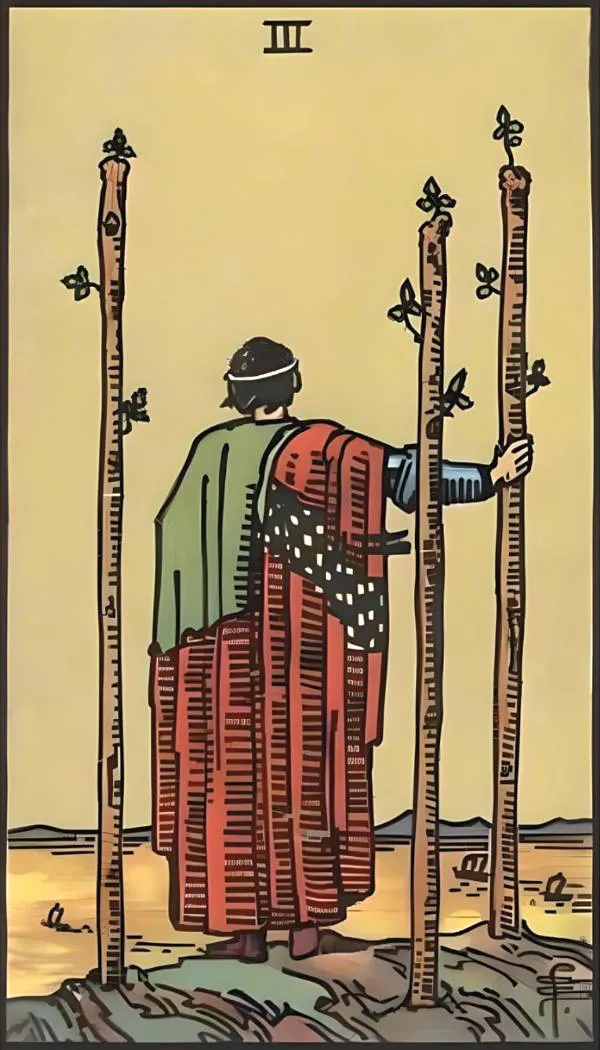
Three wands stand tall on a high ground, with a man supporting one of them with his hand. We only see the back of this man, but from his attire, it seems he is a person of status and importance.

This scene takes place on a seaside cliff, where the gentleman stands at the highest point of the earth, gazing into the distance.

The man wears a black flat cap, signifying his authoritative status. His blue sleeves and red cloak represent a balance between passion and calm. A green scarf hangs over his left shoulder, symbolizing the growth of the earth and the foundation of resources. The checkered pattern of yellow and black draped over his shoulder represents the strategic mind of conquering and planning. His posture reveals a calm, composed, and dignified character.

The three wands are held in hand or stand independently on the ground. This card shares similarities with the Two of Wands, and indeed, there is a connection between them. The two wands behind the man stand parallel to each other on the ground, like a double threshold, and the man steps forward beyond the threshold, as if he has passed through it to further develop. His right hand holds a wand and rests it on the ground in front, indicating a sense of determination and authority.

Following the man's gaze from the edge of the seaside cliff, the view is a vast expanse of water with several sailing ships navigating on the surface. The ships in the sea symbolize connections without limits and the hope that is anticipated. The sky is a bright orange, and although distant, one can faintly see the rolling hills on the other side. It seems the man is contemplating whether to cross over. Why does he stop and stand still? Perhaps it's because, despite its vastness, the ocean requires more preparation and determination to venture forth.

Wands

The three wands in the card symbolize the initial realization of a goal or vision. They are often seen as a representation of the material, emotional, and spiritual aspects of a situation, or the past, present, and future. The wands are firmly planted, indicating that a strong foundation has been laid for future endeavors.

Character Facing the Sea

The figure in the card gazes out at the sea, which represents unlimited potential and opportunities yet to come. His posture is one of expectation and readiness, suggesting that he is waiting for his ships to come in. This captures the essence of foresight and preparation for what the future holds.

Ships in the Distance

The ships sailing in the distance signify upcoming rewards, returns on investment, and the arrival of opportunities. They may represent trade, travel, or the fruition of a long-term project. Their appearance on the horizon is a favorable sign, indicating that things are coming to fruition and progress is being made.

Landscape

The natural surroundings, often a combination of land and water, symbolize the various realms and aspects of life that the questioner may be dealing with. The open vista suggests possibilities, but also the necessity of a clear vision to navigate them.

Red and Yellow Garments

The red and yellow clothing of the figure implies a blending of willpower and intellect. Red is the color of passion and energy, while yellow represents wisdom and clarity. Together, they symbolize a balanced approach towards achieving one’s goals.

Psychological patterns in Three of Wands
Analysis Paralysis
The same cliff that gives the figure perspective can also lock him into position. The hand remains on the wand, the gaze stays on the horizon, and the body holds itself at the edge as if one more scan of the distance will finally make movement safe. That is the body language of cognition turning into a holding pattern. The mind keeps trying to reduce uncertainty through more observation, but every new interpretation postpones contact with the feeling that is already asking to be entered. In introspective work, Analysis Paralysis appears when you keep rereading your inner landscape instead of crossing into the next psychological step. The pattern is not a lack of intelligence; it is an overactive safety strategy that mistakes perfect understanding for emotional readiness.
Timing Perfectionism
The ships are already moving, but the figure remains on the cliff, measuring the distance between readiness and departure. The planted wands can look stable, yet in the reversed texture they become conditions that must be satisfied before any real crossing is allowed. This turns timing into a defense mechanism. Instead of supporting action, preparation becomes a gatekeeper that keeps asking for one more plan, one more source, one more clean emotional state, one more sign that the moment is safe. In academic life, Timing Perfectionism appears when You delay writing, submitting, asking for feedback, changing majors, or applying because the internal clock never declares the moment good enough. The cost is not laziness; it is a readiness standard so exacting that the work cannot enter reality.
Sunk Cost Fallacy
The man has moved beyond the rear wands, but his hand still holds the forward wand planted in the ground. In the reversed texture, the very structure that once proved readiness can harden into an argument for staying attached to what has already been invested. Sunk Cost Fallacy forms when planted effort becomes mistaken for future obligation. The mind treats prior time, labor, money, or identity as evidence that the current path must continue, even when the sea ahead no longer matches the real return. In a choice reading, this pattern makes the hidden price of staying visible. You are not only choosing between options; You are also negotiating with the part of You that fears admitting a past investment may not deserve more of Your future.
Timing Discernment
The figure stands above the shoreline with one hand resting on the forward wand, watching the ships move across the water rather than running down toward them. The card's whole geometry is built around distance: high ground, open sea, a visible horizon, and movement that can be tracked but not instantly controlled. That posture turns timing into a perception task. The wand gives the body a grounded point of reference, while the gaze scans the wider field for evidence of momentum, return, and readiness. This is not passive waiting; it is the psychological skill of letting the external cycle become legible before choosing the next push. Timing Discernment emerges when You can tell the difference between a real opening and the discomfort of not acting yet. In the Three of Wands, the mind is asked to hold vision, preparation, and environmental feedback in the same frame, so the next move is guided by rhythm instead of urgency.
Threshold Tolerance
Two wands stand behind the figure like a threshold already crossed, while the wand in his hand marks the forward edge of his position. He is no longer inside the old frame, but he has not yet entered the sea beyond it. Threshold Tolerance is the capacity to remain conscious in that in-between zone. The card gives the body a stable place to stand while the identity system adjusts to a larger field of possibility. In personal growth, this pattern matters because every level-up creates a short period where the old self no longer fits and the new self is not yet embodied. You are not required to collapse that space into urgency; the threshold itself can become part of the growth architecture.
Delayed Gratification
Three wands are already planted, yet the visible reward is still offshore. The man's hand stays on the wand as if holding the body in place while the horizon proves the project is moving somewhere beyond immediate control. That distance externalizes a mature career tension: effort has left your hands, but returns have not yet become tangible. The pattern holds the gap between investment and recognition without forcing premature proof. In work, this is the patience required when skill, reputation, and influence are compounding before the promotion, raise, or public credit appears. The card makes waiting visible as an active psychological container, not passive resignation.
Strategic Foresight
The three wands are already planted in the ground, and the figure's hand rests on one of them as though the structure can hold his weight. From the cliff, he can see the ships and the distant shore, but he remains positioned where the whole map is visible. This visual field shows foresight as a defense against scattered urgency. Instead of collapsing into immediate action, the mind uses elevation, distance, and stable supports to build a working model of what comes next. The body is still, but the cognition is active. Strategic Foresight appears when You stop treating timing as a guess and start treating it as pattern recognition. The Three of Wands links this mode to preparation that has already begun, making the pause a planning stance rather than a retreat from risk.
Strategic Intimacy
The man on the cliff has already moved past the two rear wands, but he does not rush into the sea below. His hand rests on the forward wand as a stabilizer, and his gaze follows the ships at a distance, creating a picture of desire held inside a deliberate structure. That posture maps closely onto Strategic Intimacy because the card does not show emotional withdrawal or reckless pursuit. It shows a nervous system using perspective, timing, and grounded self-possession to decide how much closeness a relationship can safely carry. In love, this pattern can feel like standing at the edge of a deeper conversation and choosing not to force it before the connection has enough evidence beneath it. You are not avoiding intimacy when this pattern is healthy; you are auditing whether the bond has the emotional infrastructure to support the next crossing.
Decision Deferral
The figure stands at the edge of land with two wands behind him and one wand under his hand, facing a sea crossed by more than one ship. The composition contains direction, but it also contains too many possible cues: stay with the foundation, follow the ships, cross later, cross now. In reversal, the threshold can become a holding pattern. The mind keeps reading the horizon for more evidence while the body remains parked at the same edge. Preparation becomes a way to avoid the irreversible moment when timing has to be tested through action. Decision Deferral appears when You keep extending the evaluation phase so the choice never has to become real. The Three of Wands makes the mechanism concrete: the future is visible enough to obsess over, but not close enough to force a commitment unless the psyche chooses one.
Resource Alignment
The three wands are not floating ideas; they are planted into the ground around the figure, turning ambition into a structure with weight. From that stable cliff, the man can look outward without losing his footing, which gives the future a base rather than leaving it as pure projection. Resource Alignment emerges from this physical arrangement. The card links expansion to support systems: what has already been built, what can actually carry weight, and what resources must be in place before a choice becomes sustainable. In a decision reading, this pattern turns the question away from fantasy and toward fit. You may want the wider sea, but the audit asks whether the option ahead matches Your actual capacity, not just Your ideal self-image or the version of the future that looks impressive from a distance.
Core Struggles in Three of Wands
Threshold Disorientation
Two wands stand behind the figure like a line already passed, while one wand is held at the edge of the next terrain. He has stepped beyond the earlier posts, but the ocean ahead is not a path his body can simply walk. That composition captures the inner disorientation that follows real change. You may no longer fit the old self-structure, yet the next version of you is still a horizon rather than a stable place to stand. The card gives the threshold a precise shape: land behind, sea ahead, a body paused between systems. It shows why the pause feels charged; the struggle is not indecision alone, but the loss of familiar coordinates before new ones have become livable.
Belonging-Authenticity Split
Two wands stand behind the figure like an old gate, while the wand in his hand anchors him at a newer edge. His body still belongs to the marked ground, but his gaze has already crossed into a wider field. In friendship, this becomes the exact pressure point where belonging and authenticity stop feeling automatically aligned. You can feel the value of the old bond, the shared language, and the social safety it provides, while also sensing that full honesty would move you beyond the version of yourself that the friendship expects. The Three of Wands does not frame this as disloyalty. It shows a person standing between a known social threshold and a larger horizon, carrying the strain of wanting connection without shrinking back into an outdated role.
Inherited Role Lock
The wand is useful on land, but it cannot become a ship. When the same support is treated as the tool for every terrain, the figure remains dignified and composed while the actual crossing stays out of reach. Inherited Role Lock appears when the family role that once helped You belong is still being used to navigate a life that now requires different equipment. You may keep trying to become independent through the very identity that the family assigned to keep You predictable, useful, or emotionally available. The reversed card places the trap in the tool itself. The old role can look responsible, mature, and stable from the outside, while quietly keeping You at the same cliff edge each time You try to move beyond the family script.
Autonomy Guilt Bind
The figure has stepped beyond the pair of wands behind him, yet his hand still rests on the staff planted at the edge of land. The image holds two facts at once: the body is oriented toward a wider horizon, and its stability still comes from something rooted in the old ground. Inside family conflict, that posture gives Autonomy Guilt Bind a visible shape. You may be genuinely ready to build a life beyond inherited expectations, but the act of moving forward still feels as if it pulls against the structure that once made you feel held, named, and legitimate. The sea does not accuse the figure, and the planted wand does not imprison him; the pressure lives in the friction between them. This card locates the struggle at the threshold where independence stops being a private desire and becomes a visible separation from the family field.
Readiness Loop
The wand in front can support the figure, but it can also turn the posture into a fixed brace. The gaze keeps returning to the sea, while the body stays trained to hold position at the edge rather than enter the route beyond it. In a career reading, this is Readiness Loop as an internalized delay system. You may keep preparing the application, refining the pitch, earning one more credential, or waiting for a cleaner signal, while the real threshold remains untouched. The reversed structure makes preparation feel productive because it preserves composure. The card marks the boundary where readiness stops serving movement and starts becoming the place where movement is continually postponed.
Unseen Cost Bind
The horizon looks generous, but the costs of reaching it are not held in the same visible place as the ships. The figure can see expansion, distance, and possible return, while the friction of crossing remains partly outside the frame. Unseen Cost Bind emerges when the visible upside of a choice becomes easier to measure than the hidden price of entering it. In reversal, the open view can become a screen that makes risk feel abstract until the body is already committed. For a choice reading, this card sharpens the question beneath the question. You are not only deciding what you want; you are locating which costs have been made visible, which have been romanticized, and which have been pushed beyond the horizon.
Cycle-Action Desynchronization
The wands are fixed in earth while the ships move on water, and the man stands between those two pacing systems without a bridge. The card places stable personal intention beside currents that obey a different rhythm. This is Cycle-Action Desynchronization. You may be applying force from a solid plan while the external cycle is still moving offshore. The struggle is not laziness or lack of commitment; it is the friction of acting from one cadence while the available opening belongs to another.
Reciprocity Deficit
The figure stands on high ground with three wands planted behind and beside him, watching ships that are visible but still offshore. The card's promise is not empty, but the return is separated from the investment by distance, water, and time. In friendship, that structure mirrors the strain of giving care into a bond and then waiting to see whether anything comes back with equal weight. You may have offered loyalty, emotional availability, introductions, patience, or repair attempts, yet the evidence of mutuality remains somewhere on the horizon rather than in your hands. The Three of Wands holds this struggle at the exact point where hope has not disappeared, but reciprocity has not landed. It names the cost of standing in an open friendship field while your inner system keeps asking whether this connection can actually carry care in both directions.
Permission Paralysis
The horizon is visible, the ships are moving, and the figure has enough height to see what could come next. Yet the body remains planted at the edge, using the wand as an anchor while waiting for the distant field to send back a signal. Permission Paralysis forms when that waiting becomes internal law. In a family system, You may keep postponing your own move until the people behind You approve, soften, understand, or stop needing You to be who they remember. The card's reversed tension is not a lack of desire. It is the conversion of open possibility into a waiting room, where family permission becomes the invisible bridge You keep expecting before You allow yourself to cross.
Vision-Execution Split
The man stands beyond the two planted wands, with one hand on the third while his gaze travels across water toward ships already in motion. His body has crossed a threshold, but the next movement is displaced into distance: sight moves faster than feet, and strategy reaches farther than contact. For personal growth, this structure names the friction between a clear future self and the daily mechanics that would make that self real. You are not lacking a horizon; the card locates the strain in the gap between knowing where expansion points and having an embodied path across the water.
Inner Emotions in Three of Wands
Directionless Urgency
The forward wand touches the ground like a point of intended movement, but the figure's body does not step toward the water. His gaze reaches outward while the actual route remains unmarked, creating a sharp split between pressure and orientation. Directionless Urgency is the feeling of needing to move before you know what direction is truly yours. The card exposes the inner sprint that begins when the horizon feels demanding, yet the path has not become real under your feet.
Stalled Momentum Dread
The whole image points outward: ships, sea, horizon, and the wand set ahead of the figure. Yet the body remains planted on the cliff, and the upright wands can start to read less like a launch point and more like a frame holding the figure in place. In love, this becomes the dread of a relationship that keeps looking future-oriented without actually moving. There may be plans, chemistry, conversations, or implied promises, but the lived structure stays still. Stalled Momentum Dread is the feeling that forms when potential stops being nourishing and starts becoming pressure. The card makes that pressure visible through a body prepared for expansion while the actual crossing remains suspended.
Liminal Longing
The small ships and faint hills sit far beyond the cliff, close enough to see and too distant to touch. The figure's hidden face makes the longing travel outward through posture rather than expression, as if the body is already somewhere the feet have not reached. Family can make that distance feel especially sharp. You may be present at the table, in the group chat, or during a visit, while your attention keeps drifting toward a version of life where your choices are not constantly translated through family expectation. Liminal Longing is the ache of standing between inherited ground and a wider horizon. The card anchors that ache in the pause before movement, where wanting more is no longer vague, but the crossing still asks for timing, resources, and internal permission.
Cautious Momentum
The ships crossing the water carry movement into the scene, while the figure remains grounded on the cliff with one wand under his hand. The image holds motion and restraint in the same frame, creating the feeling of progress that has started without becoming impulsive. You may recognize Cautious Momentum when a long-range path begins to activate, but your system still wants to test the scale of the crossing. The horizon is not empty; it is asking your direction to become durable enough to travel.
Resentful Waiting
The ships stay distant while the figure remains fixed on the cliff, holding his position with almost ceremonial control. Movement exists in the scene, but it is not yet reaching the person who is watching for it. Resentful Waiting forms when friendship becomes a long watch for care that keeps being deferred. You may look composed, but the inner weather tightens each time you wait for a reply, a repair, or a small sign of effort that should not require another reminder.
Cautious Autonomy
The figure has stepped beyond the double threshold of the two rear wands, yet he keeps one wand under his hand. The image does not cut him loose from structure; it shows him carrying support into a wider field. That is the emotional shape of Cautious Autonomy in friendship. You are not trying to punish anyone by needing more space; you are learning that a bond can remain meaningful without requiring constant availability, instant response, or silent self-erasure.
Long Distance Longing
A lone figure stands with his back turned, looking across open water toward ships that are present but far away. The card does not show direct contact; it shows attention stretched over distance, with the body anchored on land while the gaze travels toward something moving beyond reach. In love, that visual structure turns longing into a spatial experience. You may feel connected to someone, but the connection lives across a gap made of timing, silence, physical distance, emotional guardedness, or an undefined next step. The planted wands show that this is not a fantasy without roots. There is investment, history, or desire already in the ground, which is why the waiting has weight. Long Distance Longing names the ache of watching for a relationship to come closer while trying to stay composed at the edge of uncertainty.
Relational Distance Ache
The figure faces away from view, standing on high ground while the sea opens into a wide interval before the ships. The card makes distance visible not as emptiness, but as a charged space between the body that waits and the movement that remains out of reach. In love, this becomes the ache of emotional separation inside a bond that still matters. Someone may be present in your life, your phone, or your memory, yet the space between what is felt and what is shared keeps widening. Relational Distance Ache fits the reversed pull of this image because the horizon stops feeling spacious and starts feeling unreachable. You are not simply wanting attention; you are feeling the cost of a connection that keeps placing closeness somewhere farther away than your nervous system can comfortably hold.
Liminal Stillness
The cliff edge, the sea, and the double threshold of wands hold the figure in a clean pause. He has stepped beyond the rear wands, yet the water still separates his body from the faint hills on the other side. Liminal Stillness is the inner weather of being between versions of yourself without having to rush the crossing. For introspection, the card turns the pause into a container where an old identity has loosened, but the next one is still too new to inhabit.
Quiet Readiness
Three wands stand planted at the cliff edge while the figure keeps one hand on the forward staff, looking across the water toward ships already in motion. The body is not rushing after them; it is holding a stable line between preparation and distance. You can feel Quiet Readiness when your next direction has begun to take shape, but the right movement still asks for a wider view rather than a sudden jump. The open sea gives the feeling room to breathe, while the fixed wands keep it from dissolving into vague possibility. In direction work, this becomes the inner weather of being almost ready: clear enough to face the horizon, grounded enough to wait until your energy knows where to go.
Outer Contexts in Three of Wands
Premature Launch Pressure
The ships are visible, but they have not docked. Their distance matters: the card shows movement on the horizon, not resources already unloaded at the figure's feet. In a reversed frame, that distance becomes pressure to act as if the return has arrived before the route has completed its work. The sea holds a gap between opportunity and access, and the figure stands where vision can easily be mistaken for readiness. For personal growth, this maps the reality of premature launch pressure. You may be surrounded by a culture that pushes you to announce, monetize, rebrand, or publish the next version of yourself before the supporting structure is actually present. The card names the difference between a real opening and an external demand to perform readiness.
Situationship Ambiguity
The figure is surrounded by structure, but the open water beyond him has no shared boundary. The wands make the scene look intentional, while the turned back and distant horizon keep the central relationship to the future undefined. That is the architecture of a situationship: enough consistency to feel like something, not enough agreement to know what it is. The connection can contain intimacy, routine, chemistry, and implied expectation while still avoiding the mutual language that would make it accountable. You are being shown a bond held at the edge of definition. The card helps separate actual relational structure from the atmosphere of possibility that keeps you waiting for someone else's unnamed timeline.
Friendship Future Faking
The ships are visible, but they do not reach the shore where the figure is standing. The hand stays on the wand, the body remains at the edge, and the promised movement is always somewhere out on the water. That is the reality structure of Friendship Future Faking. You are not reacting to one delayed plan; you are watching a repeated pattern where a friend keeps creating future-facing closeness through promises, trips, catch-ups, or apologies, while the actual care never lands in the present.
Family Estrangement Threshold
The figure is past the old threshold, but the sea ahead is too wide to treat as a casual next step. The cliff creates a clean separation between where he has been standing and the route that would carry him farther away. That is the visual logic of a family estrangement threshold. The issue is not a single argument; it is the moment when distance itself becomes a serious structural option because the old terms of contact no longer hold. The card does not force a final cut. It frames the threshold as something to inspect with precision: what contact costs, what distance protects, and whether the relationship can survive without requiring you to step back behind the old wands.
Lifestyle System Overhaul
Three wands stand like installed pillars on the cliff, with one in the figure's hand and two behind him as a threshold already crossed. The image is not a blank beginning; it shows a life structure that has enough foundation to be audited from above. For lifestyle work, that height matters. You are not dealing with one isolated bad habit, but with a set of daily modules that need to be seen as one operating system: work hours, sleep pressure, recovery, physical space, and the resources still moving toward you. The card connects to Lifestyle System Overhaul because its central action is strategic re-architecture. The next move comes from seeing which pillars are already stable, which ones are only decorative, and which incoming commitments will overload the structure if they are not placed deliberately.
Launch Window Readiness
Three wands stand planted on the cliff, and the figure holds the forward staff like a stake in the ground. The ships are not imaginary; they are already on the water, but the body remains at the base camp. This is the stage where preparation has become visible but the crossing has not started. You are testing whether your resources, support, and timing can carry the move beyond intention into an actual launch.
Strategic Timing Window
The man stands high above the sea with one wand braced in his hand and two others planted behind him, watching ships move across a bright but distant horizon. Nothing in the image is collapsing or rushing; the pressure comes from timing, distance, and the fact that the route is visible before it is physically entered. That visual structure mirrors a decision point where the external world has opened a real window but has not removed the cost of choosing. You can see movement in the distance, yet your body is still on secured ground, which makes the question less about impulse and more about reading the conditions correctly. For a choice spread, this card names the moment when waiting and moving both carry consequences. The structure asks you to separate genuine strategic pause from delay that only protects you from committing to a visible route.
Delayed Reward Discipline Drift
The ships are still on the water, and the figure's body remains fixed on the cliff with no visible path down to meet them. The scene holds a long interval between effort sent out and proof arriving back. In a daily-life system, that gap can erode discipline because routines demand energy before they return visible benefits. You may be maintaining sleep changes, exercise blocks, decluttering, or focus rules while the payoff stays offshore. Delayed Reward Discipline Drift fits because the pressure is not laziness; it is a timing structure where feedback arrives too slowly for the routine to keep its authority. The useful mirror is the distance between the planted wands and the ships, where momentum either matures or leaks away.
Premature Insight Harvest
The ships are present, but they are still out on the water. The figure is already positioned to measure their return, yet the actual cargo has not arrived on land where it can be handled. In introspection, this becomes the pressure to turn one early realization into a complete explanation before the evidence has settled. You may be trying to harvest meaning from something still in transit, and the card exposes the timing problem beneath that urgency.
Delayed Reward Discipline
The ships sit far from the cliff, small but present against the open water. The figure has done enough to stand and watch for returns, yet the distance between land and sea keeps the outcome from arriving on command. That gap gives this context its pressure. You are dealing with a timeline where work has already been placed into the world, but the feedback loop is slower than your internal urgency wants it to be.