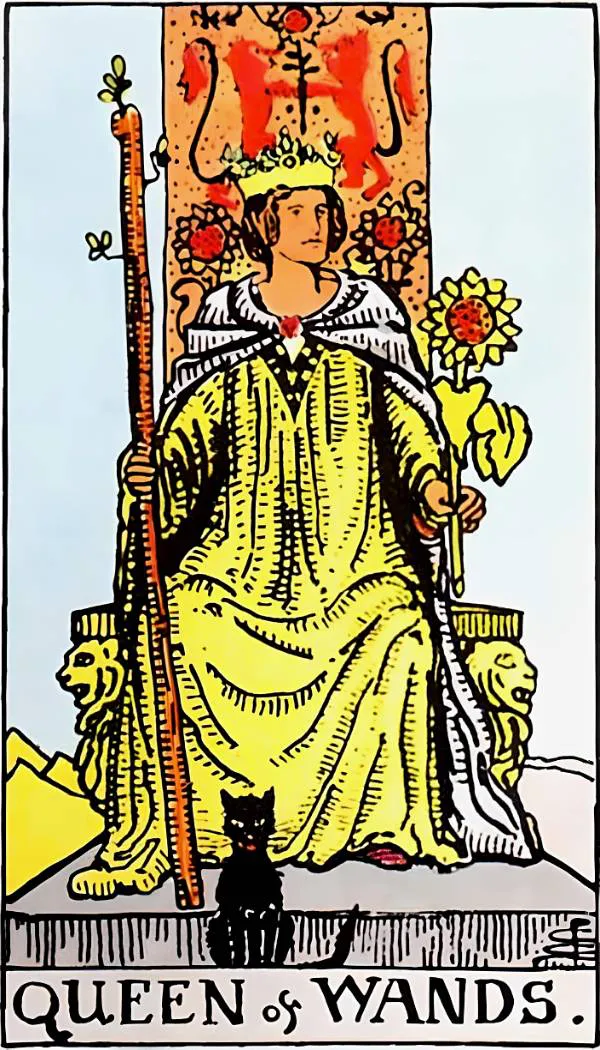
Queen of Wands Tarot Card Meaning

Overall Card Structure

This woman is facing the scene, sitting upright and gracefully, with a dignified expression on her face. She holds a wand in her right hand and a sunflower in her left, gazing upwards towards the sunflower.

She wears a golden crown on her head and has orange hair. She is dressed in an orange V-neck robe with a grey cloak.

The colors of her attire, as well as the throne, are mostly in red and yellow hues, blending with the background.

The throne is situated in the desert, and the three pyramids in the background indicate that the location is in the Egyptian desert.

Beneath the throne's steps, a black cat stands.

She is the Queen of Wands.

Detailed Pattern Explanation

The Queen of Wands has clear facial features with a prominent and sharp chin, and she has short red hair. Women with red hair are usually fiery in character, and short hair signifies a neat style. She appears proud and slightly turned to her left, glancing sideways with a piercing gaze into the distance. The Queen is facing the viewer, sitting in a bold and generous posture, revealing her strong and powerful characteristics. Her hands and feet are spread open, yet maintaining a balanced tension between the left and right. The spread of her feet shows an open personality and sexual charm. The gestures of her hands and the grip on the objects indicate a strong desire for control.

The Queen of Wands holds a wand in her right hand and a sunflower in her left. The wand of the Queen is very similar to the King's, but it touches the throne steps instead of the ground, which is different from the King of Wands. The Queen's character is very close to the King's, but she is more emotional and approachable, and full of magnetism and charm. The sunflower in her hand is tall, with the flower facing forward, symbolizing the enthusiasm and vitality she radiates to everyone like the sun. The leaves and stem are green, and the greenery in her hand is the only green in the picture.

The crown of the Queen of Wands is shaped like the edge of a petal, also resembling a golden sunflower, and it appears to have four of them. In addition, there are four sunflowers in the entire picture, echoing the four sunflowers in the Sun card. She is dressed in an orange V-neck robe, which matches the background and scene very well, also showing the Queen's passionate character. The dark brown V-neck collar. Outside, she is wearing a grey cloak, which reveals a stubborn and conservative side, and also a strong protective color. The clasp of the cloak is in the shape of a cat's face, echoing the black cat on the ground.

The throne of the Queen of Wands extends upwards at the back, symbolizing high power. The entire throne has many double lion patterns, as well as sunflowers. There are two red lions on the back of the throne, on both sides of the Queen's head, standing facing each other with their front paws touching, holding a black XX together. There is a smaller sunflower on top, as if growing on this XX, and as if the lions are pushing the sun ball. The fiery lions are the burning heart of the Queen of Wands. There is also a relief of a lion's head on both sides of the armrests of the throne, and they all face outward, with the intention of expanding and expanding outward. There are also sunflowers above the Queen's shoulders, one on the left and one on the right, forming four sunflowers with the one above and the real flower in her hand.

On the front of the throne steps, there is a black cat crouching, which is the exclusive pet of the Queen of Wands. The black cat represents vitality, energy accumulation, mysterious power, and symbolizes the ability of a witch. (See 78 Degrees of Wisdom) The black cat stands between the legs, also implying sexual energy and comfort. Compared to the overall bright scene, this black cat is the dark side, and it is also the concentration and gathering place of the shadow.

The throne of the Queen of Wands is located in a desert, surrounded by the scenery of yellow sand. From both sides of the throne, you can see different backgrounds. On the right side of the Queen, you can vaguely see the traces of the "Three Great Pyramids" in the distance. The pyramids are a symbol of Egyptian architecture, indicating that they are in the desert, but they contain the wisdom of ancient civilization. The colors of the Queen's clothes and the throne are mostly in red and yellow hues, blending with the background. What is shown on the left is a grey rock plate, which is almost connected with the cloak extending to the left of the Queen, making the grey part of the picture also connected. The stone plate indicates a stubborn conservative side, but it also implies mysterious wisdom, and under the stone plate may be the tomb of the Egyptian royal family. The entire sky is clear, with no clouds, indicating a bright sun.

The Figure of the Queen

The Queen herself is a central symbol, an epitome of the blending of feminine and masculine energies. She sits with a posture of poised readiness; she is neither relaxed nor tense but perfectly balanced, indicating her ability to leap into action or maintain her poise as the situation demands.

The Throne

The throne upon which the Queen of Wands sits is intricately adorned with lions and sunflowers. The lions are symbols of courage, nobility, and authority, attributes that she effortlessly embodies. The presence of the lions on her throne signifies not just outward authority but the courage to rule one’s own inner world.

Sunflower

The sunflower that she holds is not just a symbol of happiness; it’s a beacon of fertility and positivity. The sunflower turns its head to follow the sun, signifying the Queen’s eternal search for enlightenment and truth. Its vibrant yellow petals are reminiscent of the sun, a parallel to her own radiant personality.

The Wand

The wand she holds in her right hand is sprouting fresh green leaves, indicating that it is more than just a stick but a living thing. This vibrant wand serves as an extension of her will, almost like a conductor’s baton in orchestrating the world around her. It is a symbol of creative power and life force, emanating not only her desire to create but her capability to see her will manifest in reality.

The Black Cat

The black cat at her feet serves as a symbol deeply embedded with meanings of magic and mystery. Its presence indicates the Queen’s intuitive and mystical abilities, hinting at a deep connection to the esoteric and the unknown.

Psychological patterns in Queen of Wands
Shadow Projection
The card places the Queen's radiant identity above and the black cat below, creating a visible polarity between conscious charisma and concentrated instinct. The sunflower, crown, lions, and wand all support the bright self-image, while the darker charge remains embodied in a separate figure at the base of the throne. That separation gives Shadow Projection its structure. When the preferred identity becomes too coherent, the psyche can preserve it by relocating unwanted anger, desire, ambition, envy, or suspicion into an outside trigger. For introspection, this pattern appears when You sense a charge but immediately assign it to someone else, a situation, or a vague external threat before asking what part of it belongs inside. The card's audit is precise: the shadow is not absent from the room; it has simply been placed where the conscious self can look at it as other.
Family Role Regression
The Queen appears powerful, but the same throne that supports her can also read as a role that has swallowed the body sitting inside it. Her robe, throne, and desert share the same heated palette, making personal presence and inherited position blur into one field. Family Role Regression begins exactly there: the current self gets absorbed back into the old family seat. You may arrive as an adult, but a parent's tone, a familiar room, or one loaded comment can pull your posture, voice, and decision-making into the role the system already knows how to manage. The card does not reduce this to immaturity. It shows how identity can become state-dependent inside a family field. The work is to notice when the throne has become a script, and when your warmth, authority, or defiance is no longer coming from the present version of you.
Shadow Integration
The sunflower is lifted into the light, but the black cat stays at the Queen's feet, close enough to belong to the scene and dark enough to disturb its brightness. The card keeps both symbols visible: radiant confidence above, instinctive shadow below. That arrangement creates a psychological container for motives that are often edited out of a major choice. Desire, ambition, envy, attraction, fear, and private hunger do not disappear because the official reason sounds sensible; they simply move under the throne and influence the decision from there. For you, Shadow Integration means allowing the hidden driver to be named without letting it become the whole strategy. In a choice reading, this pattern helps expose the part of the decision that is too charged, too embarrassing, or too honest to fit inside the polished explanation.
Secure Visibility
The Queen sits frontally on a high throne, chest open, arms spread enough to hold both the wand and sunflower without gripping them like weapons. The black cat remains at the step, close but contained, while the desert around her leaves no hiding place. That visual arrangement turns visibility into a regulated posture. You are not pushed into the spotlight by panic; the body has a center, the symbols have places, and attention can land without tearing the self open. In career terms, Secure Visibility appears when being noticed for your work does not trigger overexplaining, shrinking, or immediate self-protection. The wand gives agency and the sunflower gives warmth, so the pattern is not about being loud for its own sake. It is the ability to let competence become readable while keeping your boundaries intact, especially when promotion politics make visibility feel both necessary and exposing.
Status Defense
The Queen’s throne lifts her above the desert floor, with lions, crown, wand, and sunflower concentrating authority around the seated body. The image carries real confidence, but reversed, that elevated position can become something the psyche feels forced to defend. The social field then turns hierarchical. A new voice, a more charismatic friend, a better-connected colleague, or a more visible creator can feel less like another person and more like a threat to placement. The body’s centrality becomes territorial because attention is being treated as limited space. Status Defense names the pattern of protecting your perceived rank in a group when belonging has fused with visibility. The card reveals the mechanism without moralizing it: the need to stay central often hides a deeper fear of becoming socially replaceable.
Shadow Avoidance
The black cat sits low at the Queen's feet, directly beneath a throne saturated with sunflowers, lions, gold, red, and orange. The image does not erase the shadow; it places it under the bright field, close enough to matter but low enough to be overlooked. Shadow Avoidance arises when the lifestyle system organizes itself around the bright identity while inconvenient signals are kept out of frame. Irritability, mess, fatigue, envy, boredom, resentment, and physical limits become data the system does not want to read. The visible life keeps performing warmth and competence, but the hidden material starts shaping decisions from below. The card's audit is precise because it does not shame the bright self. It simply shows that a life built only around radiance loses accuracy when the darker signal is not allowed into the design.
Competence Theater
The Queen's upright pose can harden into a display: chin lifted, shoulders squared, wand vertical, sunflower presented like proof of warmth. The throne still looks powerful, but the body begins to read less like ease and more like an image that must be maintained. That is where competence becomes theater. The defense mechanism substitutes visible command for internal security, so every professional interaction has to confirm that you are capable, impressive, and not replaceable. In the career field, this pattern shows up when meetings, status updates, and leadership moments become performances of certainty. You may look composed from the outside, but the system underneath is spending too much energy preventing anyone from seeing uncertainty, learning edges, or ordinary human limits.
Forced Progress
The wand and sunflower can become more than tools of vitality; under pressure, they can turn into proof objects that must keep demonstrating readiness. Against the dry desert, the small green signs of life look real but limited, while the throne still demands a radiant posture. Forced Progress appears when willpower tries to overpower the season. You may keep pushing because stopping feels like losing momentum, but the image shows a different audit: the friction is not laziness or failure, it is the cost of asking a sparse field to perform like peak season.
Authentic Self-Expression
The wand and sunflower are held separately but with equal composure, giving the Queen two visible channels of expression: agency and warmth. Her body does not fold around either object, which makes the scene feel less like a plea for recognition and more like a coherent presentation of self. The throne, lions, crown, and repeated sunflowers build a symbolic identity that is bright without becoming chaotic. This is the psychology of expression with a center: the social self can be vivid, stylish, opinionated, and warm without needing to be edited into whatever the group finds easiest to accept. Authentic Self-Expression appears here as a repeatable way of moving through social space. You are not trying to disappear into the circle, and you are not forcing the circle to orbit you; the pattern names the capacity to bring your actual energy into the room and let compatibility reveal itself.
Boundary Discernment
The throne steps lift the Queen out of the open desert, and the black cat waits at the threshold between her body and the outside world. The card does not show a wall, but it does show levels, distance, and a clear place where instinctive material is allowed to stand without taking over the whole scene. That structure is the visual root of boundary discernment in friendship. You can care about a friend without becoming the full container for their distress, and you can stay warm without leaving every private doorway unlocked. The desert setting sharpens the point because exposure is real here. The pattern is not about emotional coldness; it is about knowing which forms of access protect the friendship and which forms quietly turn closeness into obligation.
Core Struggles in Queen of Wands
Performative Competence Split
The Queen sits in full view, holding the wand and sunflower like proof that command and vitality are available on demand. The black cat remains low at her feet, carrying the darker, less displayable charge of the card while the throne keeps the whole body arranged in a composed frontal image. In academic pressure, that image becomes the shape of competence that cannot admit process. You can look capable, prepared, and bright while the unfinished draft, confused reading, or need for help gets pushed downward into the least visible part of the scene. This struggle is not simple procrastination. It is the split between the self that must keep appearing academically fluent and the self that needs room to be uncertain, messy, and unfinished before real learning can move again.
Shadow Integration Strain
The black cat sits low at the Queen's feet while the sunflowers and lions occupy the bright public register of the card. The grey cloak and stone field add a cooler side channel to an otherwise warm image, making the scene hold both radiance and guarded instinct at once. In career dynamics, that lower, darker symbol matters because ambition is rarely clean. Strategic suspicion, envy, territorial instinct, and hunger for influence can carry information about where power is actually moving, even when the workplace only rewards a polished, upbeat surface. Shadow Integration Strain appears when those sharper signals have to be hidden so completely that they can no longer guide you. The card does not ask them to take over; it shows the cost of keeping them exiled from your professional intelligence.
Boundary Control Strain
The Queen sits with her hands and feet open, holding both the wand of will and the sunflower of warmth while the throne fixes her body in place. The picture does not show withdrawal; it shows a person trying to keep generosity, visibility, and command inside one stable posture. In friendship, that structure names the strain of being emotionally open without becoming endlessly accessible. You may want the bond to stay warm, but the card shows why a boundary can feel physically difficult: the same hands that offer care are also responsible for holding the line. The desert around the throne sharpens the problem because there is no crowd, cushion, or soft transition zone. The friendship boundary has to be stated from the center of the relationship, not from a safe distance, which makes clarity feel more exposed than it should.
Willpower Dependence Trap
The wand is upright and alive, but its force is routed into the throne steps instead of the ground beyond them. Around it, lions, sunflowers, crown, and desert heat amplify the image of fire, command, and personal force. When this structure enters a decision, willpower becomes both engine and constraint. You can keep trying to solve the choice by applying more intensity, more confidence, and more pressure, while the actual route remains untested. The card shows a system that can generate enormous heat without producing movement. Its witness is precise: the blockage is not weakness, but the moment where force has become the only trusted decision tool.
Power-Choice Split
The crown, throne, lions, and upright wand make the Queen's position unmistakably sovereign. Yet the same seat that announces authority also fixes the body in place, turning power into a structure that must be carried through the choice. This is where a decision stops being a clean comparison of options. You are weighing what each path would do to your sense of command, visibility, and self-respect, so the cost is not only practical but existential. The card frames the struggle as a split between choosing freely and protecting the part of you that needs to remain powerful. Until that split is visible, every option can feel like a threat to the self that would have to choose it.
Soft Power Strain
The wand, sunflower, lions, and black cat all gather around a seated body that must hold influence without standing up or forcing movement. One hand steadies authority, the other presents warmth, and both gestures remain publicly readable. In social networks, this is the strain of leading through vibe, charm, and emotional temperature rather than explicit control. The card locates your struggle at the point where being magnetic becomes a form of labor: every room asks you to set the tone while still seeming effortless.
Joy Performance Fatigue
The sunflower is the brightest living object in the Queen's hand, surrounded by dry desert and a field of hot red and yellow. Her body remains composed and available, as if warmth and vitality must stay visible even when the environment shows little visible source of replenishment. This is not simple tiredness; the card shows radiance being held as a public function. In a career setting, the role can start to consume the very energy it praises, especially when a person becomes the one expected to motivate, charm, stabilize, or energize everyone else. Joy Performance Fatigue names the cost of being professionally valued for brightness. You may still have real fire, but the card marks the point where creative warmth becomes a deliverable and the self behind it has less space to recover.
Wholeness Performance Trap
The wand, sunflower, lions, crown, and black cat do not present one clean version of the Queen of Wands. They gather command, warmth, instinct, sexuality, mystery, and public radiance into a single seated figure, with the brightest symbols held at hand level and the darkest symbol crouched below. Her posture makes the arrangement look controlled, but the symbols are not the same temperature. The sunflower faces the light, the wand extends will, and the cat holds the dense undercurrent that cannot be turned into simple brightness. Wholeness Performance Trap appears when personal growth becomes an attempt to look fully integrated before the conflicting parts have actually been allowed to meet. You may be performing confidence, softness, discipline, depth, and self-acceptance at the same time, while the parts that make wholeness real remain staged instead of metabolized.
Visibility-Connection Split
The Queen sits in full view, saturated by sunlit reds and yellows, with almost no cover around the throne. The sunflower, wand, crown, lions, and open posture make her presence impossible to hide, while the black cat remains a dense counterweight at the base of the scene. That exposed brightness gives shape to Visibility-Connection Split inside a family system. You can want to be fully seen and still know that being seen may activate comparison, control, teasing, jealousy, or withdrawal from people who preferred a smaller version of you. The card does not ask you to dim the visible self or force connection at any cost. It shows the exact split: visibility gives the self a body, but in a reactive family field it can also turn belonging into a surveillance zone.
Performative Authority
The Queen's posture is composed, frontal, and unmistakably regal, but the same composition can harden into a role that must be held without interruption. The living wand is present, yet its contact point is the throne step, turning creative force into a symbol contained by the seat of authority. In career terms, that image captures what happens when leadership presence has to be performed before leadership power is structurally granted. The body is visible as authoritative, but the field around it offers little room to test, stumble, or move without breaking the pose. Performative Authority names the strain of having to appear decisive, polished, and in control while the role itself has not given you enough real leverage. The card reflects a professional structure where the performance of command becomes the temporary substitute for command itself.
Inner Emotions in Queen of Wands
Grounded Agency
The wand touches the throne steps, keeping the Queen's will connected to a physical base rather than suspended in fantasy. The sunflower and living wand place growth directly in her hands, while the throne gives that growth a boundary strong enough to hold it. In career territory, this becomes the feeling that your next move is not just a wish for escape or status. The card shows agency becoming practical: skill, visibility, leverage, and timing gathering into something you can actually use. Grounded Agency feels calm because it is not asking you to prove yourself through constant motion. It reflects the moment when professional ambition finds a workable shape, allowing you to choose from center instead of reacting from pressure.
Focused Confidence
The wand standing in her right hand and the sunflower lifted in her left create a clean two-point axis. Her body is not collapsed into the throne; it is seated, awake, and organized around what it has chosen to hold. The gaze toward the sunflower makes attention feel selective rather than scattered. The lions, crown, and upright wand add structure to that attention, turning inner fire into a channel instead of a spray. Focused Confidence appears when your inner audit stops becoming a maze and starts becoming a line of sight. The card reflects the moment when your psyche can name what matters without needing every hidden doubt to disappear first.
Charisma Fatigue
The red and yellow field around the Queen is bright enough to become relentless, especially when the open posture has no visible place to rest. Sunflowers, lions, crown, wand, and throne all repeat the demand for radiance until the image feels lit from every side. In romantic dynamics, Charisma Fatigue shows up when being desirable becomes a job inside the bond. You can still attract, flirt, and animate the space, but the warmth starts to cost more energy than the relationship gives back.
Imposter Exposure Fear
The Queen faces the viewer while her gaze slides toward the sunflower and the distance, creating a subtle mismatch between public presentation and private attention. Around her, the crown, throne, wand, and bright flower all make competence visible, almost too visible to hide behind. Imposter Exposure Fear takes shape when achievement becomes harder to privately digest than failure. In personal growth, the more your progress is recognized, the more your inner system may scan for the moment someone looks closely and decides the image is not solid. The open desert intensifies that feeling because the card gives the figure little shelter from being seen. The emotional logic is precise: success has not removed fear; it has made the fear more exposed by giving it a brighter stage.
Performative Warmth
The sunflower in one hand and wand in the other create a polished display of welcome and control, while the sideways gaze checks the edge of the room. The repeated sunflower and lion motifs can read less like spontaneous warmth and more like a public style held carefully in place. Performative Warmth appears when social kindness becomes a surface you maintain to stay acceptable. You may look generous, bright, and available, but the card traces the split between the warmth being shown and the private monitoring required to keep showing it.
Suppressed Rage
The lions carved around the throne and the wand gripped upright give the card a contained burn. Fire symbols are everywhere, but they are arranged inside a formal court posture, held still by rank, symmetry, and composure. The red-yellow heat does not spill into motion. It gathers around the Queen's body, her sharp chin, her fixed hands, and the rigid throne, creating pressure inside a structure that refuses to break shape. Suppressed Rage appears when your inner world carries heat that has been trained to look composed. The card reflects the moment when anger is not absent, but folded tightly into poise until it becomes a private charge waiting to be named.
Control Fatigue
Her hands keep hold of both wand and sunflower, while the throne carries the body's vertical line. The pose is impressive, but the reversed texture makes the grip feel less like natural command and more like the effort of preventing the whole arrangement from shifting. Control Fatigue follows from that over-held structure. In lifestyle terms, it is the drained feeling that comes from managing every detail of the physical life system until meals, sleep, spending, cleaning, movement, and calendar blocks all become points of surveillance. The card does not shame the need for structure. It shows the cost of having no place where structure can soften, where the hand can loosen, and where the day does not have to be held together by constant supervision.
Confrontational Courage
The lions carved into the throne, the upright wand, and the Queen's open seated stance create an image of heat that has learned form. Nothing in the card hides from the viewer, yet the figure is not lunging forward; the force is contained inside posture, symbol, and perimeter. That is the exact emotional architecture of Confrontational Courage in a family system. You are not seeking a fight for its own sake, but the old reflex to soften, flatter, or disappear no longer controls the whole scene. The card makes courage feel physically organized. You can face the charged conversation, name the pressure, and remain in your adult body without letting the family's intensity define the limits of your voice.
Performative Confidence
The same open posture can become a display held too perfectly: spine straight, chin sharp, symbols in both hands, and the body arranged for visibility. The Queen faces the viewer, yet the gaze moves sideways, creating a split between what is being shown and where attention actually goes. Performative Confidence appears when personal growth becomes an image that must be maintained. You may look upgraded, capable, and composed while privately monitoring the pose for cracks, treating confidence as something that has to be proven in real time. The throne, crown, wand, and sunflower become a stage set for the self you are trying to inhabit. The card gives that tension a clear shape: not absence of power, but power trapped inside the need to look already finished.
Courageous Readiness
The Queen's planted feet, upright spine, and outward-facing lions create a body that is not waiting to be rescued into authority. The distant pyramids behind her extend the scene beyond the immediate throne, giving her presence a long horizon instead of a closed room. In career questions, that arrangement becomes readiness with range. You can feel the next move approaching: a promotion conversation, a strategic pivot, a boundary with a difficult senior figure, or the first real claim to leadership. Courageous Readiness is not reckless certainty. It is the charged steadiness that appears when your ambition has enough structure to move, and when your body begins to believe it can survive being more visible, more direct, and more consequential.
Outer Contexts in Queen of Wands
Main Character Friend Dynamic
The crowned figure, central throne, repeated sunflowers, and lion emblems create a scene where attention has a single gravitational center. In reversal, the same charisma can become a stage that requires everyone else to orbit the person holding it. This is the friendship structure where one person's drama, glow-up, crisis, or social image repeatedly becomes the main event. You may still care about them, but the card exposes how the circle's attention economy has been arranged so that your role keeps shrinking into audience, helper, or witness.
Personal Brand Performance
The sunflower is held outward, the wand is controlled at the side, and the Queen's body faces the viewer from an elevated seat. The image carries the architecture of a personal brand: warmth, power, desirability, creativity, and confidence are all made legible at once. In an introspective context, that visual display becomes a realistic map of how identity can turn into an ongoing performance surface. The person is not simply expressing themselves; they are maintaining a recognisable signal that other people can consume, approve of, remember, and expect again. You may be dealing with a version of selfhood that has become too optimized for reception. The card brings attention to the gap between authentic fire and curated radiance, especially where your inner process has to compete with the pressure to remain impressive, coherent, and visibly evolved.
Creative Leadership Trial
The wand rests in her right hand against the throne step, close enough to act as a tool rather than a decoration. Lions, sunflowers, and the upright seat make the scene feel less like private inspiration and more like a role that now has social weight. In a growth cycle, that visual pressure matches the point where an idea, practice, or talent asks to become a led initiative. You are being shown a structure where personal fire has to pass through coordination, visibility, and responsibility before it can become real momentum.
Community Leadership Trial
The wand held like a social baton and the sunflower held like an offering place the Queen in a role of activation. Her throne does not isolate her from the scene; it gives her a stable position from which warmth, plans, attention, and momentum can move through the group. In friendship, this becomes the trial of being the person who naturally gathers people, starts the thread, hosts the dinner, names the mood, or keeps the group alive. You can hold influence without being consumed by it only when the circle recognizes leadership as shared social labor, not an endless supply of energy from one person.
Executive Presence Test
The Queen sits upright on a lion-carved throne, facing the viewer with her tools held visibly in both hands. Her posture does not hide effort; it converts effort into composed authority, making competence legible before anyone asks for proof. In a career setting, that visual structure maps onto the moment when your work is no longer judged only by output. You are being read through presence, steadiness, judgment, and the ability to occupy a visible seat without shrinking or overperforming. The card frames this as an external evaluation stage, not a personality flaw. The real question is whether the room is recognizing authority that is already functioning, or whether it is still making you audition for a role you are effectively carrying.
Friendship Spotlight Test
Seated in full view, crowned and framed by sunflowers and lions, the Queen occupies a bright social center without shrinking. The sunflower in her hand makes warmth and visibility tangible, turning confidence into something the whole circle can see and respond to. That visual structure fits the friendship moment when your good news, changed style, public confidence, or personal momentum becomes a test of the people around you. You are not only asking whether friends like you; you are watching whether they can hold your visibility without reducing it, competing with it, or making you manage their discomfort.
High Standards Dating Filter
The crown, throne, lions, and upright posture make the Queen visually selective rather than merely available. Her body is open, but the throne steps and cat create a threshold around who gets access. In love, that structure matches a dating filter built around self-respect, taste, and non-negotiable standards. You are not just choosing who is attractive; you are testing whether attention can meet the level of steadiness and respect required to enter your space.
Safe Visibility Trial
The Queen faces the viewer from a raised throne, surrounded by lions, sunflowers, crown, cloak, and armrests. The scene is visibly public, but it is not unprotected; the body is exposed within a defined platform. That makes the card a strong mirror for a choice that would put you on display. The decision is not just whether the opportunity is good, but whether the visibility that comes with it has enough structure, boundaries, and support to be safe. The desert setting matters because there is nowhere to hide once the role becomes visible. The card reframes the trial as a visibility audit: you are not rejecting growth by checking the container; you are testing whether the stage can hold the version of you it is asking to reveal.
Family Boundary Backlash
The Queen's open posture is powerful, but in reversal the same visibility can become exposure. The throne that should define her space becomes the frame through which everyone can see, measure, and challenge her position. Family boundary backlash happens when a limit is treated as disloyalty rather than structure. A shorter visit, a delayed reply, a private relationship, or a refusal to discuss money may trigger guilt, comparison, coldness, gossip, or a sudden campaign to restore the old access pattern. The family system reacts because the boundary changes the geometry of power. This card fits because its symbols gather around authority and visibility. You are not just managing one uncomfortable conversation; you are touching the architecture that tells relatives who gets access to whom. Seeing the backlash as a system response keeps it from being mistaken for proof that the boundary was wrong.
Lifestyle System Overhaul
The Queen sits upright on a decorated throne, holding the wand and sunflower as if the entire scene is organized through her physical center. The lions, sunflowers, crown, and warm color field do not look random; they create a visible command system around vitality, attention, and daily direction. In a lifestyle reading, that visual structure points to the moment when ordinary routines need more than small tweaks. You are looking at the architecture of your day as a whole: where your energy is generated, where it is displayed, and which parts of your physical life have been waiting for a stronger organizing principle. The card links to Lifestyle System Overhaul because the throne does not merely decorate the Queen; it stabilizes her. The useful question is not whether you can push harder, but which external supports, spaces, rituals, and boundaries can let your life run without needing constant improvisation.