See how narrowing access shapes your next move, related Tarot Cards, and reading insights drawn from others facing similar crossroads.
Strategic Timing Window
What is this situation?
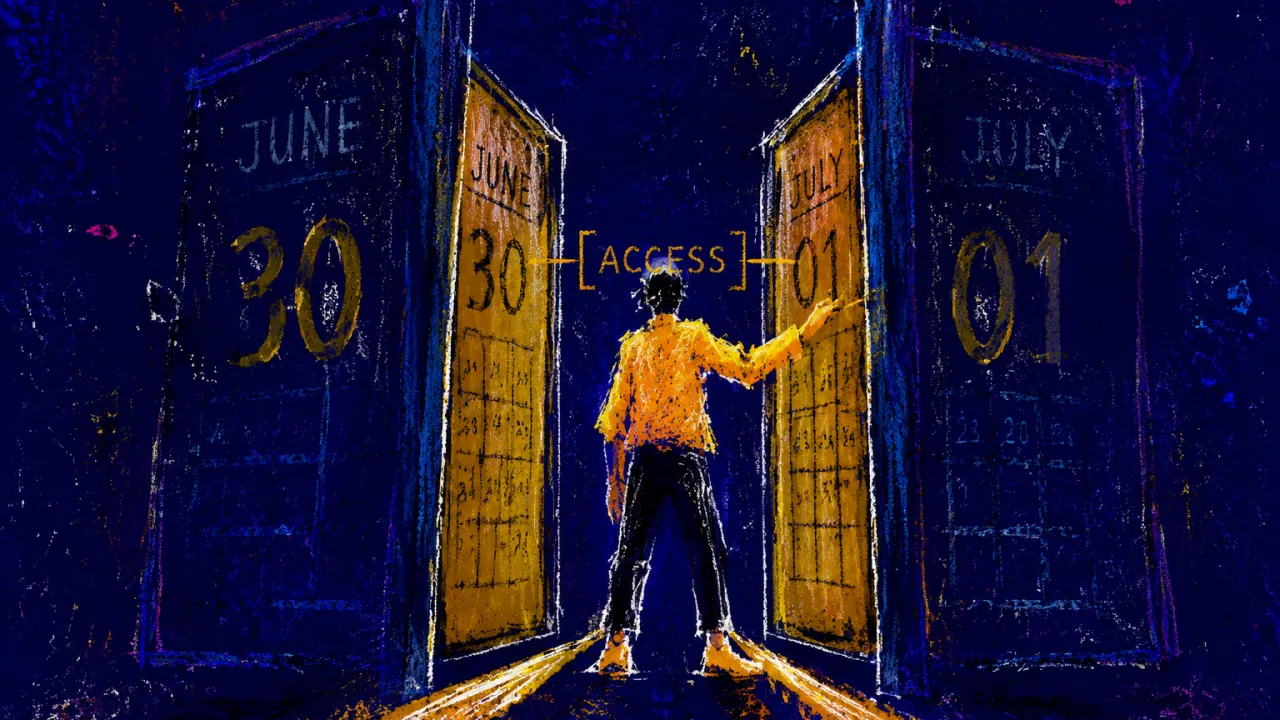
Strategic Timing Window: you enter it when a move you have been preparing stops being available on your schedule and starts depending on a brief overlap of outside conditions. On a weekday morning, one screen holds a nearly finished application, pitch, booking, or message while another holds the deadline, a gatekeeper's availability, and a calendar that is already changing. The opening is visible but conditional: approval arrives in stages, budgets close at quarter-end, a collaborator is free only this week, or the person you need to speak with is reachable before travel and competing commitments reshape the timetable. You keep the draft ready, watch inbox timestamps, compare calendars, and delay public plans because moving too early could expose an unfinished route while moving too late could leave no workable point of entry. Your day breaks into repeated checks from the desk to the commute; your shoulders tighten over the send button, and your feet stay planted while the deadline advances. The cost is not simply waiting; it is carrying a prepared move through a system where visibility, resources, permission, and low-friction access almost align, but may do so only briefly. You stand with the next move assembled but not yet released, much like The Chariot paused at the riverbank, fully equipped for motion while the usable route still has to open.
Why it's not you?
This is not a failure of nerve, discipline, or decisiveness. Deadlines, gatekeepers, budget cycles, and other people's availability create a moving window in which the same action can travel cleanly one week and meet closed access the next. That instability belongs to the conditions around the move, not to your worth or capability.
Strategic Timing Window in Tarot Cards
In a Strategic Timing Window, preparation can be complete while deadlines, gatekeepers, and shifting access still decide when the route is usable. That pressure appears in shoulders tightening over the send button and feet staying planted as the deadline advances. This is an environmental, structural dynamic: leverage changes as visibility, resources, permission, and access move in and out of alignment. The Tarot Cards below reflect the visible contours of that narrow opening.
Centered between the overhead symbol, the prepared table, and the flowering ground, the Magician occupies a precise operating position. The stance is open enough to act, but controlled enough not to spill energy in every direction. That visual balance translates into a strategic timing window: a phase where leverage matters more than force. The surrounding structure is not chaotic; it offers a readable stage where the next move can be placed with intention. For you, this context names the moment when timing is not about waiting forever or rushing to prove momentum. It is about recognizing the external point where visibility, preparation, and low-friction access briefly overlap.
Seated between the black and white pillars with the scroll partly covered, the High Priestess turns timing into a threshold rather than a sprint. The veil and the water behind it show that the next move depends on information and conditions that are real, but not fully visible yet. For a timing question, this points to a stage where pushing harder may add friction because the passage has not opened. You are being shown the difference between passive delay and strategic waiting: one loses agency, while the other studies the threshold until the least resistant opening appears.
The twelve-star crown, the mature wheat, and the visible stream place The Empress inside a cycle that has already produced tangible growth. Nothing in the image is rushing; the scene shows ripeness, continuity, and a supported center of action. For timing work, that visual field maps to an external window where the conditions are no longer purely theoretical. You are not being asked to force movement through resistance, but to notice where resources, attention, and environmental momentum have already gathered enough weight to support a clean next step.
The Emperor sits high on a stone throne, with the scepter held vertical and the mountain range arranged behind him like a map of hard terrain. The card anchors power in elevation, structure, and surveyed distance rather than in speed. For timing work, that image points to a moment when force becomes effective only after the field has been read. You are not dealing with a lack of action; you are dealing with a sequence that needs the right opening, the right backing, and the right amount of pressure before the move can land.
The steps, keys, raised hand, and formal central aisle create a controlled opening rather than an open field. The scene suggests that access becomes available through the right sequence at the right point of contact. This is a timing window with structure around it. You are not being asked to force motion everywhere at once; the card points to a specific place where effort, permission, and readiness can meet. For a timing reading, the value is precision. The question becomes less about whether you are motivated and more about whether the external gate is actually opening, which conditions make it open, and how long that window is likely to remain usable.
The two figures stand in a cleared garden under direct sunlight, with the angel above them, the trees behind them, and the mountain centered beyond the pair. The image arranges choice, support, consequence, and challenge inside one visible field instead of scattering them across an unclear landscape. For a timing question, that geometry maps to a window where the necessary signals can be seen at the same time. You are not only asking whether to move; the structure is showing whether desire, values, available support, and the next challenge have entered the same frame. The Lovers gives this context weight because the scene is not about random opportunity. It is about a moment when action becomes cleaner because the relational, practical, and ethical coordinates are simultaneously legible.
The chariot is not shown racing; it is parked at a threshold with the city behind it and the route ahead implied through open ground. The driver’s posture is active, but the visual tension comes from controlled delay rather than immediate motion. For career decisions, this points to a narrow window where preparation, visibility, and external conditions are close to alignment. You may be positioned to ask, pitch, move, negotiate, or launch, but the strength of the moment depends on reading the field before forcing speed. The stable cube, upright staff, and still sphinxes all emphasize timing as a strategic resource. The card does not reward hesitation for its own sake; it marks the difference between a paused command position and a stalled career path.
One hand on the lion's head and one at its jaw creates a precise image of force being timed rather than denied. The lion still has teeth, heat, paws, and momentum, but the woman works at the exact pressure point where release can be shaped instead of simply unleashed. In a timing question, that picture maps to a window where action is possible but not yet about speed. You are not being shown a closed door; you are being shown a live system that needs the right amount of pressure at the right moment. The card links this context to the practical difference between forcing a breakthrough and recognizing the point where the situation will actually move with you.
Standing on the frozen ridge with a lantern lifted ahead, the Hermit does not flood the whole landscape with light; he isolates the next usable portion of the path. The staff stays planted, turning insight into measured contact with the ground rather than restless forward motion. For a timing question, that image matches a moment when the real issue is not whether you have enough willpower, but whether the environment has produced a workable opening. You are being asked to distinguish a true window from a reaction to pressure, so movement can happen where signal, footing, and direction briefly line up.
The rising figure, descending serpent, and eight-spoked wheel create a scene of contact points rather than a straight road. Movement is available, but it depends on where pressure meets the wheel and which segment of the cycle is actually open. In personal growth, a strategic timing window appears when effort, attention, environment, and readiness briefly line up. You may have tried the same discipline before and watched it collapse, but the current structure may offer better traction because the surrounding conditions have shifted. The card connects to this context through its visible mechanics of rotation. It does not reduce growth to willpower; it shows that effective self-evolution often depends on catching the moment when inner readiness and external rhythm can finally move together.
The balanced scales in the left hand and the upright sword in the right hand create a scene where action is present but deliberately held. The figure does not rush the blade forward; the visible logic of the card is measurement before impact. For timing questions, that visual order becomes a strategic window rather than a generic delay. You are dealing with a moment where conditions can support movement, but only if the threshold is read with precision instead of forced by urgency. The foot touching the step gives the scene a concrete edge: the next point is near, not abstract. The card connects this context to the kind of timing where one clear move has leverage because the external field has finally become legible.
The suspended body hangs from a living T-shaped frame, held still by one ankle while the head glows with alert clarity. Nothing in the image suggests ordinary forward motion, yet the posture is not collapsed; the figure is held inside a precise structure where timing, not speed, determines what can happen next. That visual arrangement mirrors a strategic timing window: the opening exists, but it cannot be forced by pushing harder. The rope, beam, and centered body show a situation where the correct move depends on alignment between pressure, support, and release. For a timing question, this card turns delay into a measurable structure rather than a vague block. You are not being asked to romanticize waiting; the image asks you to locate the point where stillness stops being avoidance and starts becoming leverage.
The armored rider moving across the foreground is not negotiating with the figures around him; the scene is already in motion. The raised black standard, the fallen emblems of status, and the distant route across the river all point to a moment when the outer field has shifted before everyone inside it has fully adjusted. That is the core of a strategic timing window. You are not looking at a blank calendar where any day can carry the same decision; you are looking at a threshold where pressure, passage, and visible signs of change have converged. The card gives shape to the difference between forcing an outcome and noticing that the environment has become newly passable. For timing questions, this context asks where the old arrangement has already lost practical authority and where a narrow route is starting to show itself. Your agency sits in reading the opening clearly enough to move with the cycle, rather than waiting for total certainty from a world that is already changing.
The angel pours liquid between two cups without spilling a drop, and the road behind the figure rises toward the distant light. The image is not frozen hesitation; it is controlled movement, where one stream finds the right channel before the path ahead becomes usable. For timing questions, that visual structure points to an external window that opens through calibration. You are not being shown raw speed or passive waiting, but a stage where several conditions have to move together before action carries cleanly. A Strategic Timing Window appears when pressure, readiness, and available direction briefly align. The card gives that window a physical shape: the hands are steady, the stream is continuous, and the path is visible enough for a measured next step.
The loose collars around the man and woman are one of the most important visual facts in the card: the restraint is real, but it is not mechanically absolute. The black altar, iron ring, and raised hand create a visible system of pressure, while the slack around the necks marks a small but usable opening inside that system. For a timing question, this points to a window that opens through recognition rather than force. You are not being shown unlimited freedom; you are being shown the exact place where the structure has more give than it first appears to have. The practical tension is about reading the constraint before choosing the move. This card links to Strategic Timing Window because the scene does not reward panic, rebellion, or passive waiting; it rewards noticing where the chain is loose enough for a precise shift in timing, attention, or commitment.
The stars sit above the scene as distant markers, visible only because the night is clear. The figure is active, but the action is measured and quiet, suggesting that the opening is defined by conditions as much as by willpower. In a decision context, this connects to timing as an external variable rather than a vague feeling. You may have the right option in view, but the card draws attention to sequence: when to move, when to conserve, when to reveal information, and when the environment can actually receive the choice.
Straight and wavy rays radiate from the Sun in an ordered cycle while the horse carries the child over the wall into open light. The image does not show random motion; it shows a threshold crossing under maximum visibility, with enough heat, direction, and protection for movement to become less frictional. For timing questions, this maps to a period where the external environment has started to meet your action. You are not being asked to manufacture momentum from an empty field; the structure around the move is becoming legible, and the useful question is where the light is already reducing resistance.
The trumpet in the sky is the only moving signal in a cold, suspended field. Below it, the figures do not scatter in separate directions; their bodies orient upward together, as if the environment has finally produced a cue strong enough to coordinate action. In timing work, this points to a window where movement becomes cleaner because the signal, the body, and the wider field begin to line up. The important feature is not constant readiness, but the presence of a usable cue that reduces friction and gives action a shared direction. Strategic Timing Window names the difference between pushing because pressure is loud and moving because the system has opened. The card gives shape to the moment when the least resistant path can be seen, not through certainty, but through alignment.
The dancer's body, twin wands, flowing scarf, and laurel wreath are all synchronized inside one closed frame. The four corner figures hold the perimeter, making the scene feel less like raw motion and more like a completed system ready to release a clean signal. For timing questions, this visual structure points to a window where action gains traction because the surrounding conditions have cohered. You are not being measured by how hard you push; the relevant pressure is whether the cycle has enough closure, support, and public shape for a move to land without unnecessary friction.
At the center, the cloud-borne hand holds the chalice exactly as the dove descends and the water moves into the pool below. The image is built as a sequence: signal, vessel, overflow, and receiving basin. That sequence mirrors a timing window where action becomes cleaner because the cue and the container are finally aligned. You are not being asked to overpower resistance; the structure points to the moment when flow has somewhere to go and a move can land without unnecessary friction.
Two figures holding cups at the same height create a visible threshold where movement, consent, and recognition briefly line up. The man's step gives the scene momentum, while the clear sky and distant town keep the next stage legible rather than abstract. For timing questions, this arrangement points to a window that is formed by coordination, not force. You are not looking at raw effort alone; the image shows a moment when another party, a route, and a landing place can all be seen at once. The central caduceus turns the opening into a negotiated structure. Action becomes more viable when the exchange has a counterpart, the horizon has shape, and the surrounding field is not actively resisting the move.
The couple standing together beneath the ten cups creates a scene where the body, the household, and the wider environment all point in the same direction. The raised arms do not look like strain; they mark a visible opening toward what is already assembled above and around them. The river, garden, home, children, and cup arc turn timing into an ecology rather than a countdown. You are not only looking at personal desire; you are looking at whether support, emotional flow, shared rhythm, and practical ground are arriving at the same time. In a timing question, this card links to a Strategic Timing Window because the scene shows readiness as a coordinated field. Movement becomes more viable when the external world is no longer fighting the direction you are trying to take.
A knight on a calm white horse carries a single cup toward a river, keeping the pace slow enough for the vessel to remain steady. The scene is not stalled; the horse is moving, the sky is clear, and the next threshold is visible. That visual structure matches a timing window where momentum is available, but only at the speed the situation can actually hold. You are not looking at brute force timing here; you are looking at coordinated timing, where the offer, the vehicle, and the crossing point need to arrive together. The card gives this context its clarity because the Knight is neither charging nor retreating. The useful opening is defined by precision, not urgency: the move becomes viable when the external conditions can carry what you are trying to bring across.
The distant boat moves through the waves while the King's foot nearly reaches the water, creating a scene where motion is possible but must be entered with precision. The card does not show a road; it shows a route that depends on reading currents, distance, and timing. That visual structure fits a timing window because the environment is neither closed nor fully ready. You are dealing with a moving opening, not a fixed instruction, and the real task is to identify where the external rhythm can carry the next action instead of resisting it. The cup-focused gaze adds another layer: the decision is not only about speed, but about alignment between inner capacity and outer conditions. The window becomes usable when observation, readiness, and the moving field line up.
The archway in the garden is a timing symbol because it is open, bounded, and specific. The road does not spill everywhere; it leads through one threshold into a protected field, then toward a mountain that asks for sustained effort after entry. Strategic Timing Window emerges from that geometry. The card does not show frantic motion; it shows a resource held above a place where entry is possible under the right conditions. For your timing question, the value is in recognizing the window as structured rather than accidental. The scene suggests that the next move works best when you enter through the available opening instead of trying to break through the fence or wait for the whole mountain to become easy.
The two coins do not sit still; they travel through one continuous loop while the figure's steps answer the rhythm of the sea. That image fits a timing window because movement is already present, but it has to be entered at the phase where the loop can carry it. The ships in the background keep moving across rough water, which frames timing as navigation through changing conditions rather than brute force. You are not being pushed toward maximum effort; the scene points to the moment when available resources, external motion, and your own bandwidth briefly line up.
The town and mountains sit beyond the figure like a larger field that exists, but has not yet been entered. In front of that horizon, the four pentacles create a stable frame around the body, marking a decision that depends on both external access and internal containment. This context fits timing questions because the card is not only about possession; it is about when a protected structure can safely interface with the wider world. You may be facing a moment where the opening exists, but its usefulness depends on whether your boundaries, resources, and external conditions are aligned. The visual tension is precise: the horizon is visible, yet the body remains fixed. Strategic Timing Window names that suspended point where the next move becomes effective only when the outer field and the inner base start matching each other.
The benefactor's hand is caught at the exact point where coins begin to fall. The scene is not static possession; it is a timed release, with one figure receiving, another waiting, and the scales keeping the whole exchange within a visible rhythm. That suspended transfer gives the card its timing signature. A window opens when the resource holder, the measuring system, and the receiver's readiness briefly line up, creating a moment where less force is needed because the structure is already moving. You are being asked to locate the active opening inside the exchange. The card does not reward frantic effort here; it highlights the moment when support is already in motion and your action can meet it without wasting energy against resistance.
Leaning on the hoe beside a vine heavy with pentacles, the figure is not shown in the rush of planting or the satisfaction of a completed harvest. The scene holds the exact middle point where work has produced evidence, but the outcome is still partly attached to time, conditions, and the decision of when to act. That suspended posture turns the card into a map of timing rather than effort. You can see one result already on the ground, six still in process, and a clear horizon beyond the garden, which makes the decision less about whether anything has worked and more about whether the next move should be harvesting, waiting, or reinvesting. In a choice context, this describes the narrow window where action is available but not automatic. The structure asks you to audit timing as a real variable: what is mature enough to use, what is still gaining value, and what starts costing more the longer it stays unchosen.
The woman’s hand rests near the pentacles with controlled contact, while the vineyard, falcon, glove, and manor sit in an ordered field. Nothing in the image is frantic; the scene is built around deliberate access to resources that have been prepared over time. A strategic window appears when the outside environment is neither empty nor chaotic. The visual structure shows a moment where the crop is visible, the boundary is stable, and the body can choose a measured action instead of reacting to pressure. In timing work, this card points to the usable opening created by prior discipline. You are being shown the difference between any available moment and the specific moment when resources, attention, and external conditions line up enough to make action efficient.
The family is not rushing; every figure is placed inside a stable architecture of coins, wall, crest, and threshold. That stillness is not passivity in a timing reading. It marks a Strategic Timing Window, where the useful question is when the social and material structure lowers resistance enough for You to act with leverage instead of friction.
The motionless black horse, the steady rider, and the pentacle held out in front create a scene of readiness held under control. Nothing in the image is scattered or collapsing; the tension comes from disciplined pause, not absence of ability. The field ahead is visible, but the rider has not yet converted preparation into movement. In a career context, that visual structure maps cleanly onto a timing window before a pitch, negotiation, promotion ask, or role shift. You may have the asset in hand, the skill set mostly built, and a real direction ahead, but the card frames the next move as a matter of leverage and sequencing rather than speed. The useful pressure here is not whether you are doing enough. It is whether your effort, evidence, and external opening are aligned closely enough for the move to land. The card gives the pause a concrete function: it turns waiting into strategic positioning rather than passive delay.
Armor sits under the King’s robe while the throne remains steady and the walls still hold. The image is calm, but it is not passive; resources are arranged before movement, and readiness is hidden under comfort. For a major choice, this points to the window where action is easier because support still exists. You are not forced into urgency; the card shows how timing changes when stability becomes a launch platform instead of a waiting room.
The sword rises through the open sky with the hand already locked around a tool that fits its grip. Its point carries the crown, and the paired branches make the scene feel less like random force and more like a clean opening where clarity, legitimacy, and action briefly share one line. For timing work, that image maps to a window where the external field is no longer purely resistant. You may still be facing hills in the distance, but the card's structure suggests that a precise move can travel farther now because the signal, criteria, and available leverage are aligned.
The crescent moon hangs between the two swords while the sea waits behind the seated figure. Nothing in the image is fixed in a final state: the tide can rise or fall, the arms can hold or lower, and the distant shore remains visible but not yet entered. That visual structure makes Strategic Timing Window one of the strongest timing contexts for the Two of Swords. The issue is not whether action exists; the swords prove that capacity is already present. The question is whether the outside cycle, available information, and personal readiness are synchronized enough for the action to land cleanly. You are looking at a window, not a command. The card reveals the difference between forcing progress because pressure is loud and moving when the environment gives the action somewhere to go.
The figure crosses the scene at dusk, one foot lifted and the other stretched back, with the camp still close enough to matter. The card’s timing is precise: the movement works because the path is visible enough to use but dim enough to avoid immediate capture by the old order. In personal growth, this points to a limited window where change is easier because the old pattern has loosened and the new structure has not yet hardened. You may be between routines, identities, roles, or commitments, with enough mobility to adjust the system before it becomes public, scheduled, or socially reinforced again. The Seven of Swords links this context to tactical pacing. It asks for a clear reading of the opening itself: what can be moved now, what must be left for later, and what becomes harder once the camp wakes up again.
On the wind-cut ridge, the Page grips the sword with both hands while looking in a different direction from the blade. The body is not idle; it is triangulating between the tool, the horizon, and the unstable ground underfoot. That makes the card a strong image of a timing window rather than raw momentum. You have enough elevation to see movement forming, but the terrain asks for a precise entry point. The useful question becomes which signal is backed by real footing, not which impulse feels loudest.
The white horse is already in full gallop, the wind bending trees and clouds backward while the sword points past the edge of the frame. The picture has no seated planning table; it shows a live field where timing, direction, and available force have already converged. When You are weighing options, this visual pressure makes timing part of the decision structure rather than a background detail. The card exposes the moment when delay becomes its own move, and when a usable opening can only be understood by looking at momentum, leverage, and the cost of waiting together.
Seated on a grey throne with the sword held upright, the King turns action into a timed verdict rather than a reflex. The blade is lifted but controlled, and the open sky behind him gives the decision a clear field of view. That visual structure fits a Strategic Timing Window because the pressure is not simply to move; it is to move when the criteria are visible and the external field can receive the cut. You regain agency by distinguishing a clean opening from raw urgency, then letting the narrowest useful moment carry the force.
The figure looks beyond the battlement across land, sea, and mountains, using height to read distance. The two wands frame a choice, but the horizon and calm bay make the more precise issue one of sequence and opening. This structure fits a moment when the external field is arranged enough for action, yet still demands timing rather than brute force. You are reading the cycle around the move: when visibility, resources, and pressure line up tightly enough for the step to carry.
From the high ground, the figure does not step into the sea; he studies ships already moving across a bright horizon while one wand stays under his hand and two mark the ground behind him. That visual structure turns timing into an external landscape: progress is visible, but it has routes, distance, and conditions of its own. You are not simply delaying; you are reading whether the cycle has become open enough for a clean move instead of forcing effort into resistance.
The square of four wands creates a clean frame in the foreground, while the bridge and distant house give the scene a route beyond the celebration itself. The card does not show frantic movement; it shows a threshold where order, passage, and support are all visible at once. This is the logic of a strategic timing window. The environment is not merely permissive; it is organized enough that a decision can move through it without excessive friction. The garlands mark the point where preparation has become socially and materially visible. In a timing reading, this context points to the narrow but usable opening where action can carry more weight than usual. You are reading the architecture of the moment: what is stable, who can witness it, and which bridge is actually available to cross.
From the high ridge, the young man can see the six wands rising before they reach him. The visual field is clear, but the ground under his feet is rugged, which turns advantage into a position that must be actively timed rather than passively enjoyed. Strategic Timing Window fits because the card shows a live interval where leverage exists, opposition is visible, and delay has a cost. You are not dealing with a frictionless opening; you are standing at a point where the window is real but narrow, and the timing has to be read through resistance rather than comfort.
The eight wands do not drift; they travel in a clean diagonal toward a landscape that already contains a visible destination. The small house on the hill gives the motion a point of reference, turning speed into directed arrival rather than raw acceleration. This is the visual logic of a strategic timing window. The path is open, the destination can be seen, and the moving parts are temporarily parallel enough to make timing itself a resource. You are being shown a phase where the key leverage is precision. The card does not glorify speed for its own sake; it marks the interval when a move can travel farther because the external current, the target, and the route are briefly aligned.
The Page stands in clear desert light with a wand held upright, looking past it as if a message has reached the point of public air. The empty ground does not show completion, but it does show visibility, direction, and enough symbolic authority for a first declaration to matter. For timing work, that scene maps to an opening where the next move is not fully guaranteed but no longer invisible. You are dealing with a narrow window in which the environment can hear the signal, and the task is to separate usable momentum from raw excitement.
Mounted above a red horse caught between halt and launch, the knight holds the reins with one hand and the wand with the other. The image is controlled acceleration: energy is available, the route is visible, and the moment of release matters as much as the direction itself. This structure mirrors a decision window where the option is no longer abstract, yet the timing still carries leverage. You are facing a threshold where movement can create momentum, but a rushed release could scatter the force that the reins are still organizing.
The Queen sits upright rather than reclining, with the wand vertical and the sunflower held at attention. Her body is still, but it is not passive; the posture is organized, available, and ready to move when the moment requires it. That visual readiness fits a decision point where the question is less about whether an option exists and more about whether the opening has ripened enough to use. You may have enough information, enough visibility, and enough internal consent to act, but the cost of moving too early or too late still needs to be named. The clear sky and readable horizon keep the field from feeling chaotic. The card frames timing as a strategic window, not a demand for impulsive certainty: the useful leverage is identifying what is already stable, what is still symbolic, and what will expire if you keep waiting.
Seated upright with the wand touching the ground, the King of Wands looks across a bare expanse as if measuring when command can become motion. The throne, lion emblems, and grounded staff make timing feel less like hesitation and more like a public decision point where authority, visibility, and terrain have to align. You meet this context when a move is close enough to be real but still needs the correct opening. The image gives the moment a structure: the field is open, the role is visible, and the next act carries more weight because it will set the rhythm for what follows.
No cards available for this filter.
Strategic Timing Window in Tarot Card Reading Insights
When a Strategic Timing Window narrows, others have brought the same mix of preparation, conditional access, and moving deadlines into their readings. Browse the Tarot Reading Insights below from readings centered on that opening.