Page of Cups Tarot Card Meaning

Overall Card Structure

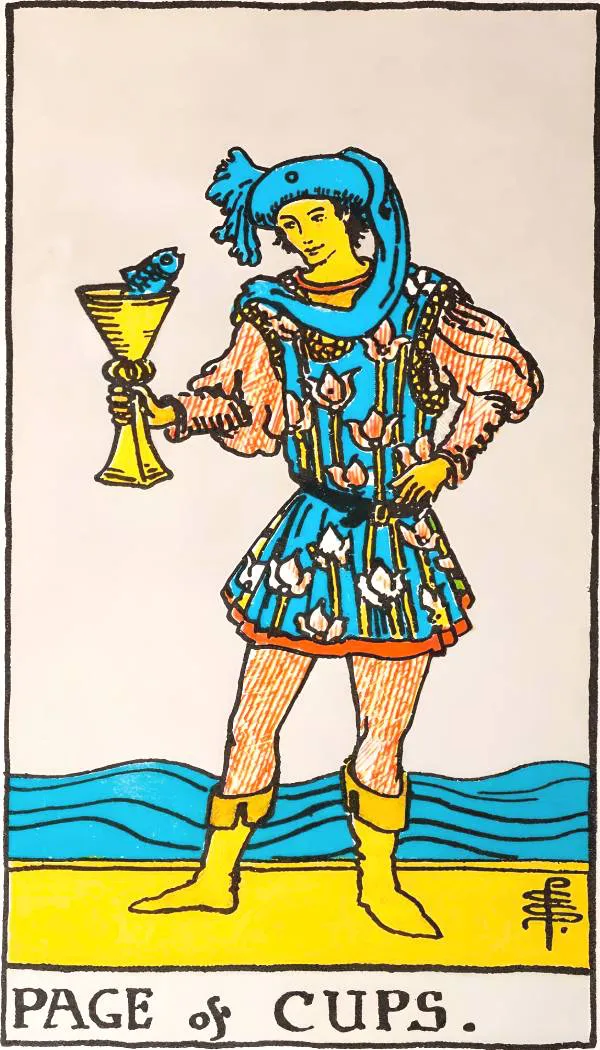
This young man stands facing the viewer, with his weight on his left foot.

He holds the Chalice with his right hand and places his left hand on his hip, his gaze focused on the sacred object in his hand. A fish leaps out of the cup, seemingly looking back at him.

He is the Page of Cups, a servant tasked with maintaining the Chalice. Holding the Chalice is his duty. His role is related to the maintenance of emotional connections.

He wears a blue hat and a pink shirt, with a blue outer garment embroidered with long-stemmed plants and their flowers.

He stands on a platform by the sea, with the water rising behind him, the waves pulsating, and the sky above is empty of anything else.

Detailed Pattern Explanation

The Page of Cups has a pleasant and delicate appearance, handsome and charming, very likable, even somewhat feminine rather than masculine. The Page of Cups places his left hand on his hip and holds the Chalice with his right hand, with the Chalice level with his shoulder. He gazes at the Chalice with a serious expression. A fish peeks out of the Chalice, seemingly meeting the gaze of the Page of Cups, as they look at each other intently. The Page of Cups is focused and sincere, full of a spirit of eagerness to learn and progress, yet there may be hidden secrets that are unknown.

Actually, the Page of Cups has a unique emotional side because of his childish heart. His emotional level is delicate and requires special attention. The little fish in the cup he holds is a symbol of what he cherishes within. Perhaps he has just fished this little fish out of the sea, delighted, but soon he will have to consider the future of the fish, whether to keep it or release it. Perhaps he has been raising this little fish for some time, and now, standing by the sea, he is contemplating whether to release the fish back into the wild. Perhaps it could be on the deck of a ship, where he has to release this little fish, but his heart is full of reluctance. Should he release this little fish, or continue to keep it? The look in his eyes might be a lingering attachment. And perhaps his task is to take care of this little fish, or perhaps he has been raising it privately, taking this moment to breathe and 'communicate' with the little fish.

The Page of Cups wears a blue headpiece with a band around his neck and shoulders. He is dressed in a pink-based coat with blue lily patterns. Pink symbolizes tender and naive emotions, lovely and warm feelings. The blue coat is the color of the water element, embroidered with the flowers of the long-stemmed daffodil, a symbol of a pure heart, also connecting to the Ace of Cups card (or other cards with lilies).

The Page of Cups stands on the platform, with the waves behind him rising and surging, seemingly on the deck of a ship. That's why there is the aforementioned scenario about releasing the little fish. The yellow deck is close in color to the Chalice, and the waves represent the fluctuating emotions within. Although the place he stands is flat, it might be swaying, suggesting that the Page's heart is rippling, and his perception of the world is wavering. And the entire sky is clean and empty, symbolizing the innocence and purity of emotions.

Page Holding the Cup

The Page, as the youngest member of the court cards, represents someone who is still learning or beginning their journey. The cup he holds is emblematic of his domain – the emotional and intuitive realms. His gentle grip on the cup suggests a tentative but curious approach to his own feelings and intuitions.

Fish in the Cup

The unexpected appearance of the fish from the cup is a symbol of surprises, messages, and insights coming from the subconscious or spiritual realms. It emphasizes the idea that the Page of Cups has a budding psychic or intuitive nature, receptive to emotions and messages from unseen places.

Waves and Water

The water behind the Page represents the realm of emotions, the subconscious, and intuition. The gentle waves indicate the ebb and flow of emotions, hinting at the Page’s ability to connect with his emotional self. It also suggests that emotions, like water, can be both calm and turbulent, and the Page is learning to navigate these waters.

Blue Hat with a Scarf

The blue hat adorned with a long, flowing scarf represents a connection to the emotional and intuitive realms. Blue, as the color of water, underscores the card’s association with the emotional realm. The scarf flowing freely in the wind suggests being open to messages from the subconscious and being attuned to one’s inner feelings and intuitions.

Floral Print Tunic

The floral print on the Page’s tunic suggests growth, blossoming, and the unfolding of psychic abilities or emotional maturity. Flowers are often symbolic of emotions, feelings, and the beauty of the inner world, emphasizing the Page’s connection to these areas of life.

Psychological patterns in Page of Cups
Timing Perfectionism
The Page's gaze can become so locked onto the cup that the living sea behind him disappears from awareness. The fish is a signal, but when the whole body freezes around that signal, the scene shifts from receptivity into over-monitoring. Timing Perfectionism emerges when the mind demands an emotionally perfect sign before it permits movement. The cup becomes a narrow tunnel of certainty, while the water behind it keeps changing. The defense is subtle: by waiting for the moment to feel completely clean, clear, and safe, the system avoids the ordinary risk of acting in real time. In timing work, this pattern can make every season feel almost right but never usable. You may keep searching for the flawless inner click, even though the card shows that timing is read through movement, not by freezing the entire field until uncertainty disappears.
Limerence
The fish rises from the cup like a private answer, and the Page stares back as if the small creature has become the whole message. The wider sea is behind him, but his attention contracts around this intimate, almost unreal exchange. That contraction is the visual engine of Limerence. A tiny emotional signal starts behaving like a complete relationship in the mind: a look, a text, a memory, or a moment of sweetness becomes loaded with imagined mutuality. The cup becomes a projection chamber, and the fish becomes the evidence the nervous system keeps returning to. In love, this pattern can feel magnetic because it appears to offer certainty through intensity. The card's reversed psychology asks you to separate the living signal from the story built around it, especially when the fantasy keeps feeling more available than the actual person.
Shadow Projection
The fish looks back at the Page from inside the cup, making the inner image feel almost separate from him. It appears as a messenger, but its entire stage is emotional: the chalice, the sea behind him, and the receptive focus of the figure all point back to the same inner source. This is where Shadow Projection begins. A feeling that belongs to the self can be experienced as a sign, a person, a fate pattern, or an outside message because owning it directly would disturb the conscious image. The cup gives the projection a beautiful container, while the fish gives it a face. In introspective tarot, this pattern becomes active when You keep asking what a symbol, person, or reading means about the outside world while the deeper charge is coming from within. The card redirects attention from the message to the maker of meaning, revealing the part of the psyche that placed the fish in the cup.
Timing Discernment
The Page stands on a narrow platform by the sea, holding the cup high enough to study it while the fish rises unexpectedly from inside. His body does not lunge toward the water or turn away from it; it creates a small pause between the inner message and the outer environment. That pause is the psychological mechanism behind Timing Discernment. The card shows attention becoming precise without becoming panicked: the signal is real, but it is still being observed inside a container before it becomes action. You are not asked to force the wave or deny the fish; the pattern is about reading whether the inner impulse and the external season are actually meeting. In timing questions, this matters because urgency often disguises itself as clarity. The Page of Cups holds a message before acting on it, which turns timing from a fear-based countdown into a process of perception, boundary, and proportionate response.
Insight Hoarding
The small fish is already a message, yet the Page keeps staring into the cup rather than moving toward the sea or away from it. The scene holds insight in place, suspending the body between interpretation and action. Insight Hoarding turns that suspension into a coping loop. You may collect more readings, more meanings, more screenshots, and more interpretations because each new layer feels like progress. The card reveals the hidden bargain: more insight can become a way to avoid the irreversible moment when the choice has to leave the cup and enter real life.
Family Role Regression
The Page's young body is formally dressed for an emotional duty, yet the fish in the cup pulls his focus into a private exchange that feels older than the moment. The posture can read as composed from the outside while the inner system has shifted into a younger state. Family Role Regression follows that shift. Around parents or older relatives, the adult self can lose access to present-day agency and fall back into the role that once kept connection predictable. The cup becomes the old assignment to watch the mood, hold the feeling, and respond as the family remembers you.
Premature Vulnerability
The Page lifts the chalice to shoulder height and meets the fish's gaze as if an inner message has already become a conversation. Nothing in the open sky interrupts the contact, so attention moves straight into the tender thing emerging from the cup. Premature Vulnerability forms when that first emotional signal is treated as enough proof of safety. In friendships, You may open the private cup before reciprocity has been tested, mistaking the intensity of disclosure for the stability of mutual trust.
Shadow Integration
The fish rising from the cup turns the Page's chalice into a small, living chamber for material that has come up from below the surface. He does not throw the cup away, ignore the fish, or merge with the sea behind him; he looks directly at the strange image while keeping it held in a defined vessel. That visual structure is the core of Shadow Integration. A surprising inner signal becomes workable only when it can be seen without being inflated, denied, or projected outward. The platform beside the water gives the psyche enough distance to observe what the emotional sea has produced. For introspective tarot, this pattern points to the moment when You can let a hidden feeling, shame fragment, fantasy, or tender impulse become conscious without making it the whole story. The card does not romanticize the subconscious; it shows the disciplined act of holding an inner message long enough for it to become part of the self instead of remaining a secret pressure beneath it.
Resource Blindness
The fish in the cup is the card's most revealing imbalance when the image is read under pressure. A living thing appears inside a vessel that can display it, protect it briefly, and make it feel special, but cannot replace the sea. Resource Blindness forms when emotional attachment overrides the reality of containment. The Page can cherish the signal so intensely that the size of the cup stops registering. Psychologically, the defense protects hope by ignoring capacity, timing, and the environment that would have to sustain the next move. In timing questions, this pattern shows up when a meaningful idea is pushed as if meaning alone can carry it. The card asks you to distinguish the value of the fish from the readiness of the container, because acting too soon can drain the very thing you are trying to keep alive.
Social Masking
The Page's charming presentation is unusually composed for a card built around a strange fish emerging from a cup. His clothing is soft, decorative, and pleasant, while the unexpected emotional object remains neatly held at shoulder height, contained inside something acceptable to display. That split between polished surface and private strangeness maps onto Social Masking in its introspective form. The psyche learns to present sensitivity, sweetness, or emotional intelligence while keeping the less convenient material sealed inside a graceful container. The platform beside the sea reinforces the distance between the public-facing self and the deeper emotional field behind it. In inner work, this pattern becomes visible when You can speak fluently about feelings without actually letting the disruptive ones alter the mask. The card exposes a refined defense: looking emotionally open while quietly controlling which parts of the inner world are allowed to be seen.
Core Struggles in Page of Cups
Capacity Misalignment
A living fish rises from a chalice that was never built to function as an ocean. The cup can receive the surprise, display it, and hold it for a moment, but its scale and purpose are mismatched with the life it is being asked to contain. In a lifestyle reading, that mismatch becomes the pressure of asking a narrow daily container to hold a much wider set of needs. A five-step routine, a minimalist room, a productivity template, or a perfectly blocked calendar may look elegant while still being too small for the actual volume of work, recovery, emotion, sensory input, and creative demand moving through your life. Capacity Misalignment names the moment when the failure is not personal weakness but container error. The Page's careful grip shows real sincerity, yet the fish points to a structural question: whether the system you are maintaining is sized for the life it is supposed to support.
Belonging-Authenticity Split
The Page of Cups holds a living fish in a cup while the sea, the fish's larger element, moves behind him. The image places a small, tender, animated thing inside a social-sized vessel rather than in the field where it could move at its own scale. In social networks, that visual friction becomes Belonging-Authenticity Split. You may be liked for the manageable version of yourself while the part that feels most alive stays miniaturized, watched, and carefully contained, leaving belonging dependent on how little of your real signal reaches the room.
Potential Overidentification
The Page's attention narrows around the fish as if this small living sign carries more meaning than the surrounding sea. His body protects the cup at the edge of release, keeping the fragile possibility close enough to admire and far enough from the larger water that could test it. In academic life, potential can become a cherished object that feels safer before it is graded, submitted, or compared. You can sense the promise inside the cup, but the struggle begins when preserving that promise matters more than letting it meet evidence.
Inner Compass Overload
The Page's eyes are held by one small cup while the whole sea behind him continues to move. The sky offers no marker, no road, and no external point of orientation; the most vivid signal in the scene is the one he is already holding. Inner Compass Overload appears when every inner ripple starts competing for the status of guidance. You may not be lacking signs; the strain comes from having too many delicate signals and no stable hierarchy for which one should become your long-range direction. The card gives that overload a shape: a young body trying to stay poised while the smallest symbol becomes louder than the horizon. It marks the point where sensitivity stops feeling like guidance and starts flooding the navigation system.
Intuition-Reality Split
The Page looks directly into the cup, but the cup answers back with a fish, not with a clear reflection. The object in his hand is familiar enough to trust and strange enough to destabilize trust, turning a private emotional vessel into a messenger from a place that cannot be fully checked against ordinary evidence. That is the exact pressure point of Intuition-Reality Split in introspection. You can sense that something inside is speaking, yet the message arrives through symbol, timing, body feeling, or projection rather than clean proof. The struggle is not that your intuition is wrong or right; it is that the inner signal has crossed into awareness before your reality-testing system knows how to hold it without either dismissing it or worshipping it.
Ambiguity Dependence
The fish is neither fully released to the sea nor simply contained as an object in the cup. The Page stands at the edge of water with a calm pose that can become a holding pattern, as if the threshold itself has become the place where the scene must stay. In reversed romance, ambiguity can become more than a temporary phase. You may stay attached to almost-answers, almost-commitment, almost-repair, or almost-closure because uncertainty preserves emotional possibility while delaying the cost of truth. The card shows why that limbo can feel strangely compelling. The undefined state keeps the fish alive in the cup, but it also prevents the relationship from finding its real environment, leaving you bonded to a maybe that cannot mature.
Emotional Secrecy Spiral
The Page stands with one hand on the hip and one hand around the chalice, presenting a graceful outer shape while his real attention is locked onto the private exchange in his hand. The fish has surfaced enough to be seen, but it remains held above the cup instead of returning to the larger water behind him. Emotional Secrecy Spiral takes shape in that suspended position. In introspection, the hidden material is not fully buried and not fully released; it keeps appearing at the edge of awareness, asking to be decoded, protected, and contained again. You may look composed from the outside while the inner system keeps circling the same private signal, unsure whether naming it would bring relief or make it too real.
Masked Self-Division
The Page's pleasant presentation can harden into a pose: the body stays charming, balanced, and contained while the cup holds something stranger than the role is built to display. The fish makes the inner content visibly alive, yet the formal chalice still frames it as if everything is orderly. Masked Self-Division lives in that mismatch between the graceful surface and the private anomaly. For introspection, the card does not point to a lack of self-awareness; it shows the cost of maintaining an acceptable outer shape while the inner life keeps producing material that does not fit the mask. You are left managing two selves at once: the one that appears delicate and composed, and the one holding a signal that refuses to stay decorative.
Caretaker Role Lock
The Page holds the chalice at shoulder height while his other hand braces at his hip, and the fish inside the cup turns the vessel into something he must monitor rather than simply carry. The pose makes care visible as a job: attention, balance, and emotional containment all run through one small hand-held object. In a family system, that structure mirrors the person who becomes responsible for keeping contact warm, smoothing moods, and making other people's feelings legible. You are not just caring; you are being positioned as the container that keeps the family connection from spilling, which is why ordinary calls, visits, or holidays can feel like returning to a role before you return to yourself.
Vulnerability Without Containment
The living fish is held in a vessel built for liquid, not for a creature that needs space, movement, and a fitting environment. The Page's careful stance keeps the cup steady, but steadiness is not the same as containment that can actually sustain what has emerged. In family conversations, vulnerability can become visible without becoming safe. You may reveal something tender and still feel exposed, because the available container is too small, too unstable, or too focused on appearance to hold the full living need behind the disclosure.
Inner Emotions in Page of Cups
Intuitive Self-Doubt
The Page's gaze can become so fixed on the fish in the cup that the living message turns into an object under inspection. The chalice still holds the signal, but the platform edge and the rising sea make the boundary feel thin, as if one private impression could be swallowed by a larger emotional field. Intuitive Self-Doubt appears in love when your first read on a connection immediately gets cross-examined. A tone shift, delayed reply, almost-confession, or soft withdrawal starts to feel impossible to interpret. The problem is not the absence of feeling; it is the loss of trust in your own ability to sense what is happening. The Page of Cups in this state shows receptivity folding back on itself. The same sensitivity that can receive a subtle romantic signal can also start questioning its own antenna, leaving you caught between what you felt and what you can prove.
Bittersweet Release
The fish hovers between the chalice and the sea, close enough to be cherished and close enough to belong somewhere wider. The Page's serious gaze keeps the moment intimate, while the open water behind him reminds the image that living things do not always stay inside the containers that first protected them. In friendship, Bittersweet Release appears when affection remains but the old shape of the bond can no longer hold both people cleanly. You may still care deeply, yet the card names the ache of letting a friendship breathe beyond the role it once played in your private world.
Mixed Signal Dread
The Page appears composed, but the cup answers him with something uncanny: a fish that looks back. Behind him, the sea keeps moving, so the scene carries both a readable signal and a shifting field that makes the signal hard to place. For a decision, this is the dread of receiving cues that do not line up. One option may feel emotionally alive but practically unstable; another may look rationally safe while leaving the inner field flat and unresponsive. Mixed Signal Dread fits the reversed Page of Cups because the problem is not a lack of information. It is the emotional disorientation of too many partial signals, each asking to be trusted while none of them fully settles the choice.
Premature Bloom Anxiety
The Page is young, dressed in flowering patterns, and already holding a cup that contains living movement. The blossoms are visible on the surface, but the image does not show deep roots; growth has appeared before the whole system feels fully established. In career, this maps to promotions, leadership exposure, or public opportunities that arrive while your internal sense of readiness is still forming. The card names the specific pressure of being seen as blooming before you feel stable enough to carry what the new role asks of you.
Intuitive Overflow
The fish emerging from a small cup while the sea moves behind the Page creates a scale mismatch between signal and container. The image is fertile, but it is not tidy; a living idea appears before the Page has any visible system for sorting it. Academic work often produces this exact weather when readings, theories, seminar comments, and private associations start arriving faster than they can be filed. You may feel full of insight and still unable to turn that fullness into a clean outline or exam answer. Intuitive Overflow fits the Page of Cups because the card honors the arrival of inner material without pretending that arrival is the same as structure. It shows the creative surplus before the notebook, paragraph, or argument has learned how to hold it.
Tenderness Overwhelm
The young Page holds the cup with visible care while a living fish rises from the vessel and meets his gaze. The cup is not just a container here; it becomes a small emotional ecosystem, alive enough to answer back and fragile enough to require attention. That image turns tenderness into something active rather than decorative. In introspection, a minor feeling, memory, dream, or inner signal can suddenly feel much bigger than its size, because it carries a private vulnerability that has been waiting for a safe place to surface. Tenderness Overwhelm belongs to this card because the Page is not drowning in the sea behind him, yet he is not detached from it either. You are standing at the edge of your own emotional water, holding one living piece of it in your hands, realizing that softness can feel intense precisely because it is finally being taken seriously.
Quiet Knowing
The Page's posture is gentle but not vague: one hand steadies the chalice, the other rests at his hip, and his eyes stay locked on the fish emerging from the cup. Nothing in the scene announces certainty, yet the body has already chosen a point of attention. That is the emotional logic of Quiet Knowing. In a direction question, the card points to a form of clarity that begins as a small internal alignment before it becomes explainable to anyone else. You may not have the full route, but the image shows a nervous system orienting around one living signal. The sea behind him keeps moving, the sky stays empty, and still the cup holds enough focus to make the next inner truth visible.
Playful Courage
The fish rising from the chalice is small, strange, and alive. The Page does not recoil from it; he holds the cup steady with a posture that is careful but not rigid. That is the emotional logic behind beginning again in daily life. A tiny habit, a room reset, a new sleep boundary, or a slower morning plan can feel brave precisely because it is not yet secured by proof. Playful Courage fits this card because the Page meets the unknown at a human scale. You are not being pushed into a total reinvention; you are being shown the courage of letting one small living change ask for your attention.
Open-Ended Wonder
The young Page stands on a platform by the sea, holding a chalice that has become unexpectedly alive. The fish rising from the cup gives the card its emotional charge: the future is not presenting itself as a finished map, but as a strange small signal asking to be noticed. That visual structure mirrors the moment when direction has not arrived through certainty, achievement, or external validation. You are not being handed a fixed route; you are being asked to stay with a living possibility before it has enough language to become a plan. Open-Ended Wonder belongs here because the card holds curiosity without forcing closure. The empty sky and moving water make the unknown feel wide rather than blank, giving your inner compass room to register what still feels alive before your mind turns it into a strategy.
Cautious Hope
The young Page holds a golden cup at shoulder height while a fish rises from it and meets his gaze. The image gives hope a small, living body: not a grand announcement, but a quiet signal appearing inside a vessel he is still learning how to hold. For timing questions, that visual logic matters because the scene does not show a fully open road. It shows an early sign. You may feel a careful lift in the chest, a sense that something could begin if it is handled gently rather than rushed.
Outer Contexts in Page of Cups
Professional Infantilization
The Page's youthful styling, charming presentation, and careful handling of the cup create a visible tension between appearance and responsibility. He is carrying a meaningful object, but the scene still codes him as junior, delicate, and not yet granted full authority. In a career setting, that becomes professional infantilization: real work is filtered through how young, soft, new, or agreeable you appear. The card exposes the gap between the responsibility already in your hand and the reduced status the workplace keeps projecting onto you.
Sunk Cost Exit Dilemma
The small fish rising from the cup turns the Page's duty into a live decision. He is not holding an abstract symbol; he is holding something that has been contained, tended, and made personal while the sea behind him shows the larger environment it may belong to. That image mirrors a choice where past care starts to feel like evidence that you must continue. The cup becomes the invested option, the sea becomes the wider set of possibilities, and the platform becomes the uncomfortable edge where attachment has to be separated from future viability. In a decision context, this card exposes the exact pressure point of a Sunk Cost Exit Dilemma. You are not simply choosing between staying and leaving; you are auditing whether the energy already spent is still producing a real path, or whether it has become the reason the path cannot be questioned.
Intuition Reality Mismatch
The gaze locked on the fish turns the chalice into a closed feedback chamber, while the body remains planted on a platform with no route marker ahead. A live signal has appeared, but the physical setting provides no obvious way to translate it into movement. That is the outer structure of intuition colliding with reality: the cue is strong enough to interrupt the current path, yet the surrounding world has no clean category for it. You are not being asked to romanticize the signal or dismiss the platform; the card maps the friction between what keeps calling your attention and what your present route can actually hold.
Projected Mirror Loop
The Page and the fish stare back at each other in a sealed exchange, while the larger sea remains behind them. A small object inside the cup becomes intense enough to absorb the whole field of attention. Projected Mirror Loop fits this reversed state because the card shows a minor trigger becoming a reflective chamber. One message, person, memory, or symbol can start carrying the weight of a much larger internal pattern, making the outside event feel strangely overcharged. For introspection, the point is not to dismiss the trigger or treat it as absolute truth. The Page of Cups reveals how the psyche can use a small external image to mirror something unresolved, and that recognition gives you a way to study the loop without becoming trapped inside its reflection.
Community Integration Trial
The Page stands as the youngest court figure on a narrow platform, holding the cup with care while the fish breaks the surface of that small vessel. The image places a beginner in front of a living social signal, not yet surrounded by a settled group but already responsible for reading tone, timing, and response. In a social ecosystem, that becomes the trial of entering a community before its rhythm is fully known. You are not dealing with simple awkwardness; the structure is asking whether the group can offer enough footing for your softer signals to become visible without forcing you to perform belonging too quickly. The open water behind the Page keeps the field fluid. Integration here depends on watching how the circle receives small bids for connection, how it handles newness, and whether its rules become clearer as you participate.
False Binary Trap
The cup and the sea create a stark visual split: one small vessel in the Page's hand, one vast body of water behind him. The fish sits between those two realities, making the scene look like a choice between containment and release. That narrow framing is exactly how a False Binary Trap works. The visible options become so symbolically charged that the wider field disappears, even though the card itself shows more than two elements: the Page, the cup, the fish, the platform, and the sea all participate in the decision structure. For choice work, this card asks the decision to be redrawn before it is answered. You may be treating the available options as fixed opposites when the real leverage is hidden in how the problem has been framed, who defined the terms, and what third configuration has not yet been given language.
Safe Visibility Trial
The fish appearing from the Page's cup is a tiny disclosure inside a protected container. The Page does not pour the cup out or hide it behind his body; he holds it at shoulder height, close enough to guard, visible enough to be witnessed. That visual tension mirrors a social visibility test: a part of you is ready to be seen, but only in a setting that proves it can respond with care. The card links the trial to pace, because safe visibility is not a demand to reveal everything; it is the gradual audit of who can hold a real signal without turning it into gossip, pressure, or performance. The sea behind him shows that the feeling is larger than the cup. You regain agency by treating each small disclosure as data about the social container, not as a final verdict on your place in it.
Creative Pitch Window
The fish breaking the surface of the cup is a visible message arriving through a small vessel. Page of Cups does not grip it like a finished product; he watches it with focused care, as if a fragile idea has just become present enough to name. That is the structure of a Creative Pitch Window. The opportunity is not fully mature, but it is visible enough to be caught, shaped, and offered into the right room before the freshness drains away. For timing questions, this card marks the difference between forcing a launch and recognizing a live pitch moment. You are dealing with a small opening where sincerity, timing, and receptivity matter more than having every detail fully hardened.
Public Mask Maintenance
The Page faces the viewer in soft colors and floral clothing, but his eyes stay locked on the private life inside the cup. The image holds two stages at once: the charming surface presented outward and the small living thing that must remain controlled inside the vessel. Public Mask Maintenance emerges here because the card shows emotional sincerity being filtered through a socially acceptable presentation. You may be maintaining a likable, gentle, composed version of yourself while the more unpredictable inner material is kept small enough to be displayed safely. In introspection, this matters because the mask is not simply false; it is a social role that can become expensive when it has to manage every sign of vulnerability. The Page of Cups makes that cost visible by placing the live fish inside the polished cup, turning private feeling into something that must be carried carefully under observation.
Premature Launch Pressure
The fish in the cup is alive, but the cup is not the sea. When this image tilts into pressure, the page is asked to handle a living signal in a temporary container while standing beside a much larger, more volatile environment. Premature Launch Pressure emerges when the outside world treats early emergence as proof of full readiness. You may be pushed to publish, decide, move, commit, or announce before the structure around the signal can actually protect it. The card's realism is in the scale mismatch. A real opening can still be too early for full exposure, and the pressure to act now may be less about timing alignment than about other people's impatience with the incubation stage.