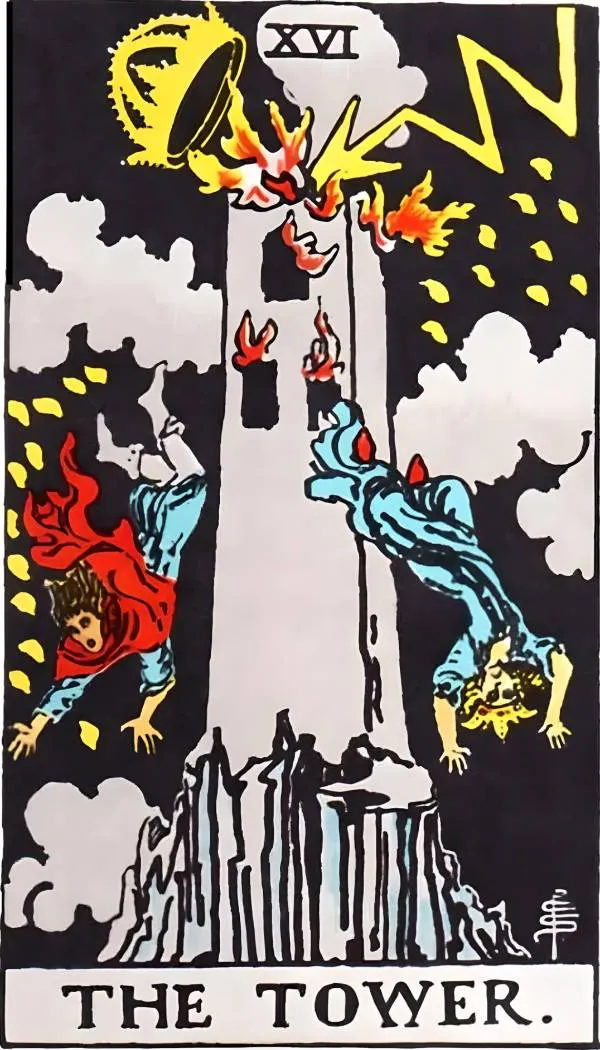
The Tower Tarot Card Meaning

This card features the most startling imagery in the tarot, depicting a scene of disaster where a towering, majestic structure is destroyed by a sudden lightning strike. This scene is often referred to as "The Tower struck by Lightning," and while the card is named "The Tower," it does not represent the completion and stability of a tower, but rather a tower that has been struck down by lightning, or one that is in ruins or has collapsed.

The towering structure, which was a target for lightning strikes in ancient times, is a metaphor for natural phenomena. The danger of tall buildings still exists today! This reflects the deep-seated fears and unease associated with being high up and out of reach. Throughout history, this has been a common metaphor, with stories from mythology and ancient history providing relevant examples. The towering structure symbolizes human self-satisfaction, the pride of material victory, and the disregard for spirituality and faith. Therefore, anything that is too materialistic or spiritually inflated is also a target for lightning strikes.

The emphasis on the height of this tower easily brings to mind the construction of the "Tower of Babel." In this story, a building designed by humans was supposed to be praised by God and built, but later humans became too arrogant and complacent, thinking they could build a "heaven-reaching tower" to probe God and leave their eternal names for posterity. They also believed that from then on, human life could be worry-free and that they could compete with the heavens and God in height. This attitude led humanity towards destruction and eventually they were punished by God. The etymology of "Babel": in Hebrew, it means "confusion," while in Babylonian it means "gate of God."

The lightning in the tarot card scene destroys this Babel tower. Similar situations can be associated with buildings related to material desires or spiritual inflation, such as the Castle of Plutus in ancient Greece, a castle filled with mountains of money, which was also a target for God's disapproval. (This part is for entertainment)

The destruction of another magnificent building can also be seen from another direction, as the "House of God" being abandoned, losing its luster and eventually being destroyed. The historical Solomon's Temple, built by Solomon, was destroyed by the Babylonian Empire due to being abandoned, which is a clear symbol. This is also a history that many people enjoy and pass on, so some people call this card "the House of God," but others call it something else, as this building can be occupied by anyone, so it is "the House of God," "the House of Man," or even "the House of the Devil," and it doesn't really matter what this card is called.

This tower not only stands tall but is also built on a towering mountain, with the top of the tower reaching into the clouds. The towering man-made structure is an unfamiliar situation for people, who are blinded inside, unaware of the impact on the overall environment, and still complacent, thinking they have reached the peak and can compete with the power of creation or nature, but ignoring the consequences that easily lead to danger. For example, the feedback force of nature and the physical and mental after-effects that humans themselves are not adapted to.

This tower was destroyed by lightning. The lightning that came from the sky, shining with a golden yellow light, turned three corners. The end is an arrow, looking like the symbol of Mars, with great destructive power. Does this lightning also represent God's arbitration and revelation? It also symbolizes all disasters, swords and weapons of war, and flames. Forming a "W" shape, it is very close to the Hebrew letter "ש", no matter where it comes from, it is a sin and punishment. Whose lightning is this? Thunder and lightning are things that humans fear, and in early Western times, it was also believed that thunder and lightning were weapons used by God Zeus to punish humans. Zeus is the god of thunder and lightning in mythology, and also the main god, using the weapon of this supreme ruler to express the action of this supreme ruler punishing humans.

This flash is also a kind of radio wave, a bright yellow fluorescent color, indicating the idea of clear consciousness awakening. It is related to enlightenment, breaking the chaos of ignorance. In fact, lightning is also a kind of stimulation and enlightenment, a sudden awakening, a thunderbolt, and a sudden awakening. And, maybe, the acquisition of higher wisdom, is to pay a higher price to obtain, sacrifice and break the past.

This tower, which has been devastated, is what kind of building? The whole tower is built of stone or bricks, with a dark gray color, representing rigidity and persistence. The crown is used to replace the top of the tower, indicating that this building is the top of wisdom, the crown of glory, the spiritual indicator. The lightning directly hit the crown, causing it to flip and fall, which is a failure of knowledge and a crisis of faith, and also implies that lightning has selective targeting. The crown symbolizes the spiritual side, and the crown that is held high by the material of bricks and stones is still inevitably falling. The whole tower collapsed and collapsed, in addition to the top of the tower caught fire and smoke, the tower's windows also emitted several flames, and the smoke was everywhere.

In this disaster, two people fell from the tower, what kind of people are the two people who fell down? Are they fleeing or are they shaken down? This picture can be a man and a woman, or if it is two men, or even two women, this is deliberately blurred by the author to allow people to extend. A man and a woman can be said to be the emperor and the queen, and the crown on the head of the person falling on the left side of the picture also fell down at the same time. Of course, it can also be seen as Adam and Eve who were exiled by God. If you think both of them are men, then the other represents the highest clergy, they can be the king and priest of the temple. Of course, they can also represent the emperor and the Pope, both representing the disintegration of the organization, or the conflict between politics and religion or the disintegration together.

The situation of these two people is a fall, but it is also a return to the origin, to the ground. They are shaken down, not jumping down calmly. It is worth noting that these two people are also upside down in the picture, which is similar to the hanging man's upside down, but more intense (falling from a high altitude). The overall feeling, the picture of this tower card in the Waite card is more vivid than the classical card painting, not only more three-dimensional and layered, but also more correct in proportion, so that it can show that falling down will be very tragic, otherwise it is just like falling from the second floor.

Regarding the three windows of the tower, they are arranged in a triangular shape. The windows are arranged in a triangular shape, representing organization. It represents the body, mind, and spirit, the past, present, and future. Now the three windows are on fire, emitting flames. The flame represents burning, all of which are represented. There is a thick smoke around the tower, and the gray clouds are diffused. These smoke that comes out is the annihilation and transformation of the existing, and the smoke will also obscure thoughts and vision, and also symbolizes negative emotions such as anger and fear. There are four clouds of smoke, symbolizing the four elements of annihilation, and each is the past clouds, the fog in front of the eyes, the uncertainty of the future, and the complete ignorance.

Additionally, on both sides of the high tower, twenty-two yellow dots fell, like things scattered in the building. The dots on the left side surround the emperor, and the dots on the right side are above the smoke under the lightning. However, the shape of these dots is very special, and it contains special meanings. This shape is the so-called "Finger of God," which comes from the Hebrew alphabet. This letter has only one dot, which is the simplest stroke and is also the most creative meaning. This Hebrew letter is also the first of the "Holy Four Letters" of the name of God, "י" "ה" "ו" "ה", and is the first creation of God's will. The "Finger of God" י represents the great power of God's creation revealed here.

There are twenty-two of these "Finger of God" dots, twenty-two is the number of the tarot major arcana, so it also connects to the tarot, and also shows the importance of this card in the tarot. These dots are divided into two sides, there are twelve dots on the left side of the tower, twelve is a whole number, representing the perfection of the body and mind? Is the whole zodiac, is twelve months or twelve hours. There are ten dots on the right side of the tower, representing the end of an old cycle and the beginning of a new cycle. The emergence of these "Finger of God" light spots also indicates that God is involved in this event, and the whole event is actually related to God's will. These dots, these numbers and arrangements, can also be regarded as signs of causality and fate phenomena.

The whole scene is full of chaos, the design of the pattern is like this, and the meaning and connotation are also like this. The dark background represents darkness, emptiness, heaviness, and oppression. The dark blue part is a kind of melancholy and confusion of reason. This card is a failure, and it is also a deviation. The material structure of the tower is close to God, but the spirit is far from God, and tends to the devil. It may also offend the should not, and in addition to not being rigorous enough, what kind of mistakes have been made? This is a question worth thinking about.

The Tower Itself

The central structure, tall and solid, symbolizes the constructs and institutions we build in our lives, be they beliefs, values, or relationships. Its sudden destruction reminds us that even the most seemingly permanent and stable things can be upended in an instant.

Lightning Bolt

The bolt of lightning that strikes the tower signifies a sudden, unforeseen force of change or realization. It can also be seen as a divine intervention, cutting through our illusions and making us see the truth.

The Crown

Falling from the top of the tower, the crown represents loss of power or control. It emphasizes that no matter how high or mighty, everything can be toppled.

Figures Falling

The human figures plunging from the tower symbolize the abruptness of the change, the sense of being ungrounded, and the chaos that can ensue when our foundational beliefs are challenged or destroyed.

Flames

Emanating from the windows of the tower, the flames signal distress, turmoil, and destruction. They embody the purifying nature of fire, which clears away the old to make way for the new.

Gray Clouds

The dark clouds surrounding the scene emphasize the stormy and tumultuous nature of the event, underscoring the sense of upheaval and unpredictability.

Psychological patterns in The Tower
Hyper-Independence
The Tower's figures are not standing in relation to each other; they are expelled from a sealed height into open air, each body cut loose from the walls, the ground, and mutual contact. The tower itself has functioned like a rigid emotional enclosure, keeping the inner world protected, elevated, and unreachable until the strike makes that separation impossible to maintain. That visual structure maps directly onto Hyper-Independence in love: the defense is not simply distance, but the belief that safety depends on needing no one too much. You may preserve control by holding feelings inside, avoiding dependence, or refusing to let a partner see how much the relationship matters. The collapse shows the cost of that defense. When intimacy keeps getting managed from inside a private tower, the relationship does not receive enough real-time truth to repair itself gradually; it only encounters the hidden pressure once the structure breaks open.
Illusion of Control
The Tower stands upright in hard stone, high above the ground, with its crown fixed at the top as if elevation itself could guarantee safety. The structure looks complete until the lightning exposes how much of its stability depended on height, separation, and the belief that the top could not be touched. That visual logic maps directly onto a control-based defense: the mind tries to manage uncertainty by building a future that feels sealed, ranked, and protected from disruption. You may not be avoiding direction; you may be trying to make direction so certain that no unexpected force can reach it. In a life-path reading, Illusion of Control shows up when planning becomes a substitute for listening. The tower reveals the cost of turning a compass into a fortress: the more rigidly the future is secured, the less room there is for live feedback, inner change, or a more honest route to appear.
Cognitive Dissonance
The ordered tower still stands while its crown is already torn away and its windows are burning from inside. The image holds two incompatible facts in one frame: the structure still claims authority, and the evidence of failure is already visible. In a choice reading, that split mirrors the strain of defending an option whose assumptions no longer match reality. You may keep explaining why the path still makes sense while another part of the system is registering the cost, and the pattern names the mental pressure created by keeping both truths alive.
Boundary Diffusion
The walls of The Tower split open, and the figures are no longer contained by the structure that once separated them from the storm. Inside and outside become indistinguishable in the moment of impact, while the falling crown removes the symbol that used to organize the scene. Boundary Diffusion works like that loss of containment. External expectations, sudden change, social timelines, and other people's certainty start flooding the inner compass until it becomes hard to tell which direction is truly yours. The issue is not having too many options; it is losing the boundary that separates inner signal from outer noise. In a direction reading, this pattern points to a compromised navigational field. The Tower shows a self that has been living inside a structure so dominant that when it breaks, every outside voice rushes in at once and competes for the role of truth.
Forced Progress
The tower rises from a high cliff as if height itself could guarantee safety, but the lightning enters from outside the system and breaks the structure at its crown. The image compresses ambition, elevation, and impact into one moment where upward force meets a timing reality that cannot be negotiated by effort alone. That is the core mechanism of Forced Progress: the body and mind keep pushing vertically when the field is already pushing back. In timing questions, this pattern turns delay into a threat to identity, so You respond by adding more pressure, more urgency, and more action instead of reading the resistance as information. The falling figures show the cost of mistaking escalation for alignment. The collapse is not a moral punishment; it is a visual audit of what happens when a structure built on constant upward drive loses contact with the conditions that actually support movement.
Catastrophizing
The Tower compresses lightning, fire, falling bodies, smoke, and a dislodged crown into one instant. The eye has almost no visual pause between trigger and consequence, so the whole scene reads as a cascade already underway. Catastrophizing develops in family systems when contact is mentally preloaded with collapse. A text, call, visit, or change in tone can become the first strike in an imagined sequence where everything will explode. The reversed Tower shows the cost of living inside that forecast. You are not reacting only to what happened; you are bracing against the whole collapse your mind has already simulated.
Limiting Beliefs
The lightning bolt hits the crowned tower exactly where the structure presents itself as highest, most finished, and most untouchable. The stone walls look solid, but the strike shows that the tower's strength was also its rigidity: it could stand tall, but it could not flex when reality arrived with force. That visual logic mirrors the way a limiting belief can become a private architecture of certainty. You may not experience it as a belief at all; it can feel like realism, maturity, discipline, or self-knowledge. The Tower exposes how a thought that once organized your growth can become a locked structure that keeps every new version of you outside. In personal growth, this pattern is not about needing a softer mindset slogan. It is about seeing which internal rule has been crowned as truth, then noticing where that rule collapses the moment life asks for expansion, risk, or a more complex self-image.
Shame Binding
The falling crown and exposed bodies turn an internal failure of structure into a public scene. Nothing in the image is private: the dark sky, the scattered sparks, and the bodies falling headfirst make visibility feel inseparable from impact. Shame Binding forms when the mind uses exposure as a control mechanism. In social settings, one awkward comment or visible mistake can become the whole tower, as if the self has been proven unsafe in front of the group. The Tower links this pattern to the instant when social visibility stops being neutral and becomes a threat signal that keeps you policing yourself long after the moment has passed.
Shadow Possession
The figures fall upside down as the crown separates from the tower, leaving no stable top, center, or orientation. The scene does not show a calm encounter with hidden material; it shows the whole structure being overtaken by what it could not contain. Reversed, that intensity can feel like one disowned part of the psyche has seized the entire room. Anger, shame, envy, fear, or the need to destroy an old image may become so loud that it feels like the only truth available. Shadow Possession fits because the card shows the shadow not as a subtle hint, but as a takeover of the field after containment fails. The pattern is not a fixed identity. It is a signal that a rejected part has gained power because it was kept outside conscious relationship for too long.
Identity Foreclosure
The figures are enclosed inside a tower that rises far above ordinary ground, as though life has been organized around one elevated structure. The crown, stone walls, and height all suggest a role that has been made to look permanent before the body has any chance to test whether it belongs there. Identity Foreclosure lives inside that kind of structure. It forms when a person commits to a path, status, or future self before enough genuine exploration has happened, often because certainty feels safer than ambiguity. The defense is not laziness or weakness; it is the attempt to reduce existential risk by becoming a finished answer too early. In a direction reading, The Tower shows what happens when that finished answer can no longer hold the whole self. You may feel disoriented because the path is collapsing, but because the path was also acting as an identity container, the collapse touches who you thought you were allowed to become.
Core Struggles in The Tower
Threshold Disorientation
The two figures fall through open air with no ledge, ladder, or visible landing point. The tower that used to define up, inside, and safety has become the thing they are being expelled from, while the surrounding sky offers movement without orientation. Threshold Disorientation is the timing wound carried by that suspended space. You may know that the old phase is over, but the next phase has not acquired weight, direction, or traction, so every possible move feels premature and every pause feels unsafe.
Capacity Misalignment
The lightning does not strike an empty field; it hits a rigid tower whose height, crown, and stone walls all imply confidence in its own capacity. The impact exposes a mismatch between what the structure was built to represent and what it can actually absorb. Capacity Misalignment appears in lifestyle systems when the blueprint of the day assumes more energy, attention, recovery, cleanliness, social availability, or work output than the body and environment can hold. The burning windows matter because the overload is not abstract; pressure has to escape somewhere. You may be trying to live inside a schedule or home rhythm designed for a version of you with more bandwidth than the present system has. The card gives that mismatch a visible boundary: the load has exceeded the container.
Routine Freefall
The figures fall from a tower that moments earlier functioned as shelter, status, and vertical order. Their bodies are not stepping down or choosing a new path; they are being expelled from the very structure that used to hold their position. That image gives Routine Freefall its shape in lifestyle work. A daily system can look solid until one overloaded pillar takes a direct hit, and then sleep, meals, cleaning, work rhythm, recovery, and attention stop behaving like separate tasks. You are not looking at a small lapse in discipline here. The card shows a whole routine architecture losing its load-bearing logic at once, which is why the struggle feels less like forgetting a habit and more like trying to find ground while the old ground is still breaking apart.
Relational Pacing Collapse
The figures are already airborne, separated from the tower and from any visible ground. Nothing in the image offers a threshold, pause, hallway, landing, or intermediate space between being inside the structure and being thrown out of it. In love, this becomes relational pacing collapse. The bond moves from intensity to rupture, disclosure to fallout, closeness to disappearance, or conflict to finality without enough shared space for timing, consent, or repair. You may feel as if every emotional turn becomes irreversible too quickly. The Tower identifies the problem as a missing middle: the relationship has impact points, but no workable passage between them.
Idealization-Reality Split
The lightning-struck tower shows a structure that looked immovable until one clean fracture exposes its instability. The crown falls, the walls burn from within, and the people inside are forced out into open air before they can choose a graceful exit. That is the visual shape of a relationship ideal breaking under direct evidence. You are not just reacting to one bad moment; you are watching the image of the bond separate from the facts now visible in front of you. In love, this struggle appears when the version of the relationship you protected no longer matches the behavior, silence, avoidance, or rupture you are actually living with. The card does not flatten the bond into failure; it locates the exact split between what the relationship was supposed to mean and what it can no longer hide.
Risk Normalization
The tower stands high on exposed ground, built as if elevation itself were proof of strength. The lightning reveals that the position was never neutral; it was a risk structure made ordinary by repetition and height. Risk Normalization in lifestyle work appears when the body and environment adapt to too little sleep, constant work spillover, chronic clutter, skipped recovery, or zero buffer until those conditions feel like baseline. The danger is not always dramatic from the inside because the system has learned to navigate it as normal. The card does not frame the collapse as a surprise from nowhere. It shows a long-standing exposure becoming visible in one instant, giving you a way to see which parts of daily life have been treated as livable only because the nervous system had no other reference point.
Potential Overidentification
The tower reaches upward as a crowned stone height, but that elevation makes it the exact point of impact. The structure that seemed to prove magnitude becomes the structure most exposed to the force that breaks it open. For personal growth, this binds potential to pressure. You can become so identified with who you could be that small, ordinary action feels beneath the tower, while feedback or delay feels like the whole imagined self is being struck.
Masked Self-Division
The tower still has the outline of a finished structure while fire vents from its windows. Its height, crown, and stone surface present completion, but the interior is already contradicting the image from within. Masked Self-Division lives in that split between facade and internal weather. In introspection, you may still be able to sound composed, maintain the public version, and explain yourself cleanly while the hidden system is already burning through the vents. The strike makes the division visible, but the split existed before the lightning. The card names the cost of keeping the elevated image intact after the inner structure has stopped matching it.
Timing Control Strain
The stone tower still presents a hard vertical outline while fire exits through narrow windows and the crown has been split from its seat. The image carries a structure that is trying to remain legible as a tower even after its internal timing has been overtaken by heat, smoke, and impact. Timing Control Strain lives in that forced verticality. You keep trying to make the date, delay, launch window, or life phase behave like something that can be held steady, while the pressure inside the structure is already telling a different story about readiness and release.
Internal Authority Collapse
The tower stands so high and rigid that its verticality appears to define the whole scene until the strike exposes how brittle that authority was. The crown does not merely move; it is displaced from the top of the structure that gave it meaning. In relationship terms, the reversal points to an inner rulebook collapsing after being treated as unquestionable for too long. The beliefs that told you what loyalty, patience, forgiveness, commitment, or love should require may suddenly stop functioning as reliable coordinates. You may not only be questioning a partner or a relationship outcome. You may be watching the internal authority system that kept you inside the bond lose its power to explain what you have lived through.
Inner Emotions in The Tower
Freefall Anxiety
Two figures drop from the broken tower with no visible ground beneath them, arms thrown into open air while smoke removes any easy sense of direction. The image does not show a planned exit; it shows support disappearing before the body has found a landing place. Career pressure can take on that exact vertical feeling when a restructure, failed launch, leadership change, or sudden feedback knocks the floor out of your role. You are not only worried about what happened; you are trying to orient while the reference points that made you feel employable, credible, or secure are moving. Freefall Anxiety belongs here because the Tower makes uncertainty physical. It turns career disruption into the inner sensation of dropping through space before a new structure has appeared.
Scattered Overwhelm
Flames burst from the tower's windows while sparks scatter down both sides, breaking the scene into too many points of attention. The eye cannot stay with the lightning, the falling bodies, the crown, the smoke, and the burning openings at the same time. That visual scatter mirrors the lifestyle moment when ordinary tasks stop forming a sequence and start arriving as simultaneous alarms. You may still know what needs to be handled, but the inner field is filled with fragments, and every fragment feels like it is asking for the whole nervous system.
Existential Vertigo
Two figures tumble headfirst through black air while the tower rises from a mountain with no visible ground to receive them. The composition turns height into disorientation: what was built as elevation now becomes a vertical void, and the eye cannot locate a stable horizon. For direction work, that image maps to the moment a long-range path stops feeling like progress and starts feeling like exposure. You are not simply unsure what comes next; the inner compass has lost its floor, so the future feels open in a way that is physically unsteady rather than liberating.
Free-Fall Anxiety
Two figures falling headfirst from the blasted tower turn the choice point into a loss of ground. Their bodies have no ledge, no foothold, and no visible landing, only open dark space and fragments of a structure that can no longer hold them. In a decision reading, this maps to the second after the old plan stops working and before the next plan exists. You may know staying inside the tower is not viable, but the nervous system still reads the open air as too much, too fast, with no backup surface. Free-Fall Anxiety is the feeling of having agency without a platform. The Tower captures that terrifying interval where movement has begun, but orientation has not returned yet.
Timeline Panic
The Tower compresses the whole scene into a single violent now: lightning hits, the crown falls, windows burn, and bodies are already outside the structure. There is no gradual sequence in the image, only several consequences happening at once, which makes the card a precise visual anchor for time pressure that has become too concentrated to process. Timeline Panic, in this card, is the feeling of every clock catching fire at the same time. In timing questions, it can surface when social milestones, resource limits, postponed action, and sudden external change converge until waiting feels dangerous and acting feels premature. The structure of the card does not demand frantic movement. It exposes the difference between real timing and compressed pressure, giving you a clear place to ask which clock is actually yours to answer.
Hollow Control
The Tower is made of hard stone, crowned at the top, and sealed into a vertical shape that looks powerful until the strike reveals its brittleness. Its control is architectural, not alive; it depends on height, rigidity, and appearance. In academic life, Hollow Control appears when planners, grade targets, polished notes, and high-achiever routines look stable from the outside while the inner learning process is barely breathable. The structure is impressive, but it cannot flex when feedback, uncertainty, or difficulty arrives. This emotion is the quiet dread of realizing that your control system has become a shell. The card gives that dread a precise image: a tower that stood tall, but did not have enough internal adaptability to stay whole.
Imposter Exposure Fear
The crown falling from the Tower strips the structure of its public sign of authority. At the same time, the figures are forced out into open air, no longer protected by the walls that once kept the inner condition hidden. In academic life, this image fits the fear that a seminar, exam, viva, critique, or supervisor comment will reveal that the role you occupy is less secure than it appears. The terror is not only getting something wrong; it is being seen as someone who should never have been placed that high. Imposter Exposure Fear is anchored in the visible loss of cover. The card does not judge the student; it shows the moment when performance, status, and private uncertainty are violently pulled into the same field of view.
Status Anxiety
The crown is the first object to be knocked away from the tower's highest point. Height, rank, and visibility dominate the whole scene, but the image shows how quickly an elevated position can stop feeling like proof of safety and start feeling like exposure. Work can make status feel structural: title, salary band, manager access, headcount, and reputation all become bricks in the tower. When one strike lands, you may feel the entire vertical order of your career wobble, even if the external facts are still unfolding. Status Anxiety is not vanity in this image. It is the pressure of tying your sense of professional worth to a height that can be shaken by forces outside your control, and the Tower gives that pressure a precise visual form.
Adult Child Panic
The bodies fall upside down from the tower, caught in a frame where there is no ground, no balance, and no time to choose a composed response. The scene carries the physical logic of being pulled out of adult posture before the mind can catch up. Adult Child Panic appears when family contact drops you back into an old nervous role. You may enter the conversation as an adult, but the family structure can still pull your body into the small, braced, over-responsive position it learned years ago. The smoke pressing around the tower intensifies the feeling because the space itself offers no clear exit. The card gives the reaction a visible architecture: the panic is not random, but a bodily memory of standing under a family structure that once felt too tall to question.
Belonging Shame
The figures falling from the tower are not posed, protected, or granted a dignified exit. With the crown dislodged and the walls breached, the image strips away status and privacy at the same time, leaving the need for shelter painfully visible. Belonging Shame forms when the desire to be included starts to feel humiliating. In social life, this can happen when you notice how much effort you have spent trying to stay acceptable to a group that still makes you feel replaceable, watched, or outside the real room. The Tower gives this shame a precise container because it shows the collapse of the social height that once promised safety. The card does not frame your need for belonging as weakness; it reveals the cost of seeking it inside a structure that made visibility feel like punishment.
Outer Contexts in The Tower
Life Reset Phase
Two figures falling from the tower are not choosing a graceful exit; the old height has stopped being a livable place. The crown falls with them, so the scene strips status, control, and old identity markers away at the same time. Life Reset Phase belongs here because the card shows a forced return to ground level after an overbuilt structure breaks. You are not just adjusting a calendar; you are being pushed to redraw the basic coordinates of how days are arranged, what gets protected, and which parts of the old lifestyle no longer deserve load-bearing status.
Routine Collapse
The tower’s stones, crown, flames, and falling figures all leave their assigned places at once. What had been organized vertically becomes scattered across the dark sky, turning structure into debris before anyone can restore order. For timing, this describes the collapse of the rhythm that made action possible. A plan may still exist in your head, but the daily supports around it, stable hours, predictable feedback, reliable energy, or a clean sequence of steps, have stopped behaving like a usable system. The card’s value is in naming the difference between laziness and a broken container. Once the routine itself has collapsed, the next timing move has to rebuild sequence, not just demand more effort from the same disrupted frame.
Ignored Red Flags
The rigid tower keeps its shape while fire pushes through the windows and smoke gathers around it. The warning signs are not absent; they are visible, but the structure still presents itself as tall, official, and worth maintaining. In a relationship, this reflects the period when inconsistent behavior, repeated discomfort, or boundary strain is already showing through the surface. You may still be organizing your interpretation around the relationship's promise, history, or image while the evidence keeps arriving through the cracks. The card's value is in naming the gap between signal and story. It does not shame the delay; it shows how a structure can keep looking meaningful long after its interior conditions have become unsafe for trust.
Decision Cliff Edge
The tower offers no staircase, bridge, or careful descent. Once the roof is broken open, movement happens at the edge of a structure that has stopped providing a safe route. This is the architecture of a decision cliff edge: the pressure is not just that a choice exists, but that the old container no longer lets you stay neutral. Delay, compliance, and sudden movement all carry consequences because the former path has lost its navigational function. The card gives the pressure a shape. It helps you see whether the real issue is the decision itself, the missing landing zone, or the false belief that the tower was still a usable platform.
Risk Blind Spot
The tower rises on a mountain with no visible path, turning height into a substitute for safety. From that elevation, the structure appears dominant, but the card shows how a single exposed point can reorganize the entire risk map. You may be weighing an option whose upside is easy to see because it is tall, public, or impressive. The smoke and falling crown redirect the audit toward hidden fragility, unpriced costs, and the parts of the decision that were kept outside the original frame.
Premature Launch Pressure
The crowned tower rises high before the image shows any grounded passage, scaffolding, or gradual route into stability. Its height creates visibility, but the lightning exposes how much of that visibility depends on a structure that cannot absorb sudden pressure. In a timing question, this is the pressure to launch, commit, announce, move, or escalate before the underlying conditions are ready. The crown makes the plan look impressive from the outside, while the stone body of the tower shows rigidity where adaptability is needed. The card does not shame ambition; it audits the launch conditions. You get clearer timing by asking whether the move is supported by real infrastructure or mainly by the social pressure to appear already elevated.
Bad Timing Loop
The bodies suspended outside the tower show movement that is intense but not coordinated. There is velocity, impact, and exposure, yet no visible path that turns that motion into a controlled transition. That is the signature of a bad timing loop: action keeps happening at the wrong point in the cycle. You may push when the structure is already closing, wait when the window requires contact, or mistake urgency for readiness because the environment keeps producing pressure. The card makes the loop visible by separating force from timing. The useful question becomes where the cycle actually opens, rather than how much harder you can throw yourself against a structure that is not currently receptive.
Commitment Cliff Edge
The tower stands on a rocky height with no visible stair, soft landing, or gradual route down. Its structure turns elevation into risk: the higher the commitment has been placed, the more visible the lack of support becomes. A commitment threshold in love can work this way when moving in, getting engaged, becoming exclusive, or ending a long-term plan suddenly makes the whole relationship load-bearing. You are not only choosing a next milestone; you are testing whether the structure underneath can hold the extra weight. The card brings the cliff edge into focus without forcing a verdict. It shows the difference between a commitment that stabilizes the bond and a commitment that simply raises the height of the fall.
Social Circle Reset
The lightning-struck tower turns a fixed vertical structure into an immediate break in the social map. The old route upward is no longer usable, the crown is no longer attached to the top, and the figures are returned to open ground without the protection of the former structure. In a social context, that image maps to a circle whose organizing logic has stopped holding. The friend group, community scene, or professional-adjacent network may have looked stable because everyone knew the roles, the status ladder, and the rituals of belonging, but the rupture exposes how brittle that arrangement had become. You are not only dealing with a social fallout moment; you are standing at the point where the whole ecosystem has to be redrawn. The card frames the reset as a structural audit of who still belongs in your life, which rooms no longer support you, and where connection can be rebuilt without the old performance architecture.
Lifestyle System Overhaul
The stone tower is not damaged in one decorative corner; the strike runs through the crown, windows, walls, and air around it. Fire comes from multiple openings, showing a whole container under pressure rather than a single broken habit. Lifestyle System Overhaul fits because the image points to a full operating system failure. You can see calendar logic, home setup, recovery time, food logistics, digital boundaries, and maintenance rituals as connected load-bearing pieces, not separate problems to patch one by one.