King of Cups Tarot Card Meaning

Overall Visual Structure

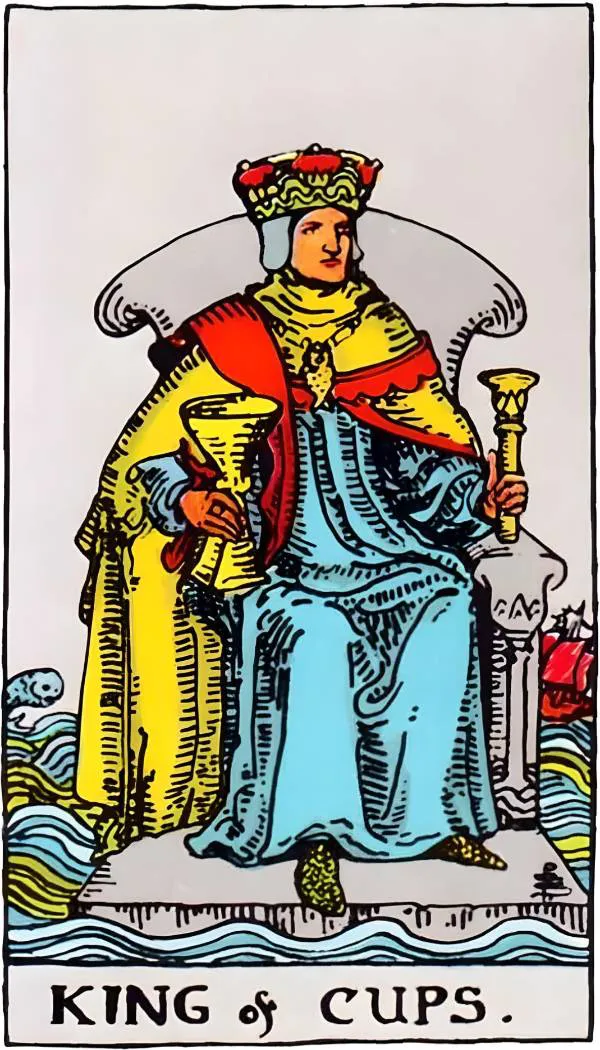
A mature man sits upright in the center of the scene; he is the King of Cups.

He sits calmly, his body slightly turned to his left. In his right hand, he holds a large Cup, while his left hand grasps a scepter shaped like a Cup, and his gaze is directed towards the Cup.

His crown and cloak are the same golden color as the items in his hands, and his hat and inner robe are the same blue as the sea in the background. He also wears a necklace with a fish-shaped pendant. His feet are shod in green shoes, with his right foot almost touching the surface of the sea.

The King of Cups' throne is made of shell material and design, located right in the middle of a vast ocean. This is a non-realistic painting technique, so the background consists of layers upon layers of green waves and blue waves. We can see a dolphin leaping out of the sea on the right side of the king, and a distant sailboat navigating through the waves on the left.

Detailed Pattern Explanation

The King of Cups has a melancholic appearance, especially evident in his gaze focused on the Cup, representing his value and concern for the emotional realm. He looks deeply at the water element's exclusive object, the Cup, a man of deep and concentrated emotions. On his right hand holding the Cup, one can notice a ring on the middle finger, a symbol of marital commitment. His left hand grasps the Cup's handle, indicating proficiency in emotional control and still possessing authority and mastery in matters of the heart.

His golden crown is adorned with red fish decorations, signifying active emotions in the mind. The hat is blue, resembling the ocean, symbolizing mental spiritual wisdom. The golden cloak represents nobility, elegance, and brightness, showing his high spiritual realm, and the fish-shaped necklace pendant pinned at his chest represents a soft, delicate, and romantic heart. The green shoes on his feet are meant to blend with the seaweed and the green vitality.

The king's seat is like a large shell on the sea surface, with a shell-shaped backrest. The throne is situated in the center of the sea, with turbulent waves all around, akin to the surging emotions, and the interplay of blue and green waves represents a pure and richly varied state of mind. The King of Cups sits here to enjoy and appreciate, and to steer the rudder of his heart. The King of Cups is in a position of practical observation, facing the vast ocean of emotions, but not fully immersed in the watery realm. The tip of the king's right foot seems to stretch towards the sea surface, still with a sense of contact and exploration.

The entire sea surface is a layer upon layer of undulating waves, representing endless creativity and vitality, with the blue-green waves shimmering. The sea on both sides of the throne is not empty; on his right, there is a dolphin leaping out of the sea, and on his left, a red boat is seen. The dolphin is always a symbol of peace, wisdom, and warmth, representing a pure and kind heart, harmless and innocent enthusiasm. The red boat rises and falls with the waves, representing a red heart, fluctuating in the tide of emotions.

Throne on the Sea

The King of Cups is depicted sitting on a throne that seems to be floating on the sea, symbolizing the depth of his emotions, intuition, and the unconscious mind. The water around him represents the vastness of his emotional understanding, and his ability to stay composed and wise even in the midst of turbulent emotional waters. This mastery over emotions indicates maturity, control, and balance.

Golden Cup

The King holds a golden cup in one hand, representing the emotional wealth, intuition, and deep understanding he possesses. It’s a sign of his control over feelings and situations. The cup’s golden color signifies the purity and value of his emotional intelligence.

Ship

In the distance, a ship sails smoothly, signifying successful navigation through the emotional and subconscious realms. It’s symbolic of his capability to guide and be a beacon of emotional wisdom and understanding for others.

Scepter

The scepter in his other hand represents authority and leadership. It emphasizes the King’s power, not just over his realm, but over his emotions and feelings. He leads with compassion, understanding, and emotional intelligence.

Fish Amulet

On his necklace, there’s an amulet with a fish emblem. The fish is often a symbol of the unconscious mind and hidden depths. In this context, it suggests that the King has profound insight into the mysteries of the emotional and intuitive world. He’s someone who can dive deep into the emotional waters and emerge with wisdom.

Psychological patterns in King of Cups
Rescuer Identity
The king's hands stay locked around the cup and scepter, and the throne sits alone in the middle of the sea. What looks like mastery can also become a fixed identity: the one who holds the feelings, interprets the waves, and stays composed for everyone else. This is where Rescuer Identity takes shape in friendship. You may start by being supportive, but the role hardens when being needed becomes the main way you feel secure, valuable, or irreplaceable in the bond. The isolation of the throne is the cost. The more you become the calm emotional authority for your friends, the less room there may be for your own mess, need, anger, or uncertainty to exist inside the friendship.
Strategic Surrender
The waves move in every direction, yet the King does not try to flatten the sea. His throne floats, the distant boat navigates, and the dolphin rises from the same water that could otherwise feel unstable. The card's composure comes from working with motion rather than pretending motion is failure. Strategic Surrender appears when your lifestyle system stops confusing rigidity with reliability. You still need structure, but the structure has to bend around delayed rewards, uneven energy, and changing emotional weather; otherwise discipline becomes another force that breaks the container it was meant to protect.
Boundary Diffusion
The throne separates the king from the sea, but the sea touches every edge of the scene. His foot nearly reaches the water, making the boundary feel present yet constantly tested by the emotional field around him. That tension is the visual logic of Boundary Diffusion in friendship. You may believe you are simply being empathetic, but the internal line between listening and taking responsibility can soften until another person's mood feels like your task. The cup and scepter show why this can feel noble rather than invasive. You are not trying to control the friendship; you are trying to keep it emotionally safe, but the cost is that your own limits become harder to locate.
Boundary Discernment
The throne floats inside the ocean but does not dissolve into it, and the king's foot reaches toward the water without entering it. This is not detachment; it is contact with a visible edge. The body remains available to feeling while the architecture keeps feeling from becoming total immersion. That edge is the logic of Boundary Discernment in family dynamics. You can care about a parent's mood, a sibling's crisis, or an inherited conflict without treating every emotional wave as a command. The card shows a boundary that is relational rather than punitive: close enough to know what is happening, firm enough to know what is yours.
Purpose Anchoring
The king's gaze rests on the golden cup while the boat, dolphin, and waves stay in the wider field. He is not scanning every possible horizon; he is letting one emotionally weighted object organize the larger ocean around him. That visual structure maps to Purpose Anchoring because direction is being filtered through felt value rather than external noise. You are not being asked to chase motion for its own sake; the pattern reveals that the next path becomes legible when the cup, the thing that actually carries meaning, is allowed to outrank the waves of other possible futures.
Emotional Regulation
The King's body stays vertical while layered waves move around the shell throne. One hand holds the Cup and the other holds the scepter, so feeling and executive control are both present in the same frame without collapsing into each other. That visual structure maps the core mechanics of Emotional Regulation: emotion is acknowledged as data, but it is not allowed to seize the whole steering system. You are not asked to shut the water out; the pattern shows whether you can keep a stable center while the water is active. For personal growth, this becomes the difference between using insecurity as feedback and letting insecurity rewrite the entire strategy. The Cup receives attention, but the scepter remains in hand, which is the psychological posture of growth that can feel deeply without abandoning direction.
Emotional Cutoff
The same calm throne that stabilizes the King can also look eerily fixed when the sea keeps moving and the body does not respond. The cup and scepter remain in place, but the posture starts to read less like mastery and more like a polished freeze. That is the reversed logic of emotional cutoff. Feeling is still present in the image, but it is held at such a distance that it stops functioning as useful information. In academic life, this can appear as going blank after feedback, acting unaffected by a deadline, or becoming strangely flat when the work matters most. The pattern protects You from being overwhelmed, but it also blocks the signals that would tell You what kind of support, rest, revision, or direct action is needed. The card exposes the cost of looking composed while the inner weather has been disconnected from the study system.
Illusion of Control
The crown, cup, and scepter broadcast command, but the throne still rests on water. The king can hold authority, yet the environment beneath him remains fluid, layered, and impossible to turn into fixed ground. Illusion of Control appears when command symbols are used to deny the changing nature of the field. The pattern makes You manage timing through pressure, planning, or emotional overcontrol, as if a private schedule could force the ocean of conditions to stabilize on demand.
Emotional Gatekeeping
The King's hands keep the Cup and scepter contained, and the right foot only tests the water without entering it. The body presents calm control while the entire field around the throne remains saturated with moving water. In the reversed state, that containment becomes Emotional Gatekeeping. The system permits only feelings that preserve composure, competence, or self-image, while the messier data stays outside the gate. For personal growth, You may look regulated while the most important material never gets admitted into the work. The pattern protects dignity and control, but it also blocks the exact emotional evidence that would force the inner system to update.
Shadow Projection
The sea surrounds the king, the fish rests at his chest, and his gaze narrows toward the cup. In the reversed state, the symbols of depth can stop being gateways into the unconscious and start acting like screens onto which the unconscious casts its own material. The emotional object becomes too charged. A person, memory, image, or repeated theme can appear to contain the whole problem, while the disowned part of the self stays hidden inside the intensity of the projection. Shadow Projection fits because the card's water imagery shows inner depth pressing close to the surface. You may keep circling an external symbol because it is carrying something in You that has not yet been given a conscious place to land.
Core Struggles in King of Cups
Inner Compass Overload
The King's gaze narrows onto the golden cup, yet the same water language repeats across the entire scene: the ocean, the fish pendant, the dolphin, and the distant boat. The image is not empty of guidance; it is crowded with signals that all seem to belong to the same inner element. When the question is direction, that crowded field becomes the shape of an overloaded inner compass. You are not simply lacking purpose; the card shows too many emotionally charged bearings arriving at once, so the real path loses definition inside a sea of meanings.
Emotional Withholding Tension
The king's attention concentrates inside the Cup while both hands remain occupied. The sea is everywhere, but no visible channel carries the water outward into another vessel. In a relationship, that creates a painful form of withholding: the feeling exists, but it stays sealed inside a controlled posture. You may appear composed while the partner receives only fragments, making the bond feel starved even when the inner emotional world is full.
Emotional Secrecy Spiral
The king's calm surface sits on a throne that has no land beneath it. His hands hold the symbols of feeling and rule so steadily that the posture can start to hide the instability of the water below. Emotional Secrecy Spiral appears when composure becomes a closed emotional system. You may keep private pressure out of view so consistently that even your own introspection begins to meet the managed version first, not the raw signal underneath. The cup-shaped scepter matters because it makes control look almost identical to sensitivity. This card locates the spiral where emotional intelligence becomes the mask that protects hidden material from being seen, named, or released.
Timing Control Strain
The cup and scepter fill both hands while the throne stays unnaturally upright on moving water. Nothing in the scene gives the King a solid floor, yet the whole posture insists on composure, command, and containment. When this structure tightens, timing becomes something the hands try to hold still instead of something the body can read. You may feel the need to manage every window, sign, delay, and opening, but the card shows the cost of turning a living current into an object of control.
Cycle-Action Desynchronization
The King sits upright on a shell throne while the ocean moves around him, with a ship and dolphin already responding to the water's rhythm. His body is composed, but the field is not still; the image holds a person in stable posture inside a cycle that keeps changing. For a timing question, that physical split gives form to the strain of acting from an inner rhythm that no longer matches the surrounding current. You may be applying pressure, discipline, or patience at the wrong beat, and the card locates the blockage in synchronization rather than personal inadequacy.
Power-Intimacy Split
The Cup and scepter split the king's body into two functions: one hand receives and contains feeling, the other holds authority. The throne does not sit on land; it asserts control from inside the emotional field itself. In love, the same structure can make intimacy feel inseparable from power. You may want softness, but the relationship keeps asking whether closeness will cost control, whether needing someone will shift the balance, or whether emotional skill has become a quiet way to stay in charge.
Boundary Control Strain
The King's right foot nearly reaches the sea, but the rest of his body remains on the shell throne. The image is built around contact without immersion: close enough to sense the water, contained enough not to be swallowed by it. In career life, that threshold becomes the pressure of being emotionally available without becoming the workplace's open reservoir. The card frames your boundary issue as a spatial problem: the field around you keeps expanding, and your capacity depends on knowing where contact ends.
Family System Overidentification
The blue garments echo the sea so closely that the figure can appear made from the same field he is trying to govern. The shell throne still marks a boundary, but water surrounds every edge and becomes the visual baseline. Reversed, the card locates a family bind where inherited moods, expectations, and old reactions start feeling like your own inner weather. You may enter a call or visit as an adult and leave carrying a family state that has overwritten your individual signal.
Intuition-Execution Split
The King's gaze rests on the cup while his other hand keeps hold of the scepter, splitting attention between inner perception and outward command. The body is composed, but its tools point in two directions: one receives the emotional field, and one must govern it. Academic work often creates the same split when you can sense the meaning of an idea but cannot make that insight obey the format of an essay, exam answer, presentation, or supervisor expectation. The difficulty is not that nothing is happening inside; it is that the inner signal and the output channel are not moving as one. Intuition-Execution Split gives shape to that disconnect. The card shows a mind close to the water of understanding, yet still required to translate that water through a held instrument of performance.
Inner World Entrapment
The throne sits alone in open water, with the boat and dolphin pushed to the edges of the scene. The ocean is expansive, but it also becomes the entire world around the figure, leaving no visible ground outside the emotional field. Inner World Entrapment is the point where introspection stops creating clarity and starts becoming the only room available. You may keep going inward because the inner world is rich, symbolic, and alive, yet the same movement can become circular when every signal is processed through the same private ocean. The cup cannot hold the sea, and the sea cannot give the king a shore. This card names the enclosed vastness of an inner life that feels deep but increasingly hard to exit.
Inner Emotions in King of Cups
Performative Calm
The upright posture, crown, cup, and scepter create a surface of perfect emotional governance while the sea presses in from every side. The body looks composed, but the composition also shows how much effort it takes to keep the role intact on a floating seat. Inside an introspective reading, this becomes the feeling of appearing emotionally fluent while privately managing a split between presentation and actual inner weather. You may look steady because the mask is well built, but the card exposes the cost of keeping that mask polished while the water keeps moving underneath.
Hollow Control
The king’s body is composed, crowned, and ceremonially equipped, but the same stillness can read as a sealed surface when the gaze stays fixed on the cup. The scepter and cup remain intact in his hands, yet their weight can become symbolic of maintaining control rather than staying emotionally alive. That is the emotional texture of Hollow Control. In personal growth, it appears when discipline, self-awareness, and emotional management become so polished that they start to drain the life out of the process. The surface says mastery; the inner field feels distant, muted, and over-contained. You may be managing your growth with impressive precision while quietly losing contact with why it matters. The card exposes the cost of control that has stopped functioning as support and started functioning as a barrier between you and your own emotional truth.
Contained Overwhelm
The throne is surrounded by layered blue-green waves, yet the cup in the King’s hand remains intact and held. The image does not remove the scale of the water; it places a vessel, a seat, and a body inside it so the volume can be met without becoming shapeless. For introspection, this points to the feeling of having too much inside while still having enough structure to stay present. You are not calm because the inner sea is small; you are contained because some part of you has found a way to hold the sea in view without drowning in it.
Submerged Anxiety
The throne sits in open water, yet the King's body stays carefully lifted above the moving sea. His attention narrows toward the cup while the wider ocean continues to rise, fall, and press around the edges of the scene. That arrangement captures unease that has learned to stay beneath the surface. You may look composed in a direction question, but the deeper system keeps scanning for drift, loss of orientation, or the possibility that the current path is not actually yours. Submerged Anxiety fits this card because the visible control does not erase the water underneath it. The emotional signal is quiet enough to hide, but persistent enough to shape every attempt to choose a long-term course.
Hard-Won Composure
The King sits upright on a shell-like throne while the ocean moves in layered waves around him. His body is not removed from the water, but it is not pulled apart by it either; the cup and scepter stay held, centered, and visible. That visual structure mirrors the feeling of keeping an inner axis while the long-range future remains fluid. You are not being asked to deny the scale of the unknown; the card frames composure as something maintained inside motion, not outside it. Hard-Won Composure belongs here because the emotional work is already visible in the posture. The direction question is not solved by forcing certainty, but by noticing the part of you that can hold uncertainty without surrendering the wheel.
Compassion Fatigue
The King sits surrounded by water on every side, close enough to the emotional field that there is no dry landscape in sight. The cup is present, but it does not visibly refill; the body stays composed while the sea keeps asking to be held. In friendship, this is the felt cost of becoming the reliable listener. You may still care, and your care may be real, but repeated venting, crisis loops, and unbalanced emotional access can leave the inner cup feeling used rather than nourished. Compassion Fatigue names the dull ache that appears when empathy has been repeatedly drawn on without reciprocity. The card's reversed pressure makes the boundary issue clear: the problem is not that you lack heart, but that your heart has been treated like an unlimited public resource.
Leadership Loneliness
The King is central but alone, seated on open water with the boat and dolphin kept at a distance. He is surrounded by movement, yet the throne separates him from immediate contact with everything he is meant to understand. Leadership Loneliness often arrives when career growth gives you more authority but fewer places to be unguarded. You may be visible, consulted, or responsible for the emotional tone of the room, while your own uncertainty has to stay private. The card names the isolation that comes with holding the container instead of simply belonging inside it.
Control Fatigue
Both of the King’s hands are occupied: one holds the cup, the other holds the cup-shaped scepter. Around him, the ocean keeps moving, while the shell throne prevents full immersion. Control Fatigue arises from this sustained holding, where stability depends on constant internal management. In a lifestyle spread, the objects in the King’s hands can resemble the endless management of a modern day: sleep, food, work, health, money, messages, cleaning, planning, recovery. Each item may be reasonable on its own, but the emotional cost gathers when you are always the one keeping everything upright. You may not need another optimization layer as much as a clearer view of where control has become maintenance without nourishment. The card points toward the exhaustion that comes from stabilizing the sea by hand, and it gives you a place to ask which containers truly need to be held right now.
Cyclical Surrender
The throne floats within layered waves, and the boat in the distance moves by working with the water rather than standing outside it. The King is centered, but he is not above the sea; his authority exists inside a larger rhythm. For timing questions, this turns the ocean into a living clock. The card points to the relief that comes when you stop treating every delay as resistance and start reading rhythm, season, and available current as part of the emotional data. Cyclical Surrender is not giving up. It is the felt shift from forcing a result to recognizing when a cycle is asking for containment, conservation, or a more precise release of energy.
Enmeshed Resentment
The throne is surrounded by sea on every edge, and both of the King's hands are already occupied. One hand holds the cup, the other grips the scepter, leaving no open palm, no casual release, and no clear dry ground around the body. In friendship, this image captures the resentment that grows when closeness keeps crossing into obligation. You may care about the person deeply, but the emotional water has reached the edges of your seat so often that every new request can feel like another quiet invasion. Enmeshed Resentment names the bitterness that forms inside blurred boundaries. The reversed King of Cups does not make the feeling cruel; it shows how warmth can curdle when a friendship treats constant access as proof of love.
Outer Contexts in King of Cups
Public Mask Maintenance
Seated upright on a shell throne in the middle of active water, the King of Cups presents a controlled surface while the surrounding sea keeps moving. The crown, cloak, cup, and scepter turn emotional composure into a visible public costume, something structured enough for other people to recognize and rely on. That visual arrangement matches the outside pressure of having to look emotionally sorted before the inner material has actually been processed. You are not simply dealing with private turbulence; the social field is rewarding the calm version of you and making the less polished material harder to bring into view. For introspection, this context matters because the mask is not just an inner habit. It is maintained by rooms, relationships, workplaces, and family systems that respond better to your controlled face than to your full signal.
Reflective Study Container
Seated on a shell throne in the middle of open water, the King holds the cup steady while the waves continue moving around him. The cup, scepter, blue robe, fish pendant, and throne form a contained system for working with water rather than being swallowed by it. In an academic setting, that image maps onto the need for a study structure that can hold intensity without turning it into chaos. You are not just looking for more motivation; the situation calls for a container strong enough to separate reading, writing, feedback, and rest into forms your attention can actually use. The card’s composure is practical, not decorative. It shows how academic progress becomes possible when emotional load is given a structure instead of being treated as noise that should disappear before the work can begin.
Designated Peacekeeper Burden
Both of the King's hands are already occupied: one holds the cup, the other holds the scepter. Around him, the sea keeps moving, but the composition makes one seated figure responsible for keeping the scene readable and contained. In a family context, that becomes the role of the person everyone expects to stay calm, translate conflict, soften sharp messages, and prevent emotional spillover from becoming visible. You may be treated as the mature one not because the role is fair, but because the family system has learned to outsource regulation to the person least likely to collapse the performance. Designated Peacekeeper Burden fits the reversed pressure of this card because the symbols of emotional mastery become a job assignment. The issue is not that You are good at staying composed; it is that the whole family stage may depend on You doing that labor without naming its cost.
Emotional Dumping Friendship
The cup is held above a restless ocean, and the throne has no shore around it. In the reversed texture of this image, the container is still present, but the surrounding water keeps pressing toward it from every side. That is the shape of emotional dumping in friendship: one person's crisis material repeatedly arrives without checking whether there is consent, timing, space, or mutual capacity. You become the exposed platform where someone else deposits what they cannot process elsewhere. The card makes the structure visible without blaming care itself. It separates real intimacy from unfiltered discharge, showing that a friendship can include emotional honesty while still requiring pace, permission, and reciprocity.
Friendship Boundary Creep
The King's foot hovers at the surface of the sea, and his throne is not on land but in the water itself. In the reversed reading, that almost-contact becomes a weak threshold where the outside keeps finding small ways in. Friendship boundary creep rarely begins as a dramatic violation. It shows up through tiny repeated permissions: one more late-night call, one more emergency that is not an emergency, one more private disclosure you did not agree to hold, one more expectation that you answer fast because you answered fast before. The card's value is in making the gradualness visible. It shows that the friendship may not be broken by one event; it may be shaped by accumulated access that was never renegotiated after your capacity changed.
Emotional Blackmail Cycle
The scepter is shaped like a cup, turning the symbol of care into an object of command. In the reversed structure, the same hand that appears to hold emotional wisdom can also define what counts as loyalty, gratitude, or betrayal. This maps directly onto family guilt systems where concern is not offered freely; it arrives with a pressure point attached. You may hear language about sacrifice, worry, or love, but the practical effect is compliance, silence, or the surrender of a boundary. Emotional Blackmail Cycle fits because the card's authority is emotional rather than openly forceful. The pressure works by making refusal look like cruelty, and the structure becomes visible when care starts functioning as leverage.
Relationship Power Play
The crown, scepter, and cup place emotional material inside a hierarchy of control. Soft water is present everywhere, yet the visible authority belongs to the figure who decides what is held, shown, or withheld. In love, that visual order points to a dynamic where calmness can become a lever. You may be dealing with someone who controls the pace of disclosure, repair, or commitment by appearing composed while keeping the emotional terms in their own hands.
Friendship Boundary Reset
The King's right foot nearly touches the sea, yet his body remains seated on a defined shell throne. The cup is close, the water is close, but the image keeps contact and immersion as two different states. That distinction is the core of a friendship boundary reset. You can care, listen, respond, and stay emotionally present without becoming permanently reachable, endlessly absorbent, or responsible for every wave that passes through someone else's life. The card's authority comes from containment rather than withdrawal. It points to a friendship stage where the bond can become more honest because the terms of access are being made visible: what you can hold, what you cannot hold, and what must be carried by the other person.
Emotionally Unavailable Partner
The cup stays in the King's hand, his gaze remains fixed on it, and no other figure in the scene receives what he is holding. Around him, the sea moves with life, but the central exchange never happens. In a romantic context, this becomes the shape of a partner who can possess depth without offering access. You may see signs of feeling, commitment, or sensitivity, yet the actual doorway to mutual vulnerability keeps narrowing at the moment it should open.
Executive Presence Test
The centered King sits upright above restless water, dressed in repeated gold and blue that make his authority visually legible. His posture, cup, and scepter all communicate controlled emotional intelligence under public observation. That arrangement maps cleanly onto a career moment where competence is being judged through composure, tone, and room command rather than output alone. You are not only being assessed on what you deliver; the structure is testing whether you can remain readable, calm, and authoritative while the environment around you stays fluid.