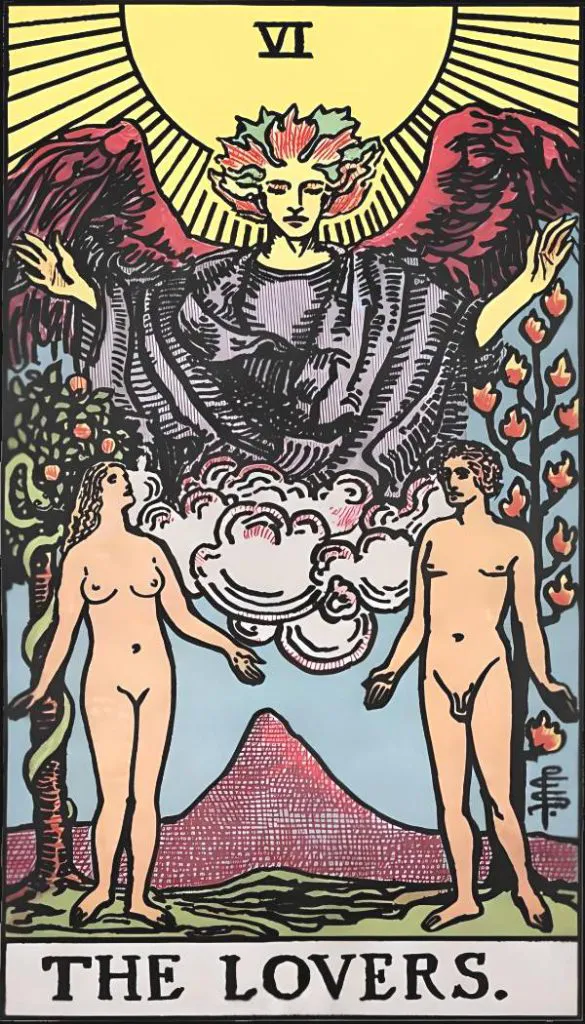
The Lovers Tarot Card Meaning

The Lovers card scene is inspired by the famous biblical story of Adam and Eve in the Garden of Eden, using the first human male and female to express the meaning of lovers and love. Waite uses the "Paradise" to depict "men and women in the world," which is a very special technique. The love between people is also the theme that this card wants to express. The story of the Garden of Eden represents entering the world and the secular realm. Strictly speaking, the choice of love between people is a representative of the secular world, which is also a departure from God. In fact, not only in Christianity, but also in many religions, this is the distinction. The initial human beings did not understand love, and Adam and Eve were just companions, they had to love and serve God together. Until the moment when men and women ate the forbidden fruit and began to understand love, the unique history of mankind was born, and a boundary was drawn with God.

Above the picture, there is a dazzling sun hanging high, which is a scene of light and peace. Under the sun, there is an angel with a pair of purple-red wings and hair like flames on his head. This angel is dressed in purple, representing nobility and loyalty, strong spiritual power, and high-level truth and healing power. The fiery purple wings show spiritual passion. And the flame-like hair represents the vigorous and sharp spiritual power. This angel is opening his hands and pouring down his influence to the people in the garden.

According to the biblical story, this angel is the guardian of the Garden of Eden, named Cherubim, belonging to the rank of cherubim. Cherubim is specialized in guarding sacred objects. In legends, it has four faces and many wings, and sometimes it is described as a spherical shape because it is related to the divine chariot and the holy wheel (related to the imagery of the four living creatures, and connected to these related cards). In the stories of Judaism and Christianity, God sent Adam and Eve out of the Garden of Eden, and in order not to let people eat the fruit of the tree of life again, he sent Cherubim to the Garden of Eden, holding a rotating sword of fire, guarding the tree of life.

In one of the Western esoteric traditions - alchemy, winged figures are often used to represent the unconscious. This winged angel can also be said to be an unconscious created by the thoughts of the two naked men and women on the ground, and they are observed by this unconscious created by themselves. The angel is under the sun and above the clouds, far away and hidden, and the two men and women on the ground seem to be unable to see the existence of the angel. The status of the angel is high, so the connection with the couple on the ground seems to be connected through the clouds, and the appearance of the angel in the clouds is also a way of the angel's appearance.

In this beautiful garden, there is a beautiful and peaceful scene. The protagonist is a man and a woman on the ground. They are not covered with any items, completely naked to each other, just like Adam and Eve when they first had their earthly bodies in heaven. They all open their hands and do not touch each other. However, we must also pay attention to the man's eyes full of worry and hesitation, looking at the woman's face, and the snake that is slowly crawling up behind the woman. The woman has an innocent look, looking up at the angel. Their expressions are not very happy and joyful, and they seem to have doubts and hidden worries.

Behind the man is a tree called "the Tree of Life". There are no leaves on the tree, but there are fruits on each branch. There are a total of twelve fruits on the tree, representing the twelve months of the year and the twelve zodiac signs, corresponding to the biblical Tree of Life, which will bear different fruits every month and have twelve different functions. Twelve is a complete number, loved by ancient peoples, and is also related to the twelve tribes of Judaism. The shape of the fruit is like a flame, and each fruit has three flames on it, representing the three stages of each zodiac sign, which is called decans in astrology, and contains the characteristics of other same-sign zodiac signs in the zodiac interval. There are a total of thirty-six zodiac intervals in the twelve fruits (zodiac signs), which can also be used as a unit of ten days in time, showing thirty-six ten-day periods in a year. This design symbolizes the timeliness, using the twelve zodiac signs to represent the change of seasons.

Behind the woman is this tree, which is the "Tree of the Knowledge of Good and Evil". This tree has dense leaves, and there are apples on it that are rich and fruitful, representing rich sensory ability. There are four fruits on the tree, representing the four elements of the secular world. This tree contains the understanding and knowledge of the material world. God gave Adam and Eve in the Garden of Eden the "Tree of Life", and stipulated that all the fruits in the garden can be eaten, but only the fruit of the "Tree of the Knowledge of Good and Evil" cannot be tried, which is the "forbidden fruit" that God clearly ordered not to eat. However, the invader wants to tempt Eve to eat this fruit, and then instigate Adam to eat the forbidden fruit. The two trees are behind the two people, and they can also symbolize the characteristics and fate of these two people. The tree is a reflection of the person itself, Eve is related to the Tree of the Knowledge of Good and Evil, and Adam is the Tree of Life.

The trunk of the "Tree of the Knowledge of Good and Evil" is entwined by a snake, which is the invader of the Garden of Eden, and it is unknown how to escape the angel's eyes. The snake has entwined many circles, and finally, it lowers its head at the branches and whispers to Eve. For the pagan system, the snake represents the symbol of wisdom, so it is placed on the tree of good and evil, entwining this tree, which is a cultural choice of wisdom. The snake has the meaning of pagans, but it represents the devil relative to the Garden of Eden, and it tempts Adam and Eve to eat the fruit of the tree of knowledge of good and evil, thus staying away from God and leaving the original primitive state. The snake finally tempted Eve to eat the fruit of the tree of good and evil, which means that mankind has made a choice - to stay in the Garden of Eden or to leave the shelter and face the adventurous life.

The inquiry of the identity of the snake is a key, and it is also the crux of the whole card - the positioning of the snake, which is the focus of the choice. The snake represents vitality, desire, and the awakening of self-awareness. The picture where the snake and the angel appear at the same time has a paradox. Who is driving the snake, is it a rebellion of the angel, or is everything in God's plan?

In the center of the ground, there is a protruding mountain peak, like a volcano that is about to erupt, implying a surge of passion. It is also a symbol of the fusion of the left and right men and women, and the fusion of the masculine and feminine. This was not in the Garden of Eden, the mountains in the Garden of Eden were all gentle, perhaps it is going to change the weather - when life is about to have a huge turning point, such a phenomenon will appear.

All the settings and plots are the same as the story of the Garden of Eden, and the story will also be staged like the plot of "Paradise" and "Paradise Lost". In the original script of the story, the angel finally drove Adam and Eve away, but the scene in the picture is still at the stage before temptation, so the subsequent development of this couple may not be the same, and it is unknown.

The Man and Woman

Representing the primal forces of masculine and feminine energy, these figures denote the potential for conscious choices, unity, and the duality of human nature. They are the incarnate form of attraction and desire, indicating the union of opposites and the balancing act of relationships.

The Angel

Hovering above, the angel symbolizes divine guidance and protection. The radiant sun behind the angel indicates blessings from the universe, emphasizing that love is a divine force that transcends our earthly understanding. The angel can also signify the higher self, overseeing the choices we make in our personal relationships.

The Flaming Tree & Serpent

To the man’s side stands a tree aflame, signifying passion, desire, and primal energies. On the woman’s side, a tree entwined by a serpent represents knowledge, temptation, and the Garden of Eden story. Together, they depict the dance between passion and reason, temptation and morality.

The Mountain

In the distance, a mountain rises, pointing towards the spiritual ascent and the challenges we face in relationships. It speaks of the hurdles and growth experiences that lovers must face and overcome together, elevating their bond.

The Clouds

The clouds surrounding the angel signify the unknown and the mysteries of love. They remind us that while we can make choices based on our understanding and intuition, there are always elements in relationships that remain beyond our comprehension, guided by the divine.

The Garden

Beneath the figures of the man and woman lies a verdant garden, symbolizing fertility, growth, and the potential that love brings. This garden is reminiscent of the Garden of Eden, pointing towards the idea of paradise, innocence, and the primal state of being before knowledge brought about conscious choice.

Psychological patterns in The Lovers
Commitment Avoidance
The two figures stand fully exposed yet do not touch, and the man's face carries visible hesitation while the mountain lifts between them like a wedge. The whole card is paused on the edge of consequence, with desire present but not yet translated into an act that closes other possibilities. That is the core of Commitment Avoidance around life direction. Keeping multiple futures half-open can feel like freedom, but the deeper function is often to avoid the grief of choosing one reality and losing the others. The reversed card supports this pattern because its tension lives in the suspended threshold itself: openness stops being spacious and starts becoming a chronic refusal to cross.
Analysis Paralysis
Your eye has nowhere simple to land here. The man's worried gaze, the woman's upward look, the angel in the clouds, the serpent at the tree, and the mountain in the center all compete for attention at once. Even the open space between the figures does not release tension, because the scene keeps redirecting attention instead of resolving it. That visual traffic jam is the structure of Analysis Paralysis. In timing questions, You keep checking instinct, consequences, social feedback, and future risk until no signal feels trustworthy enough to act on. The card shows a mind trying to prevent the wrong move by processing every variable, only to turn the decision window itself into the place where momentum dies.
People-Pleasing
The same open posture becomes precarious when the man's worry is visible, the bodies still do not touch, and the serpent enters from behind the woman's tree. Energy moves sideways and upward instead of forward, so direct preference is displaced by scanning for danger and managing the atmosphere first. In a family system, that mechanism easily turns into People-Pleasing. You feel the pressure cue before you feel your own answer, then soften, agree, or self-edit so the room will not turn against you. The card captures appeasement as a survival reflex disguised as harmony.
Permission Seeking
The woman's face tilts toward the angel, the man's attention goes to her, and the whole scene stacks heaven above human action. That vertical arrangement makes choice feel observed before it is owned, as if the next move must first pass through a higher witness. That is how Permission Seeking operates around timing. You may sense the opening, yet the body does not move until a mentor, partner, algorithm, omen, or inner authority seems to bless it. The card captures a protective strategy that reduces the risk of regret by outsourcing agency, but it also leaves your own timing instinct underused.
Cognitive Dissonance
Two different trees rise behind the couple, and the mountain between them blocks any simple merge. The man's worried face and the woman's upward gaze pull the scene in different directions, so the image holds desire, value, innocence, and consequence together without resolving them. That is the structure of Cognitive Dissonance. In introspective tarot, the pattern shows up when two self-definitions feel true at once and your mind keeps switching courts instead of delivering a verdict. The friction is not proof that you are broken; it is proof that your shadow material has reached a depth where simplification no longer works.
Self-Sabotage
The serpent coils through the fertile tree while the central mountain swells like a turning point that cannot stay theoretical for long. Nothing in the image is chaotic, yet the whole card vibrates with the pressure of a choice that will change the landscape once it is made. That combination is why the card speaks so clearly to the moment just before you interrupt your own momentum. In personal growth, self-sabotage rarely begins as simple destruction. It often enters as a tempting detour, a delay, a rationalized sidestep, or a sudden split in attention right when the next level starts becoming real. The card links that derailment to threshold anxiety: part of you wants the new life, while another part would rather preserve a familiar identity than survive genuine transformation.
Black-and-White Thinking
The card splits itself into stark symbolic camps: one tree speaks of enduring life, the other of knowledge and temptation, while angel and serpent hover over the choice like competing moral narrators. The layout invites the mind to sort reality into sacred versus dangerous, pure versus contaminated. When this pattern takes over, you stop auditing trade-offs and start judging options as if one choice will prove who you are. You may feel clearer for a moment, but the clarity is brittle, because it erases nuance, mixed outcomes, and the third route that only appears once the binary loosens. The card shows how moral polarization can impersonate certainty inside a decision.
Certainty Seeking
The woman's eyes lift to the angel while the sun blazes above the scene, and the figures below remain exposed yet motionless. That vertical pull sends the decision upward, as if clarity has to arrive from a higher source before the bodies on the ground are allowed to move. In you, this can operate as Certainty Seeking. Ambiguity starts to feel unsafe, so you keep waiting for the option that appears unmistakably blessed, clean, or consequence-proof, even when the real issue is that every meaningful choice carries a cost. The card exposes how the need for perfect clarity can quietly become the mechanism that keeps you from choosing at all.
Timing Perfectionism
The two figures stand completely naked in full daylight, yet their hands stay open and separate. The angel above them and the two different trees behind them make even a simple step toward each other feel like something that must satisfy desire, meaning, and consequence at the same time. The whole composition holds a poised pause rather than a completed act. That is the mechanics of Timing Perfectionism. In timing decisions, You do not just wait for an opening; You wait for emotional readiness, moral clarity, external conditions, and inner certainty to all line up at once. The card shows how discernment can become over-ripening, where normal friction gets read as evidence that the season is still not right.
Co-dependency
The figures stand naked and undefended while the space around them is already filled by the angel above, the serpent behind, and the mountain between. Instead of a simple two-person field, the scene shows a bond that is highly permeable, with outside meaning and instinct pressing directly into the connection.\n\nIn friendship, that permeability can turn into Co-dependency. Your time, mood, and self-definition start organizing themselves around what the other person needs, and separation begins to register as disloyal rather than clarifying. The card fits because its intimacy is real, but the container around that intimacy is fragile enough for self-other boundaries to blur.
Core Struggles in The Lovers
Threshold Disorientation
The mountain rises between the figures like pressure gathering in the distance, while the garden still holds the calm of the moment before change. Nothing blocks the figures physically, yet the serpent, the angel, and the divided trees turn the open space into a charged threshold. That is how a career transition can feel before the visible move happens. You may have outgrown a role, industry, or identity, but the next step has not become a map yet; the old paradise is still recognizable, and the new terrain has not given you coordinates.
Relational Boundary Drift
The two naked figures stand in complete visibility, but the space between them remains untouched. Their arms are open enough to signal availability, while their bodies preserve a clear physical gap, so the card does not show fusion as much as a charged boundary waiting to be defined. In a relationship, that visual structure mirrors the moment when openness feels real but the terms of closeness remain unspoken. You may be exposed to each other emotionally, sexually, or energetically, yet the relationship still lacks a shared edge that tells both people what is being entered, protected, or promised. The Lovers holds this struggle as a boundary field rather than a simple romance scene. It names the drift that happens when attraction, vulnerability, and possibility expand faster than the relationship's capacity to define mutual responsibility.
Belonging-Authenticity Split
The two figures stand naked in the same garden, open to each other but not touching. Their bodies are visible without armor, yet their attention is divided between human presence, higher guidance, and the separate symbolic trees behind them. That visual split gives social belonging a precise shape: contact is available, but full alignment is not guaranteed. You may be inside the room, the group chat, the network, or the circle, while still feeling the cost of becoming acceptable to it. The Lovers holds this tension as a choice between being seen and being absorbed. In social life, the card names the moment when connection asks for openness, but your deeper self is still checking whether the belonging being offered can hold the truth of who you are.
Autonomy Guilt Bind
The two naked figures stand in a garden built for union, yet their hands never meet. The man looks toward the woman, the woman looks upward, and the angel holds the highest point of the scene, so choice is visibly routed through attachment and authority at the same time. In a family system, that same geometry becomes the pressure of trying to choose your own life while still feeling exposed to parental judgment, loyalty guilt, and the fear of being cast outside the safe garden. The card locates the struggle in the space between the open body and the withheld step: autonomy is available, but every move seems to carry the cost of belonging.
Readiness Loop
The figures stand naked in a charged pause, surrounded by signs that should matter: the angel above, the serpent at the tree, the fruit within reach, the mountain rising in the distance. Yet the scene contains no step, no contact, and no visible conversion of signal into movement. Readiness Loop takes shape when preparation keeps producing more preparation. You may keep waiting for the final internal click, the unmistakable sign, or the perfectly aligned condition, while the actual threshold remains suspended in front of you. The reversed Lovers does not show emptiness; it shows a field too saturated with meaning to become action. The struggle is the exhausting belief that readiness must feel complete before the timing can be trusted.
Performative Intimacy
The figures are naked and open, but the openness stops at display. No body moves into touch, and the angelic frame above them can make the scene appear whole even while the actual contact between the two people remains incomplete. In a relationship, that structure can feel like intimacy because the symbols are all present: vulnerability, attraction, meaning, confession, chemistry, even a sense of fate. Yet the bridge of reliable response is missing, so closeness becomes something performed in atmosphere rather than proven through repair, consistency, and mutual reach. The reversed Lovers names this as a functional gap inside the image of connection. It witnesses the exhaustion of being surrounded by signs of intimacy while the relationship itself keeps avoiding the concrete exchange that would make intimacy real.
Resource Integration Strain
Two trees stand behind two separate bodies, each carrying a different resource system. One side holds flame and life-force, the other holds fruit, knowledge, and the serpent, while the center of the card remains open but unbridged. A modern life can become organized in the same separated way. Work, sleep, health, home care, social energy, and desire may all exist, but they fail to feed one another because no shared architecture connects their demands. The strain is not caused by having too little. The card shows the heavier problem of having real resources distributed across disconnected zones, forcing you to keep translating between life parts that should be able to support one another.
Intuition-Reality Split
The man's gaze moves toward the woman, while the woman's gaze rises past him toward the angel. The relationship field is therefore not a closed circuit between two people; it is split between human attention, higher meaning, and the charged presence of the serpent beside the fruit tree. That split is the physical grammar of a love situation where lived signals and inner knowing refuse to line up. You may be reading texts, tone, chemistry, and behavior while another part of you keeps looking upward for a sign that the relationship means what you hope it means. The Lovers makes this conflict visible through divided sight lines. It shows a bond where reality is not absent and intuition is not false, but the two are operating from different reference systems, leaving the heart unable to decide which signal is the actual ground.
Binary Choice Lock
Two trees stand behind the figures like two complete worlds, not two small options. The garden appears open, yet the serpent, the angel, and the distant mountain turn the space into a threshold where any movement carries consequence. That is the shape of a career fork that has become too symbolic to choose cleanly. You may be deciding between staying and leaving, promotion and freedom, prestige and alignment, but the bind comes from the way the choice has been compressed into a verdict on your future self.
Emotional Withholding Tension
The man's attention reaches toward the woman, but her gaze moves upward into the angelic field. The emotional current does not travel back across the space between them; it is redirected into another axis, leaving one line of longing unanswered inside the picture. That is how withholding often feels in love: not necessarily cold, not necessarily empty, but suspended. You may sense feeling in the room, yet the decisive response keeps moving somewhere else, toward timing, ideals, fear, interpretation, or a private inner authority that never quite meets you. The reversed Lovers makes the blockage visible through misaligned gaze. It names the tension of affection that exists without arrival, where the heart keeps waiting for a signal that remains present enough to hope for and absent enough to destabilize trust.
Inner Emotions in The Lovers
Grounded Agency
The upright bodies, the central mountain, and the clear vertical line from garden to sky give the scene a composed architecture. The figures are exposed, but they are not falling apart; the landscape gives their choice a visible axis and a place to stand. Grounded Agency grows from that combination of openness and structure. In a career context, it is the felt sense that you can choose without surrendering your center to panic, hierarchy, or other people's expectations. The next move may still matter deeply, but it no longer feels like a random lurch through pressure. The Lovers anchors this emotion in conscious alignment. You can feel the difference between reacting to a workplace demand and selecting a path because it matches your values, skills, and long-term direction. The card's stillness becomes a mirror for the kind of clarity that is quiet, embodied, and self-owned.
Courageous Vulnerability
Two uncovered figures stand in the open garden with their arms unguarded, separated from each other yet fully visible under the same bright sky. Nothing in the scene functions as armor: no clothing, tools, walls, or professional mask interrupts the body's direct exposure to the moment of choice. That visual openness gives Courageous Vulnerability its emotional shape. In career life, the same inner weather appears when you stop hiding your ambition behind competence and let your real standards be seen. You may still feel the charge of exposure, but the structure holds that exposure inside a clear field rather than letting it collapse into self-protection. The Lovers does not make vulnerability passive. The two figures remain upright, distinct, and present, which turns being seen into an act of agency. For you, this emotion names the moment when visibility at work becomes risky but clarifying: a promotion conversation, leadership transition, or honest career choice asks you to show what you want before the outcome has been secured.
Relational Anxiety
The man's gaze moves toward the woman while her gaze rises past him, and the serpent coils behind her tree outside the direct line of contact. The scene is beautiful, but the attention lines do not meet, leaving the connection exposed to unanswered signals. That split focus is the emotional logic of Relational Anxiety in love. You are not reacting to one isolated detail; the whole relational field feels slightly unconfirmed, so small silences, delays, or shifts in tone can begin to carry too much meaning.
Mutuality Hunger
The man looks toward the woman, the woman looks upward, and the open space between them remains untouched. Their bodies share the same garden, but their attention is distributed across different centers. That asymmetry is the root of Mutuality Hunger. In love, you may not be asking for intensity; you may be aching for the simple evidence that both people are emotionally facing the relationship at the same time.
Decision Dread
Two uncovered figures stand in the garden with open hands, close enough to belong to the same scene yet separated by a small but charged distance. Their bodies do not show battle or escape; they show exposure in the exact moment before a choice becomes embodied. The split gaze gives the card its pressure. One figure looks toward the human other, while the other looks upward toward the winged presence above the clouds, creating a triangle of attention where desire, conscience, and consequence all occupy the same frame. That is why Decision Dread belongs here. The card does not make the decision look simple; it makes it visible as a threshold where choosing one path means allowing a previous state of innocence, neutrality, or delay to end. You are not only afraid of the option itself, but of the version of yourself that will become real once you choose.
Boundary Guilt
The two figures stand close enough to be vulnerable, but their hands do not meet, and the space between them remains visible. Above them, the angelic figure and the high sun make the private act of choosing feel witnessed by something larger than the couple. Inside a family system, that visible gap becomes the emotional charge around saying no, stepping back, or refusing a role that used to be automatic. Boundary Guilt forms when your body reads separation as danger, even while your clearer self can see that distance is the only way to keep the relationship honest.
Knowledge Anxiety
The Tree of Knowledge stands heavy with fruit, and the serpent’s body wraps the trunk in a slow, concentrated motion. Knowledge is not shown as a clean download; it is textured, embodied, tempting, and already tangled with consequence. In study, that image becomes the uneasy charge that appears when every paper, lecture, or theory expands the size of what you do not know. Knowledge Anxiety is the feeling that learning is making you more exposed rather than more secure, as if each new insight also raises the standard by which your work can be judged.
Permission Anxiety
Under the high angel and blazing sun, the uncovered bodies stand in a garden where desire and restriction occupy the same frame. The figures are visible from above, exposed before the choice has even been spoken. Permission Anxiety forms when a personal direction starts to feel like it needs clearance from something outside you. In a direction reading, this card mirrors the tension of wanting a life that is truly yours while still feeling monitored by invisible standards of acceptability.
Desire Anxiety
The two figures stand close enough for attraction to be visible, yet there is no touch, no completed movement, and no physical resolution. Around them, fruit, bare skin, and the coiled serpent gather appetite into the scene while the garden keeps that charge contained. For personal growth, this becomes the anxious intensity of wanting a future self so clearly that the wanting starts to tighten around the action. You can feel the pull toward visibility, mastery, creativity, or expansion, but the charged space before commitment makes the next move feel heavier than it needs to be. Desire Anxiety belongs to The Lovers because the card shows desire as a threshold, not a distraction. The emotional work is to see the wanting clearly enough that it becomes information, rather than letting its intensity convince you that growth must be delayed until the body feels completely calm.
Analysis Paralysis
The Lovers is built from divided reference points: two figures, two trees, a serpent winding through one side, and an overhead presence that neither figure physically touches. The eyes do not settle into one shared line, so the image holds multiple interpretations at once. In reversal, that multiplicity hardens into a loop. The coiling serpent becomes a perfect image for thought circling the same branch again and again, while the separate trees turn each option into its own self-contained argument with its own cost, promise, and hidden implication. Analysis Paralysis belongs to this card when the decision has become over-symbolized. You are no longer comparing options; you are trapped inside the meaning of comparing, trying to solve the entire future before allowing one grounded move to exist.
Outer Contexts in The Lovers
Ignored Red Flags
The serpent is visible in the image, coiled beside the fruit-bearing tree, yet the human attention does not gather around it. One figure looks across, the other looks upward, and the warning sits in the side channel of the scene. Ignored Red Flags fits when external cues are already present but the social field keeps attention elsewhere: chemistry, approval, potential, or the wish for a cleaner story. The card does not make the warning dramatic; it shows how ordinary misdirection can be enough. For introspection work, this context matters because the blind spot is not purely internal. The situation is supplying mixed signals, and the task is to separate what is actually being shown from what the surrounding narrative encourages you to excuse.
Decision Cliff Edge
The mountain at the center rises like a point of no easy return, and the figures stand exposed beneath a watching presence in a garden organized by visible rules. The scene holds the exact moment before a choice becomes lived reality. This is why The Lovers connects so directly to a decision cliff edge. The pressure comes from knowing that the situation can no longer remain abstract; choosing, delaying, or refusing will all create consequences. The card turns that pressure into a visible threshold rather than a vague dread around change. You are not being shown a random fork in the road. You are being shown the moment where the structure asks for authorship, where the next move changes the terms of belonging, identity, or future direction.
Third Path Search
The scene offers two trees, two human figures, and a mountain rising between them, but the composition is not a simple left-or-right map. The central peak creates another axis: upward, harder, and not fully marked by either side. In academic life, that visual structure fits the search for a route outside the obvious program, degree, or grad-school script. You may be comparing options that both feel incomplete because the real question is whether a third structure can be built from the values each option only partially holds. The card does not flatten the choice into preference. It frames the search as a threshold where intellectual direction, institutional rules, and personal alignment have to be reorganized into a path you can actually study inside.
Premature Launch Pressure
The serpent and fruit sit inside an abundant garden, but the scene is paused before the choice has been integrated. The bodies are exposed, the resource is visible, and the mountain beyond the pair suggests that one quick action can open a much harder stage. For timing, this is the pressure to launch before the conditions have ripened. An opportunity may look available, but the card shows that access, readiness, and consequence are not the same thing. The reversed Lovers gives this context its edge because the problem is not lack of desire. The problem is a field where visible possibility is being mistaken for durable timing.
Situationship Ambiguity
The bodies are visible and vulnerable, but the space between them remains unsealed. Nothing in the scene confirms whether the connection is a promise, a possibility, or a charged moment that has not been given a name. That suspended quality is the core of situationship ambiguity. The relationship can contain intimacy, attraction, and repeated access while still avoiding the shared language that would create accountability. The mountain in the center marks the next threshold, but the figures have not moved toward it together. You are being shown a bond where emotional exposure has outpaced definition, leaving the relationship active enough to matter and undefined enough to destabilize you.
Commitment Cliff Edge
The mountain rises directly between the two figures like a threshold the garden can no longer hide. The scene is still calm, but the structure has already gathered around a decision point. That is the outer pressure of a commitment cliff edge. The relationship has reached a place where avoiding definition, escalation, repair, or exit no longer keeps things neutral; it becomes the very condition that creates strain. The Lovers makes the choice visible without forcing a single answer. You are being shown the point where intimacy requires structure, and where continued suspension starts costing more than the conversation, decision, or boundary that has been delayed.
Ignored Social Red Flags
The serpent is plainly present in the garden, but the figures' attention does not settle on it. The warning is not absent; it is displaced by the larger relationship field around it. That is the structure of ignored social red flags in friendship. The friend may show jealousy, boundary testing, secrecy, competitiveness, or selective warmth, yet the bond's history makes those signals easier to explain away than confront. The protected garden makes the red flag more serious, not less. When something off enters a trusted space, the cost is not only discomfort; it is the slow distortion of what you allow in the name of keeping the friendship intact.
Premature Major Commitment
The figures stand uncovered at the exact moment before contact, fruit, and consequence fully enter the body. The scene is suspended at the threshold where a choice looks meaningful before the lived workload has arrived. In academic life, that becomes a major, program, thesis direction, or postgraduate track selected before enough evidence has been gathered. The serpent near the fruit marks the pull of an option that appears vivid and immediate, while the mountain shows the long climb that follows after the decision is declared. The card makes the cost visible without shaming the choice. It shows a commitment point where prestige, pressure, curiosity, and fear of delay can crowd out a slower assessment of fit.
Friendship Boundary Creep
The uncovered bodies, bright overhead light, and lack of walls make privacy almost impossible to hide inside the scene. Openness is visually intense, but the card gives no practical barrier that says where access stops. That pressure maps cleanly onto friendship boundary creep. A friend may treat emotional closeness as automatic permission: constant texts, assumed disclosure, entitlement to updates, or quiet resentment when you are not available on demand. The serpent's side-channel sharpens the issue because boundary creep often arrives through soft language rather than open conflict. The card shows how a friendship can look intimate while slowly training one person to give more access than they consciously agreed to give.
Off-Script Family Path
The garden is safe, fertile, and ordered, but the mountain rising between the figures points beyond that protected scene. The human bodies are centered on the ground rather than absorbed into the trees behind them. The Lovers frames adulthood as a threshold where the prepared environment no longer answers every question. For family life, this becomes the moment when the inherited path stops fitting the shape of the person living it. You may be choosing a different partner, city, career rhythm, household model, or timeline than the one relatives silently built around you. The card does not make the off-script route reckless. It shows that leaving the prepared script can be the first visible act of alignment, especially when family comfort has been exchanged for compliance for too long.