The Hermit Tarot Card Meaning

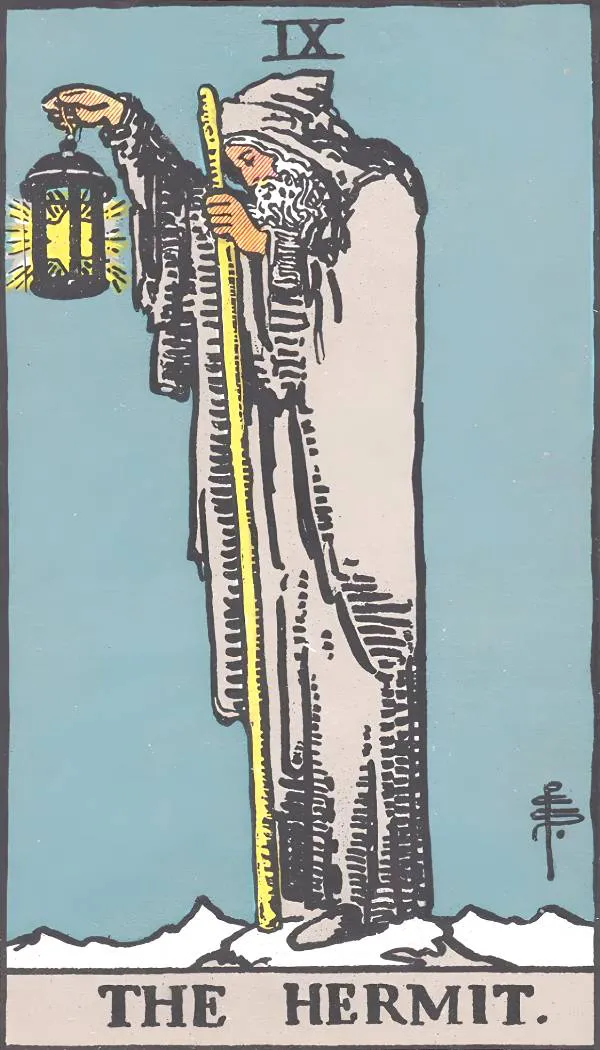
At the summit of the ice field, in a dimly lit landscape, a mysterious elder can be faintly seen from a glimmer of light. This old man standing on the high ridge is no ordinary elder. Although he is dressed in dim attire, his posture and the light in his hand reveal his extraordinary nature. It is from the lamp held by the old man that the light radiates, illuminating the entire night sky, which is devoid of any moon or stars.

The elder in the image stands alone, dressed in a gray robe that covers his head. This signifies a sense of isolation from the world, also deepening the sense of concealment and mystery. His aged face and the thick white beard reveal his age and the trials of time, yet also show his composure and certainty. His beard droops, covering his chest, representing the closure of speech and expression, hinting that this hermit is not very talkative and does not wish to widely publicize himself.

This hermit is an alchemist, possessing great power, adept at using advanced magic, and is of an older age. The Magician has missions, the alchemist is a scholar, a researcher. The Magician may have faults, but the alchemist is well-learned and knows no bounds. The Magician has the impulsiveness of youth, the hermit is not impulsive, having accumulated personal views and insights, possessing personal wisdom, with mystical experiences, peak experiences, capable of communicating with mysterious forces. As an alchemist, the goal is to study the principles of the mysterious and enter the world of the mysterious.

The ideals are broader and more fundamental, and the power exerted is formidable.

The hermit's talents are personal insights and experiences, more than being taught, and are self-cultivated. He has no affiliation with any organization or institution, unlike the Hierophant (without subordinates), without tasks from above (the High Priestess), and unlike the Magician, who serves the world. The hermit has talents that transcend the secular and mystical abilities, yet still has secular and practical power, which he does not use. All of this is hidden, making him the most secretive of all the cards.

This hermit holds a lamp in one hand and a staff in the other, standing alone on the mountaintop. His posture is stiff, holding a lamp, standing on the icy summit, in a cold world, too aloof, looking at the world from a high place where the cold is unbearable. The hermit's stiff posture, standing alone, as if seeing time, indicates his stubborn mindset, unwilling to change his stance, showing a calm and stable determination.

The hermit's right hand is raised high, holding a lamp, which is not an ordinary oil lamp, but one lit from the hermit's heart. The lamp represents the hermit's cultivation. The light inside the lamp is in the form of a six-pointed star. The six-pointed star is an esoteric symbol, representing the light of wisdom and hope. It is a combination of material and spiritual, yin and yang principles, and also the four elements that make up all things. The six-pointed star is a system of elemental combination, also representing all complete elements. In alchemy, it is the cultivation of gold, a result of cultivation. The six-pointed star represents the search for truth and also has a subtle wish to save the world.

And this lamp containing the light of stars is raised with the right hand parallel to the heart, also connected with the line of sight of the bowed head, which is equivalent to the starlight, heart, and brain being connected as one, the three being connected and circulating in place of each other. This lamp is actually equivalent to the hermit's avatar and soul, possessing the energy it imparts.

The staff supported by the hermit's left hand is actually a special staff used by ancient alchemists, capable of casting spells. This kind of staff can usually transform into a snake, or it can summon snakes. If we observe carefully, we will find that this hermit is actually standing on an independent, elevated stone slab, and the staff is also placed here, his power is enough to subdue everything in the world. The hermit can touch the ground with his staff, indicating that his ability is sufficient to control the practical side, to contact the reality, to probe the news. (Capable of handling worldly affairs with the staff) This can also be seen as a kind of language, representing silent transmission and communication. Although this staff is inconspicuous, it has vitality and magical power. Energy is born from the ground, guided and circulated upwards.

The hermit lowers his head and closes his eyes in deep thought, what is he worrying about? A hermit should have no worries, no secular duties to tie him down. However, the deep furrows of his brow reveal what he is concerned about, and why does he hold up a lamp in the wilderness at midnight? He is not worried about his own affairs, but is lamenting the ignorance of the world, worrying about the common people. This bright lamp is also a call, attracting the hearts of those with ambition, or the appreciation of wise monarchs and virtuous lords, or the pursuit of like-minded people. However, he does not wish to call through education or propaganda, he is no longer willing to express himself, too lazy to argue with the world, only passing on the mysterious and profound message with the lamp, becoming only a passerby for those who are predestined and those who are knowledgeable, creating a high-style aloof way, everything is implied in silence...

The hermit stands alone on the peak, surrounded by an ice field and frozen peaks. It is a dark night, the sky is very cold and desolate, symbolizing the inner state and the real environment, both are very bleak. This card has a lot in common with the Fool, in that the main character is standing on a cliff. The Fool is in a very happy state, the hermit is in a more melancholic state, but both are in a high position, in a peak experience, and may fall at the next moment.

The overall tone of the picture is dark, and the hermit standing on the frozen plateau is revealed in the hazy, overlooking the whole world from a high place, holding a lantern containing a lot of truth, which is a special light. He can attract those who are knowledgeable, guide the change of the world and the change of people's hearts. The overall composition is biased towards a direction, the back of the hermit is a blank background, the front he faces implies the direction he yearns for.

The Lantern

At the forefront of The Hermit card, the lantern represents guidance and enlightenment. The Hermit, in his wisdom, holds this lantern out to illuminate the darkness, showing the way for others. This symbol speaks to the idea of wisdom being a guiding light, offering clarity to those who seek it.

Star in the Lantern

Inside the lantern, a six-pointed star shines brightly. This star, often associated with the Seal of Solomon, represents the balance of opposites and the union of the spiritual and material worlds. It’s a symbol of inner wisdom and the spiritual guidance that The Hermit possesses and shares.

The Staff

The Hermit leans on a staff, often interpreted as the staff of authority or of the patriarchs. This staff symbolizes The Hermit’s power and strength, but not in a worldly sense. It is the strength derived from truth, wisdom, and experience. The staff also supports The Hermit in his journey, indicating that wisdom and truth provide support during solitary quests.

Snow-Capped Mountains

The backdrop of The Hermit card is a range of snow-capped mountains, representing challenges, obstacles, and also spiritual elevation. The Hermit stands at the peak, suggesting that after introspection and seeking inner truth, one can attain great spiritual heights. The snowy peaks also symbolize isolation and purity.

Cloak of Solitude

The Hermit is draped in a gray cloak, symbolizing invisibility, a sense of being unnoticed, and also neutrality. This cloak protects him from the external environment and distractions, allowing him to focus inward. It signifies The Hermit’s withdrawal from the outside world in pursuit of inner wisdom and understanding.

Psychological patterns in The Hermit
Emotional Cutoff
The same distance that protects the Hermit can become absolute in the ice field: no warmth, no witness, no visible bridge back from the ledge. The landscape is so stripped down that separation itself starts to feel like the only reliable form of order. That is how Emotional Cutoff appears here. You may stay upright, articulate, and observant while quietly severing contact with the vulnerable layer underneath. During self-reflection, this looks like being able to describe your inner world with precision while remaining untouched by the feeling that needs to be metabolized.
Hyper-Independence
The Hermit stands alone on the ridge with his lantern in one hand and his staff in the other, wrapped so completely in his cloak that no part of his body reaches outward. That closed perimeter turns self-containment into visible strategy. You can see a figure who trusts what he can carry, verify, and stabilize alone more than anything that might come from the crowd below. In work life, that geometry often becomes Hyper-Independence. Competence becomes the staff, privacy becomes the cloak, and the lantern only illuminates what you can personally control. The pattern protects you from being underestimated or disappointed, but it also keeps mentorship, delegation, and political support outside your field of trust, which is exactly how capable people end up carrying more while advancing less.
Analysis Paralysis
The same lantern that can guide the path can also trap the eye when it never leaves the same patch of ground. On the cold ridge, the body stays rigid, the staff holds position, and the darkness outside the lantern grows more absolute. Instead of supporting movement, the scene begins to look like attention locked inside too small a frame. That is the inner mechanics of Analysis Paralysis under career pressure. Feedback, options, and strategic decisions keep getting processed, compared, and refined until reflection starts consuming the energy required for action. You are not failing to think; you are stuck in a loop where thinking keeps promising relief but only makes the next step feel more loaded.
Certainty Seeking
The lantern is the only light in a starless landscape, and it reveals just enough ground for the next careful step. The Hermit's eyes are lowered toward that narrow circle rather than the whole mountain range. The image makes limited certainty feel precious, and it builds trust around what has been directly inspected rather than what is merely possible. That visual logic maps cleanly onto Certainty Seeking in work life. You may keep waiting for the role, pivot, or promotion path to feel fully validated before you move. The pattern is not laziness; it is a private rule that says action only becomes legitimate when enough unknowns have been removed, even though careers rarely offer that kind of clean light.
Timing Perfectionism
The Hermit stands rigid on ice, lamp lifted and staff planted, as if movement has been suspended until the terrain can be morally certified. The six-pointed star inside the lantern turns guidance into an exacting inner standard, while the frozen negative space makes friction feel louder than possibility. You feel this as Timing Perfectionism when real-world seasonality gets filtered through a flawless internal threshold. Instead of asking whether the next step is workable, the pattern keeps asking whether the window is clean, elegant, and uncontested. That is why delays can feel wise even when they are quietly becoming the main force keeping life on pause.
Emotional Gatekeeping
The lantern is lifted close to the Hermit's line of sight, lighting only a small controlled circle while the rest of the landscape remains untouched. His hood, lowered head, and covered body create a visual system of selective access: nothing spills, nothing broadcasts, and even insight is rationed rather than poured out. That is the logic of Emotional Gatekeeping. You may let yourself approach feeling, but only through a narrow passage where exposure can be measured and contained. In introspective work, this often looks like understanding your emotions from a safe distance while delaying the unfiltered contact that would make them fully real.
Spiritual Bypassing
The star burns inside the lantern high above the ice while the staff that could touch the ground remains secondary and restrained. The whole card lifts truth upward into symbol, elevation, and purity, making earthly friction feel distant and almost beneath the main task. That arrangement is how Spiritual Bypassing forms in personal growth. You keep reaching for meaning, transcendence, or inner revelation when change becomes messy, repetitive, and measurable. The pattern preserves a sense of depth and specialness, but it can leave your actual habits untouched by the very wisdom you keep collecting.
Self-Sabotage
The Hermit stands on a cold, narrow summit where one careful step matters, yet his posture is so rigid that balance depends on not moving. The darkness around him and the drop beneath him turn caution into a full-body strategy, making stillness look safer than momentum. That is the psychology of Self-Sabotage in personal growth. When the next step could make your progress real, your system answers with delay, overcomplication, or withdrawal so the result never has to be tested. You are not simply failing to act; you are using friction to protect yourself from the exposure that comes with visible change.
Avoidance Coping
The Hermit pauses on the ridge instead of moving through it, holding his light in place while the surrounding darkness stays untouched. The posture suggests observation without approach, as if thinking can replace contact for a little longer. In love, that becomes the familiar move of retreating into space, solitude, or private processing whenever the conversation starts to feel exposing. The high stone footing and cold negative space make engagement look risky, because one wrong step seems able to disturb the entire balance. That is why this card points to avoidance coping rather than healthy reflection: solitude is being used to lower emotional intensity without resolving the bond. The relationship stays suspended while the inner rehearsal keeps running.
Imposter Syndrome
The hood shadows his face, the grey robe mutes his presence, and even the light he carries is partly veiled inside glass. The card shows real guidance in his hand, yet his posture folds downward instead of outward, as if visibility itself must be rationed. That tension becomes Imposter Syndrome when applied to personal growth. You may carry real insight, skill, or hard-won change, but the system keeps hiding the evidence from your own self-recognition. Each time you reach a new level, legitimacy moves further away, so your growth feels borrowed or premature instead of embodied.
Core Struggles in The Hermit
Threshold Disorientation
The Hermit stands on a snowy summit with no visible road beyond the ridge. The lantern extends forward, but its beam is small compared with the dark field around him, so arrival and orientation are not the same physical event. Threshold Disorientation appears when an old route has carried you somewhere real, yet the next route refuses to appear as a clean continuation. You may have reached a milestone, aged into a new life phase, or outgrown a goal, but the card gives form to the moment when perspective expands faster than your usable path.
Belonging-Authenticity Split
A warm light is visible in the Hermit's hand, but the figure remains wrapped, elevated, and physically unreachable. The card does not show total disappearance; it shows a controlled signal of selfhood held at a distance from the wider field. That visual tension maps cleanly onto the social split between being real and being included. You can sense that your truest signal survives when it is protected, yet the circles you want access to may seem to demand easier warmth, faster disclosure, or a more performative version of you. The struggle is the pressure to choose between belonging and keeping your actual outline intact.
Readiness Loop
The Hermit's staff belongs to a journey, yet it is pressed into the snow as the body stops at the summit. The lantern stays alive in the cold, but the figure does not descend; the image holds preparation, attention, and suspension in the same narrow frame. Readiness Loop appears when preparation keeps proving itself by generating more preparation. You may keep seeking one more signal, one more confirmation, one more inner alignment point, while the actual timing threshold remains untested. The card gives that loop a physical boundary. The light is not false, and the pause is not empty, but the structure shows how a necessary incubation phase can become self-sealing when every sign of wisdom is used to postpone contact with the next step.
Inner Compass Overload
The star inside the lantern, the bowed head, and the hand held near the heart create a closed circuit of light. With the outer sky blank, the entire navigation system is forced into one small object. In career decisions, that structure becomes the burden of having to generate direction, meaning, and certainty from within when external markers are not trustworthy enough. You may be weighing role changes, skill bets, or leadership moves as if each choice has to prove your entire purpose. The card names the overload of an inner compass carrying too much of the map. Its light is real, but the pressure increases when it has to replace feedback, community, timing, and practical coordinates all at once.
Knowledge-Output Gap
The lantern is raised into the dark, but the figure's mouth is hidden behind the beard and the body remains sealed inside the grey cloak. Light exists in the scene, yet its path into shared language is narrow and filtered. In a career field, that becomes the shape of insight that is real but hard to convert into proof. You may understand the system, see the next strategic move, or hold knowledge others need, while the promotion machinery still asks for visible output, stakeholder narratives, and repeatable evidence. The card links this struggle to the distance between inner clarity and public legibility. Your value is not absent; it is trapped at the point where private wisdom has to become recognized career currency.
Emotional Secrecy Spiral
The lantern is bright enough to be noticed, but it remains sealed behind glass, carried by a figure whose face and voice are largely hidden. Light is present, yet the path from inner source to relational exchange is restricted. In a romantic relationship, this reversed structure shows secrecy becoming self-reinforcing. A partial signal may prevent total disappearance, but it can also disguise how much has been withheld, making each later truth feel harder to release. The card gives shape to the spiral by showing how concealment can keep functioning while appearing meaningful from the outside. You are not looking at an absence of emotion; you are looking at emotion trapped in a private container that keeps replacing conversation.
Internal Authority Collapse
The night contains no shared lights beyond the Hermit's lantern, and the staff supplies only a private vertical axis against the ice. When that small system has to carry every decision, the scene loses any stable outer horizon. Internal Authority Collapse appears when neither outside expectations nor inner signals feel trustworthy enough to steer by. The card names the crisis of reference itself: you are not merely choosing between paths, you are trying to recover the instrument that tells you what a real path is.
Boundary Rigidity
The staff, cloak, and high ridge form a self-supporting column, but the same structure can harden into a position that cannot easily be approached. The figure remains upright because the boundary is doing real work; it is holding the body together in a cold and exposed field. Inside a social ecosystem, that kind of boundary can stop functioning as a filter and start functioning as a wall. You may experience invitations, new friends, or group closeness as pressure against a perimeter that has become load-bearing. The card names the exact strain: the protection is valid, but its rigidity can make every possible connection feel like a threat to stability.
Observer-Self Split
The lantern is visible before the person is fully visible. The cloak, lowered head, and surrounding night make the Hermit appear as both the source of light and a body withdrawing from the field that light opens. In personal growth, this reversed structure can turn self-awareness into an observation post. You may become precise at watching your patterns, naming your beliefs, and tracking your inner weather, while the living self stays behind the cloak, untouched by the insight it produces. The card does not treat reflection as false. It shows the strain that appears when the observing part becomes overdeveloped and the embodied part remains under-contacted, leaving you able to study your life without fully entering it.
Shadow Integration Strain
The lantern stays close to the bowed head, and the mountain keeps the figure apart from the ordinary world below. Light is present, but the circuit is narrow: head, lamp, frozen ground, and back again. In reversed Hermit territory, shadow material can be repeatedly seen without being integrated. You may recognize the harsh inner critic, the old shame reflex, or the projection pattern, yet the recognition loops inside the same isolated chamber instead of entering a wider life. Shadow Integration Strain is the friction between exposure and absorption. The card shows the hidden material near the light, but not yet warmed, shared, or embodied enough to become part of a more livable self.
Inner Emotions in The Hermit
Existential Vertigo
The high ridge, the empty night sky, and the small lantern place the figure above ordinary landmarks while giving him no broad map to follow. The height creates perspective, but it also removes the comfort of familiar ground. In a direction question, that height becomes emotionally unstable when the future expands faster than meaning can organize it. You may be able to see how large your life is, how many routes exist, and how little certainty any of them can offer from this vantage point. Existential Vertigo names the dizzying inner weather of standing above your old map and realizing it no longer gives you balance. The card does not erase the height; it helps you locate the lantern, the staff, and the next small radius of clarity inside it.
Unspoken Grief
The Hermit's head is bowed, his beard covers the chest, and the lantern speaks more than the mouth does. Around him, the dark sky and frozen ground hold everything in a silence that has weight but no outlet. In love, Unspoken Grief gathers when something has been lost before it has been fully admitted. It may be the version of the relationship you hoped for, the softness that disappeared, or the conversation that never became safe enough to have. The card links this grief to withheld expression. The feeling does not need to become a dramatic confession to be real; it already exists in the lowered gaze, the protected chest, and the quiet light carried through emotional cold.
Leadership Loneliness
The Hermit stands above the landscape with no companion beside him, his cloak closing the body into a single vertical shape. The height gives perspective, but it also removes the warmth of shared footing. Career leadership can create the same emotional geometry. The more you are expected to hold judgment, strategy, expertise, or authority, the less casual honesty may feel available; every reaction starts to carry consequence, and every uncertainty has to be filtered before it is shown. Leadership Loneliness belongs to this card because the summit is both an achievement point and an isolating position. You may have earned the view, but the card reveals the cost of standing where fewer people can meet you without wanting something from your light.
Belonging Ambivalence
The gray-cloaked figure stands apart on the icy summit, holding a lantern outward while keeping his face lowered into the hood. The body is present to the world, but the eyes and mouth stay inside a private circuit of light, creating a social signal that reaches out without fully opening the self. That visual structure mirrors the split inside Belonging Ambivalence. You may want a place in the group, but only if the contact has enough depth, rhythm and space to keep your inner signal intact. Around friends, communities or wider social circles, this card names the moment when shallow inclusion starts to feel more invasive than comforting. The lantern does not reject connection; it asks connection to meet you without swallowing the protected center that makes you feel real.
Profound Loneliness
The solitary figure is surrounded by ice, blank sky, and a ridge with no nearby witness. Even the lantern, meant to be seen, is held inside a vast field that does not answer back. Profound Loneliness emerges when independence stops feeling spacious and starts feeling unreachable. In lifestyle terms, the quiet apartment, minimal schedule, and self-managed day may look clean from the outside, while inside they create the sense that no one can locate you where you actually are.
Intellectual Loneliness
The lantern’s small, exact light meets the Hermit’s lowered gaze while the rest of the landscape remains cold and distant. The figure has vision, but no visible companion inside that vision; insight becomes a summit experience, elevated and isolating at the same time. In family dynamics, Intellectual Loneliness appears when You can map the emotional pattern with painful precision while everyone else insists it is normal. The card’s height reflects that strange separation: understanding gives You perspective, but it can also move You out of easy belonging. The Hermit does not make insight glamorous here. It shows the private ache of being the one who can name the system before the system is ready to hear its own name.
Liminal Stillness
The summit gives The Hermit a wide view, but the card does not show the road down. His staff is grounded, his body is paused, and the lantern illuminates only the immediate field of attention. In love, Liminal Stillness describes the relationship moment when something has shifted but nothing has been formally decided. The bond may be between repair and ending, closeness and distance, clarity and delay. The card gives that pause dignity without romanticizing it. Stillness becomes the container where the next emotional truth can become visible, instead of another space to be filled with panic, pressure, or premature closure.
Quiet Knowing
The lantern held at heart height, the lowered gaze and the staff planted into stone form a closed circuit of perception. Light, body and ground align before the figure says anything, so clarity arrives as a contained signal rather than a performance. Quiet Knowing grows from that exact arrangement. In social spaces, you may register who feels aligned, who drains the room and which circles no longer match your pace before you can explain it in language. The card gives that private read a stable shape. It does not need approval from the group to become valid; it only needs enough silence for the signal to separate itself from social noise.
Solitary Clarity
The lantern held before the Hermit's lowered face turns attention into a narrow beam rather than a public performance. Its light does not flood the whole mountain; it isolates what can be seen clearly enough to navigate by. In career terms, this matches the moment when distance from the workplace noise becomes useful rather than merely lonely. You are not trying to win the room through volume, charisma, or constant availability; you are separating signal from status theater, hidden incentives, and other people's urgency. Solitary Clarity names the private steadiness that arrives when your professional situation stops feeling like a blur of pressure and starts revealing its actual structure. The card supports this emotion because its guidance is quiet, self-contained, and precise: one small light held high enough to make the next true edge visible.
Quiet Certainty
The Hermit stands planted on the ridge, with the staff taking weight from the body and the lantern held in a controlled line of sight. Nothing in the image rushes toward proof. The posture, the contained light, and the elevated viewpoint all create a kind of still pressure: the body knows where it stands before the wider landscape becomes welcoming. Quiet Certainty belongs to this card because the visible confidence is not social, loud, or performative. It is built from restraint, accumulated perspective, and a willingness to keep the light small enough to remain honest. In the personal growth field, that matters because real evolution often begins before it can be explained convincingly to anyone else. This emotion feels like trusting the next disciplined step without turning it into a public identity. The card shows certainty as a private alignment between what you have seen, what you can carry, and what no longer needs to be argued into legitimacy.
Outer Contexts in The Hermit
Life Reset Phase
The solitary figure on the ice peak carries only a lantern and a staff, with the gray cloak filtering the whole body down to its essentials. The scene has no crowd, no city, and no extra supply; it is a stripped-down operating field where only the tools that still support orientation remain. That visual logic fits a Life Reset Phase because the outer world has become too noisy or overbuilt for your inner system to keep sorting. The card frames the pause as structural: you are reducing inputs, routines, and social performance until the hidden backlog can be seen without distortion.
Off-Script Life Path
The cloaked figure stands apart from the routes below, using a lantern instead of a road sign. The light is real, but it is selective; it can guide those close enough to read it, not satisfy a crowd that wants obvious proof. An Off-Script Life Path often feels exposed because the usual social markers stop confirming that you are moving correctly. You may be building direction without the reassurance of a standard timeline, shared milestone, or familiar audience. The Hermit gives that separation a sober structure. The card shows a path held together by inner coherence, practical footing, and a willingness to move beyond routes that only look safe because they are widely recognized.
Third Path Search
The lantern raised over the dark mountain does not flood the whole landscape; it makes one narrow field of orientation visible at a time. The staff keeps the body grounded while the summit gives distance from the routes below, creating a picture of guidance that is precise but not socially prepackaged. In a Third Path Search, the pressure comes from discovering that the obvious options are too small for the life question being asked. You are not simply choosing between two doors; you are standing where the existing map has run out of resolution. The Hermit's height matters because it creates perspective without immediate participation. The card reflects a stage where clarity has to be recovered through distance, pattern recognition, and the courage to let a non-obvious route become visible before public validation arrives.
Pathless Transition
The summit gives the Hermit altitude, but the surrounding darkness hides any clear road down. The staff can hold the body in place, and the lantern can mark a small circle of visibility, yet neither one automatically produces a route through the wider terrain. Pathless Transition is the external stage where the old coordinates no longer organize your future, and the new ones have not stabilized into a usable map. You may have enough awareness to know the previous direction is over, but not enough visible structure to move cleanly into the next one. The reversed Hermit captures the pressure of that suspended middle. It shows direction as a terrain problem: not a lack of intelligence, not a lack of seriousness, but a life field where the next path has not yet become traversable.
Social Circle Reset
The gray cloak wraps the figure into a narrow boundary while the lantern keeps only one focused area visible. The mountain space is quiet, cold, and deliberately separated from ordinary traffic. This is the social architecture of a circle reset: less noise, fewer automatic invitations, and a clearer audit of which connections still have warmth. You are not disappearing from people; the structure is asking which ties can survive without constant performance.
Pathless Social Transition
The snowy summit gives height but not a road. Under a moonless sky, the figure has a lantern and a staff, yet the surrounding terrain offers no obvious trail, landmark, or companion. That is the pressure of a pathless social transition. You may have outgrown one network or been moved out of it by life stage changes, and the card turns the blank space ahead into a map problem rather than a personal defect.
Unscaffolded Learning Environment
The lantern becomes the only working light on a moonless ice field. No road, shelter, companion, syllabus, or marked descent appears around the figure; the staff can keep the body upright, but it cannot turn the whole mountain into a learning structure. An Unscaffolded Learning Environment emerges when personal growth has effort but no architecture. You may be doing the reading, tracking the habits, and holding the question, while the external system offers no feedback loop strong enough to turn insight into a next step.
Off-Script Career Path
The solitary figure stands away from any city, ladder, or institutional frame, with only a lamp and staff to mark the route. The mountain gives perspective, but it also removes the usual signs that tell a career what counts as progress. This mirrors an off-script career path where you are building direction outside the clean corporate ladder. The useful question is not whether the route is legitimate, but which parts of your own toolkit can become a repeatable map instead of a private survival method.
Off-Script Family Path
The Hermit stands outside the shared road, holding a lantern that creates its own direction in a dark field. The staff touches the ground, so this is not fantasy or escape; the body is still negotiating reality while refusing to move by inherited coordinates. In a family system, that image fits the moment when the expected path no longer contains the life you are trying to build. Career choice, partnership, location, belief, identity, and lifestyle can all become contested when the family's map is treated as the only legitimate one. The card does not romanticize isolation. It shows the cost and clarity of walking by a light that may not be recognized by the people who raised you.
Family Estrangement Threshold
The ice field gives the Hermit height, but not warmth. The cliff-like summit, blank background, and absence of a shared road create a scene where remaining in place and moving away both carry weight. In a family system, this is the threshold where minimal contact, low contact, or deeper distance starts to become thinkable because ordinary repair routes have narrowed. The pressure is not just conflict; it is the repeated discovery that the shared field may not have enough safety or reciprocity to support the adult self. The card holds estrangement as a structural edge rather than a dramatic gesture. It shows the cold geometry around the decision, where access, history, guilt, and self-protection all meet on the same ridge.