

The High Priestess Tarot Card Meaning
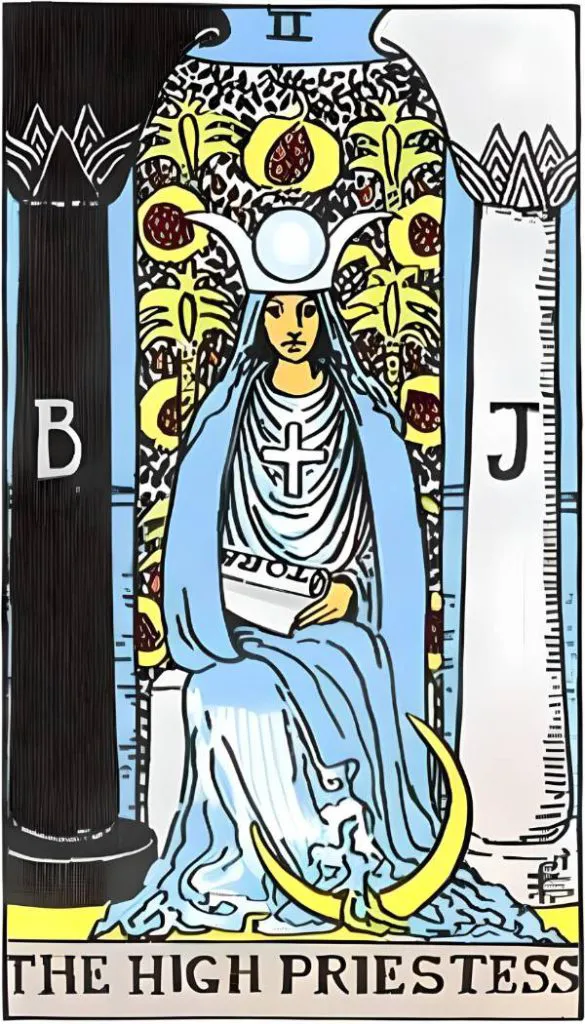
The High Priestess sits upright on a stone seat, positioned between the black and white pillars at the entrance to the sanctuary, wearing a disc-shaped hat, adorned with a cross, standing on a crescent moon, and holding the "Book of Truth".
The High Priestess has a dignified appearance and wears simple, unadorned clothing in plain colors. The crown she wears combines a full moon and the horns of a sacred cow, an emblem originally associated with the Egyptian goddess Isis. Isis, the supreme female deity of Egypt, embodies infinite power and represents the revered feminine ideal of her time. The High Priestess embodies an aspect of Isis, acting as a divine intermediary, speaking the oracles on behalf of the goddess.
This combination of horns and a full moon also represents the image of the "moon boat," signifying that the High Priestess is an incarnation of the moon goddess. The white veil on her crown signifies the dedication and status of the priestess. A crescent moon shape is visible at the front of her left foot, protruding through her robe, symbolizing a pure state of mind and feminine traits. This depiction, akin to standing on a crescent moon, is a Christian tradition representing virtuous women, reminiscent of many depictions of the Virgin Mary ascending to heaven with a crescent moon under her feet. The crescent and full moon also suggest a mysterious cycle, akin to the waxing and waning phases of the moon.
The cross on the High Priestess's chest represents the wisdom and charity of the heart chakra. This symbol is a solar cross originating from ancient Egypt, embodying "Continuous Creation" and being a wellspring of wisdom and language. The equal-armed cross represents the intersection and harmony of duality or dual aspects, as well as the axes of time and space, the intersection of matter and spirit, symbolizing the equal and interdependent union of consciousness (vertical) and subconsciousness (horizontal), representing the balanced and combined energies of yin and yang.
The cross is placed on the chest, signifying that one must feel and experience with the heart to perceive and speak the oracles, with energy concentrated and intersecting at the heart. The cross on the chest, positioned in the middle of the body, can also connect to the headwear and the crescent moon at the feet, forming a mystical set of symbols representing the spirit, matter, and will: circle, cross, and half-moon.
The High Priestess holds a scroll, an ancient form of a book, with the inscription TORA visible, suggesting that a letter H is hidden, completing the word TORAH, which refers to the "Law of God," a significant part of the Old Testament, also known as the Pentateuch (Genesis, Exodus, Leviticus, Numbers, and Deuteronomy).
These five letters are also seen as a divine code, where every fiftieth letter in the "Law of God" forms a cycle of T, O, R, A, H. This phenomenon has long been known to mystics and has recently been rediscovered by the media. The "Law of God" represents the unchanging truth and symbolizes the mysteries of the universe. The scroll showing only four letters suggests secrecy and also aligns with the letters on the Wheel of Fortune, creating additional meanings. The High Priestess holding the scroll signifies that she holds the truth. Her right hand, along with part of the scroll, is hidden within her cloak, while her left hand is visible, touching one end of the scroll, indicating that the law and mysteries are not easily revealed but are hinted at subtly.
The dual pillars in the background are distinctly contrasting colors, typically black and white, representing the clear distinction between right and wrong, and the concept of absolutes. The interweaving of black and white signifies wisdom and impenetrability, embodying supreme wisdom. The High Priestess stands between the two pillars, symbolizing the separation and reconciliation of dualities, and the harmonization of the known and the unknown. Each pillar is inscribed with a letter; the black pillar has B, and the white pillar has J. These letters are abbreviations of the names of the pillars, B for Boaz and J for Jakin, which are the two pillars of the Temple in Jerusalem, named by God with specific meanings. Boaz signifies "to establish," and Jakin signifies "to have inner strength." These pillars are the "Pillars of Truth," representing the tangible manifestation of divine truth.
The origin of these divine pillars is that they were crafted by divinely chosen artisans following rituals and intentions, cast in bronze, and coated with olive oil to make them smooth and gleaming. The gleam of the bronze columns suggests solemnity and the inherent wisdom and justice. The casting and hammering of bronze, along with the purification of oil, symbolize the trials and tribulations the pillars have undergone. The tops of the pillars are cast in the shape of lilies, a motif derived from the lotus flowers of Egyptian temples. The petal shapes at the top of the pillars are distinct, and the parts near the column necks are engraved with the shapes of calyxes. Both lotuses and lilies are known for their purity, representing sanctity and inviolability. The pillars stand at the entrance of the temple, marking it as the dwelling place of the divine, with the High Priestess guarding this critical passage.
In the temple of Jerusalem at the time, a curtain hung from the lily tops with chains, with pomegranates hanging on either side of the curtain. This image is also used in the illustration, with the curtain between the two pillars adorned with pomegranates and vertical palms, behind the High Priestess, obscuring the interior of the temple. The curtain connects the two pillars and separates the inner and outer levels. The plant decorations of palms and pomegranates on the curtain represent a serene image, and the fruits imply wisdom, achievements, and harvest. Together, pomegranates and palms are a source of mystical wisdom. Moreover, the arrangement of these two plants in the image forms the shape of the Kabbalistic "Tree of Life," representing the combination of paths and sephiroth.
The pomegranate, a fruit with a sweet and sour taste, is encased in a thick skin that contains red, juicy flesh and many seeds. Its rich content and seeds are a source of abundant creativity, and the thick skin suggests a firm character. Due to its red flesh and juice, many myths regard it as the blood of the gods, making the fruit a symbol of spiritual nourishment and rejuvenation. Its shape, resembling a pinecone, associates it with the "pineal gland," the third eye chakra, and is closely related to inspiration, mystery, and spiritual elevation.
The palm, with its mystical connotations, represents the pituitary gland and its magical growth control. Palm plants were an important crop in the Mediterranean region and were valued by many early human civilizations for their nourishing fruits, earning them the title of the "tree of life." The entire palm tree represents the vitality of growth and creative power, and it is also a plant favored by God. The palm tree and its leaves represent masculine, decisive strength, and creative power through action. The branches and leaves of the palm are often symbols of victory.
The three-legged chair on which the High Priestess is depicted, here rendered as a cubic stone, both the cubic stone and the three-legged chair have mystical connotations. Although the High Priestess image contains many specific scenes, it does not mean that it is really in the temple of Jehovah, but is a combination of many different historical images. It signifies that the High Priestess has mastered the wisdom of all mysterious civilizations, rather than a single, pure tradition.
Looking through the pillars and the curtain, a blue body of water is faintly visible in the background, indicating that this is the oracle place of the ancient High Priestess. The water behind the temple of the High Priestess can be considered the spring of the ancient Greek High Priestess, and some say it is the source of the four rivers of the Garden of Eden, more like a sea. The sea is the hidden emotion behind the scene, and the crescent moon at the forefront and the sea behind form a corresponding restraint, creating a tidal effect, which is a balanced tension. The dualistic nature of this card is not expressed by the High Priestess's own division but is replaced by the dual pillars on the side of the scene and the invisible gravitational pull of the tide (similar to the Two of Swords). The blue and white clothes on the High Priestess are a symbol of the sea, and the folds at the hem of the skirt symbolize the ripples of the waves, connecting to the mysterious ripples of the sea tide. The blue skirt covers her left side, indicating the richness of the subconscious content.
Pillars
There are two pillars on either side of the High Priestess, labeled “B” and “J”. They represent the pillars of Solomon’s temple, Boaz and Jachin. They are indicative of duality, knowledge, and the boundaries between the conscious and unconscious realms.
Veil
Draped between these pillars, adorned with palms and pomegranates, the veil symbolises the veil of illusion and the secretive esoteric knowledge. It hints at truths hidden from the casual observer and secrets yet to be revealed.
Scroll
In her lap, she holds a scroll labeled “Tora”, symbolising divine law and the Akashic records. It’s partially hidden, suggesting that some things remain a mystery.
Cross
The cross on her chest represents equanimity and a balance between intuition and logic. It’s a symbol of her grounding between two realms.
Moon
Beneath her feet and also on her crown, the crescent moon signifies cycles, intuition, and the feminine mystique. It represents the ebb and flow of intuition and understanding.
Blue Robe
Her flowing blue robe signifies knowledge. It is a reminder that she is a conduit between the conscious and the unconscious.
Crown
The crown on her head, or the tiara, is a symbol of her divine knowledge and her status as a spiritual queen.
Water
Behind her is a body of water, representing the subconscious mind and the deepest layers of intuition and memory.

An Unsent TTC Update Becomes One Clear Contribution Sentence

When Rest Felt Disloyal: Separating Privacy From Permanent Access

The Portfolio Request Led to Another Tab; One Draft Became Evidence

When Secret Access Became Proof of Friendship: Reading Reciprocity

When a Body Signal Gets Called Intuition: Test the Hunch Against Facts
