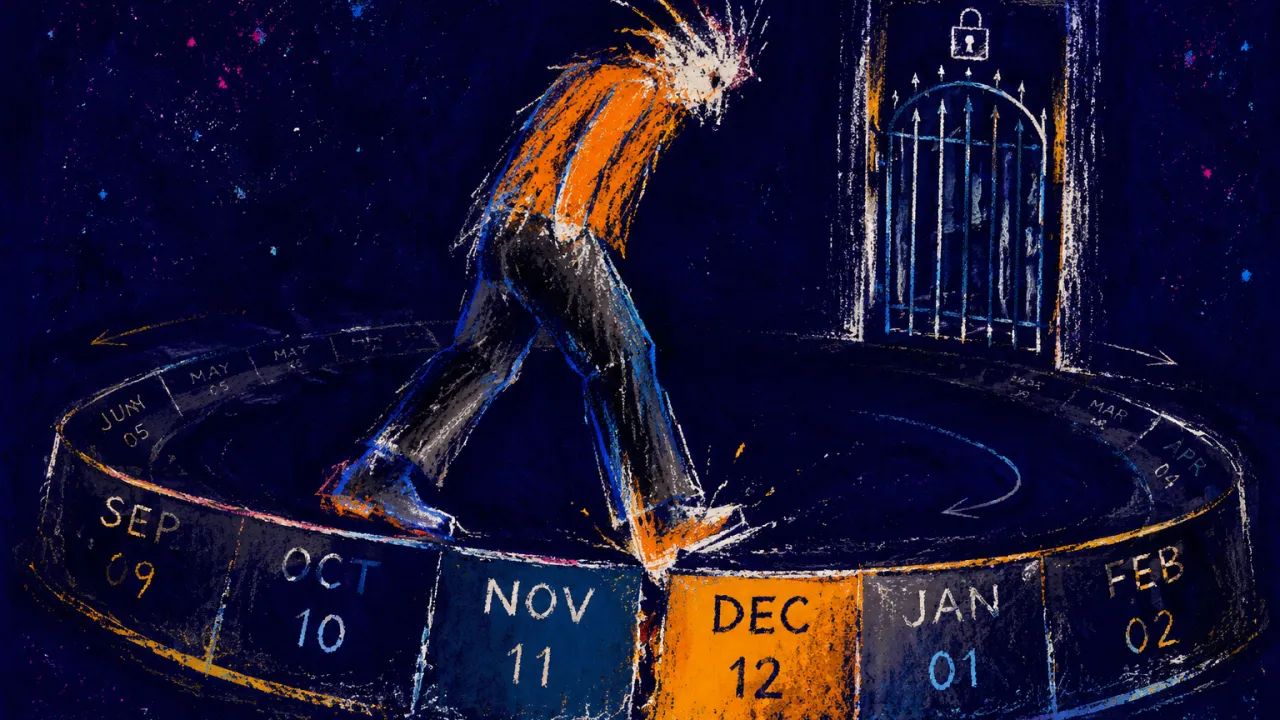
That tight jaw and braced chest around every missed window are part of the Bad Timing Loop, not proof that the plan matters less. This is an environmental and structural timing dynamic: calendars, reply windows, systems, and other people's availability keep changing the moment your effort tries to land. The cards below do not decide whether you should push or pause; they reflect the outline of the timing field you are already inside. Here are the Tarot Cards that tend to surface for this kind of loop.
The Fool ReversedThe Fool's stride, the dog's alert, and the cliff edge all happen at once, but they are not coordinated into a clean movement. The body keeps going while the environment supplies signals that have not yet changed the direction of travel. That is the anatomy of a bad timing loop: effort repeats because the rhythm is disconnected from feedback. The card makes the stuckness visible as a cadence problem rather than a character flaw, showing where force needs to become timing awareness.
The Magician ReversedThe Magician's gesture is built for transfer, but in reversal the body can remain locked in the same conducting pose while nothing materially moves beyond the table. The tools are present, yet the scene keeps returning to activation instead of completion. A bad timing loop works through repetition. You try again with more force, a new plan, a cleaner ritual, or another push, but the external conditions keep refusing to carry the action because the phase itself is wrong. This context gives the loop a concrete shape. The card points to a stalled transfer between intention and outcome, helping you identify whether the issue is effort, sequencing, missing support, or a window that has already closed.
The High Priestess ReversedThe moon symbols, the covered scroll, and the veiled doorway create a scene governed by cycles and withheld access. In reversal, that same architecture becomes a loop: the body is held in place while the mind keeps trying to force a passage through a curtain that has not opened. Bad Timing Loop is the external pattern where each push creates more friction because the action is landing at the wrong point in the cycle. You are not being shown a lack of capacity; you are being shown a rhythm mismatch that keeps turning effort into resistance.
The Emperor ReversedThe throne is high enough to command, yet no road down from the mountain is visible. The raised feet and gripped symbols imply readiness, but the composition holds the body in the same fixed seat. That locked visual rhythm mirrors a timing loop where every push meets the same resistance. You may be repeating effort at the wrong point in the cycle, creating the appearance of action while the real opening remains elsewhere.
The Hierophant ReversedThe still followers, fixed symbols, stone steps, and guarded keys can become a scene of stalled motion when the structure refuses to move at personal speed. The body waits, the rule remains, and the threshold does not open just because urgency has increased. This is the pressure pattern of a bad timing loop. You keep returning to the same gate with more force, while the external sequence that would make action effective remains unchanged. In timing work, the card makes the loop observable. It separates persistence from misalignment, showing where repeated effort is being spent against a locked system instead of redirected toward the condition that would actually change the timing.
The Lovers ReversedThe gaze lines fail to meet: the man looks sideways, the woman looks upward, the angel remains separated by cloud, and the bodies do not touch. Influence still moves through the scene, but it moves indirectly, through distance, suggestion, and uncoordinated attention. For timing, that misalignment becomes a loop where every push lands against a different signal. One part of the situation wants action, another waits for approval, another follows temptation or pressure, and the result is movement that keeps losing traction. The Lovers connects to this context because its central image is coordination under pressure. When the coordination breaks, timing does not simply become slow; it becomes repetitive, with the same decision returning in slightly different forms.
The Chariot ReversedThe wheels, canopy, armor, and sphinxes all belong to a vehicle designed for movement, yet the chariot is parked by the riverbank. Its power is present, assembled, and visible, but the scene holds that power in suspension rather than release. Reversed, this becomes a bad timing loop in a relationship. The connection may keep producing potential, attraction, reunions, conversations, or almost-moments, but the timing never converts into a stable next phase because readiness keeps arriving out of sync. The card names the loop without flattening it into simple incompatibility. It shows a relationship where the ingredients for movement exist, but the shared window repeatedly closes before both people can enter the same direction at the same time.
Strength ReversedThe lion's claws disturb the soft ground while the woman's hands stay fixed at its mouth, turning movement into management. The scene does not show an open road; it shows force pressing into terrain that is not yet giving clean passage. In a bad timing loop, every extra push adds friction because the system is being engaged at the wrong point in its cycle. You may be spending more effort and seeing less movement, not because effort is absent, but because the timing of the pressure keeps meeting resistance. The card makes the loop visible as a mismatch between force, ground, and release point.
The Hermit ReversedThe lamp burns, but the ridge remains frozen and route-less beyond the small circle of light. Repeating the same stance in that field does not create a path; it only intensifies the demand for certainty before movement. That is the structure of a bad timing loop. You keep applying force to a moment that has not opened, and the environment keeps returning you to the same position, making effort feel like evidence that you should try harder instead of evidence that the timing mechanism needs to be reread.
Wheel of Fortune ReversedThe figures on opposite sides of the wheel create a visible rhythm of rising, descending, and being carried around again. In the reversed state, motion continues, but it does not translate into a grounded path out of the cycle. This is the bad timing loop in personal growth: starting the routine during a chaotic week, launching a reset before support exists, quitting just before feedback appears, or changing systems whenever the wheel turns uncomfortable. The effort is real, but the contact point keeps arriving at the wrong moment. The card connects because it shows timing as a structural force around action. You are not simply failing to follow through; you may be entering growth cycles at unstable intervals, confusing repeated motion with momentum and treating every disruption as proof that the whole system should be restarted.
Justice ReversedThe sword is raised, but the image does not show impact. The scale keeps demanding calibration, and the hall threshold functions less like an open path than a checkpoint that must be cleared before force can become useful. That is the visual logic behind a Bad Timing Loop. You may keep pushing the same plan, message, launch, transition, or decision, while the outer structure keeps returning friction because the sequence is wrong. The card does not reduce this to hesitation. It shows a system where motion is repeatedly interrupted by measurement, making the core issue timing architecture rather than personal drive.
The Hanged Man UprightThe figure hangs in perfect alignment, yet the scene offers no road, doorway, or ground-level action. Everything is organized, but the organization produces delay rather than movement. In a relationship, that becomes the loop where timing keeps doing the work of a decision. You may have chemistry, recognition, or history, but the external conditions keep resetting the connection to almost, later, not yet, or not while life looks like this.
ReversedThe figure's body is full of potential motion, but the structure converts that energy into suspension. One ankle bears the load, the hands cannot intervene, and the open white field gives no timing marker that would tell the body when to release. This is the visual grammar of a bad timing loop. Effort keeps entering the system, but the point of contact is wrong, so each push creates more strain instead of clean movement. For a timing question, the card does not frame delay as personal weakness. It shows a misalignment between effort and entry point, asking you to identify the cycle that keeps turning urgency into friction before another push repeats the same result.
Death ReversedThe kneeling and fallen figures cannot coordinate with the force crossing the card. The crown and scepter are still visible, but they are no longer usable tools; the nearest ground is dominated by impact, while the possible route lies farther away across water and between towers. Bad Timing Loop appears when you keep applying effort to the part of the cycle that cannot receive it. The card does not frame the blockage as laziness or lack of ambition. It shows a mismatch between action and field conditions, where the visible pressure to move keeps colliding with resources that have already stopped functioning. In a timing reading, this context asks where repetition has replaced responsiveness. Your agency begins with recognizing the loop itself: not every resistant moment needs more force, and not every delay means the path is gone. Some openings only become reachable after the ground has finished shifting.
Temperance ReversedThe motion between the cups can become a closed circuit when the card is reversed. Instead of a clean exchange that prepares the way forward, the stream repeats itself while the road in the background stays distant. That visual structure maps directly onto a Bad Timing Loop. You keep encountering openings, starts, delays, and near-moves, but the sequence does not resolve into forward passage because action and receptivity keep missing each other. The card does not frame the loop as permanent. It makes the mechanics visible: the rhythm is off, the receiving point is unstable, and the path becomes usable only when the transfer stops repeating the same mistimed pattern.
The Devil ReversedThe figures are not lying down or physically crushed; they are upright inside a loop. Their collars attach them to the same ring, the torch burns downward, and the black altar keeps every possible movement orbiting a fixed center. In a reversed timing context, that structure becomes a pattern of repeated misfires. You can keep moving, reacting, deciding, restarting, and pushing, yet the movement stays inside the radius of the same pressure system. This is the visual logic behind Bad Timing Loop. The card shows action that is real but poorly placed, energy that is intense but directed downward, and a stage where timing has been hijacked by impulse, urgency, or repeated external triggers.
The Tower ReversedThe bodies suspended outside the tower show movement that is intense but not coordinated. There is velocity, impact, and exposure, yet no visible path that turns that motion into a controlled transition. That is the signature of a bad timing loop: action keeps happening at the wrong point in the cycle. You may push when the structure is already closing, wait when the window requires contact, or mistake urgency for readiness because the environment keeps producing pressure. The card makes the loop visible by separating force from timing. The useful question becomes where the cycle actually opens, rather than how much harder you can throw yourself against a structure that is not currently receptive.
The Star ReversedThe figure keeps pouring, but the scene offers no road out of the oasis. Water leaves both vessels, one stream disappearing into the pool and the other breaking across the ground, while the body remains fixed in the same kneeling posture. That reversed structure turns motion into a loop rather than progress. You may be spending energy, making attempts, and reading every small sign as a reason to push again, but the external route has not formed enough to convert output into movement. The Star shows the cost of mistaking flow for timing. When the environment cannot consolidate what you are pouring into it, the harder push becomes part of the stall, and the real leverage point is the moment when the cycle can be interrupted.
The Moon ReversedThe road under the Moon does not disappear, but it keeps refusing clean timing. The creature is caught at the edge of emergence, the towers narrow the distant passage, and the falling droplets create contact without giving the ground a stable feedback system. This is the loop of moving too soon, pulling back, waiting too long, and then pushing again under the same low visibility. The problem is not a missing desire to act; it is an external rhythm that keeps producing unclear signals and poorly timed openings. The reversed Moon anchors this context through a path that can be seen but not trusted at full speed. You regain agency by naming the loop itself, because the first leverage point is no longer effort, but rhythm detection.
The Sun ReversedThe horse is caught at the crossing point, the wall marks a hard threshold, and the Sun's rays repeat in a fixed cycle above the scene. Movement is present, but it is bound to timing, visibility, and the exact moment of landing. When this pattern turns into a loop, the issue is not a lack of effort. You may be repeatedly pushing at the moment that looks bright on the surface while the deeper sequence has not aligned, so each attempt creates more friction instead of clean forward motion.
Judgement ReversedThe trumpet sends a powerful signal, but the landscape below offers no visible road beyond the opened boxes and distant mountains. The bodies reach upward, while their lower halves remain fixed inside the same structures that first held them. This is the visual pattern of acting whenever urgency sounds, then finding no path for that action to travel. The issue is not lack of effort; it is a one-way timing signal that triggers response without providing a usable route, feedback loop, or landing place. Bad Timing Loop names the cycle where movement keeps starting from pressure instead of from opening. The card helps you separate real timing from loud timing, so repeated friction can become information rather than proof that you should push harder.
The World ReversedThe same oval wreath that marks completion can become a track when the movement has nowhere to exit. The raised leg, floating body, twin wands, and circulating ribbons keep the scene in motion without creating a landing point. For timing, this names the external friction of acting inside a cycle that keeps repeating. You may be pushing harder, but the structure is recycling effort into delay because the exit point, support layer, or usable threshold has not opened.
Ace of Cups ReversedThe chalice still overflows, but the image is suspended in a vertical column with no road, shore, or grounded exit. The hand has to stabilize the vessel while the dove descends and the water keeps moving, so every part of the scene is active at once. In a bad timing loop, movement is real but sequencing is broken. You may be acting, reacting, preparing, and waiting all at the same time, which turns effort into spillover instead of progress.
Four of Cups ReversedThe scene holds two rhythms at once: the grounded stillness of the seated figure and the interruption of the fourth cup arriving from outside the frame. Nothing connects them. The body, the prior cups, and the new offer occupy the same space without entering the same timing. That is the structure of a Bad Timing Loop. The card shows the kind of external rhythm mismatch where the offer appears when the body is closed, the body pauses when the opening is active, and the whole scene becomes suspended between arrival and response. The loop is not a single bad choice; it is a repeated failure of timing between readiness, opportunity, and movement. For You, this context names the pattern that makes every move feel slightly off. The card helps locate the loop so the next decision can be judged by rhythm and fit, not by pressure alone.
Five of Cups ReversedThe figure's body is fixed toward the overturned cups, and the bridge sits outside the active line of movement. The scene contains a route, but the operating focus keeps returning to the same failed point in the foreground. That is the visual mechanics of a bad timing loop: each new attempt begins from the old spill rather than from the remaining supports or the actual crossing. The problem is not effort in isolation; it is effort launched from a timing map that has not been updated. For you, the card identifies the loop by showing where attention and action keep getting trapped. Agency returns when the closed window is named as closed, because only then can the bridge become part of the working plan.
Seven of Cups ReversedThe clouded field has no road, horizon, or sequence, only cups that keep producing possible futures. The figure's suspended gesture captures a body caught between reaching and withholding, never receiving a clear external cue for when to move. That is the structure of a Bad Timing Loop: every window looks briefly real, then dissolves back into uncertainty. The card links the loop to an environment where timing is being read from attractive projections rather than from stable access, resources, or sequence.
Eight of Cups ReversedThe moon crossing the sun darkens the timing signal, and the path begins through water that does not offer clean traction. The figure may be moving, but the environment makes every step demand extra verification. This maps to a loop where effort keeps meeting the wrong conditions. You can push, restart, and try to force momentum, yet the card shows that the real obstruction may be timing quality rather than effort level. The leverage comes from seeing the cycle instead of treating each failed push as a separate personal shortfall.
Page of Cups ReversedThe fish appears from the cup at a moment that the page can notice but cannot fully control. Behind him, the sea keeps moving, while the platform offers a place to stand without showing a clear route forward. That is the architecture of a Bad Timing Loop. A signal keeps arriving, but the user meets it from the same narrow stance each time: watching, holding, delaying, then trying again when the surrounding rhythm has already shifted. The card does not frame timing failure as a lack of effort. It shows how repeated friction can come from acting from a fixed platform while the external cycle is fluid, making the real task a rhythm audit rather than another forceful push.
Knight of Cups ReversedThe cup is held forward, but it has not been handed over. The horse moves, but the river crossing is still ahead, and the composition can keep the Knight suspended in a graceful almost-action. This is the visual logic of a bad timing loop: enough movement to keep hope active, not enough transfer to complete the stage. You keep arriving at the edge of action, but the moment resets because the path, recipient, or condition for completion is not fully present. The Knight of Cups makes the loop especially subtle because it does not look chaotic. The friction hides inside elegance, carefulness, and renewed anticipation, which is why the pattern can repeat before it is named.
King of Cups ReversedThe throne appears to float without a shore, while the boat remains distant and the foot never fully enters the water. Movement exists in the picture, but the figure's position keeps returning to the same suspended point. In a reversed timing pattern, this becomes a loop where every push meets the same environmental drag. You may keep changing tactics, but the real obstruction sits in the timing field: the route is current-based, unstable, and not yet giving a clean passage. The card exposes the cost of treating repetition as effort. When the same friction keeps appearing, the issue is not only what You are doing; it is the external cycle You keep trying to force at the wrong point.
Two of Pentacles ReversedThe loop that should coordinate the coins can become a closed circuit where every correction creates the next correction. The body keeps moving, but the motion no longer proves progress; it shows a system caught in the wrong phase. The rough sea behind the figure sharpens the problem because outside conditions are also moving. In a bad timing loop, you may push when the current resists and hesitate when an opening appears, not from lack of effort but because the rhythm of action and the rhythm of the environment have fallen out of sync.
Four of Pentacles ReversedThe pentacle on the crown makes the whole posture fragile: one move and the most visible symbol of control falls first. The flat foreground offers no active road into the town, so the body keeps repeating stillness as a way to prevent immediate loss. This is the architecture of a timing loop. You push, the structure tightens; you wait, the window feels smaller; you prepare, the preparation becomes another reason not to move. The card shows how timing can become a closed circuit when security depends on staying fixed. In this context, the issue is not whether action is good or delay is bad. The card points to the pattern itself: the same blocked rhythm keeps returning because the external opening, the available resources, and the need for control are not arriving in the same moment.
Five of Pentacles ReversedThe figures are moving, but the blizzard makes movement look punishing rather than progressive. The path exists only as a strip of exposure, with the light above them unable to translate into immediate relief. Bad Timing Loop fits when action keeps occurring inside a resistant season. You may be using more effort, more discipline, or more urgency, yet the environment keeps answering with drag because the timing conditions are not open enough to carry the push. The card’s realism is blunt: motion alone is not proof that the moment is right. The loop breaks first through seeing the weather around the action, not through blaming the person walking through it.
Seven of Pentacles ReversedThe hoe rests against the body instead of cutting into the soil, and the coin at the feet does not yet move into use, exchange, or replanting. The image becomes a stalled circuit: effort, tool, and reward are all present, but the sequence between them is not flowing. Bad Timing Loop describes the point where You keep applying force at a moment the field cannot answer. The card connects the repeated friction to a timing structure, not a lack of effort, making visible the cycle where pushing harder only returns You to the same waiting surface.
Page of Pentacles ReversedThe reversed Page keeps the coin in front of the face until the object becomes a screen. The body has not collapsed, but it has not converted attention into a path either. That visual repetition is the structure of a bad timing loop. The same goal keeps generating the same push, yet the wider field is not being read clearly enough for the action to land. You are not looking at a single failed attempt. The card points to repeated friction between effort and moment, where the useful work is to identify which checkpoint keeps being mistaken for a green light.
Knight of Pentacles ReversedThe Knight's equipment is complete, the horse is capable, and the field is visible, yet the whole scene remains caught before movement. In the reversed texture, the same preparedness can become a closed control loop where every possible opening is inspected until it loses momentum. That is the structure of bad timing as a repeated external pattern. The issue is not one isolated delay; it is the way caution, pressure, and changing conditions keep producing late starts, premature pushes, and missed openings. For you, this card turns the loop into something that can be audited. Once the repeated timing error is named, the question shifts from blaming yourself for not moving to identifying which part of the system keeps turning readiness into another non-start.
Ace of Swords ReversedThe sword is angled as if in motion, but it swings through open air above hills with no road, platform, or receiving surface. Force is present, yet the scene gives the action almost nothing concrete to meet. Bad Timing Loop names the outer pattern where repeated effort keeps producing friction because the field has not opened a workable path. You may be pushing with real clarity, but the card's barren spacing shows why timing can turn effort into repetition when the next foothold is missing.
Two of Swords ReversedThe crossed swords can be held for a while, but the body cannot keep that exact brace forever. Behind the figure, the tide continues to move under the moon, meaning the outside cycle does not stop just because the body is trying to preserve balance. Bad Timing Loop emerges when the pause outlives its purpose. The same structure that once protected the decision starts consuming the window: too early creates friction, too late creates stiffness, and every delay makes the next opening harder to read. For timing work, this card exposes a repeated misalignment between force and cycle. You are not simply choosing slowly; the environment keeps changing while the decision posture stays fixed, creating a loop where every potential move feels slightly out of sync.
Three of Swords ReversedThree blades enter from separate angles and meet at the exact center of the heart, turning every line of force toward one point of impact. The image does not show a clean path forward; it shows repeated convergence, as if different attempts keep arriving at the same blocked place. In a timing question, that convergence maps to a loop where pushing harder does not create movement because the pressure is landing on the same unresolved constraint. You are not looking at a simple delay; you are looking at a rhythm where action, reaction, and external resistance keep syncing at the worst possible point. The rain and grey field make the cycle harder to read from inside it. The useful lever is not more force, but locating the repeated contact point: the moment, condition, or audience that keeps turning effort into friction.
Four of Swords ReversedThe scene offers no road, doorway, or forward horizon; the only directions are the horizontal line of the tomb and the downward points of the swords. Movement is not absent because the figure forgot to move, but because the room itself gives no clean route for action. In timing questions, that geometry mirrors a loop where launches, conversations, or decisions keep starting from the wrong structural position. You push from a sealed chamber, then meet the same blades, then return to stillness with less clarity than before. Bad Timing Loop is anchored in this repeated collision between action impulse and blocked conditions. The card turns the problem from a vague delay into a map of where the cycle keeps catching.
Five of Swords ReversedThe planted sword fixes the foreground figure in place while the remaining swords point in scattered directions around him. The image has force, but not sequence; it shows energy being applied inside a field that is not arranged for clean movement. For timing, this is the pattern where every push creates another point of resistance. You may be trying to move because delay feels intolerable, yet the available conditions keep turning action into cleanup. Bad Timing Loop fits the card because the problem is not lack of effort. The structure reveals effort landing in the wrong part of the cycle, where more pressure produces more fragmentation instead of progress.
Six of Swords ReversedThe oar is long enough to move the boat, but in a blocked state it becomes a repeated push against water that does not translate into distance. The vessel angles away from shore while still staying close to the point of departure, turning activity into a visible loop. This is the timing problem of effort without release. You may be doing the right kind of action at the wrong point in the cycle, so each attempt creates ripples, fatigue, and proof of motion without the structural shift that would make movement stick. The Six of Swords exposes the mechanics of the loop. Progress requires the boat, current, weight, and destination to cooperate; when one part is out of rhythm, more pushing simply redraws the same waterline.
Seven of Swords ReversedThe tiptoe movement, backward glance, and dusk setting create a body caught in a moving clock. The figure is active, but every step must negotiate exposure, direction, and the risk of being seen at the wrong moment. A Bad Timing Loop is the external rhythm where effort keeps arriving out of phase with the opening. You push when the environment is narrowing, wait when the route is briefly clear, then compensate for the friction created by the previous mistimed move. The divided landscape behind the figure matters because there is no single stable stage. Camp, open ground, hills, and distant shelter all pull the timing question in different directions, making the problem less about willpower and more about reading the cycle correctly before repeating the same costly rhythm.
Nine of Swords ReversedNine swords run in a hard horizontal stack over the bed, all pointing in one direction while the room gives no doorway, window, or horizon. The image turns movement into a pressured channel: there is direction, but not usable passage, and the body is upright without being able to step into action. For timing work, that is the anatomy of a loop where every push is made from the same trapped position. You are not simply late or hesitant; the structure shows pressure arriving before route, rest, and external alignment have caught up. The chaotic timing symbols on the quilt sharpen the pattern. When the codes under you are incomplete and the blades above you keep pointing forward, each move can repeat the friction it was meant to escape.
Ten of Swords ReversedThe swords form an almost uniform row, repeating the same downward force along the same vulnerable line. Nothing in the image suggests one clean obstacle; the pressure looks patterned, scheduled, and over-applied. Bad Timing Loop fits when every attempt to force progress lands in the same blocked place. You may be applying real effort, but the card shows a cycle where effort and timing are misaligned, so the system keeps converting motion into impact instead of passage.
Knight of Swords ReversedThe horse keeps driving forward into a wind that does not yield, while the raised sword treats the field as something to cut through. The image contains enormous movement, but the background gives no clear arrival marker, checkpoint, or stable receiving point for all that force. In timing work, this is the structure of repeated action meeting repeated resistance. You may be pushing harder, sending another message, making another plan, or trying another launch, but the card shows that acceleration alone does not change the cycle when the external timing remains misaligned. Bad Timing Loop names the pattern where effort keeps returning to the same friction point. The card's audit is precise: locate the headwind before increasing force, because the next useful move may be a shift in timing rather than a stronger charge.
Queen of Swords ReversedThe Queen has the sword, the posture, and the vantage point, yet the image contains no forward path down from the elevated seat. A bird crosses the open air in the distance while the figure remains fixed above a heavy belt of cloud. That stuck contrast gives the Bad Timing Loop its shape. You may keep applying force because the tool is in your hand, but the environment around the move is not moving with you. The card makes the loop visible as a mismatch between readiness, route, and external season.
Five of Wands ReversedThe Five of Wands reversed turns the suspended clash into a repeating mechanism. Wands keep entering the same congested center, and the bodies keep spending force without producing a clear passage through the scene. That is the anatomy of a bad timing loop. You act, meet friction, push harder, read the resistance as a need for more effort, and then recreate the same blockage because the timing layer has not changed. The card makes the loop external and observable. It does not accuse you of failing; it shows a field where effort is being applied into the wrong phase of the cycle, so the leverage point is not intensity but timing recalibration.
Seven of Wands ReversedHis feet are split by uneven ground and a small stream while the wand keeps meeting pressure from below. The body is active, but the terrain keeps turning effort into repeated correction rather than clean movement. Bad Timing Loop fits when action is real but keeps landing into the wrong external rhythm. You may be pushing with enough force, yet the card shows why more force does not automatically create progress when the ground, route, and incoming pressure are all misaligned.
Eight of Wands ReversedEight wands descend together in one compressed movement, with no staging area between the sky and the ground. The picture carries urgency, but it also shows how little room exists for pacing once the formation is already in motion. Reversed in a relationship, that becomes the repeated experience of conversations, plans, or expectations arriving at the wrong speed. One person may be ready to define, confront, move, or escalate while the other still needs time for the bond to become stable enough to receive it. The card gives the loop a shape: timing is not a minor inconvenience, but the structure that keeps turning momentum into friction. Seeing that pattern lets you locate the real blockage before treating every delay as rejection or every push for clarity as pressure.
Nine of Wands ReversedHands clamp around the wand, the body stays fixed, and the path ahead is not visible. The support object has become part of the lock, keeping the figure upright while also keeping him in the same position. That is the mechanics of a bad timing loop: action keeps being generated from pressure rather than from an actual opening. You may keep meeting resistance because the timing field is still closed, and the card exposes the loop where effort repeats before conditions change.
Ten of Wands ReversedThe road is technically open, but the raised bundle dominates the man's immediate world. He can move, yet the same load that creates motion also blocks pacing, sight, and adjustment. Bad Timing Loop appears when effort keeps happening at the wrong point in the cycle. You may be repeating a familiar push because the destination is visible, while the conditions directly in front of you keep making that push more expensive than it should be. The card's timing lesson is structural, not motivational. It shows a route where progress exists on paper, but the body has lost the ability to read the moment it is moving through.
Page of Wands ReversedThe side-facing figure holds the wand upright, yet no road, gate, or immediate destination appears in the desert around him. The body is prepared for announcement while the space gives no clear next step after the announcement lands. In reversed timing, that can become a loop of starts that do not convert into movement. You keep meeting the same dry ground because the issue is not only effort; it is the repeated mismatch between action, season, and receiving environment.
Knight of Wands ReversedThe rider is caught between command and acceleration: one hand holds the wand forward while the other keeps the horse from breaking fully into motion. The desert ahead is open, but the immediate posture is not a clean run; it is a charged stop-start position. That is the anatomy of a bad timing loop. You may keep pushing when the ground has not opened, then braking when the energy finally builds, creating repeated friction at the exact point where movement should begin. The card makes the loop physical through reins, raised hooves, heat, and suspended forward force. This context is useful because it shifts the focus away from blaming motivation. The structure shows that the problem may be rhythm: effort is real, direction exists, but the release point keeps missing the external cycle that would let motion carry.
No cards available for this filter.