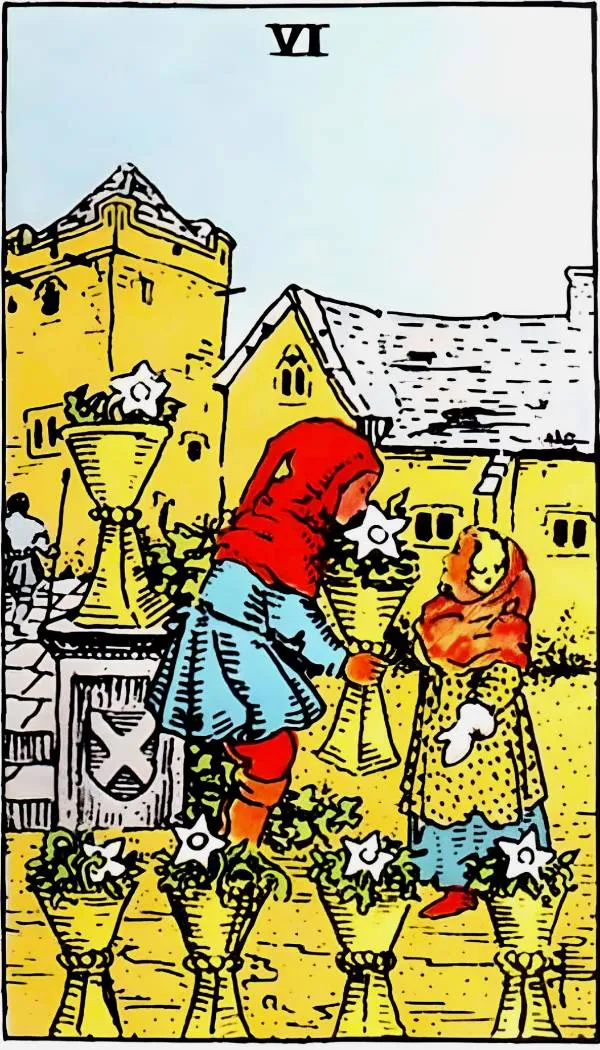
Past Relationship IdealizationThe golden courtyard and flower-filled cups preserve the past in its prettiest form. Nothing in the image shows the full weather of the relationship, only the clean offering, the protected setting, and the childlike roles that make memory feel simpler than lived reality. Past Relationship Idealization appears when that preserved sweetness becomes the main evidence in a love situation. An ex, a first love, or an early honeymoon phase can start functioning like one of the cups: beautiful, contained, and stripped of the conflicts that actually shaped it. This card helps separate memory from current data. You can honor what was tender without letting the storybook lighting decide whether a present partner, old partner, or possible reunion is actually capable of meeting adult needs now.
Infantilized Partner DynamicThe tenderness of the scene is carried by children, which gives the exchange innocence but also limited adult agency. Inside the protected courtyard, care can easily become supervision, and the smaller scale of the figures makes the relationship feel sheltered rather than fully self-governing. Infantilized Partner Dynamic emerges when one partner is treated as someone to manage, rescue, teach, or protect instead of someone to meet as an equal. The cup may still look kind, but the relational structure tilts when care becomes permission-giving or when accountability is softened because one person is cast as less capable. This card helps name the imbalance without turning care into a villain. It asks whether tenderness is supporting mutual growth or keeping one person small enough for the other to feel needed, certain, or in control.
Past Support OfferThe child offering the flower-filled cup turns support into a visible object: something carried, presented, and received inside a sheltered garden. In a career reading, that image points to help arriving through a known bond rather than through a cold application funnel or public competition. The protected manor matters because the offer is not floating in open space. It comes from an environment with history, trust, and social permission, like a former manager sending a referral, an old colleague opening a door, or an alumni contact making a warm introduction. You are not being asked to romanticize the past. The card makes the structure visible: support can be real, but its value depends on whether the old connection gives you current leverage, not just emotional familiarity.
Professional InfantilizationThe central figures are children, and the entire exchange happens in a world arranged by adults, walls, and inherited order. Reversed in a career context, that child-scale scene becomes a workplace structure where you may be treated as pleasant, promising, or grateful while being denied adult authority. The gift matters because it can look kind on the surface. Praise, small assignments, friendly encouragement, and protective language may circulate freely, while ownership, strategic context, compensation leverage, or decision rights remain out of reach. This card identifies the difference between being cared for and being empowered. You regain clarity by asking where the workplace keeps you symbolically junior even when your competence, output, or judgment has already outgrown that role.
Parent Phone Boundary PressureA child offers a flower-filled cup to another child inside an old protected courtyard while an adult figure recedes in the background. Reversed, the nostalgic setting becomes a role structure that has not updated, so a parent call can pull you from an adult room and schedule back into the position of a child expected to report in. The familiar cups preserve genuine affection, which is why the access conflict cannot be reduced to simple dislike or estrangement. You can value the bond while identifying the outdated age hierarchy that still governs response time, privacy, and permission.
Childhood Home Sale CrossroadsTwo children exchange a flower-filled cup inside an old courtyard while additional cups occupy the familiar domestic space around them. The image anchors family memory in physical place and ordinary objects, closely matching the way a childhood home sale reactivates earlier roles through bedrooms, photographs, mugs, furniture, and repeated household details. You can see why relatives may be responding to different versions of the same property. The offered cup makes memory shareable, but the separate figures and surrounding vessels reveal that no family member possesses the entire story; the sale is asking a present-day family system to negotiate several childhood maps at once.
Boomerang Kid NegotiationThe manor courtyard is not a wilderness; it is protected, furnished, and already governed. Returning to it can provide cover from the outside world, but the scale of the buildings and the monitored perimeter show that shelter comes with a pre-existing order. For you, Boomerang Kid Negotiation appears when moving back home or leaning on family infrastructure reopens the question of adulthood. The Six of Cups makes the negotiation concrete: the house can protect you, but it may also shrink your privacy, schedule, choices, and authority unless the terms are named.
Family Script PressureThe manor protects the children, but it also frames the entire exchange inside inherited walls. The patrol in the background and the orderly cups make affection look socially sanctioned, as if the relationship is safest when it stays inside a familiar domestic script. Family Script Pressure fits when love is being filtered through what a relationship is supposed to look like: innocent enough, stable enough, public enough, acceptable enough. The card's sheltered beauty becomes a structure where approval can quietly shape timing, roles, and even the kind of partner who feels permissible. You are not required to reject every inherited value to regain agency. The card simply makes the script visible, so you can tell the difference between a bond that genuinely feels safe and a bond that only looks safe because it matches the courtyard you were taught to recognize.
Friendship Role Lock-InOne child offers a cup to a smaller figure while other flower-filled cups occupy a sheltered courtyard. Reversed, the tender memory scene becomes a friendship hierarchy preserved past its relevance, especially when longtime friends keep treating you as the shy one, the irresponsible one, the baby of the group, or the person who always absorbs everyone else's needs. The shared past remains real, but it cannot serve as complete evidence about the present. You can separate mutual nostalgia from the repeated use of old stories and nicknames to overrule current boundaries, preferences, and competence.
Family Album Performance PressureTwo children stand in an old courtyard among six flower-filled cups, with a large house and an adult figure receding in the background. The enclosed setting and child-sized exchange carry the visual texture of an old family album: a preserved scene that appears innocent, complete, and available for later generations to interpret. Reversed, the past is no longer an uncomplicated source of comfort; it blocks your present identity by fixing an earlier version of you in place. At a reunion, relatives may use childhood photographs, old captions, or familiar family stories to decide who you still are and how far you should have progressed. You are then asked to reproduce continuity for the camera even when your actual life has changed beyond the role the archive assigned.