Seven of Pentacles Tarot Card Meaning

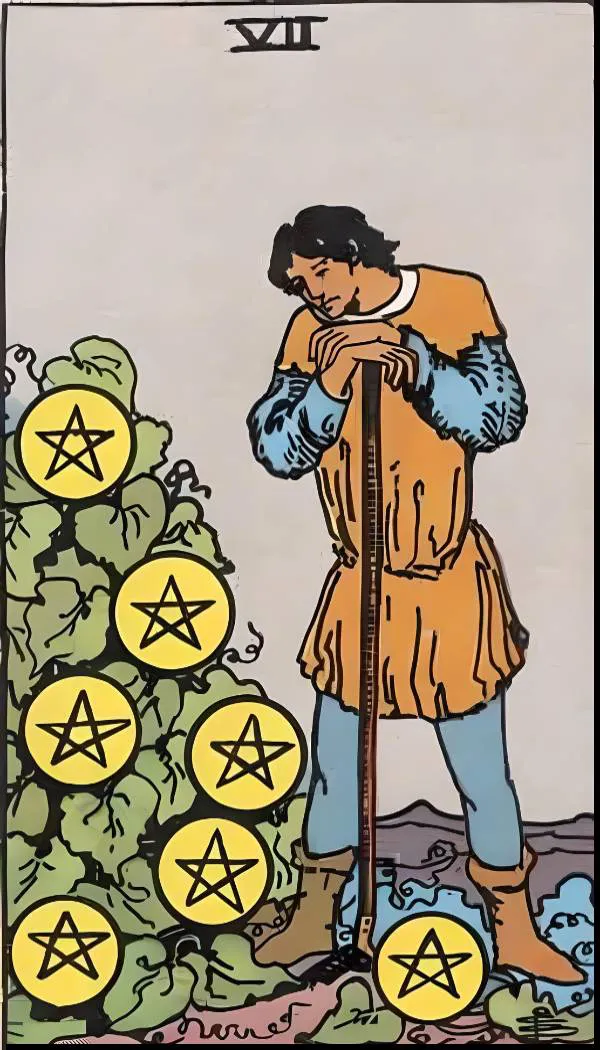
The coins in the image are the fruits of the harvest growing on the crops in the garden. Six of them are still hanging on the tree, waiting to be harvested. The only coin not on the tree has fallen to the ground, between the figure's feet and next to the hoe, indicating that it has been taken down and placed on the ground, signifying the fruit that has been harvested.

The young person in the image is standing on the right side of this money tree, leaning on the hoe in their hand, intently watching the grapevine that they have cultivated, laden with fruit.

There is no joy in his expression because his mind is preoccupied with more thoughts. Besides the future cultivation of the fruit trees, he is also contemplating how to deal with this harvested coin fruit - whether to enjoy it immediately or to plant it as a seed to continue investing.

The tiller is dressed in blue, with an orange-red coat over it, and the boots on their feet are also orange-red, symbolizing a balanced and harmonious state of mind that combines reason and passion, while maintaining a relaxed and cheerful demeanor.

This fruit tree can be said to be a money tree, and the fruits it grows represent wealth. Cultivating this tree must be after a period of cultivation, a long-prepared opportunity.

The orchard where the farmer is located has fertile and vivid soil, representing good innate resources. In the image, only this fruit tree is particularly lush, indicating that the protagonist is focusing on this one fruit tree. The background is a clear sky, with a small range of blue-purple mountains visible in the distance.

The Man

The man in the Seven of Pentacles is a cultivator, a farmer if you will, who represents the investment of time, energy, and resources. His demeanor reflects careful thought, deliberation, and expectation for the fruits of his labour.

The Pentacles

The seven pentacles, six on the bush and one at his feet, signify the tangible results of his efforts. They are the manifestation of his work, yet they are still in the process of maturing, symbolizing potential and anticipation.

The Sickle

The sickle in his hand is a tool of harvest, indicative of the impending reaping. It serves as a reminder that results are not instant; one must wait for the right time to harvest what has been sown.

The Crossroads

The character’s posture suggests he is at a crossroads, contemplating the next steps. This represents the decision-making process that often comes after an initial period of investment and hard work.

The Earth

The fertile ground on which the bush grows represents the material world. It is a sign that the hard work and investment have not been in vain but have led to substantial, albeit not yet fully realized, gains.

The Background

The unadorned, somewhat barren background behind the man suggests that his focus is solely on the task at hand. The absence of distractions in the scenery signifies the importance of dedication and concentration when one is anticipating a harvest.

Psychological patterns in Seven of Pentacles
Analysis Paralysis
The worker's body is paused over the hoe, with his gaze fixed on the crop and the pentacles clustered in front of him. In reversal, the same stillness that could support wise assessment starts to look like a closed circuit: body braced, attention narrowed, action deferred. This is how Analysis Paralysis becomes visible in the card. The mind keeps inspecting the harvest, checking the timing, replaying the investment, and searching for certainty before it allows the next movement. The tool meant for work becomes a prop for waiting, and the evidence meant to guide choice becomes another object to re-check. In personal growth, this pattern often feels like deep reflection from the inside. The card exposes the hidden cost: the review process has stopped feeding action and started protecting you from the vulnerability of choosing while the outcome is still incomplete.
Timing Perfectionism
The worker has already produced something tangible: one pentacle rests near his feet. Yet most of the harvest remains attached to the vine, and his body stays in the contemplative pause between using what is ready and waiting for the rest to mature. In reversal, that threshold becomes a perfection trap. Timing is used as a shield against imperfect release, so the mind keeps telling itself that one more sign, one more cycle, or one more condition will make action safe. The balanced scene turns into suspended animation. In personal growth, Timing Perfectionism appears when the need for the right moment becomes more powerful than the actual readiness of the next step. The card supports the pattern because it shows partial readiness with unusual clarity: something is already harvestable, but the psyche can still remain hypnotized by what is not yet complete.
Sunk Cost Fallacy
The vine carries visible proof of labor already spent, and the worker's body is stationed beside it as if leaving would abandon a living record of effort. The grounded coin shows that some value has been harvested, but the larger crop still exerts a claim on attention. Sunk Cost Fallacy appears when past investment starts arguing for future commitment on its own. In career decisions, the pattern makes years, tenure, and effort feel like reasons to stay even when the next yield no longer matches the price of remaining.
Relational Scorekeeping
The pentacles are arranged like visible units of return: six still on the vine, one already brought down near the figure's feet. The image makes effort countable, and the figure's concentrated gaze turns the relationship between labor and result into the central drama of the card. In the reversed texture, that assessment can harden into a private ledger. Relational Scorekeeping begins when emotional needs cannot be spoken cleanly, so the psyche converts them into evidence. Who initiated, who apologized, who sacrificed, who waited, and who cared more all become entries in an internal account. The problem is not the need for fairness; the problem is that accounting becomes safer than vulnerability. You may recognize this pattern when resentment builds before the actual request is ever made. The card shows how a relationship can become a harvest audit when the deeper need is to be met without having to prove the imbalance first.
Forced Progress
The same hoe that once cultivated the vine can become a lever for pressure when the harvest is visible but not fully ready. One pentacle is down, six remain attached, and the figure's attention can harden into the urge to make the whole field deliver at once. Forced Progress forms when waiting feels like losing ground, so action is used to discharge timing anxiety. You may push, announce, launch, confront, or extract before the conditions can support the result. The reversed psychology exposes the friction created when effort is applied against the grain of the cycle instead of at the point of natural release.
Timing Discernment
The worker leans into the hoe instead of swinging it, standing at the exact point where effort has slowed into assessment. The six pentacles still hang from the vine while one rests on the ground, so the image does not show failure or completion; it shows a threshold where the nervous system has to read timing, not just desire. This posture turns growth into a pacing problem. You are not being asked to push harder or quit faster; the scene exposes the psychological skill of knowing when a result is ripe enough to use, when a process needs more tending, and when waiting has become avoidance in a more respectable costume. In personal growth, Timing Discernment is the mechanism that separates disciplined patience from frozen potential. The card anchors that pattern because every object in the scene is suspended between investment and harvest, forcing the mind to audit the difference between readiness, fear, and strategic restraint.
Energy Scorekeeping
The seven pentacles are visually countable: six on the vine, one at the feet, each fruit turned into a unit of measurable return. The figure's gaze stays on the ledger-like crop instead of on the open field around it. Energy Scorekeeping appears when family care becomes internally tallied because direct limits feel too risky. You may count visits, favors, messages, money, and emotional labor as evidence that the imbalance is real. The card links the counting to a deeper boundary problem: the ledger is trying to say what the mouth has not been allowed to say.
Delayed Gratification
The young cultivator leans on the hoe instead of cutting the six pentacles from the vine, while one harvested coin rests at his feet. The body is still, but the field is not empty; the scene holds evidence that effort has already produced something and that the remaining yield is still attached to a living process. This is the psychological logic of delayed gratification in academic work: You are being asked to let learning compound before demanding final proof from it. When study progress feels slow, the card separates real cultivation from passive waiting, showing the difference between abandoning the crop and letting spaced effort mature into retention, confidence, and usable output.
Overfunctioning
The whole scene is organized around one cultivated tree, and the figure's tool-bearing body remains oriented toward more tending. Even in the pause, the body is still shaped by labor: leaning, inspecting, calculating what else might need to be done. Overfunctioning makes friendship feel safe only when care is being produced. You may become the fixer, therapist, mediator, planner, or emotional maintenance worker because usefulness creates a temporary sense of belonging. The card exposes the hidden cost of that role: the relationship survives through your effort, but mutual support never has to mature.
Decision Deferral
The scene is balanced but unmoving: crop, tool, figure, and harvested pentacle all remain in relation, yet nothing breaks the pause. The six pentacles still on the vine keep the future open, while the one on the ground proves that action is possible but not yet repeated. This creates a psychological field where postponement can masquerade as prudence. You may keep saying the timing is not quite right, but the stillness begins to carry its own hidden cost. In a choice tarot reading, Decision Deferral names the moment when the non-choice becomes part of the decision. The card reveals how waiting can protect you from regret in the short term while quietly handing the choice over to inertia, timing pressure, or other people's moves.
Core Struggles in Seven of Pentacles
Autonomy Guilt Bind
The lone pentacle on the ground sits between the figure's boots while the other six remain bound to the vine. The body is placed between taking one real yield and returning attention to the crop that still asks to be tended. Inside family decisions, that split gives guilt a physical shape. You are not choosing between love and abandonment; the card locates the bind between a harvested piece of your own life and the old system that keeps treating reinvestment as proof of belonging.
Readiness Loop
The hoe is present, but the body is not using it to plant, cut, or move soil. The tool of cultivation has become a leaning post, while the figure studies the vine as if one more round of assessment might reveal the right moment. In a relationship, this reversed structure turns patience into an endless threshold. The bond keeps appearing almost ready: almost defined, almost repaired, almost emotionally available, almost able to meet you with consistency. Readiness Loop names the way waiting can become self-renewing when every delay is interpreted as a sign that the relationship needs more time. The card marks the boundary between organic growth and a moving target, where the promise of maturity keeps replacing the experience of maturity itself.
Direction Stagnation
The farmer leans on the hoe beside a vine heavy with pentacles, with one result already on the ground and the rest still attached. The body is not empty-handed, but it is not moving either; it is held at the exact point where effort has become evidence and evidence has not yet become a direction. This is the structure of Direction Stagnation: You are not stuck because nothing has grown, but because growth has created too many consequential next moves. The card locates the struggle in the pause between harvest, reinvestment, and departure, where every possible future asks for a different use of the same energy. For a direction question, the image matters because the horizon is present but secondary. The immediate field keeps pulling attention back to what has already been cultivated, making the next path feel less like a simple choice and more like a full audit of where your life force should go now.
Sunk Cost Paralysis
The whole composition narrows around one cultivated vine, with the figure's weight, tool, and gaze already invested there. The fertile ground may extend beyond the frame, but the visible body keeps its reference line tied to the crop that has consumed effort. In personal growth, this turns past effort into a binding coordinate. You may keep feeding a method, identity, or goal because leaving would make the old labor feel unclaimed, and the card locates that stuckness in the body's refusal to step away from the field it has built.
Knowledge-Output Gap
The vine carries most of the pentacles, but only one has been brought down into the worker's reachable space. The hoe is in hand, close to the result, yet the scene is paused before full conversion. That physical split maps cleanly onto the Knowledge-Output Gap in academic life. You may have read, understood, highlighted, and rehearsed the material, but the work has not yet become an essay paragraph, exam answer, presentation argument, or research claim. The card gives this struggle a shape: knowledge is not absent, but it is still attached to the vine. The pressure comes from needing the harvest to become visible in a format the academic world can count.
Timing Control Strain
The pentacles on the vine make growth measurable, and the figure's posture makes monitoring almost physical. He leans into the hoe and watches the crop as if closer attention could regulate the pace of ripening. In timing questions, that visual pressure becomes a control strain. You can track progress, compare signals, count evidence, and still be dealing with a living cycle that does not speed up because it is being watched. The more the bush becomes the whole field, the more timing collapses into surveillance. Timing Control Strain names the exhaustion of trying to command a season through vigilance. The card marks the boundary between useful observation and the kind of monitoring that turns uncertainty into a private workload.
Life Audit Exhaustion
The figure does not celebrate the visible pentacles; he studies them. The hoe rests under his hands, the body is paused, and the entire field of attention contracts around the question of what the harvest means and whether it is enough. That posture mirrors the inner state where self-reflection becomes a standing inspection site. You keep checking your motives, your progress, your triggers, and your unfinished emotional material until the act of looking starts to use the same energy it promised to restore. Life Audit Exhaustion lives in that narrowed gaze. The card does not condemn introspection; it shows the moment when review becomes its own weight, and the psyche needs the audit to be recognized as a structure rather than mistaken for clarity itself.
Pacing Control Strain
The harvest is visible, but the figure has paused instead of cutting everything down. The hoe touches the ground, the gaze stays fixed on the vine, and the body waits inside a timing problem rather than a simple action problem. With family boundaries, this structure names the strain of knowing that a confrontation, visit, apology, or distance may be necessary while the moment never feels clean. The card holds the pressure at the threshold where waiting protects the crop and also keeps you stuck beside it.
Desire-Timing Bind
The cultivator leans into the hoe beside a vine that is visibly productive but not fully released. Six pentacles still hang from the living plant while one rests at his feet, so the card holds desire in contact with evidence, but not yet with completion. That physical arrangement gives the timing struggle its shape. You are not frozen because nothing is happening; you are caught because something is happening, but not in a form that cleanly authorizes the next move. The body can reach, the tool is present, and the result is visible, yet the crop still belongs partly to the cycle that produced it. Desire-Timing Bind names the pressure of wanting to move while the field itself is still negotiating maturity. The card does not flatten that tension into patience or action. It locates the exact bind: the moment when wanting the harvest becomes inseparable from respecting the rhythm that made the harvest possible.
Inherited Repair Burden
The figure has stopped beside a single cultivated vine, body propped on the hoe that made the harvest possible. The tool is no longer only an instrument of work; it is carrying part of the body's weight while the fruit remains mostly attached to the plant. In a family field, that posture mirrors the person who becomes the maintenance point for everyone else's growth. You can see results, yet the system keeps your body close to the tool, as if repair only continues while you keep standing there.
Inner Emotions in Seven of Pentacles
Decision Fatigue
The figure stands between the pentacle on the ground and the six still attached to the vine, visually caught between using what has been gained and continuing to cultivate what remains. The narrowed focus makes the field feel less like open land and more like a decision chamber. Decision fatigue belongs here because the card is not only about waiting; it is about evaluating what to do with partial results. The body is paused, the tool is held, and the mind has too many possible next uses for the same effort. In academic life, this can feel like being drained by choices that all seem reasonable: revise or submit, switch topics or stay, ask for feedback or keep working alone, rest or keep pushing. The exhaustion comes from constant assessment, not from a lack of care.
Stalled Momentum Dread
The reversed Seven of Pentacles compresses the card's waiting posture into a feeling of movement that has thickened in place. The figure leans on the hoe, the pentacles remain suspended, and the one coin on the ground does not create forward motion by itself. Stalled momentum dread grows from that suspended field. The work exists, but the body cannot feel it converting into completion, direction, or release; the visible crop starts to feel like evidence of being stuck beside the same problem for too long. In academic life, this is the dread of revising the same chapter, rereading the same material, or circling the same research question without a felt shift. You are not at zero, but the card reflects the particular heaviness of progress that no longer feels like movement.
Self-Audit Anxiety
The fixed gaze on the vine turns the garden into an inspection site. Six pentacles remain attached, one lies on the ground, and the whole image narrows around the question of what has matured, what has not, and what should be done with the result. Self-Audit Anxiety emerges when that evaluative posture turns inward. In introspection, You may keep checking whether you are healed enough, self-aware enough, calm enough, mature enough, or making enough progress to justify the effort. The card’s measured harvest becomes a mental review loop where every partial result feels like data and every delay feels like evidence to re-examine. The reversed pressure sits in the way attention stops being reflective and starts becoming surveillance. The psyche is not simply looking at the crop; it is scanning the self for proof that the inner project is working, and that scan can make even genuine growth feel unfinished.
Optimization Fatigue
The reversed card makes the hoe feel less like a support for rest and more like a measuring device held too long. The whole scene narrows around one vine, one field, and one set of visible results until cultivation becomes constant assessment. Optimization fatigue emerges when the work plot stops feeling like a living process and starts functioning like an audit loop. The figure's attention has nowhere soft to go; every visible pentacle becomes another data point asking whether the method, timing, or investment is efficient enough. In academic life, this is the drained state of endlessly refining study systems, productivity routines, note formats, reading plans, and output metrics while the actual learning feels less human. The card reflects the cost of turning growth into a continuous performance dashboard.
Social Burnout
The figure leans into the hoe as if the tool has become a temporary spine, with the vine still full and the work not fully complete. The scene is not chaotic; it is quiet in a way that makes the accumulated labor more visible, because there is nothing around the body except the field it has been tending. In a social network, that posture becomes the feeling of having no spare charge left for upkeep. Messages, invitations, group dynamics, professional acquaintances, and casual obligations may still be alive on the vine, but your body has moved into a pause that is closer to depletion than rest. Social Burnout names the inner weather of being surrounded by connection demands while feeling under-resourced to meet them. The card gives that depletion an objective frame, helping you see where continued tending has stopped being generous and started consuming the energy needed to remain present at all.
Academic Dread
Leaning on the hoe beside a crop that is visibly growing, the figure is not shown in celebration but in a suspended audit of effort. The body is still, the eyes stay fixed on the vine, and the distant mountains make the longer path feel present even while the immediate work plot fills the frame. That visual structure maps cleanly onto academic dread because the card holds proof of labor and unfinished evaluation at the same time. You can see that something has grown, but the result has not yet resolved into safety, certainty, or release. In study life, this becomes the heavy inner weather of staring at drafts, grades, reading lists, or exam timelines and feeling the future press into the present. The dread is not random panic; it is the emotional cost of waiting for slow work to prove whether it was enough.
Premature Bloom Anxiety
Most of the pentacles remain attached to the vine, while the figure's entire attention rests on the crop as if looking could pull the harvest forward. The hoe sits close to the feet, giving the body a tool for action even though the plant still holds back most of its yield. Premature Bloom Anxiety grows from that pressure to convert potential into proof before the cycle has completed its own work. You may feel the opportunity so intensely that waiting starts to feel like losing control, even when the visible field is still asking for ripening rather than extraction.
Sunk Cost Grief
The single cultivated bush dominates the scene because effort has been concentrated there for a long time. The figure's lean into the hoe makes the past physically present, as if the body is resting on everything already spent to make the vine grow. In a long friendship, that concentration of effort can make leaving, reducing access, or naming imbalance feel like mourning the years themselves. The grief comes from seeing that the bond has history and value while also sensing that history cannot be the only reason to keep investing. Sunk Cost Grief belongs to the reversed card because the harvest becomes emotionally complicated. What has grown is real, but the weight of prior care can start to trap your discernment, making the friendship feel painful to release and painful to keep tending.
Timing Dependence Anxiety
The ripe-looking pentacles hang close enough to matter, but the figure does not reach for them. Attention gathers around timing: whether the fruit is ready, whether the moment has arrived, whether acting now would preserve or waste what has been grown. In love, that suspended timing can make your inner steadiness depend on when the other person defines the relationship, responds, repairs, commits, or changes. The horizon is visible, yet the emotional system stays locked on the next signal from the bond. Timing Dependence Anxiety belongs to this card because Seven of Pentacles is not about absence; it is about the pressure created by almost-ready evidence. You are not reacting to nothing. You are trying to live inside a relationship where the next emotional move feels powerful enough to change the whole harvest.
Conditional Hope Anxiety
The figure’s gaze stays fixed on the vine as if the next sign will determine what the whole season means. One coin has arrived, but the rest of the harvest remains held above ground, visible enough to keep attention attached. In a relationship, that image becomes hope with a condition attached. Your inner steadiness may rise or fall around whether they text, choose you, apologize, commit, or finally act in a way that proves the waiting has not been one-sided. Conditional Hope Anxiety fits the reversed Seven of Pentacles because the card shows evidence that is partial, delayed, and emotionally expensive. The relationship keeps offering just enough to keep hope alive, while the uncertainty around the rest of the harvest keeps your body braced.
Outer Contexts in Seven of Pentacles
Sunk Cost Exit Dilemma
The worker's weight sinks into the hoe while the gaze stays fixed on the vine, even though only one pentacle has actually been brought down to the ground. The scene contains accumulated effort, visible potential, and a body that has not yet stepped away from the plot it has tended. In love, that structure becomes sharp when time already spent starts to function like a tether. You may be measuring the relationship less by what it gives now and more by how much you have already poured into it, especially when the imagined harvest still looks close enough to keep you standing there. Seven of Pentacles reversed exposes the pressure point without turning it into a verdict. It shows a relationship context where the real question is not whether the investment was meaningful, but whether continuing to invest under the same conditions is still producing a livable return.
Premature Launch Pressure
The body braced over the hoe carries the weight of a field that looks productive but has not fully released its yield. The pentacles are visible enough to attract pressure, yet most of them are still attached to the plant, turning potential into a demand before it has become usable harvest. Premature Launch Pressure appears when You are pushed to act because something looks ready from the outside, while the actual support system is still forming underneath. The card's reversed logic exposes the trap of confusing visible growth with launch conditions, especially when timing pressure starts replacing material readiness.
Bad Timing Loop
The hoe rests against the body instead of cutting into the soil, and the coin at the feet does not yet move into use, exchange, or replanting. The image becomes a stalled circuit: effort, tool, and reward are all present, but the sequence between them is not flowing. Bad Timing Loop describes the point where You keep applying force at a moment the field cannot answer. The card connects the repeated friction to a timing structure, not a lack of effort, making visible the cycle where pushing harder only returns You to the same waiting surface.
Launch Window Readiness
The hoe is ready, the crop is visible, and one coin has already separated from the vine, but the figure has not begun a full harvest. The card holds the exact moment before release, where a future direction can be seen but the field has not yet converted all growth into usable output. Launch Window Readiness describes that narrow interval when You are close enough to move that waiting feels costly, yet early enough that exposure could still outrun the structure. The visual logic is practical: the right window is not created by wanting the launch; it opens when tool, yield, and external conditions line up.
Resource Readiness Check
The fertile soil, the loaded vine, and the countable pentacles make the card unusually concrete. There are resources in the scene, but they are not all in the same state: some are still attached to the growing structure, and one is already available on the ground. That uneven distribution is the logic behind a readiness check. The issue is not whether you have any resources; it is whether your current daily system can support the next expansion without confusing potential with usable capacity. For lifestyle questions, this card points to the practical audit before adding a new habit, buying another organizing tool, changing your schedule, or redesigning your home routine. You regain agency by distinguishing what is fertile, what is measurable, what is already available, and what is still only a promise inside the system.
Strategic Timing Window
Leaning on the hoe beside a vine heavy with pentacles, the figure is not shown in the rush of planting or the satisfaction of a completed harvest. The scene holds the exact middle point where work has produced evidence, but the outcome is still partly attached to time, conditions, and the decision of when to act. That suspended posture turns the card into a map of timing rather than effort. You can see one result already on the ground, six still in process, and a clear horizon beyond the garden, which makes the decision less about whether anything has worked and more about whether the next move should be harvesting, waiting, or reinvesting. In a choice context, this describes the narrow window where action is available but not automatic. The structure asks you to audit timing as a real variable: what is mature enough to use, what is still gaining value, and what starts costing more the longer it stays unchosen.
Habit Maturation Lag
Six pentacles still hang from the vine while one rests at the cultivator's feet, making progress visible but not fully transferable. The hoe supports a pause rather than a new swing, so the scene holds the body inside a slow-feedback system where labor and reward are out of sync. In personal growth, that maps to routines, learning cycles, or skill practices that have started producing proof but have not yet changed the larger structure of your life. You are not looking at a blank field; you are looking at a maturing crop whose timing forces the difference between disciplined cultivation and premature judgment to become visible.
Friendship Plateau
The hands stay fixed on the hoe while most of the fruit remains unpicked. The tool is available, the crop is visible, and yet the scene holds the body in a waiting circuit rather than showing a clean movement into harvest. That stalled posture fits a friendship or group that has stopped deepening after repeated contact. You can point to the hangouts, messages, shared routines, and time invested, but the connection still hovers at the same surface level. The reversed texture of the card makes the plateau structural. It shows a social ecosystem where effort has accumulated, but the next layer of closeness is not becoming accessible through more of the same tending.
Career ROI Reckoning
The single pentacle at the figure's feet changes the whole orchard from a place of labor into a place of accounting. One return has become tangible, while six more remain suspended in the system that produced them. In career terms, this is the moment when effort, skill, time, and opportunity cost have to be counted together. You are not simply wondering whether the job is hard; the structure is forcing a comparison between what has been invested and what the role is actually returning. The card's realism comes from the hoe still in the worker's hands. The work can continue, but the next unit of effort needs a clearer reason than habit, loyalty, or the hope that delayed recognition will eventually catch up.
Premature Monetization Pressure
One coin sits loose on the ground while six still hang from the living vine. The image places a small harvest beside a much larger immature crop, making the timing of extraction the central pressure in the scene. In personal growth, an early result can attract pressure to package, sell, post, or brand the work before the system has matured. The card frames that pressure as a harvest-timing problem: value exists, but forcing the whole crop into public use too soon can mistake proof of life for readiness.