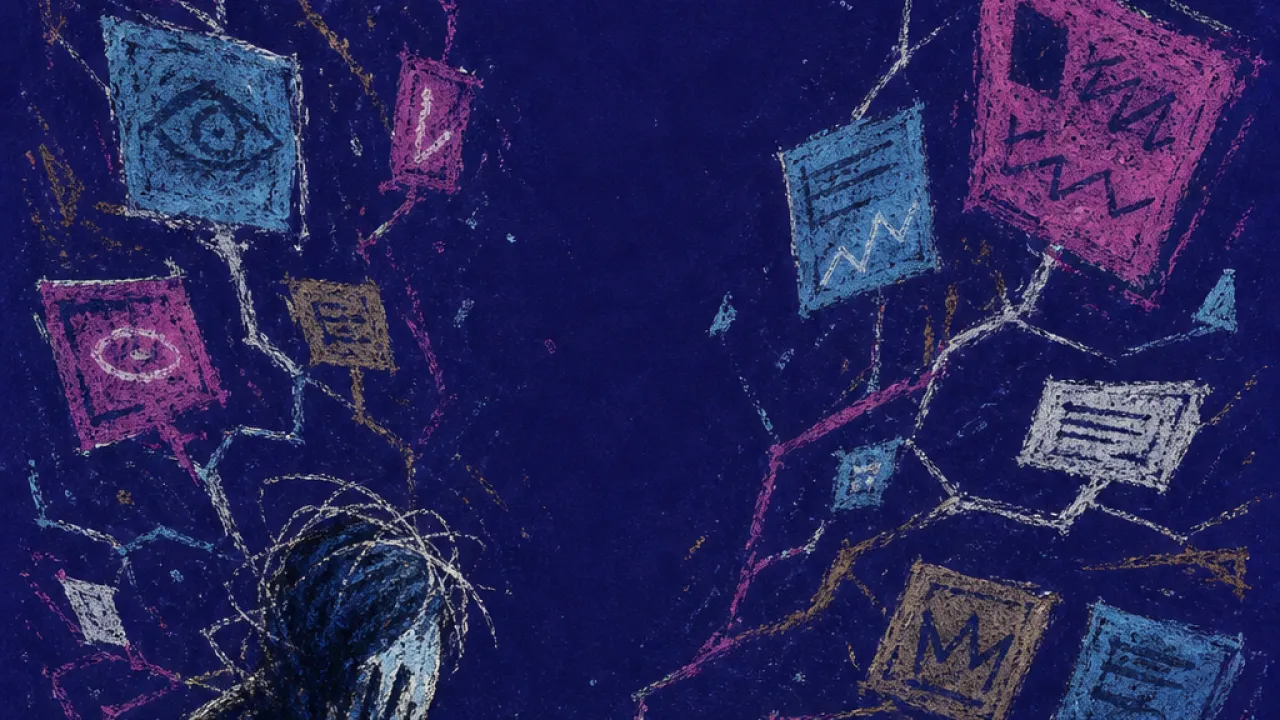
Analysis Paralysis turns a decision field into a place where every option opens another comparison, another tab, another person to ask, and another reason the next step stays suspended. The tight jaw and body locked at the desk are not random; they mark an environmental, structural dynamic where movement is delayed by the way the choices are arranged. The cards below do not decide for you or rank your options. They show the Tarot Cards that mirror the shape of a decision field crowded with possibilities but short on usable ground.
Seven of Cups UprightA silhouetted figure stands before seven suspended cups, close enough to see every possibility but not close enough to act on any one of them. The scene is full of options, yet the body remains fixed in place, with no hand reaching forward and no path marked through the clouded air. That visual structure maps directly onto academic decision overload. You are not facing a lack of options; you are facing a field where every option asks for a different future self, a different study system, and a different risk profile before the first concrete step can be made. In study life, Analysis Paralysis shows up when choosing the perfect major, thesis angle, revision method, reading order, or graduate pathway becomes a substitute for contact with the work itself. The card names the bottleneck as an overloaded choice environment, not a personal failure to be decisive.
ReversedThe person in the Seven of Cups has not moved into the scene of any cup. The body stays below the visions, and the clouded space removes the practical markers that would turn one option into a route. In personal growth, this is analysis paralysis at the level of identity and strategy. You may be comparing methods, timelines, possible selves, and imagined outcomes so intensely that the act of deciding becomes a second life lived above the real one. The card holds up a clear mirror to the stuck point: observation has replaced selection. Its value is not in pushing a faster choice, but in showing where the field needs to be narrowed before disciplined action can re-enter the body.
Eight of Cups ReversedThe moon covers the sun while the route crosses water and climbs into dark terrain. In the reversed texture, the staff becomes less a tool of movement and more a brace for repeated preparation, because the next stable position cannot be fully audited from where the figure stands. Analysis paralysis forms when uncertainty becomes the gatekeeper of action. You are not lacking information in a neutral way; the decision system is demanding a level of visibility that this stage of the route cannot provide.
Page of Cups ReversedThe Page's body has stopped around the cup. His attention loops between the vessel and the fish while the sea behind him continues to move, creating a scene where observation replaces action without producing a clearer route. That is the external structure of Analysis Paralysis: the decision keeps being examined, but the examination does not widen the map. One signal gets reread until it becomes heavier than the full situation, and the threshold remains a place of suspension rather than transition. For choice work, this card shows where more thinking has stopped adding information. You are not being asked to force a reckless move; you are being asked to identify which missing criterion, constraint, or tradeoff would turn repeated inspection into an actual decision.
Queen of Cups ReversedBoth hands keep the ornate cup upright while the Queen's eyes remain fixed on what cannot be opened from the outside. When this scene turns inward past its useful limit, containment becomes a closed loop: attention stays inside the vessel, movement stays seated, and the shoreline never turns into a path. This is the structure of a decision that has gathered too much private interpretation and not enough usable movement. You can keep refining the inner reading of the choice, but the card shows the point where more contemplation becomes another way the decision stays unmade.
King of Cups ReversedThe King’s body remains perfectly seated while the ocean moves, the boat travels, and the dolphin breaks the surface outside his direct line of sight. His gaze stays on the cup, concentrating the whole field into one object. Reversed, that stillness can become a decision room where review replaces movement. You may keep rereading the same emotional signal while deadlines, options, and consequences continue to shift around the throne, making certainty feel like the price of action.
Two of Pentacles ReversedThe loop between the pentacles can become a closed circuit when the body keeps rehearsing the same transfer without landing either coin. One lifted foot, one fixed gaze, and the restless sea behind the figure create a stage where motion consumes energy without producing a settled position. That is how analysis paralysis forms around a decision: the external variables keep shifting, and the mind tries to match every wave before acting. The card names the trap as a coordination problem, not a personal flaw, so the real audit becomes which variables actually deserve control.
Three of Pentacles ReversedThe hammer is lifted near the pillar, the plan is open, and the figures are still gathered outside the doorway. Everything required for action appears close at hand, yet the scene can remain suspended in review, measurement, and pre-impact discussion. In a decision, this shows the moment when planning stops serving movement and starts replacing it. You can see the bottleneck as a loop of comparison and consultation, which clarifies why more information may not automatically create more agency.
Four of Pentacles ReversedThe whole body is organized around one rule: do not let anything fall. The head, hands, and feet all maintain separate points of control, which leaves almost no energy for actual movement. Analysis Paralysis appears when a decision becomes a system for preventing loss rather than selecting a direction. The card makes the freeze visible: every variable is treated like a pentacle that must stay perfectly balanced before any step can count as safe. The flat foreground intensifies the stuckness because there is no marked first step. You may be gathering more information because the structure has not identified which variable can move first without bringing the whole arrangement down.
Eight of Pentacles ReversedThe craftsman's body is split between the bench, the tools, and the ground while the path to town remains visible in the background. The scene is full of measurable order, yet the active focus is narrowed to tiny corrections on a single coin. Analysis Paralysis appears here as a decision environment where refinement replaces movement. The more criteria you add, the more the workbench becomes a closed loop: another comparison, another correction, another reason the path cannot be taken yet. For a choice reading, this card does not treat hesitation as weakness. It shows a structure where the demand for mastery, proof, and precision has become so dominant that the decision itself cannot move from the bench into the world.
Page of Pentacles ReversedThe young Page holds the pentacle at eye level until the whole landscape narrows to one object. His left foot carries the body while the right foot hovers back on the toe, creating a posture of readiness that has not become movement. In a decision spread, that suspended stance maps onto the moment when one visible variable keeps being inspected beyond its useful limit. You are not short on intelligence; the structure has made the coin so central that every route, mountain, and next step loses operational weight. The card gives Analysis Paralysis a physical form: careful scrutiny has stopped functioning as preparation and has become the container that delays choice. Seeing that container clearly is the first way to separate useful information from the loop that keeps asking for one more detail.
Knight of Pentacles ReversedThe horse is built to move, but it stands still while the rider studies the distance over a carefully held pentacle. The open field expands the number of possible routes without giving the body a clear entry point. In personal growth, that becomes the stage where research, comparison, and planning keep replacing action. You are not facing a lack of information; the card points to a stuck interface between knowing enough and transferring weight into one workable first step.
Queen of Pentacles ReversedThe Queen's gaze narrows to the coin in her lap while the garden, foothills, and water sit outside her immediate field of action. The hands keep holding the same object, creating a loop where inspection replaces circulation. In a decision reading, this is the point where responsible analysis stops producing movement. You may have enough information to see the option clearly, but the system keeps pulling attention back to one variable, one risk, or one asset until the act of choosing feels physically blocked.
Ace of Swords ReversedThe sword is raised and slightly tilted, yet it never reaches a visible object to cut. Around it there is open sky, distant hills, and no human-scale path, so the instrument of decision remains suspended inside a field of abstraction. In personal growth, analysis paralysis often looks like more frameworks, more life audits, and more possible versions of the self. The card shows the exact blockage: the blade is sharp enough, but the environment gives it nothing concrete to enter. Your agency returns when the question shifts from evaluating every direction to identifying the first real cut through the field.
Two of Swords ReversedThe woman's body is still, but the stillness is physically expensive. Her arms hold two swords in a sharp cross, the blindfold cuts off direct orientation, and the dim shoreline behind her multiplies possible references without giving her a stable center. In personal growth, that scene becomes the loop of collecting more clarity while the body never enters the experiment. Frameworks, courses, journaling prompts, and identity plans can all become additional blades in the same frozen geometry. Analysis Paralysis is strongly anchored here because the card shows thought converted into a barrier. You are not lacking information in a simple way; the decision field has become so balanced and protected that movement itself is treated as a threat to the system.
Four of Swords ReversedThe knight's body is perfectly still while blade points hang over the head, throat, and chest. Thought is present as pressure rather than movement, and the fourth sword beneath the body turns the whole platform into a sealed decision surface. This is the outer stage where the choice has become so over-processed that the next move cannot form. You are not looking at a lack of options; You are looking at an option field that has become too sharp, too layered, and too internally monitored to translate into action.
Six of Swords ReversedThe swords are perfectly ordered, but the boat has only just begun to move. Thought has become structure, while the actual crossing still depends on the oar meeting water. In a decision field, that image exposes the point where analysis stops reducing uncertainty and starts replacing movement. You may have enough structure to cross; the card shows the friction created when certainty is demanded before the route can become real.
Eight of Swords ReversedThe blindfolded woman stands inside a field of swords that look absolute from the center but do not actually touch her. The visual pressure comes from sharp boundaries, limited sight, and a body held still while a narrow exit remains physically present. That is the exact structure of analysis paralysis in personal growth: the mind builds a high-security map around every possible move until action feels unsafe unless it is fully explained in advance. The muddy ground and pooled water add a threshold quality, placing You between instinct, uncertainty, and the demand for clean logic. The Eight of Swords does not frame this as a lack of intelligence. It reveals a system where too much internal auditing has turned into a movement barrier, and the first useful shift is seeing which constraints are real, which are inherited from the current framework, and which opening is already present in the layout.
Nine of Swords ReversedNine swords stretch across the bed like a rigid thought grid, cutting through the head, throat, and heart while the figure remains upright but unable to move. The image turns pressure into architecture: every possible line of thought is already occupied, and the body has nowhere to place a clean next action. For personal growth, this maps directly onto the moment when self-analysis becomes the external environment rather than a tool. You are not simply thinking deeply; you are sitting inside a system where every option is framed as a threat, every next step demands certainty, and the absence of a visible doorway keeps the whole upgrade process suspended. The card’s value is in naming the structure of the stall. The blockage is not a lack of intelligence or ambition, but a decision field crowded by too many sharp internalized standards, making movement feel unsafe until the actual constraint is separated from the noise around it.
Ten of Swords ReversedThe ten swords are not scattered; they are aligned into a hard grid across the body. Thought, comparison, and verbal certainty have become physical weight, pinning the figure before the river can be crossed. Analysis Paralysis in this card is not a lack of intelligence. You are facing an information environment where every extra scenario becomes another blade in the structure, and the useful work is to identify which pieces of information create leverage and which ones only deepen the immobilization.
Page of Swords ReversedThe Page's body is prepared to move, but its orientation is divided: sword one way, eyes another, feet negotiating uneven ground. The scene holds too much alertness in too many directions at once. This is the external pressure pattern behind analysis paralysis: the decision environment keeps producing new signals, risks, and possible interpretations faster than they can be integrated. The sword wants a clean cut, but the clouds and terrain keep multiplying what must be checked before the cut feels legitimate. In this position, the card does not shame the delay. It shows that the loop is being fed by an unstable decision field, then asks which pieces of information are actually decision-grade and which ones are keeping you on the ridge without changing the path.
Queen of Swords ReversedThe Queen's body is ready to judge, yet the throne keeps her fixed above an unclear landscape. The sword is active, the mind-space is elevated, and the ground below offers no obvious road to walk. That tension mirrors a personal growth environment crowded with frameworks, plans, and life audits but short on grounded movement. You can see the options sharply enough to keep comparing them, while the actual next step remains suspended because the system has rewarded more analysis instead of a livable action threshold.
King of Swords ReversedThe sword is lifted for decision, but the body remains seated and still. The open sky expands the field of thought, while the barren ground with no clear path keeps the decision from turning into movement. Reversed, that visual tension becomes analysis paralysis inside lifestyle design. You can keep comparing routines, storage systems, wellness plans, budget templates, and habit methods while the actual day remains unchanged. The card shows how reason can become a holding pattern when every option must pass a perfect standard before anything begins. It does not ask for less intelligence; it reveals where judgment has stopped serving action and started delaying the first workable version.
Two of Wands ReversedThe globe turns the world into something small enough to hold, while the open landscape multiplies the number of possible directions. The figure has an overview, tools, and status, but the scene stays frozen at the point where too much mapping can delay contact with the road. In introspective work, this becomes a loop of reading, journaling, comparing frameworks, and auditing every motive before allowing one small change to occur. You may be trying to make the inner map perfect enough to remove uncertainty, but the map itself has become the place where movement stalls. The reversed Two of Wands fits this context because it shows control becoming static. It names the blockage as over-observation: a structure where self-knowledge keeps expanding while the threshold into lived experience stays uncrossed.
Three of Wands ReversedThe body is set at the threshold of expansion, but the feet do not enter the crossing. The wand in hand becomes a brace, the two wands behind become a frame, and the ships remain visible enough to keep the mind working without bringing the decision into contact with action. Analysis Paralysis appears when the cliff becomes an observation platform instead of a launch point. The open sea supplies endless variables to model, while the structured wands can turn planning into a self-contained system that delays the cost of choosing. For a choice spread, this context names the point where more information may no longer be producing more clarity. You regain agency by identifying which uncertainty is genuinely decision-relevant and which uncertainty is being used to keep the crossing permanently theoretical.
No cards available for this filter.