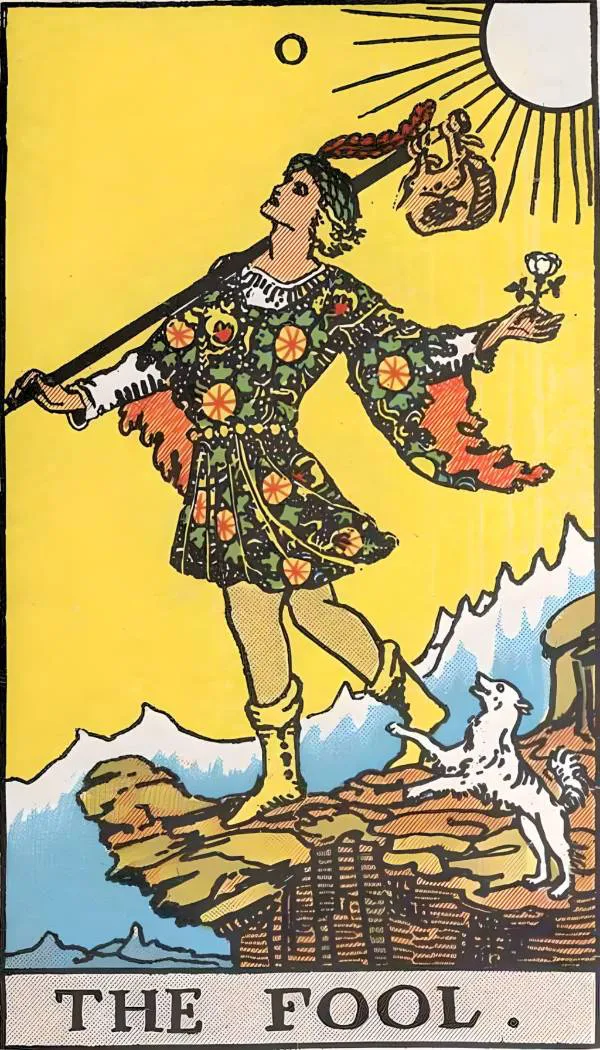
The Fool Tarot Card Meaning

This young person stands on the edge of a cliff, facing the precipice, and his actions seem to have no intention of stopping. Perhaps he is about to move forward, or perhaps he is jumping. His face shows a joyful smile, and his posture is pleasant and jubilant. We cannot understand his behavior, so we call him the Fool.

Perhaps he is a free-spirited bard, or perhaps he is just a wanderer. We do not know where he comes from, nor can we predict where his next step will go. He looks up at the sky, with a light and casual posture. He ignores the existence of the surrounding affairs, regardless of the situation he is in, he is just 'striding forward', ignoring the steps under his feet to step on the edge of the cliff.

Behind the Fool, the sun is hanging high, and he is walking towards the sun with his back to it, and there is a white little dog at his feet. His gender is not obvious, he may look like a boy, but he can be seen as a gender-neutral or sexless character.

The Fool's left hand is holding a rose, holding the stem with his index finger and thumb. The rose is a symbol of nobility and passion, and the white rose represents a passionate and pure heart. If it is a red rose, it strengthens the passion and changes with the flower in the hand. His hand is open, as if he is about to welcome something.

The Fool's right hand holds a staff, which is on his shoulder. At the other end of the staff is a bundle. The appearance of this bundle is red and has the mark of an eagle's head, which is facing the direction of the sun behind him. We are curious about what is hidden in the bundle, and this curiosity is a mystery, which is hiding an unknown. Some people say that it contains the exclusive items of the four elements, which are the props on the Magician's desk - the Cup, the Coin, the Wand, and the Sword. Some people say it is the scroll in the hands of the High Priestess, some people say it is the key in the hands of the Pope, or the Ankh in the hands of the Emperor. Anyway, the content can be any mysterious element, or various powerful magical tools.

The Fool is wearing a laurel crown on his head, which is a symbol of spiritual victory, representing absolute confidence and unparalleled courage. There is also a long feather inserted on it, which, like the child in the Sun card, has an innocent meaning. The red feather also symbolizes a hot brain and mental operation. The feather on the Fool's head can also echo the eagle on the end of the staff.

The clothes worn by the Fool have a bit of ragged sleeves, and it can be seen that the inside is red, which also reveals the passionate inner state. And the outside color is green, representing a peaceful and open consciousness. He is wearing yellow boots on his feet, which is a symbol of lightness and non-attachment. On the whole dress, there are many colorful patterns and patterns, these seemingly inconspicuous patterns are actually meaningful, and many of them contain a lot of esoteric symbols. There are some green grape leaves, which are the vitality and inspiration of wine.

If you want to delve into it, there are patterns similar to the small 'Wheel of Fortune', and there are X-shaped circles, similar to those on the Pope's body. The entire picture of the Fool has many graphics related to O. In the circle on the clothes, there are many red flame-shaped graphics, which are symbols of passionate passion, and are also related to the fruit of the Tree of Life in the Lovers card, symbolizing endless vitality. In addition, there are magical symbols, and the Hebrew letter 'ש' Shin, because this is the Hebrew letter configured to this card in the Waite's esoteric system. The meaning of this letter is the result of human pursuit of truth and faith. The function of these esoteric patterns is to enhance the mystery that the Fool carries.

Most of the time, an animal accompanies the Fool, which may be a dog or something else, and different Tarot cards have different animals. The one accompanying the Waite Fool at the foot is a white little dog. It is jumping, raising its front legs, and looking up at the person. Is the little dog the Fool's pet? Or is it a companion on the road, or just a brush encounter, or even infringing on it? Is the little dog barking at the Fool? The little white dog represents the voice of the surrounding environment, and it is also the reaction of one's own inner heart, which is another side of the Fool.

The whole cliff is a piece of rock, and the Fool is stepping on a piece of yellow soil, which is not detached from reality. The distant peaks are covered with white snow, implying the sublimity of the mountains, which is a temperature contrast between heat and ice. What we need to pay attention to is that the Fool is walking towards the sun with his back to the sun, so where will he go? It may not be towards the light, but towards the cliff and fall. However, the choice of life is unpredictable, who knows if the beating Fool will turn or look back in the next step, or will he still move forward?

The Young Man

A young, carefree man represents the Fool. He stands at the edge of a cliff, about to take a step forward into the unknown, embodying the spirit of adventure, spontaneity, and new beginnings.

White Rose

In his left hand, the Fool holds a white rose, a symbol of purity and innocence. The rose signifies that the Fool’s intentions are pure as he embarks on his journey.

Small Bag and Walking Stick

Slung over the Fool’s right shoulder is a small bag attached to a walking stick, representing his few material possessions and his readiness to travel light. The bag carries the experiences and lessons he will accumulate on his journey.

White Dog

A small white dog jumps excitedly at the Fool’s heels. The dog symbolizes loyalty and companionship, reminding the Fool that he is not alone on his journey.

Mountains

In the background, towering mountains rise, representing challenges and obstacles that the Fool may face on his journey.

Sun

The sun shines brightly in the sky, illuminating the scene. The sun represents the warmth, vitality, and energy that the Fool brings to his journey.

Colorful Tunic

The Fool wears a colorful tunic adorned with pomegranates, a symbol of fertility, abundance, and creativity. The tunic represents the Fool’s potential for growth and self-expression.

Cap with Feather

The Fool’s cap features a feather sticking out, symbolizing his free spirit and open-mindedness. The feather reminds the Fool to stay light-hearted and open to new experiences.

Psychological patterns in The Fool
Fresh Start Fantasy
The white rose, the tiny bundle, and the open hand give the scene a ritual of emotional reset: nothing heavy, nothing contaminated, everything ready to begin again. Even the pack looks edited down to only what the next chapter needs, as if the past can be carried in symbolic form without its full weight. In decision work, that imagery points to a mind that loads renewal onto the option itself. You may not just want a different path; you may want the new path to cleanse fatigue, regret, or sunk cost for you, which is why the promise of beginning can outshine the harder audit of what remains unresolved.
Self-Sabotage
The smiling figure is already at the cliff edge, with the body tilted forward and almost no physical buffer under the next step. The white dog jumps at the heel like a live feedback signal, but the posture keeps moving as if momentum itself were proof of safety. That is how a lifestyle system gets undone by one impulsive choice after progress finally starts to take shape. You are not secretly trying to fail; the pattern lets stimulation outrun calibration, so the very energy that launches change can also break the structures meant to hold it.
Optimism Bias
The lifted chin, the bright sun, and the white rose load the scene with purity cues, while the figure's gaze skips the ground right in front of the next step. Even the cliff is visible, yet it is emotionally edited out by the larger feeling of possibility. In close friendships, this is how Optimism Bias works. You read warmth, chemistry, or shared ideals as evidence that reciprocity will arrive on its own, so warning signs stay downgraded until the imbalance is already built in. The card does not mock hope; it shows how hope can become a filter.
Novelty Seeking
The whole figure is organized around forward motion: one foot at the edge, a travel staff over the shoulder, almost no baggage, and a dog that heightens the sense of movement. Nothing in the scene settles; it invites the next moment before the current one has finished landing. That makes the card a strong visual map for a system that feels most alive when something is just beginning. In love, Novelty Seeking can make pursuit, uncertainty, and sudden chemistry feel richer than steadiness. Once the relationship asks for repetition, maintenance, and ordinary intimacy, Your energy can drop because the nervous system was bonded to stimulation rather than depth. The card does not shame the hunger for freedom; it exposes the habit of mistaking activation for aliveness.
Action Bias
The Fool's body is already committed to motion before the ground has fully been checked. The chin lifts, the chest stays open, and the bundle is so light that almost nothing slows the next step. That visual structure captures a system that regulates uncertainty through movement. You do not act because the timing is clear; you act because acting temporarily quiets the tension of not knowing. The cliff matters because it is visible. This is not literal blindness; it is selective relief. In timing questions, that becomes Action Bias: sending the message, making the jump, launching the plan, or leaving the situation a beat too early because pause feels more dysregulating than risk. The card links your timing stress to a nervous system that confuses motion with alignment.
Routine Avoidance
The staff rests lightly on the shoulder, the bundle is small, and the yellow boots are built for motion rather than settlement. Nothing in the body says 'root here'; the whole figure is organized around departure, lightness, and staying unburdened. In daily life, that can turn repetition into a felt loss of space. You are not incapable of discipline; the pattern starts reading routines as enclosure, so skipped basics, spontaneous detours, or total resets become ways to recover freedom when maintenance begins to feel too fixed.
Avoidance Coping
The smile stays easy, the chin stays high, and the eyes are pulled away from the ground that actually requires attention. The scene looks light, but there is very little grounding in it, and the only way the pose survives is by not stopping long enough to feel the edge. In close friendships, that becomes Avoidance Coping. Hard conversations get replaced with humor, delay, breezy replies, or sudden topic shifts because naming the truth would force the bond to change shape. The card shows a defense that protects harmony in the moment by refusing contact with the exact point of discomfort.
Commitment Avoidance
The staff rests lightly on one shoulder, the bag is small, and the figure lives exactly at the threshold rather than inside any settled space. Even the dog's companionship stays mobile; everything in the scene says connection is allowed, but permanence is optional. In social ecology, that turns into a pattern where you can enter circles easily but struggle to root in them. You keep friendships warm, witty, and open-ended, yet the moment a community starts asking for consistency, mutual dependence, or a stable role, leaving feels safer than being known deeply enough to disappoint or be disappointed.
Social Overextension
The lead foot pushes into the cliff's airspace before the body has fully registered the drop, and the whole image leans forward as if momentum itself has taken command. The little dog at the heel adds extra activation, like outside energy pressing the nervous system to keep going rather than pause. In group settings, that becomes social overextension: saying yes before checking capacity, joining one more plan before feeling your own threshold, and staying in circulation because stopping might trigger fear of exclusion. The cost is that belonging gets measured by motion and availability, so exhaustion has to announce limits that your boundaries never got to set in time.
Emotional Cutoff
At the lip of the cliff, the figure keeps moving while the dog throws energy upward from behind and the ground nearly runs out. The body does not turn toward the signal; it creates safety by increasing distance faster than it creates understanding. You can feel the family version of this immediately. When contact starts to trigger guilt, engulfment, or regression into the old child role, the nervous system may choose silence, delayed replies, vague updates, cancelled visits, or geographic distance because disappearing feels cleaner than negotiating. Emotional Cutoff is a powerful short-term regulator, which is why it can look like freedom at first. The cost is that separation gets built through absence rather than through named boundaries, so the family field stays charged and your autonomy never feels fully settled.
Core Struggles in The Fool
Freedom-Structure Conflict
The white rose is held delicately in one hand while the staff and bundle rest lightly over the shoulder. Everything about the figure suggests openness and motion, yet the cliff makes the need for structure physically unavoidable. In friendship, this tension appears when a bond feels most meaningful because it is easy, spontaneous, and uncontracted. You may fear that naming limits, asking for reciprocity, or changing access will make the connection less pure. The card holds both truths in the same image: the rose needs openness, and the body still needs ground. The struggle is the collision between wanting friendship to stay free and needing enough structure for the freedom not to become unsafe.
Threshold Disorientation
The Fool's raised foot hovers at the cliff edge while the eyes lift away from the ground. The ledge is not hidden, yet the body is already committed to a threshold it has not fully mapped. Academic thresholds carry the same geometry when a new course, thesis, application, exam cycle, or degree decision asks for movement before orientation has stabilized. You are not simply being indecisive; the card locates the struggle at the point where possibility expands faster than your internal reference system can settle. The open sky makes the future feel enormous, while the cliff compresses the next move into one unstable step. That is the shape of Threshold Disorientation: not a lack of ambition, but a real loss of coordinates at the exact moment school demands forward motion.
Feedback Disconnection
The white dog rises at the Fool's heel while the Fool's attention stays lifted toward the open sky. A signal is close enough to touch the body, but it sits below the line of sight and fails to redirect the step. In a social ecosystem, that becomes the friction of noticing too late which group drains you, which conversation changes the room, or which friendly invitation carries a cost. You are not without signals; the signals are arriving from a channel your current navigation system is not using. Feedback Disconnection names the split between available social information and usable social guidance. The card turns the confusion into something visible: the cue is present, the movement is active, and the link between them is the broken part.
Routine Freefall
The footline keeps moving along a ledge where the usable ground has already narrowed to almost nothing. The staff is still carried, the gaze is still lifted, and the body has not lowered into a stance that could absorb the next impact. When your growth process turns into repeated resets, the image does not show a lack of motion. It shows motion without a daily surface underneath it, where plans, inspiration, and identity upgrades keep advancing faster than the routines that would let them land.
Relational Pacing Collapse
The Fool's stride compresses departure, excitement, and the drop into one suspended instant. The body has not built a transition zone; it moves as if the next stage can be entered by momentum alone. In friendship, this becomes the sudden rush from casual connection into intense access, private disclosure, constant messaging, or emotional reliance. You may feel the bond becoming real very quickly, but the relationship has not yet developed the footing that lets closeness hold weight. The small bundle over the shoulder matters because it suggests travel without much tested supply. The card does not condemn the leap; it shows the pressure created when the pace of intimacy outruns the structure that would make that intimacy sustainable.
Relational Boundary Drift
The Fool's front foot hovers at the cliff edge while the face stays lifted toward open air, and the staff rests unused across the shoulder. The body is already moving through a boundary before the eye has checked where that boundary is. In friendship, that same structure appears when warmth, access, and casual availability keep expanding without a named stop line. You may still be smiling, replying, showing up, and keeping the connection light, but the ground under the friendship has narrowed. The small white dog at the heel gives the scene a grounded signal that does not yet reorganize the stride. The struggle is not a lack of care; it is a relationship edge that keeps moving because no one has made it visible enough to stand on.
Idealization-Reality Split
The white rose, lifted face, bright sun, and joyful posture sit in the same frame as the cliff. The visual field holds innocence and consequence together, but the Fool’s attention privileges the upward story over the foot-level facts. Idealization-Reality Split becomes visible when the inner narrative of renewal outruns the body’s contact with reality. You may recognize the sincere desire to heal, start over, forgive, become lighter, or trust the unknown, while the unprocessed material underneath still has weight. The card witnesses the split without shaming the longing. It shows how a beautiful internal story can be true in intention and still incomplete as a map, especially when inner work turns brightness into a way of not looking down.
Belonging Drift
The Fool appears as a traveler with a small bundle, no visible home behind, and no certain road ahead. The mountains, sun, sky, and cliff create a world full of possible directions without offering a place where the body can settle. Across friend groups, communities, and loose networks, that picture becomes the experience of moving through many circles without finding one that returns enough recognition to feel inhabitable. You can keep meeting people, showing up, and staying open while still lacking a social ground that holds you. Belonging Drift names the difference between social movement and social anchoring. The card gives the drift a shape: the issue is not absence of contact, but the absence of a place where contact becomes a stable sense of being with your people.
Risk Normalization
The Fool's light step occurs on a ledge where the margin for error is almost gone. In the reversed texture, the dangerous route is not treated as exceptional; it becomes the path the whole body has learned to use. Academic risk can become familiar in exactly that way. Last-minute studying, skipped drafts, unread rubrics, and untested confidence stop registering as danger because the system has repeatedly survived by moving only at the edge. Risk Normalization names the moment when urgency becomes the study environment itself. The card does not shame the pattern; it shows how a cliff can become ordinary when no other ground has been made visible.
Potential Overidentification
The bundle on the staff is small, sealed, and visually charged with possibility, but its contents are not tested against the cliff, the road, or the distant mountains. The image carries potential as a symbol before it proves itself as a working system. Career culture often rewards that same sealed promise: high potential, fast learner, future leader, founder energy, creative genius, strong personal brand. The struggle begins when the self becomes attached to the promise of what could be done, while the present evidence of what can be reliably carried remains unopened. Potential Overidentification names the fusion between identity and future capacity. The card gives that fusion a visual boundary: the bundle may contain real resources, but until they meet the ground, potential is not yet the same thing as support.
Inner Emotions in The Fool
Restless Optimism
The forward stride that does not slow at the ledge gives optimism a restless motor. The Fool’s small bundle and far horizon make the next cycle look available, but the visible drop keeps that brightness from becoming simple ease. You meet Restless Optimism when timing starts to feel almost right and that almost becomes hard to tolerate. The card names the charged mood of wanting the season to turn now, before the ground ahead has fully answered.
Freefall Anxiety
The Fool's foot reaches the cliff edge while the gaze stays lifted away from the drop, creating a sharp split between forward motion and ground awareness. The open sky no longer functions as room to breathe; it frames how little usable ground remains under the next step. In lifestyle questions, that image becomes Freefall Anxiety when a reset starts to feel like losing the structures that kept work, sleep, food, health, and home from sliding into each other. The fear is not about being incapable; it is about sensing that momentum has outrun the container, and that the next move needs to be seen before it is taken.
Untethered Restlessness
The staff on the shoulder and the lifted foot turn the whole body into motion, while the path ahead thins into a ledge. The scene does not settle around a home, a partner, or a fixed route; it keeps pulling attention toward the next opening. In relationships, Untethered Restlessness names the feeling of needing movement the moment intimacy starts to stabilize. The card reveals a relational weather pattern where safety can be mistaken for stillness, and stillness can feel like losing access to air.
Liberating Uncertainty
With one foot poised at the cliff and eyes lifted toward the open sky, the Fool turns the unknown into a visible threshold. The small bundle on the staff keeps the body light, as if only the essentials are being carried into the next version of life. In personal growth, that image maps to a state where not having the full plan can feel clarifying rather than paralyzing. You are not being asked to prove the entire route; the emotional logic of the card is that movement itself can reveal which parts of the self are still alive, curious, and available for change.
Existential Vertigo
The sun behind the Fool, the gaze lifted away from the ground, and the unshown landing point create a strange directional split. The scene is full of motion, but its inner reference points do not line up: light behind, eyes above, foot at the edge, future ground absent. In academic life, this can surface when a degree, thesis, or career-track credential suddenly loses its felt meaning. You may still be moving through classes and deadlines, but the card reflects the vertigo of realizing that motion is not the same as orientation.
Free-Fall Anxiety
The raised foot hovers at the exact place where the ground ends, while the Fool’s gaze remains lifted away from the ledge. In a social setting, that creates the inner structure of entering a group before you have enough cues to know where you stand. The open air beneath the next step turns possibility into a bodily drop. Free-Fall Anxiety names the rush that comes when a room, circle, or network feels exciting from far away but suddenly becomes unstable once your own presence is on the line.
Social Vertigo
The cliff edge gives the Fool's lightness a sudden vertical dimension. Solid ground ends sharply, the mountains sit far away, and the figure's buoyant posture does not fully register how quickly the environment changes underfoot. In friendship, Social Vertigo appears when the social ground under you shifts before your emotions have recalibrated. A close friend pulls away, a group reorganizes itself, an inside joke turns into exclusion, or a familiar role no longer fits, and the whole relational map seems to tilt. This card carries that dizzy social weather because it places openness beside a drop. The image does not tell you to freeze; it helps you locate the exact edge where innocence, trust, and group belonging need a more conscious footing.
Unburdened Hope
The small bundle tied to the staff, the light yellow boots, and the wide sky around the figure make the journey look portable rather than overloaded. Nothing in the image is packed heavily; even the rose is held with fingertips, as if the hand can carry meaning without gripping it. In a lifestyle reading, that physical lightness becomes Unburdened Hope: the feeling that a more spacious life might be possible if the daily system stops asking you to carry every old obligation at once. The card gives that hope a practical shape by showing how little the figure takes forward, and how much psychological room opens when the load is visibly reduced.
Playful Courage
With the white rose held lightly and one foot moving toward open air, the Fool turns academic risk into something the body can meet without becoming rigid. The lifted chest, loose shoulders, and bright field around the figure make courage feel mobile rather than armored, like the first honest step into a paper, course, or research question that is not yet mastered. You may recognize this emotion when a new academic beginning feels risky but not deadening. The card gives that feeling a precise shape: a willingness to learn before certainty arrives, carried by curiosity, lightness, and enough nerve to let the first step be unfinished.
Untethered Excitement
The Fool’s lifted foot, open chest, and feathered cap turn motion into a visible inner weather: the body is already saying yes before the route has been measured. The cliff does not erase the charge in the scene; it concentrates it, making the unknown feel less like a wall and more like an opening that has not been named yet. For a direction reading, Untethered Excitement appears when your energy starts moving before your plan catches up. The rose, the light bundle, and the wide sky suggest a self that is not carrying every old expectation into the next chapter, which can feel thrilling precisely because the usual anchors have loosened.
Outer Contexts in The Fool
Life Reset Phase
The young traveler steps away from any visible home base with only a small bundle, a staff, and the open air ahead. The scene holds the exact architecture of a reset: light resources, few fixed attachments, and a threshold that has not yet become a mapped path. For introspective work, that image points to a period where life has been stripped back enough for hidden priorities to surface. You are not looking at a finished reinvention; you are looking at the first external clearing where old routines stop controlling the audit. The cliff matters because a reset is never just aesthetic. It creates space, but it also removes familiar railings, so the real task becomes seeing which parts of the old life were structure and which were only inherited momentum.
Routine Collapse
The raised foot hangs at the cliff edge while the gaze is lifted away from the ground. The dog is active at the feet, the route has no visible continuation, and the body keeps moving as if feedback has not reached the system in time. Routine collapse has the same structure: the day still moves forward, but the signals that would normally regulate it no longer connect. Sleep windows, meals, errands, work blocks, cleaning, and recovery stop forming a sequence, and each task begins to feel like a separate edge. The reversed Fool links this context to motion without integration. It shows the point where a lifestyle system does not need more ambition; it needs the missing feedback loops that tell you where the ground is, what has already slipped, and which part of the day requires containment first.
Impulsive Life Pivot
The raised foot at the cliff edge turns movement into a real-world commitment before the landing zone has been inspected. The small bundle and bright costume make the leap look light, portable, and almost frictionless, while the precipice underneath keeps the cost of momentum physically visible. In a choice reading, this mirrors the moment when a life pivot is being driven by urgency, novelty, or escape energy before the decision architecture has been audited. You are not looking at change itself as a problem; the card exposes the gap between the speed of the impulse and the amount of external structure actually waiting to catch it. The white dog at the feet becomes the pressure of ignored feedback, not a command to stop. It marks the data points around the decision that have not yet been integrated: timing, money, social support, exit costs, and the difference between an opening and a drop.
Off-Script Life Path
The Fool stands outside any gate, road, workplace, or institution, with only the dog and the open edge responding to the next step. The scene has no official marker telling the figure what counts as progress. That absence is the pressure point of an off-script life path. In direction work, the card names the social friction of moving without a conventional timeline: you can hear the external noise around the step, but the map has to be built from lived evidence rather than borrowed approval.
Quarter-Life Crisis
The young figure stands at a threshold with mountains ahead and no visible bridge between the present ledge and the distant terrain. The card compresses youth, possibility, risk, and scale into one exposed step. That is why it resonates with a quarter-life crisis in direction work. The external pressure is not just one decision; it is the collision of social timelines, adult markers, and long-range uncertainty arriving before a stable path has formed, leaving you to locate where the next real footing exists.
Ignored Red Flags
The small white dog jumps at the traveler's heel while the foot keeps moving toward the cliff. The warning is part of the scene, close to the body, and still not integrated into the direction of travel. For introspective work, this is the external texture of ignored red flags: feedback exists, but the pace of the situation keeps outrunning the pause it requires. Friends, timing friction, repeated misalignment, or practical warnings may be functioning like the dog at the heel, present enough to notice but not yet strong enough to redirect the step. The card gives the warning a visible body. It asks for a reality audit of what has already been signaled, rather than another search for reassurance after the edge has been crossed.
Decision Cliff Edge
The lifted foot hangs beside a cliff edge where the ground ends without a bridge, railing, or visible landing. The body is already in motion, but the environment has not confirmed that the next step can hold weight. In an introspective spread, that image becomes a decision point that has arrived before the inner audit is finished. You may be facing a choice that looks simple from the outside, while the actual structure underneath is full of missing information, timing pressure, and unclear support. The value of the card is the way it slows the threshold down. It does not decide for you; it makes the cliff line visible so momentum, fear of delay, and genuine readiness can be separated.
Risk Blind Spot
The traveler's face is lifted toward the sky while the feet approach the drop. The danger is not hidden from the viewer; it is simply outside the line of attention that is guiding the body. That is the cleanest visual logic of a risk blind spot. In introspection, the external facts may already be present, but a confidence script, idealized new beginning, or reinvention narrative has become brighter than the terrain. The card restores proportion. It shows you the scale difference between the cheerful forward motion and the larger environment, making it possible to audit what has been edited out of the story before the next step becomes costly.
Pathless Transition
The figure stands at a threshold where no paved road continues forward. There is landscape, height, sun, and distance, but there is no socially approved lane telling the body where to place the next step. That is why this card fits a pathless transition in introspective work. The outside world has stopped providing a usable script, so your inner audit is not happening in comfort; it is happening because the old coordinates no longer organize the next move. The mountains in the distance keep the stage serious. This is not aimless wandering; it is a life phase where progress has to be redefined before movement can become grounded again.
Premature Launch Pressure
The step toward the precipice has momentum, but the scene offers no bridge, rail, or landing zone. In a career setting, that visual pressure mirrors a project, role, or public move being pushed into motion before the conditions are mature. The card highlights launch energy separated from operational readiness. You are being pulled into visibility while the map, resources, or timing remain unfinished, which makes the real question less about courage and more about structural readiness.