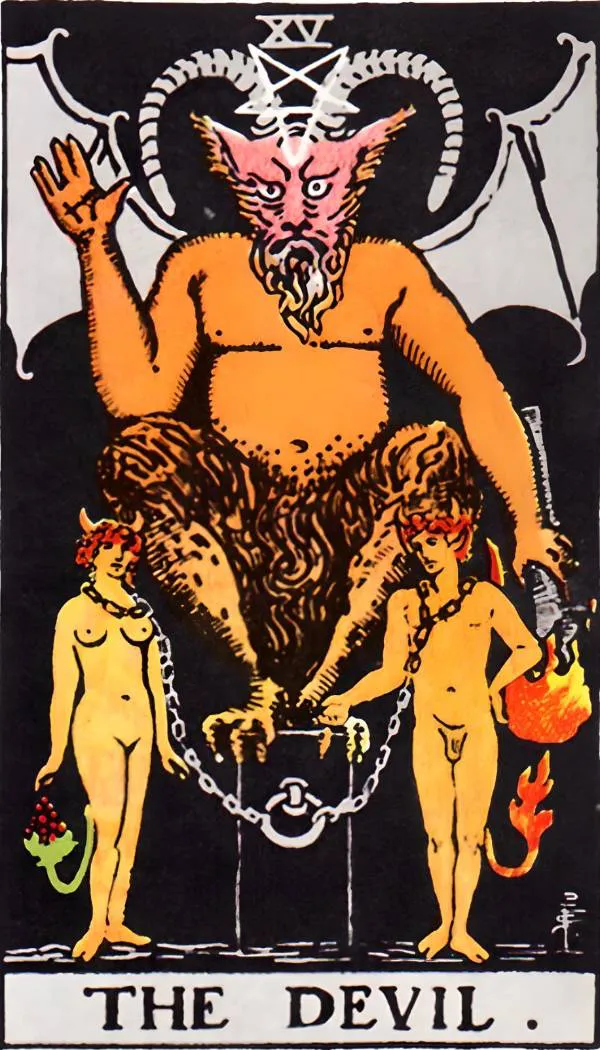
The Devil Tarot Card Meaning

This card's theme is the Devil, with the main character being the Devil himself. What is the specific image and name associated with this deeply rooted term? In the West, the image of the Devil seems quite fixed, with a name, a history, and an origin, rather than being just a general term. There has been a certain tradition over time, and the depiction of this card is most valued for its adherence to tradition, as if changing the image of the Devil would be a noteworthy record. Thus, when it comes to the Devil, there is a particular emphasis on his identity and image.

The focus of the Devil card is the Devil, so let's first explore his appearance and identity. The Devil's appearance: The traditional Western image of the Devil has several characteristics: he has two horns, which are derived from the image of the horned god. Additionally, there are some unusual features - the main body is naked and covered with animal hair, with a pair of bat-like wings, and hands and feet depicted as the greedy and cruel talons of an eagle. In the mid-eighteenth century, the Devil in Tarot cards was portrayed in this manner, presenting the bestial nature of a beast.

Actually, the goat-headed appearance of the Western Devil originally came from important Egyptian gods, such as the main god Amun and the creator god Khnum, both of whom had the form of a goat-headed human. Due to becoming the religion opposed by Christianity, these gods of fertility from various places were all belittled. These gods, along with other horned gods from various regions, retained their faith and formed what is known as 'paganism', and these types of gods were collectively referred to as 'horned gods'. For Christianity, which is considered the 'orthodox' religion, these pagans are considered to be witchcraft and magic, and the horned god actually conflicts with their religious practices. Thus, the horned god was regarded as equivalent to the 'Devil', and the goat horns later became a symbol of the Devil.

'Pan', the god of the forest, is also a god with a goat-like appearance in Greek mythology. Pan is a creature with a head and body almost entirely in the form of a goat, with only the upper body and arms resembling a human, and is also one of the original images of the horned god. However, the overall image of the Devil is a blend of many other images. The one that is most similar to the Devil's appearance should be the Satyr. He is a 'forest god' in Greek mythology, also with a half-goat and half-human shape, with a human upper body and goat's hind legs, including genitals, tail, and animal hair on the legs and hooves. Satyr is a follower of Dionysus, the god of wine, and is also associated with drama and art. Of course, his most famous characteristic is his strong sexual desire.

From the image of the Devil, the goat head is a fixed and natural product, mostly a variation of the horned god, and the wings may have been added later to indicate a confrontation with God and angels. The reproductive power and celebration of life of the horned god are also the most contradictory to the belief in Jehovah that opposes materiality and advocates for a spiritual heaven.

So, is the Devil depicted in this card the famous 'Satan'? The Devil is, of course, the chief of devils, and the title of the chief of devils is Satan. Ancient nouns with similar pronunciations have been discussed, such as the 'storm god' Seth from Egyptian mythology, the Roman god of agriculture Saturn (corresponding to Cronus in Greek mythology), and the 'forest god' Satyr. Most of these names have the meaning of being opposed to the current orthodox god, and thus they were also used by Jehovah/Christianity as the title of the Devil. This name has already appeared in the Old and New Testaments of the Bible. The Devil as Satan is not a self-proclaimed title, and it may also be a general term, in any case, it is a synonym for the Devil. There are also many devils, each with their own named titles.

Therefore, 'Satan' can be considered a 'title', and it is not limited to one person. Some 'great demons' are also named Satan, and Beelzebub is also a devil's name that has appeared in the Bible. As for the famous 'Lucifer' or 'Lucifuge', the original meaning is the morning star (which is Venus), and it is said to be the seraphim in heaven, with power, ability, and glory only second to God. The story of him becoming a fallen angel and then ruling hell as the demon king is very famous. The origins of many other names come from literary works or various writings that name the devil characters. Names we often hear, such as 'Mephisto' / 'Mephistopheles', come from 'Faust'. The 19th-century French occultist Eliphas Levi, who painted a devil image called 'The Baphomet of Mendes', made this devil's name Baphomet very famous. In fact, these names and titles each have their complex and different origins.

Levi's painting transformed the image of the Devil into one with high magical power and cultivation, with the same goat-like head, a pair of goat horns, and a chin like a goat's beard. What is different is that there is a torch between the two horns, the genitals are symbolized by a double snake staff, the lower body is covered with clothes and seems to be in a sitting position, looking like some kind of mysterious ritual. Later Tarot cards' depictions of the Devil were mostly modified according to the prototype drawn by Levi. The Waite Devil card also made changes based on this image, still using the goat head to symbolize lust, and the lower body is in the form of a beast with long hair.

The Devil usually has a pair of wings on his back, and the Waite card's Devil is no exception. This pair of wings is in the shape of a bat, showing a gray and dull color, and in the West, bat-like wings are used to represent falling into darkness. The body does not necessarily have to be painted in this image, any species as long as it has this kind of wings represents something related to the Devil. The lower body of this Devil is covered with long hair, representing the intensity of desire and the primal nature of a beast.

The Devil extends his right hand, and the palm lines on the hand are clearly visible. The two lines that intersect horizontally and vertically represent the meaning of misfortune and evil thoughts. The style of the fingers is a special gesture, indicating the doctrine of the Devil. This gesture is also very close to the gesture of the Pope, but what he shows is disaster and temptation, not blessings and guidance.

Between the two horns on his head, there is the symbol of an inverted pentagram, which is the symbol of the Devil. The original meaning of the pentagram is the balanced development of various elements, with the spiritual aspect growing accordingly. However, the inverted pentagram connects to things underground, with the tip of the shape drilling downwards, representing the meaning of falling, due to excessive materialization and falling into darkness, which is a downward energy. This card can thus connect the Major Arcana and Minor Arcana, symbolizing the fifth element Major Arcana leading the four elements Minor Arcana with the pentagram. Another meaning of the number five is connected with the card number 15, which is the meaning of the inverted pentagram or a mysterious manipulator outside the pentagram.

Most devils also have their followers, usually two 'small demons' in front of the Devil. Since Papus, the imps have been changed to naked humans, one man and one woman entangled with each other. The Waite Devil card has inherited this, and in front of the Devil, there is a very obvious pair of men and women in the picture. We can easily think of the couple in the Lovers card, but their identity here is equivalent to 'small demons', so they also have tails, but no wings. This couple may be Adam and Eve, and their faces seem almost identical to them. And the overall shape of the two is closer to the aforementioned Satyr.

The Devil squats, his claws tightly gripping a long black cubic stone, which is the altar of the Devil. In front of the cubic stone is a large metal ring, and the ring is linked by two iron chains to two vassal slaves. These two chains are respectively placed around the necks of the man and the woman.

Because the man and the woman have already fallen, they have also grown horns on their heads and have sprouted evil tails, and they have already become the form of small demons. The tails of both men and women are raised upwards. The end of the woman's tail has the flame of the fruit of wisdom (like grapes), and the end of the man's tail also has the fruit of the tree of life, clearly showing the stage of falling after being tempted to eat the forbidden fruit. The Devil holds a torch in his left hand, which is the fire of desire. The torch droops down, and this fire almost touches the man's tail, causing him to burn and catch fire, and the fruit of the tail has formed into flames.

In the territory of this Devil, the expressions of the man and the woman are different from the man and the woman in the paradise under the jurisdiction of the angel, and the focus of their eyes is different from that in the 'Lovers' card. Here, the man looks at the lower body of the woman, and the woman looks blankly into the distance. Like the position in the Lovers card, the woman is on the left of the picture and the man is on the right. They are now controlled by the Devil, and they may have become the captives of the Devil because of their fall. This couple is united by the Devil as a witness, indicating that they are united because of desire. The love between the two is now controlled by the Devil, and the love is dark from now on.

The overall background presents a dark tone, and there is a feeling of the fire of desire. From the overall picture, vitality and vitality are still vigorous, and even the passion is even more intense. It's just that the spirit tends to the dark side, the energy focuses on a narrow place, or performs dramas that the world does not recognize.

The Horned Goat

The central figure resembles the mythical Baphomet or the Horned Goat, representing the darker forces of nature, primal instincts, and our base desires. This image is a reminder of humanity’s vulnerable nature to materialism, temptation, and bondage to one’s own vices.

The Inverted Pentagram

On the forehead of the Devil is an inverted pentagram, which traditionally symbolizes the descent into matter, or the material world taking precedence over the spirit. It can represent a distortion of values and an imbalance between the material and spiritual realms.

The Torch

The torch that the Devil holds burns downwards, emphasizing the descent of wisdom and enlightenment in the material realm. It suggests the misuse of power and knowledge for lower desires.

The Chains

The chained man and woman are symbolic of the chains that bind individuals through ignorance, materialism, and addiction. The fact that the chains are loose implies that the bondage is self-imposed and can be removed with self-awareness.

The Wings

The bat-like wings of the Devil symbolize the descent into the lower realms or the shadow side of our nature. They hint at the hidden aspects of our psyche, which we might be unaware of or choose to ignore.

The Raised Hand

The raised right hand of the Devil, in a gesture similar to that seen in The Magician card, implies that he has power and dominion in his realm. But unlike the Magician, whose power is derived from higher spiritual sources, the Devil’s power is based on materialism and lower desires.

Psychological patterns in The Devil
Self-Sabotage
The torch points downward and nearly ignites the man's tail, so the image does not only show temptation; it shows desire becoming heat against the self. The same energy that could illuminate the scene is turned toward the body in a way that consumes rather than clarifies. Self-Sabotage in a lifestyle reading often appears right when a stabilizing system begins to work. A cleared room gets recluttered, a sleep rhythm gets broken, a helpful routine gets skipped, or a week of progress is followed by a sudden return to chaos. The Devil's loose chains reveal why this can feel so confusing. You may have more agency than the pattern admits, but the nervous system can still recreate disorder because disorder is familiar, stimulating, and strangely easier to trust than stability.
Avoidance Coping
The figures stand close to the chain ring, but the chain loops do not clamp tightly around their throats. The image creates a sharp psychological tension: the exit is not clean, but the body has also stopped testing the available space. In the reversed career field, Avoidance Coping appears when the system has trained You to delay the move that would reveal your real leverage. The hard conversation, job search, salary ask, portfolio audit, or team transfer becomes the thing postponed because not knowing feels safer than finding out. The Devil's power flow keeps attention fixed upward on authority, fear, and consequence. The pattern is not laziness; it is a protective freeze around agency, where staying still becomes the short-term method for avoiding the anxiety of action.
Spiritual Bypassing
The Devil's raised hand resembles a ritual gesture, and the inverted pentagram carries the shape of spiritual symbolism while directing its force downward. The torch does not open the scene; it feeds heat into the lower body and keeps the chamber charged. In the reversed texture, this becomes Spiritual Bypassing: meaning is not absent, but misused. Symbols, insight, and self-awareness can become a polished container for avoidance when they help the psyche feel evolved without requiring behavioral contact with the avoided truth. In personal growth, You may keep naming the pattern, journaling about it, reading about it, or turning it into an identity of healing while the actual choice remains untouched. The card exposes a distorted ritual of growth, where language about transformation becomes one more chain around the same old behavior.
Illusion of Control
The loose chains around the man and woman are the most psychologically precise detail in the card: the collars are visible, heavy, and humiliating, yet they do not fully close around the neck. The Devil's raised hand makes the restraint feel absolute, but the physical evidence shows a system that is being obeyed as much as it is being imposed. That visual contradiction maps directly onto a control loop inside the psyche. A belief, impulse, shame rule, or public mask can feel like an external command when it has been repeated long enough, even when part of the restraint now survives through attention, fear, and habit. The mind protects itself from responsibility by treating the pattern as a force outside its reach. In introspection, this pattern shows up when You sense that an inner chain is not fully locked, but the familiar story of being trapped still feels safer than testing the opening. The card does not shame the bondage; it audits the mechanism by showing where perceived control and actual choice have become tangled.
Sunk Cost Fallacy
The loose chains around the two figures' necks are the crucial visual contradiction: the bond looks humiliating and restrictive, yet it is not mechanically inescapable. Their bodies remain upright, exposed, and close to the black altar, as if the weight of the arrangement has become more convincing than the physical reality of the chain. That is the exact psychology of Sunk Cost Fallacy in a decision field. The mind treats past investment as a binding structure, even when the present situation no longer justifies the same commitment. What began as time, effort, money, love, reputation, or identity becomes an altar that demands continued sacrifice. In choice tarot, this pattern does not say the option is wrong; it reveals that the reason for staying may have shifted from genuine alignment to fear of admitting the cost already spent. You regain clarity when the decision is audited from the present tense, not from the emotional debt of what it has already taken from you.
Co-dependency
The two figures are linked to the same ring on the Devil's altar, each wearing a collar that keeps them inside the same field of command. Their shared bondage matters: the image is not only about one person trapped, but about a relational system that keeps both bodies oriented toward the same authority. Co-dependency appears when attachment becomes organized around managing the bond instead of meeting the self honestly. In family life, this can look like feeling responsible for a parent's emotions, staying available for crises, or confusing love with continuous emotional labor. The looseness of the chains makes the pattern sharper. The card suggests a bind maintained by fear, habit, guilt, and identity, where leaving the role may feel like abandoning the family even when staying keeps the self psychologically captive.
Permission Seeking
The two human figures stand under the Devil's raised hand with chains around their necks, but the loops are visibly loose. The image does not show a locked prison so much as a psychological contract: authority is made to look absolute, while the actual point of restraint sits closer to habit, fear, and learned permission. In a career reading, that visual structure maps onto the way workplace hierarchy can become internalized. A manager, title, performance review, or promotion ladder starts functioning like the Devil's gesture: not just a real power signal, but a cue that tells You when You are allowed to move, ask, negotiate, or decide. Permission Seeking is the pattern where agency gets outsourced to the system that withholds it. The card's loose chains matter because they reveal the core mechanism: the barrier may be real, but the deeper trap is the reflex of waiting for authorization even when a move is already available.
Cognitive Dissonance
The man's gaze drops toward the woman's body while the woman looks blankly into the distance. The bodies are near each other, but the attention is split; contact, desire, and emotional presence are not aligned. Cognitive Dissonance emerges when this split has to be explained away. In love, the mind tries to hold two incompatible truths at once: the relationship feels consuming and meaningful, yet parts of it feel empty, controlling, or misattuned. The inverted pentagram on the Devil's forehead gives the distortion a stable frame. You may find yourself calling intensity chemistry, calling control devotion, or calling emotional absence mystery, because naming the contradiction would threaten the attachment system that has been keeping the bond intact.
Intermittent Reinforcement
The downward torch nearly meets the man's raised tail, creating a visual circuit of heat, risk, and stimulation. The flame does not illuminate the whole scene; it concentrates attention into one charged point. Intermittent Reinforcement works through that same narrowing. In friendship, a person who alternates warmth with distance, crisis with affection, or neglect with sudden closeness can make the nervous system start tracking intensity as proof of significance. The reversed field makes the cycle harder to audit because the burn and the reward arrive from the same source. You may not be attached to the friendship's baseline; you may be attached to the next moment when the heat feels like connection again.
Boundary Diffusion
The two human figures stand exposed inside a field that has no clean edge between body, desire, and command. Their collars connect them to the same ring, the ring connects them to the same black cube, and the cube belongs to the same central figure. Boundary Diffusion in lifestyle terms has this exact geometry. Work bleeds into rest, rest gets contaminated by screens, food becomes emotional regulation, the bedroom becomes an office, and every module of life starts drawing from the same exhausted energy source. The Devil does not show a simple lack of boundaries; it shows a system where boundaries have been replaced by attachment to the strongest stimulus in the room. You may feel as if the day is full, but the deeper issue is that its parts are no longer differentiated enough to restore you.
Core Struggles in The Devil
Belonging-Authenticity Split
The chained figures are naked, but they are not simply exposed; horns and tails show that the environment has begun changing their visible form. Their gazes do not meet, and the social bond between them runs through the altar rather than through mutual recognition. You may be accepted in a circle while feeling that the accepted version of you is slightly altered, exaggerated, or edited. The Devil gives that strain a shape: belonging is present, but authenticity is being rerouted through the group's appetite, humor, status signals, or unspoken rules.
Inherited Role Lock
The chained figures do not only stand near the Devil; they have started to resemble him. Their horns and tails show a role absorbed into the body, while the loose collars reveal how familiar the restraint has become. Inherited Role Lock in a family system is not just being assigned a part. It is the deeper struggle of realizing that the responsible one, the fixer, the rebel, the mediator, or the invisible child can activate automatically whenever the family field appears. The card's reversed pressure makes the role feel normal because the body has practiced it for so long. Seeing the role as a chain rather than an identity is the first clean boundary between what you inherited and what you can still choose.
Autonomy Guilt Bind
The collars around the two figures are visibly loose, creating one of the card's sharpest physical contradictions. Nothing in the metal fully prevents removal, yet the bodies remain in place beneath the Devil's raised hand and downward torch. That is the anatomy of a friendship where autonomy exists in theory but carries a moral charge in practice. You may be able to decline, mute, leave the chat, or step back, but the anticipated guilt pulls at the throat before any outward movement can happen. The struggle is not a lack of choice. It is the bind created when choosing yourself feels like injuring the friendship, so freedom and betrayal occupy the same doorway.
Intergenerational Control Loop
The chained pair stands at the Devil's altar with collars that are visible, loose, and still connected to one central ring. Their horns and tails show that captivity is not only imposed from outside; the ruling shape has already begun to reproduce itself inside the people standing beneath it. That is the exact architecture of an intergenerational control loop in family life. You may enter a conversation as an adult, but the old hierarchy, the old role, and the old emotional script can pull the body back into a younger position before you have time to choose a new response. The card does not frame the loop as a personal weakness. It locates the struggle in a structure where power, imitation, and inherited reflex are chained together, so clarity begins by seeing which part of the pattern was built before it ever belonged to you.
Borrowed Purpose Lock
The horned figure sits over a black cube while the man and woman stand below with collars that look loose enough to lift away. The visual trap is not brute force; it is a stable center of authority that the bodies continue to face, wear, and orbit. In a direction reading, that slack chain becomes the exact shape of Borrowed Purpose Lock. You may be technically free to choose, yet your long-term path still organizes itself around success metrics, timelines, or desires that were installed before you could test whether they were yours. The Devil's raised hand and inverted pentagram make the borrowed path feel official, charged, and difficult to question. The struggle is not lack of ambition; it is the moment ambition has been attached to an altar that does not answer to your inner compass.
Unseen Cost Bind
The Devil's torch hangs low near the tail, and the chain remains loose enough to look almost harmless. Nothing in the image has to snap shut for cost to accumulate; the drain happens through repeated contact with heat, metal, and the same small radius of motion. In lifestyle terms, the expensive part is often hidden inside choices that look minor in isolation. One late night, one messy room, one extra scroll, one skipped reset can appear weightless until the whole week starts moving inside the cost of those micro-decisions. This card gives that cost a shape. It shows a bind that does not announce itself as crisis, only as the gradual loss of bandwidth, rhythm, and trust in your own daily system.
Comfort Entrapment
The collars are loose enough to lift, yet the figures remain stationed at the base of the black cube. The foreground is open, but the chain radius quietly turns openness into a small permitted orbit. In a reversed inner reading, the frightening part is not a locked door; it is the body learning to treat the familiar limit as shelter. You can feel why staying stuck feels safer than stepping into an unstructured freedom, and that is the exact shape the card holds up for review.
Timing Control Strain
The Devil's raised hand freezes the scene while the torch points downward and the chain lines run from the figures' necks into a fixed iron ring. The image does not show a locked gate; it shows a control system that has taught the body to measure movement by the radius of a chain. In a timing question, that geometry names the strain of trying to command a cycle from inside the cycle's own pressure. You may be watching every deadline, signal, and opening so tightly that timing stops being a field to read and becomes a force you feel trapped under.
Internal Authority Collapse
The inverted pentagram, downward torch, and raised hand create a closed reference system. With no external horizon in the image, the figures are left inside a world where the wrong axis can start to feel like the only axis. In academic life, Internal Authority Collapse appears when rubrics, deadlines, grades, advisor reactions, and institutional signals replace the student's own judgment. You can keep producing work while losing the ability to sense whether a direction is meaningful, sufficient, or yours. The Devil's structure gives this collapse a visible architecture: authority is present, but it points downward and keeps the body still. The struggle is not a lack of intelligence; it is the loss of an internal reference point after too many external systems have been allowed to decide what counts as valid.
Power-Intimacy Split
The chained couple stands where The Lovers once stood, but the open sky has been replaced by a black altar, loose collars, horns, tails, and the Devil's raised command. The scene does not show simple attraction; it shows intimacy placed inside a power structure where the bond is witnessed by a figure of domination rather than mutual recognition. The man and woman remain close, yet their attention does not meet. One gaze drops toward the body, the other drifts outward, and the shared chain pulls both figures back to the same controlling center. In a love reading, this gives shape to the point where chemistry, attachment, and control become difficult to separate. Power-Intimacy Split names the moment when closeness stops feeling cleanly chosen. You may still feel drawn toward the relationship, but the card locates the hidden cost: the same force that creates intensity also asks part of your agency to kneel beside it.
Inner Emotions in The Devil
Hollow Freedom
The collars around the two figures are wide enough to slip, but both bodies remain under the cube and ring as if the arrangement has become familiar. The image does not show a locked prison; it shows freedom that exists physically while failing to register internally. Hollow Freedom captures that strange atmosphere in a decision: technically you can leave, pivot, say no, or choose differently, yet none of those exits feel emotionally real. The card turns that gap into evidence, showing where agency has to be felt in the body before it can become a clean choice.
Limerent Rush
The raised tails, overripe fruit symbols, and downward flame make the card feel saturated with activation. Nothing in the scene disperses the charge outward; the dark background funnels attention back into the bodies, the chain, and the central figure above them. That compression mirrors the inner weather of Limerent Rush in romance. The person becomes more than a person; they become a loop of signs, signals, possibilities, and bodily anticipation, with every message or absence of a message carrying too much voltage. The card does not reduce the feeling to simple attraction. It shows how intensity can become its own atmosphere, making the relationship feel vivid, urgent, and difficult to reality-check without stepping back from the heat of the scene.
Social Vertigo
The Devil's chamber has no horizon, no open landscape, and no easy line of sight beyond the altar. The figures remain upright, but their gazes split apart inside a space where heat, shadow, and hierarchy crowd the senses. Social Vertigo emerges when a group field becomes too charged to navigate clearly. Attention, attraction, status, desire, and comparison all pull at once, until your inner compass starts reacting to the room instead of reading your own preference. You may leave a gathering or group chat unsure whether you enjoyed it, performed for it, or got absorbed by it. The card gives shape to that dizzying loss of reference: the feeling of being socially activated without being internally oriented.
Independence Guilt
The loose chain is the most psychologically precise object in the card. It shows a restraint that can be removed by the hand, yet the chain remains at the neck because the surrounding structure has made removal feel loaded with consequence. In a family context, Independence Guilt grows from that same visual tension. Choosing your own apartment, partner, values, career, or distance may be physically possible, but the inner altar of obligation can make autonomy feel like abandonment. The Devil does not present freedom as a motivational slogan. It shows the moment before self-separation, when the body knows the chain is loose and still feels the old heat of disloyalty rise around the throat.
Productivity Anxiety
The chains, metal ring, and black cube create a closed circuit of value: every figure is positioned around a single hard center, while the inverted pentagram pulls attention downward into measurable, material pressure. The card's heat is not expansive; it concentrates around output, control, and the sense that relief has to be earned. In study, that becomes the feeling that your worth is tethered to pages written, hours logged, marks received, or tasks cleared. Productivity Anxiety names the inner weather where even rest feels like disobedience because the academic scoreboard has started to sound like an inner command.
Boundary Guilt
The loose chains around the two figures do not sit like sealed locks. They hang with visible slack, leaving the body enough room to step back while the ring at the altar keeps the bond psychologically fixed in place. That visual tension fits friendship boundaries with unusual precision. You may know that turning off notifications, saying no, or asking for less intensity is possible, but the old closeness makes the act feel morally heavy before anything has even happened. Boundary Guilt is the pressure that rises when your nervous system recognizes an exit before your sense of loyalty allows you to use it. The card turns that pressure into an object you can inspect: a chain that has weight, history, and slack at the same time.
Cozy Suffocation
The Devil's wings, horns, cube, and dark backdrop compress the stage into a closed interior. The altar gives the scene stability, but that stability is so dominant that the human figures appear arranged around it rather than moving through a wider world. For lifestyle questions, this links to the strange pressure of a comfort zone that has become too sealed. You may have a home setup, routine, or low-friction pattern that keeps life manageable, yet the same softness starts to reduce your range of motion until comfort feels like a room whose horizon has vanished.
Comfort Numbness
The woman's blank stare, the hanging arms, and the loose chains create a scene where escape is physically imaginable but not embodied. The heat remains low in the image, closer to the tail and the stone than to any open air. For direction work, this becomes the muted feeling of staying with the comfortable route because it asks for less sensation than leaving. You may be surrounded by options, advantages, or familiar rewards, yet the body has learned to turn the volume down so the missing aliveness is harder to hear.
Hollow Abundance
The fruit-tipped tails, exposed bodies, and hot torch show abundance as raw charge rather than nourishment. Everything is present, visible, and intensified, while the black cube and metal ring keep that abundance circulating inside one hard structure. In a direction reading, this becomes the emptiness that can arrive after achieving the approved goal or securing the comfortable route. You have evidence of having gained something, but the inner compass registers it as heat without meaning and possession without orientation.
Authority Claustrophobia
The horned figure sits above the chained pair with a raised hand, turning the whole composition into a vertical hierarchy: one body occupies command, while the two human bodies occupy exposure and containment. The chains are not tight, yet their placement at the throat makes the pressure feel intimate, as if speech, refusal, and self-definition all have to pass through someone else's permission first. In a family system, that image becomes the emotional architecture of authority closing in. You may know you are technically grown, but the old parental or elder structure still takes up the highest point in the room, shrinking your choices before you even argue for them. Authority Claustrophobia names the airless feeling of being watched, judged, or emotionally cornered by family power. The Devil's black altar does not show a locked prison; it shows a system where the body remembers submission even when the chain could be lifted.
Outer Contexts in The Devil
Sunk Cost Exit Dilemma
The collars are loose, yet the figures remain at the base of the cube. The hardware is visible enough to show that the attachment is real, but it is not the only thing keeping the bodies in place. That is the structure of a path held together by prior investment: years spent, money paid, status built, promises made, identity attached. In direction work, the past becomes heavy not because it controls the future directly, but because leaving would force the old investment to be reclassified. The card gives the dilemma a shape. It shows where the chain is hardware, where it is habit, and where the next direction is being delayed by the need to justify the previous one.
Bad Timing Loop
The figures are not lying down or physically crushed; they are upright inside a loop. Their collars attach them to the same ring, the torch burns downward, and the black altar keeps every possible movement orbiting a fixed center. In a reversed timing context, that structure becomes a pattern of repeated misfires. You can keep moving, reacting, deciding, restarting, and pushing, yet the movement stays inside the radius of the same pressure system. This is the visual logic behind Bad Timing Loop. The card shows action that is real but poorly placed, energy that is intense but directed downward, and a stage where timing has been hijacked by impulse, urgency, or repeated external triggers.
Friendship Boundary Creep
The chains are visible but not clenched, which is what makes the image socially sharp. The figures can stand, speak, and look around, yet the architecture still defines them through the tether before it defines them through choice. In friendship, boundary creep often looks exactly like that: a series of small exceptions that become the operating system of the bond. You may not be trapped by one dramatic demand; you may be living inside accumulated access, instant replies, favors, and privacy leaks that now feel normal.
Family Boundary Backlash
The chains are loose enough to remove, but each collar still runs back to the same central ring. Movement away from the altar is possible in theory, yet the first step outward immediately reveals who benefits from the old attachment. That is the reality of family boundary backlash. The card frames the reaction to your limits as evidence of the system defending its access, not proof that your boundary is cruel, selfish, or excessive.
Conditional Family Support
The black cube, metal ring, symmetrical chains, and downward torch form a complete apparatus of support and control. Nothing in the image is broken; the problem is that every available resource is attached to a binding point. In family life, this matches help that arrives with invisible clauses. Money, housing, introductions, or practical care may be real, but the structure asks you to pay for them with access, compliance, silence, or a version of yourself the family can manage.
Emotional Blackmail Cycle
The metal sits at the throat, the shared ring is fixed to the altar, and the raised hand controls the scene from above. The couple are not shown in a mutual conversation; they are shown inside a structure where connection passes through pressure before it reaches either person. In a romantic context, that arrangement mirrors a cycle where guilt, withdrawal, or emotional consequence becomes the price of having boundaries. You still have agency, but the card makes visible why every honest move can feel expensive when the relationship has learned to treat your autonomy as a threat to its control system.
Self-Help Content Spiral
The Devil's torch points downward toward the man's tail, turning fire into a repeating ignition point inside a closed scene. There is no road in the background, no open horizon, and no spatial cue that the bodies are moving from insight into lived action. In personal growth, that becomes the loop of consuming more frameworks, videos, podcasts, and self-diagnosing language while the actual life pattern stays in the same room. The fire is real, but it keeps lighting the next piece of content rather than the next embodied decision. This card makes the spiral visible as an attention architecture. You are not simply lacking discipline; you are inside a system that converts the hunger to change into another round of stimulation, naming, and preparation.
Wellness Optimization Trap
The inverted pentagram on the horned figure's forehead, the downward torch, and the raised hand create a scene where guidance has become command. The pair below are not bound by tight locks; their collars are loose, yet the whole arrangement keeps their attention organized around the same black cube. Wellness Optimization Trap lives in that exact structure. You may be using routines, trackers, workouts, apps, or habit systems that were supposed to support your life, but the system has started measuring your worth through compliance. The card connects because it shows a lifestyle architecture where the tools are present, the ritual is visible, and the exit is technically available, while the daily energy still keeps returning to control.
Relationship Power Play
The horned figure occupies the top of the frame, raises one hand, and anchors both chains to the black cube beneath him. The couple's bodies are visible, but the governing point of the scene is not between them; it is above them, where authority, desire, and control are staged as one structure. In a relationship, that geometry exposes a power arrangement rather than a simple disagreement. You are not just dealing with mixed signals; the card shows how access, approval, silence, or withdrawal can become tools that decide who gets emotional leverage and who keeps adapting to it.
Transactional Friendship Circle
The ring on the black cube gathers both chains into one hard point, while the horned figure sits above the exchange like a gatekeeper. Nothing in the scene moves directly between equals; every bond passes through an object that measures attachment and control. In friendship, that visual logic becomes a circle where favors, invitations, attention, and insider access start acting like currency. You may still receive warmth, but the warmth is bundled with repayment pressure, loyalty tests, or silent accounting, which turns connection into a managed transaction.