Queen of Cups Tarot Card Meaning

Overall Card Structure

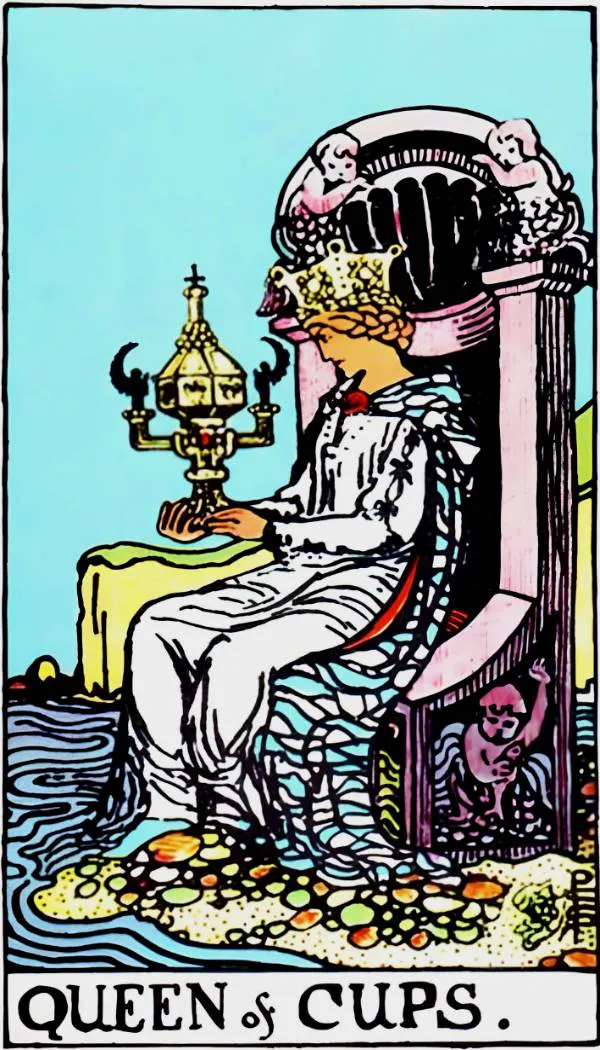
This beautiful blonde woman has a serene face and an elegant posture. She wears a golden crown, and she is focused and gazing at the chalice she holds, which has a special style and shape.

Her petite figure is nestled in a massive throne. The throne is situated on the shore, and this small piece of land is surrounded by water, indicating that it is a small sandbar island. The distant wall suggests that there is another shore nearby, which might be where the land is.

The woman's attire is elegant and fresh, and the throne is particularly exquisite, all of which show the woman's nobility and high status.

She is the Queen of Cups.

Details of the Illustration

The Queen of Cups has a focused and affectionate expression, gently revealed. Her golden hair and appearance are symbols of beauty. Her posture is gentle and comfortable, with an elegant and soothing demeanor. The Queen's feet are crossed, with her right foot lightly touching the shore, indicating her modesty and her attitude towards emotions. The Queen holds the chalice, nurturing it with both hands, supporting the base with her right hand and maintaining it with her left. The Queen gazes at the chalice, immersed in her own fantasy world, dreaming sweet dreams.

The chalice in the Queen of Cups' hands is unique, being the largest in the deck and having a special shape, unlike the simple round cups of other Cups cards. This golden chalice is angular, covered with a lid, and pointed at the top. The two handles extend outwards, each with a winged angel praying towards the chalice. This type of chalice appeared in the early classical Tarot's Ace of Cups and is the shape used by high-ranking churches, symbolizing that the Queen of Cups possesses the most noble emotions and spirit.

The Queen of Cups wears a golden crown, the height of which signifies her nobility. She is dressed in a white gown, reflecting a pure heart. The black lines on her sleeves are bows that tie the cuffs. Her shawl is a blue and white color, similar to the waves of the sea, symbolizing that she is in the water. The cloak is fastened at the chest, and the clasp is made of a shell.

The Queen of Cups' throne is located on the shore of the island, where she sits holding the chalice and looking at the waves on the shore. The island's throne shows the Queen's affinity with water. There are many colorful pebbles at her feet, distributed on the ground of the island, in front of the throne. This indicates her colorful inner world and rich imagination.

The Queen's throne is intricately carved, symbolizing the delicacy of her inner thoughts and manners. The back of the throne is sculpted into a shell shape, with two corners each having a small Cupid merman, and a Cupid merman on the side of the throne holding a fish. The appearance of Cupids is a metaphor that the Queen is the goddess of love, and the Cupids are her children, also implying that the Queen is very loving and maternal.

There is a wall outside the island, gradually rising from left to right, blocking the view of the distance. The wall is beige, and green grass grows along the top edge. This wall represents a barrier, providing a sense of security and protection, and also preserving privacy and secrets. The sky is blue and white, indicating clear and sunny weather. The water surface shows no other creatures, only beautiful ripples circling around. The sea is calm and the sky is clear, just like her smile and mood.

Throne

The throne upon which the Queen sits is symbolic of her authority over the realm of emotions and feelings. It represents stability, suggesting that she understands her emotions well and is not easily swayed by temporary disturbances. Her dominion over the water around her signifies mastery and control over the depths of intuition and the unconscious.

Chalice or Cup

The cup she holds is ornate and closed, unlike the other cups in the suit. It symbolizes the unconscious mind, intuition, and the emotional realm. The closed nature of her cup indicates the depth of her thoughts and emotions – some things are not immediately visible on the surface. She has a deep understanding of feelings, both hers and those of others.

Water and Sea

Surrounding her throne is the vast sea, a symbol of the depths of emotion and the unconscious. The calm state of the water reflects her serene disposition and balanced emotional state. It signifies her deep emotional understanding, intuition, and psychic abilities. She navigates the emotional realms with grace and understanding.

Cherubs on the Throne

The cherubs depicted on the throne of the Queen of Cups symbolize innocence, pure-heartedness, and divine love. Their presence indicates that the Queen’s emotional wisdom and intuitive abilities are deeply connected to higher spiritual truths. Cherubs, as divine messengers, also underscore her role as a conduit between the conscious and unconscious realms, reflecting her ability to tap into the collective unconscious and divine love.

Psychological patterns in Queen of Cups
Self-Silencing
The Queen's face remains serene while the cup stays closed in her hands and the wall behind the island blocks the open distance. The image holds feeling with grace, but it also shows how much emotional material can be kept behind a polished surface. In the reversed texture, composure becomes a pressure seal. You may swallow hurt, soften your language, or delay difficult truths because naming them feels like it could disturb the emotional weather of the relationship. Self-Silencing emerges when peace is maintained by removing your own signal from the room. The relationship may look calm from the outside, but the unspoken need keeps gathering weight inside the closed cup.
Emotional Gatekeeping
The Queen's lidded chalice is held with both hands at the center of her body, ornate enough to signal importance but sealed enough to keep its contents private. Her eyes stay on the cup while the wall beyond the shore blocks the far distance, creating a visual system of attention, containment, and selective access. That structure gives Emotional Gatekeeping its career logic. You may be holding intuitive reads, frustration, or relational data behind a controlled gate because the workplace has taught you that emotional information can be used politically; the pattern protects your inner signal, but it can also make your needs and strategic intent harder for others to read.
Boundary Diffusion
The throne rests on a small strip of land almost entirely surrounded by water, and the Queen's body is enclosed by cup, stone, shoreline, and sea. The scene is protected, but it is also extremely permeable; the emotional field presses close from every side. Reversed, that permeability becomes a problem for personal growth. You may absorb every framework, every mentor voice, every wellness trend, and every emotional cue before your own system has decided what belongs. The card shows a self-improvement process where the inner shoreline is too open, so the original signal gets diluted by everything that touches it.
Emotional Reasoning
The water around the Queen is calm, the sky is clear, and the cup is closed, so the emotional field looks self-contained and convincing. Her attention goes inward, toward a vessel that can reflect feeling without necessarily testing it against the outside world. When that inner mirror becomes the main source of evidence, emotion starts to masquerade as fact. Anxiety, blankness, or dread can feel like proof because the system is reading intensity as accuracy. In academic life, this pattern makes exam panic sound more authoritative than preparation history, previous competence, or actual feedback. You may feel certain that you are failing because the feeling is loud, and the card exposes the closed loop between inner weather and academic self-belief.
Boundary Discernment
The Queen sits on a small shore island, holding a covered chalice while water surrounds the throne and a distant wall limits the horizon. Her body is present but not exposed; the image separates inner feeling, public space, and the wider social field into distinct zones. That structure mirrors a social boundary mechanism: emotional access is filtered before it is granted. In group settings, this pattern helps You notice which circles deserve depth, which conversations only need light contact, and where belonging starts turning into quiet energy leakage.
Secure Vulnerability
The Queen's hands cradle the ornate cup with care, and the lid on the chalice keeps its contents protected rather than displayed. Her gaze is soft but precise, as if intimacy has to be held inside a stable container before it can be shared. This is vulnerability with a nervous system boundary around it. In social spaces, the pattern shows up when You can be emotionally real without letting every room, chat, or acquaintance have full access to what is most tender.
Parentification
The Queen holds the cup with both hands, giving the emotional object her full attention. In reverse, that tenderness can become overholding: the body keeps supporting the vessel even when its own needs disappear from the scene. This is the card's pathway into Parentification. In a family system, the child-self may learn to monitor moods, translate conflict, comfort adults, or stabilize the room long before receiving care in return. The cup becomes someone else's emotional state, and your hands become the system that keeps it upright. The islanded throne makes the role feel enclosed and official. You may be praised for being mature, sensitive, or reliable, but the deeper pattern is a premature emotional assignment that taught your nervous system to caretake before it learned to choose.
Mind Reading
The Queen looks into a cup that is closed. Its contents are hidden, yet her attention is absolute, as though the unseen interior can still be read if she concentrates hard enough. In reversal, that intuitive focus can become Mind Reading. The psyche starts treating partial cues as complete information, filling the covered cup with imagined motives, disappointments, or rejections. The privacy wall in the background matters here: not everything hidden is hostile, and not every silence is a message. In friendship, this pattern can turn delayed replies, tone shifts, or group-chat quiet into a private evidence file. You may feel like you are being perceptive, but the loop often reveals a deeper need for direct reassurance that has been rerouted into constant interpretation.
Co-dependency
The Queen sits on a small island surrounded by water, her small figure nested inside a large throne while she holds the cup as if it must be kept safe. The emotional field is beautiful, but it comes very close to the body, with land, water, wall, and vessel all pressing into one contained world. In the reversed texture, sensitivity can become enmeshment. You may organize your mood around a partner's mood, feel responsible for their stability, or lose the difference between empathy and emotional labor. Co-dependency appears when love becomes a system of regulation rather than mutual contact. The pattern keeps closeness alive by absorbing too much, but the cost is that your own center becomes harder to locate.
Rescuer Identity
The Queen holds the cup with both hands in a careful, almost devotional grip, while the throne is carved with cherubic figures and water-born imagery. The whole scene places care, receptivity, and emotional holding at the center of her authority. This can become a coping structure where being needed feels safer than being plainly loved. You may stabilize a partner's mood, interpret their pain, or become the emotional container for the relationship because that role gives closeness a purpose. Rescuer Identity forms when care becomes the way to secure attachment. The pattern is not a lack of love; it is love organized around repair, where your value starts to depend on how much emotional weight you can hold for someone else.
Core Struggles in Queen of Cups
Inner Compass Overload
The Queen sits at the edge of water with her whole upper body organized around a sealed cup. Her gaze does not travel toward the open sea or the wall beyond it; it returns to the vessel in her hands, as if the future must be read from an inner object before any movement can begin. That structure makes direction feel dense rather than absent. You are not facing a blank horizon so much as a horizon filtered through too much inner material, where every possible route has to pass through feeling, intuition, memory, and private symbolism before it can become a choice. Inner Compass Overload names the strain of having an active inner guidance system that has become too saturated to function as a compass. The card holds your search for direction inside a beautiful but closed vessel, showing how depth can become disorienting when it cannot translate into a livable line forward.
Intuition-Reality Split
The Queen's gaze stays locked on a sealed chalice while the sea, shore, throne, and distant wall offer competing reference points around her. The cup carries depth, but its lid prevents any direct test of what is inside; the outside world is present, yet it does not become a clear measuring line. When this structure turns inward, direction becomes split between what feels true and what can actually hold weight in the world. You can keep receiving inner impressions, but each one has to pass through an opaque vessel before it can meet the practical horizon, so the signal becomes hard to separate from fantasy, memory, longing, or fear. Intuition-Reality Split names that translation failure. The card marks the exact place where inner knowing and outer course stop calibrating each other, leaving you with a strong private signal and no stable way to verify whether it belongs to the life you are trying to build.
Emotional Secrecy Spiral
The sealed chalice, calm water, carved throne, and privacy wall create a composed scene where the most important container never opens. Nothing in the image is chaotic, yet the central object is inaccessible, protected by beauty, ritual, and stillness. In family systems, secrecy often works through that same polished calm. People may speak pleasantly, keep traditions running, and avoid visible conflict, while the real material remains sealed inside the family vessel where no one can name it directly. Emotional Secrecy Spiral begins when every protected silence requires another layer of protection. The card marks the spiral's shape: the more the family preserves the surface, the harder it becomes for you to tell whether the truth is dangerous or simply overdue.
Caretaker Role Lock
The two hands that cradle the chalice become a complete support system for one sealed object. The cherubs, shell motifs, and water imagery surround the Queen with care, but all of that care is organized around maintaining the vessel rather than creating mutual exchange. In love, this image can describe the lock of becoming the emotional holder for the relationship. You may stay close by soothing, absorbing, and stabilizing, yet the bond begins to measure connection by how well you can contain someone else's feelings instead of how fully both people can be met.
Reciprocity Deficit
The Queen holds the cup as if it deserves tenderness, but the vessel is covered and self-contained. Around her, the sea is calm and expansive, yet the actual point of exchange is narrowed to a closed object held close to the body. In social life, this image carries the structure of one-way emotional availability. You may notice what people need, soften the room, and remember the details that make others feel seen, while the group has no equally open channel for returning that care to you. Reciprocity Deficit is not the pain of having no connections; it is the imbalance of being surrounded by emotional water while the receiving vessel remains sealed. The card gives that imbalance a precise shape: care is present, beauty is present, even social contact is present, but mutual holding does not fully circulate.
Vulnerability Containment Strain
The Queen of Cups holds a lidded chalice with both hands, eyes lowered into its sealed surface while the sea surrounds her throne. Feeling is clearly present, tended, and protected, but the vessel is not open to direct exchange. In love, that image gives shape to the strain of being emotionally rich while remaining difficult to fully know. You can offer warmth, care, and intuitive presence while the most vulnerable center stays inside a protected container, leaving intimacy paused at the lip of disclosure.
Soft Power Strain
The Queen’s authority is unmistakable: crown, throne, formal posture, and ceremonial vessel all mark power. Yet nothing in the image asserts that power through force; her influence is expressed through steadiness, receptivity, and precise containment at the edge of the water. In career politics, that kind of authority can become structurally expensive. You may lead through timing, emotional reading, trust, and calm presence, but workplaces often reward the person who performs control more visibly than the person who actually regulates the field. The struggle forms when your strongest influence mechanism is real but quiet. The Queen of Cups gives that pressure a visible shape: power that works because it does not dominate, and therefore must fight to be recognized as power at all.
Intuition-Execution Split
The Queen’s attention is precise, but it is turned toward a closed vessel rather than toward the shore, the sea, or a path of movement. The cup concentrates knowing; the seated body keeps that knowing from becoming an outward action. In a career question, this is the gap between sensing the correct move and making it visible enough to change the material situation. You may read a manager’s politics, feel when a role is wrong, or intuit the next career direction, while still struggling to convert that internal signal into a plan, conversation, portfolio, or decision. The card locates the blockage at the interface between intuition and execution. The issue is not that the insight is absent; it is that the insight remains inside the cup while career movement requires contact with the shore.
Inner World Entrapment
Water surrounds the throne like an open field that cannot be crossed from the seated position. The Queen has sky, sea, and a distant wall in view, yet her body stays anchored to the island and her attention returns to the closed cup. That space turns inwardness into geography. You can have a rich inner life and still feel trapped by it when every route out leads back to the same private chamber of thought, memory, and interpretation. For introspective work, the card marks the moment when retreat stops restoring you. The inner world remains meaningful, but it becomes too total, too enclosed, and too structurally central to let the rest of life re-enter.
Emotional Containment Strain
The queen's face is composed, her throne is stable, and the lidded chalice is held with both hands rather than opened. The water around her is calm, but the cup's sealed architecture shows that the emotional material has been contained, formalized, and made hard to access. In study, this is the shape of holding grade fear, tutor judgment, and deadline pressure inside a polished academic persona. You can look steady while the effort of containment becomes the thing using most of your attention. The card links this struggle to the cost of staying elegant under pressure. The problem is not that you feel too much; it is that the system has made emotional control carry the load that learning, feedback, and recovery should be sharing.
Inner Emotions in Queen of Cups
Contained Overwhelm
The Queen's hands stay fixed around a closed chalice while her face remains composed and ceremonial. The cup is not spilling, but its lid also gives the contents no visible route of release. The massive throne and small island sharpen that containment into pressure. A lifestyle system can look beautiful, intentional, and well held while still leaving every task, body cue, errand, habit, and delayed need packed into the same inner vessel. Contained Overwhelm is the feeling of being full without looking messy. The card makes that state visible through controlled surfaces: the still face, the sealed cup, and the narrowed field where nothing appears to be falling apart, yet nothing has enough room to move.
Intuitive Self-Doubt
The Queen’s gaze is absorbed by a closed chalice, an object rich with meaning but visually sealed from inspection. The distant wall narrows the long view, so the scene gathers attention inward until the inner signal risks becoming too private to verify. Intuitive Self-Doubt forms when the same sensitivity that usually clarifies now starts looping around its own evidence. In personal growth, this can feel like knowing something in your body and then immediately cross-examining it until the knowing loses shape. The card’s reversed texture does not remove intuition; it overconcentrates it. You are not empty of inner guidance, but the guidance has become trapped inside a sealed chamber of checking, interpreting, and wondering whether your own perception can be trusted.
Hard-Won Composure
The Queen sits inside a carved throne on the edge of water, holding the cup with both hands while her shoulders stay low and her body remains arranged. The shore, throne, and closed chalice make composure look like a structure with layers, not a vague mood. In career pressure, that structure becomes the inner state you rely on when meetings carry hidden stakes or authority dynamics test your center. Hard-Won Composure is the feeling of staying seated inside yourself because your boundaries have become legible enough to hold pressure without letting it scatter you.
Compassion Fatigue
The Queen holds the ornate cup with both hands, and the cup is not light or simple; it is angular, covered, and visually dense. Her stillness can look graceful, but it also concentrates the whole body around the labor of holding. Compassion Fatigue appears when that holding becomes continuous. In friendship, the card points to the person who keeps receiving private pain, decoding moods, and making room for other people's feelings while their own ground gets smaller. The narrow sandbar matters because it shows limited capacity. The issue is not a lack of care; it is care without enough space around it, where tenderness starts to feel like a role your body has been asked to maintain for too long.
Intuition Fatigue
The Queen’s attention is concentrated on one symbolic object, a sealed cup elaborate enough to invite endless interpretation. The shoreline and throne keep the scene contained, so the gaze has few places to go except deeper into the same emotional signal. Intuition Fatigue arises when inner listening becomes overuse. In personal growth, every hesitation, mood shift, dream, coincidence, or gut feeling can start to feel like another piece of evidence you must decode before you are allowed to act. The reversed Queen of Cups captures the exhaustion of turning sensitivity into a constant audit. The card restores clarity by naming the pressure inside the practice itself: the inner voice may need respect, but it cannot carry the whole burden of decision, identity, and transformation alone.
Emotional Flooding
Water surrounds the Queen's throne from every side, while her body remains composed and almost motionless. The card's surface is serene, but the visual structure places a seated figure inside an emotional element that has no obvious exit route. Emotional Flooding rises from that mismatch between stillness and saturation. In friendship, it can feel like absorbing a friend's crisis, disappointment, jealousy, or need while trying to keep your face calm and your responses careful. The fixed throne sharpens the feeling: you are not simply near emotion, you are seated inside it. This card makes the flood visible as a containment problem, where the inner tide climbs faster than the social role allows you to show.
Intuitive Overflow
Water surrounds the Queen’s sandbar, touches the edge of her throne, and keeps the whole scene saturated with feeling. Her gaze is fully absorbed into the cup, as if the inner contents have become more compelling than the outside shoreline. Intuitive Overflow appears when that sensitivity has no clear off switch. In social spaces, every pause, tone shift, unread message, and subtle change in group energy can start to enter the same inner chamber until the room feels louder inside you than it did outside. The card connects to this emotion because the Queen’s gift for attunement sits right at the edge of saturation. You may be reading the social field accurately, but the image asks whether your inner cup is becoming a container for everyone else’s weather.
Hollow Fantasy
The ornate chalice draws the Queen into a private world, but its lid keeps the contents hidden and still. Around her, the island is beautiful and protected, yet it also separates the dreamer from the larger shore where movement would have to occur. Hollow Fantasy belongs to the reversed Queen of Cups because the inner image becomes more absorbing than the lived change it was meant to support. In personal growth, this is the emotional emptiness that appears when the idea of transformation feels more vivid than the practice of it. The card does not mock the dream. It shows the cost of keeping the dream sealed, admired, and untouched until it becomes a substitute for agency rather than a source of it.
Quiet Knowing
The Queen’s gaze stays on the covered chalice rather than the far shore, while calm water gathers around her small island. The image places attention on an inner vessel that is protected enough to be heard, not on a road that has already been mapped. For direction work, that visual logic names the moment when your next move does not arrive as a loud plan. You may not have external proof yet, but the signal has a stable shape, quiet, contained, and hard to unhear once the outside noise settles.
Cautious Trust
The chalice is held with deliberate care, supported from below and steadied from the side. Its lid matters: the Queen is close to the cup, but the contents are not exposed simply because closeness exists. Cautious Trust lives in that exact posture. In friendship, it is the soft opening that still keeps a boundary, the decision to let someone matter without making your whole inner world instantly accessible. The island and distant wall reinforce the same emotional logic. This card links trust to containment, showing that real closeness does not require emotional overexposure; it can grow through careful access, privacy, and steady presence.
Outer Contexts in Queen of Cups
Friendship Boundary Creep
The calm water surrounds the Queen's sandbar, and the wall protects the view, but the figure's attention is locked onto the cup. Protection becomes fragile when every ripple is treated as something she must receive. For friendship, this reflects access that expands by habit rather than agreement. The bond may still be meaningful, but constant messages, sudden disclosures, and assumed availability can turn intimacy into an unmarked duty.
Friendship Boundary Reset
The lidded chalice, crossed feet, and wall beyond the island all create a private perimeter around the Queen. The scene is intimate, but it is not open access; even tenderness has an architecture. For friendship, this points to a reset where closeness needs new rules of entry. You can preserve the bond while naming what no longer gets unlimited time, immediate replies, or automatic emotional access.
Information Gatekeeping
The cup is central, decorated, and deliberately closed. Its importance is made visible, but its contents are not available, creating a precise image of workplace information that everyone orbits while only a few people can actually inspect it. The wall in the distance adds a spatial boundary to that secrecy. You may be close enough to sense that decisions, feedback, or strategic context exist, yet still kept outside the channel where those facts become usable. This context identifies gatekeeping as a material condition of the role, not a vague feeling of being left out. The card helps you ask what information is being protected, who benefits from the closure, and how your career movement is shaped by what remains sealed.
Promotion Criteria Black Box
The covered chalice is the most striking object in the Queen's hands: elaborate, important, and inaccessible. In a career reading, that sealed form maps cleanly onto a workplace where advancement looks ceremonial and polished, while the real criteria remain hidden from the person trying to progress. The wall beyond the water makes the next shore visible but not open. You can see that a promotion path, title change, or higher-status role exists, yet the route is filtered through private conversations, unstated sponsorship rules, and evaluation standards that do not appear in the official job ladder. This card does not reduce the issue to impatience. It identifies an information structure: the thing you need to move upward is present in the system, but it is being kept inside a closed container.
Family Secrets Gatekeeping
The lidded chalice is treated like a ceremonial object, held close while the wall beyond the island blocks the longer view. The scene protects privacy so thoroughly that the central contents become inaccessible to anyone outside the frame. In introspection, that maps to family material kept behind polished language, selective disclosure, or old rules about what is not discussed. You are left working with the pressure of the sealed vessel rather than with the full story, which makes naming the boundary itself the first clear piece of information.
Care Reciprocity Test
The Queen's hands are wrapped around the ornate closed cup, and her whole posture is organized around holding it steadily. In a social reading, that image turns care into a visible function: the person who can contain what others bring, keep confidence, and remain composed while the emotional material gathers around them. The throne gives that function status, but it also fixes the role in place. You may be in a circle where being trusted feels meaningful, yet the real test is whether the group can meet your care with care of its own. This context is not about being too sensitive. It is about noticing whether emotional support circulates, or whether the social system quietly treats your steadiness as the container everyone else gets to use.
Emotional Labor Imbalance
The Queen’s cup is large, sealed, and carefully maintained, while her smaller body sits inside a throne that magnifies the role she occupies. The visual weight gathers around one figure, one vessel, and one point of emotional containment. Reversed, this becomes the relationship where one person holds the emotional logistics for two. You may be the one tracking tone shifts, initiating repair, translating silence, remembering needs, and keeping the bond from spilling over while the other person benefits from that invisible work. The card’s water is calm, but the labor behind that calm is concentrated. This context names the imbalance that appears when a relationship looks emotionally deep yet depends on one partner doing most of the processing, soothing, and relational maintenance.
Free Therapy Friend
The small body is absorbed by the throne while both hands remain occupied with the sealed cup. The image turns receptivity into a job with no obvious place to put the vessel down. In a friendship field, that structure names the unpaid confidant role. Friends may bring their emotional contents to your shoreline, but the card asks where the exchange, consent, and recovery space have disappeared.
Intuition Reality Mismatch
The Queen’s gaze stays locked on the covered cup while the shoreline, water, and distant wall remain outside her direct line of sight. The vessel is ornate and compelling, but it is also sealed, which means its contents cannot be tested against the surrounding landscape. In a timing question, that closed loop matters. The card can show a situation where the internal signal has become so absorbing that external cues, resource conditions, and practical openings are not being read with enough precision. Intuition Reality Mismatch names the stage where a private sense of timing is outpacing the environment that has to receive the action. You are not being asked to distrust your inner signal; the card reveals where that signal needs contact with visible conditions before it can become a reliable move.
Emotionally Unavailable Parent
The Queen holds the cup with tenderness, yet the vessel itself is closed. Her throne is close enough to see, but the water and the formal seat keep ordinary approach at a distance. This is the family pattern where a parent can appear caring, composed, generous, or even emotionally wise while remaining difficult to actually reach. You may receive concern, gifts, advice, or elegant words, but the deeper exchange stops at the lid of the cup. The card gives this situation a precise shape: availability is being performed through symbols of care while vulnerability stays sealed. Seeing that distinction helps you stop measuring connection only by how loving the surface looks.