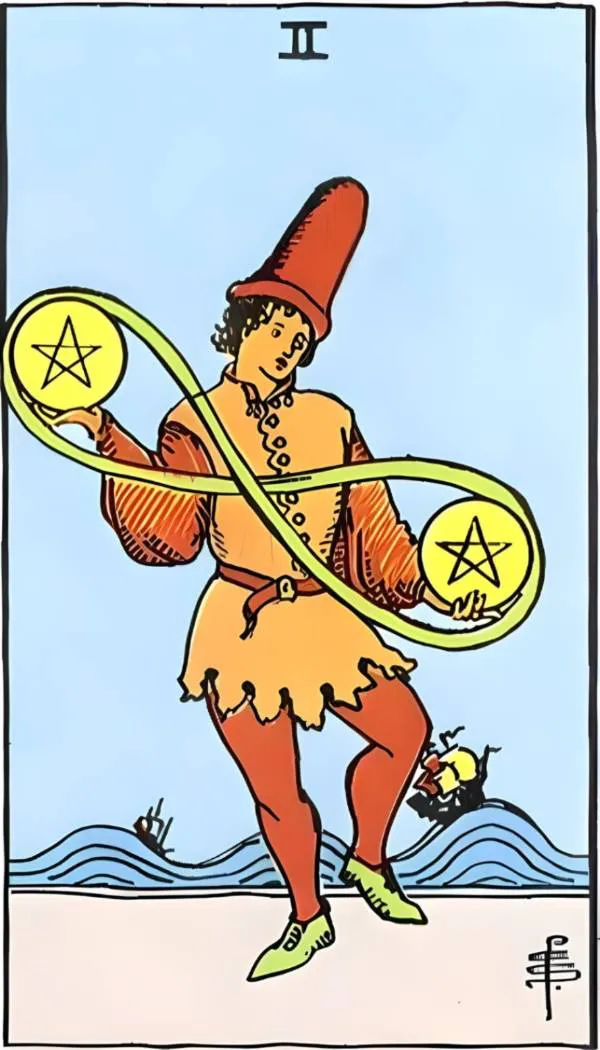
Student Loan Refinance CrossroadsThe two pentacles moving through an infinity-shaped loop, the figure's active stance, and the ships pitching on rough water reproduce the daily mechanics of refinancing research. You are trying to keep current payments, rent, income, work, and ordinary life moving while each lender comparison changes the distribution of money and attention. The upright figure remains mobile even though the background is unstable, so the image treats adaptability as an available resource rather than proof that the situation is easy. You can see that the exhaustion comes from maintaining a cash-flow system under variable conditions, not from being personally incapable of managing money.
Study Life Boundary CreepTwo pentacles sit inside an infinity loop while ships pitch across high waves behind the juggler. Reversed, that loop no longer functions as a stable daily rhythm; it becomes a closed circuit in which school and basic life keep trading places without either receiving protected time. The surrounding movement shows why greater personal efficiency cannot fully solve the problem for you. When academic inputs keep arriving through platforms, schedules, and other people's response expectations, the route to a balanced routine is obstructed by volatility outside the calendar you control.
Friendship Disclosure Pace MismatchTwo pentacles move at different heights inside one continuous loop while two ships rise and fall on uneven waves behind the figure. The image directly mirrors a friendship that keeps functioning even though personal disclosures, replies, and invitations to go deeper do not arrive at the same level or speed. The upright figure still has room to adapt, and the coins remain connected rather than dropped. You may be able to see that the strain comes from repeated pace correction: one person shares, the other redirects, and both then try to restore an ordinary conversational rhythm without having named what happened. The friendship has movement and access, but mutuality depends on whether both people can participate in setting the depth rather than leaving that power with whoever responds last.
Second Shift BurdenThe juggler, two pentacles, infinity-shaped cord, and ships pitching on high waves portray a life system that must keep moving despite unstable conditions. Reversed, the loop stops functioning as a flexible rhythm and becomes a demand cycle with no protective buffer; you carry paid work, housework, and household administration without enough space between them. Both pentacles remain present, so the problem is not a missing skill or a failure to care. The blocked resource is recoverable capacity: every task can be completed in isolation, but the combined volume and single-point ownership make the lifestyle system unsustainable at its current distribution.
Routine CollapseThe raised foot, moving hands, and linked pentacles create a system with very little tolerance for interruption. Behind the figure, the sea is already uneven, so the foreground routine is being maintained inside a larger environment that keeps shifting. In personal growth, routine collapse often appears when a plan was built for ideal conditions but placed inside a life that changes. Travel, deadlines, social demands, money pressure, tiredness, and unexpected obligations can disrupt one piece of the loop and make the whole practice feel unusable. The card gives the collapse a structural explanation. It points away from self-blame and toward the design flaw: a routine that only works when nothing moves around it is not yet a life system, only a controlled performance.
Independent Creator PrecarityTwo pentacles circulate in a continuous loop while ships occupy different heights on the same rough sea. The image gives physical form to creator timing: bills recur predictably, but invoices, sponsorships, reach, and sales arrive on separate and unstable rhythms that you must keep reconciling. The upright motion shows timing intelligence already in use, because the figure responds without dropping either coin. That adaptability is available to you, but the sea prevents it from becoming proof that every publishing push, client deadline, or income gap can be synchronised through effort alone.
Care Work SpilloverTwo pentacles loop through an infinity ribbon while ships rise and dip on rough water behind the figure. The moving coins mirror a daily architecture in which breakfast, transport, messages, appointments, laundry, and deadlines remain in circulation because neither the household nor the workplace provides a stable handover. Upright, the figure still has enough balance and practical responsiveness to keep the system moving, but that visible competence can conceal how much live coordination the arrangement consumes. You are not looking at a simple productivity problem; you are seeing a routine made functional by your repeated adjustments whenever care and work claim the same hour.
Friend Group Logistics ResetThe two pentacles circulate inside an endless loop while ships negotiate uneven waves in the background. The image captures a group trying to synchronise different work shifts, travel times, cash limits, and social-energy windows without ever reaching a stable common rhythm. Upright, movement is still possible because the figure responds to change rather than pretending the conditions are fixed. You can see that the timing problem is systemic: a successful date requires a new cadence with fewer moving variables, not another round of urgent reminders inside the same unstable loop.
Travel Prep Control LoopTwo pentacles move around an unbroken ribbon while ships rise and fall on waves behind the figure. Upright, the moving arrangement remains workable, but it never becomes static; travel timing likewise depends on continuously coordinating departure windows, transfers, check-in deadlines, replies, and changing external conditions. You may have enough information to keep the journey viable without ever receiving a perfectly settled plan. The image distinguishes live timing work from endless certainty-seeking: the schedule is a moving system, and its instability is not proof that you have failed to prepare.
Work Life Integration TrialThe two pentacles move through the figure's hands as one linked system, not as two separate objects. Every adjustment in one hand changes the pressure on the other, while the lifted foot keeps the whole body in a state of active balance. That visual structure maps directly onto a life direction shaped by several real obligations at once. Work, money, relationships, rest, and future ambition are not neatly separated lanes here; they are connected demands that keep pulling on the same limited attention. You are not looking at a simple choice between ambition and stability. The card makes the wider system visible: the long-term path depends on whether the different parts of your life can be coordinated into a rhythm that still leaves you with agency.