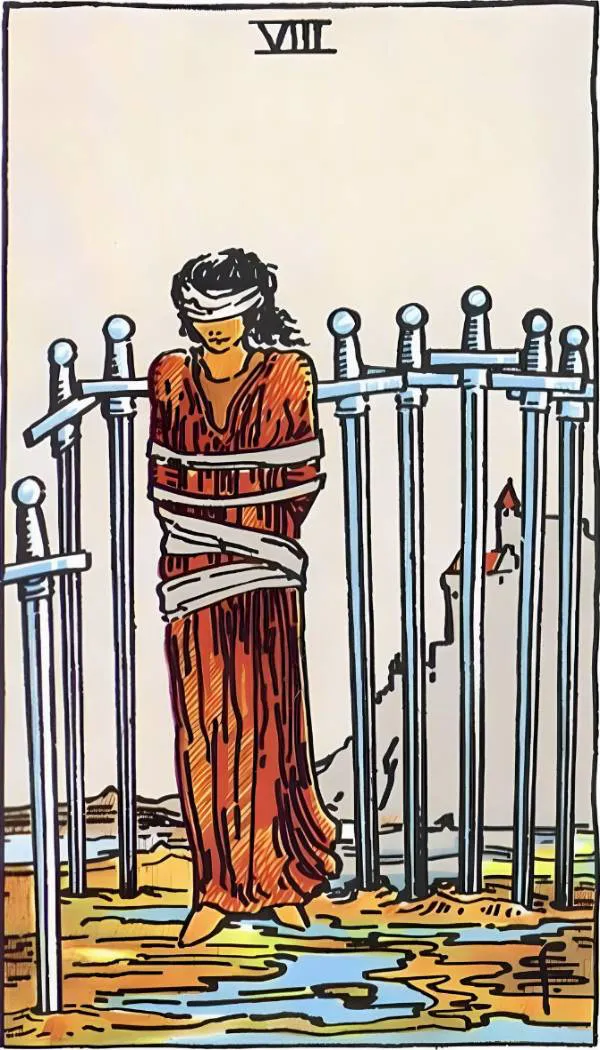
Student Debt Flexibility GapThe eight fixed swords, the blindfold, and the narrow opening around the bound figure mirror a decision field whose options have been screened before comparison begins. A lower-paid values-aligned job, a move, a freelance period, or further study may all exist, but each must first survive repayment, rent, and runway calculations. You are not choosing from the same practical menu as someone without the recurring obligation, even when the visible opportunities look identical. Upright, the opening between the swords keeps choice present, but it also requires the constraint to be named accurately: student debt is changing the eligibility of the options, not merely changing how confident you feel about them.
Academic Visibility ParalysisThe figure's blindfold and bindings restrict her current range, yet the gaps between the swords preserve a distinction between constrained movement and impossible movement. That distinction matters when an academic system has trained every act of visibility to register as a public audition. The institution supplies real blades through precarious contracts, gatekeeping, screenshots, and opaque judgement, while repetition can make the entire landscape appear equally dangerous. You do not need to convert a structural problem into a personal confidence defect in order to recover a more accurate sense of agency. The card's open ground names a developmental task of differentiating imposed limits, learned predictions, and genuinely available routes. Growth here is not greater tolerance for unlimited exposure; it is a clearer model of where your academic voice can move without denying the power surrounding it.
Routine CollapseOne foot touches muddy ground while the other meets pooled water, placing the woman between unstable surface and unstable depth. Behind her, the castle sits at a distance on higher ground, visible as structure but not currently connected to the terrain beneath her feet. This is the lifestyle texture of routines that have stopped linking together. Sleep, food, cleaning, work blocks, errands, movement, and recovery may still exist as separate ideas, but the day no longer gives them a stable sequence to stand on. The Eight of Swords frames routine collapse as a terrain problem, not a character flaw. You are not looking for a perfect system from the castle in the distance; you are identifying where the ground under the next hour has become too wet, too interrupted, or too poorly bounded to hold the weight of ordinary life.
Record Deal CrossroadsA bound and blindfolded figure stands inside a loose perimeter of swords, with muddy ground below and a distant structure still visible. The narrow arrangement resembles an offer process engineered to feel like one lit corridor: sign during the current momentum or risk losing access, attention, and legitimacy. Contract jargon and unequal expertise make the available routes harder to perceive. The swords do not form a sealed wall, and the bindings leave the figure standing rather than permanently immobilized. You can separate real constraints, such as an expiring offer or limited cash runway, from pressure narratives that artificially reduce the decision set. The scene restores visibility to paths such as clarification, redlining, narrower rights, different term lengths, another partner, or no deal.
Feedback Suppression CultureThe blindfolded, bound figure stands inside a close line of upright swords, with a visible path and distant shelter beyond the enclosure. The scene directly mirrors a workplace that advertises an open route for feedback while placing enough social and political barriers around it that the route cannot be used safely. You can identify the constraint without turning the blindfold into a verdict about your competence. Tone reviews, vague meeting summaries, and disappearing access form the sword ring; the unresolved concern remains visible, but the organization has made the cost of carrying it into the record fall on you.
Analysis ParalysisThe blindfolded woman stands inside a ring of swords that does not physically touch her, while an opening remains visible in the enclosure. The image is not a locked cell; it is a blocked decision field where available movement is hidden by restricted sight, tight bindings, and over-attention to every sharp boundary around the next step. In lifestyle terms, this mirrors the point where planning your routines becomes heavier than living them. You can see fragments of a better system, a cleaner room, a new sleep schedule, a simpler calendar, but each possible move feels like it might trigger another consequence. This card names the structure behind that freeze: the problem is not a lack of options, but an overloaded decision environment. The useful leverage begins where the field becomes visible again, so the next move can be treated as one concrete opening rather than a full-life verdict.
Advisor Outreach ParalysisThe blindfolded figure's loose bindings, the uneven ground, the surrounding swords, and the distant stronghold show real restriction alongside openings that cannot yet be perceived or tested. In advisor outreach, the stronghold is the academic hierarchy, the swords are the stated and imagined etiquette penalties, and the blindfold is the absence of feedback needed to sort one category from the other. The developmental task is not to pretend the gatekeeping is unreal; it is to build a more accurate model of where institutional power ends and untested prediction begins. You are confronting a gap between extensive preparation and observable action, and the card reveals that cognitive growth here consists of improving constraint detection rather than demanding absolute confidence before contact.
Family Boundary CreepA bound and blindfolded figure stands among eight swords on wet, uneven ground while a distant stronghold overlooks the scene. The enclosure reflects a family environment in which every independent decision appears surrounded by consequences: questions, guilt, criticism, withdrawal of approval, or pressure to ask permission first. The swords leave gaps and the bindings appear loose enough to examine, so the upright structure distinguishes learned constraint from total material captivity. You can recognise where the family's probable reaction has acquired more authority than the family actually holds, while still accounting for any practical resources or relationships that make the pressure consequential.
Lease Cosigning PressureBound and blindfolded within the sword enclosure, the figure reflects a family system in which the formal freedom to refuse is narrowed by loyalty, obligation, and anticipated backlash. The distant home-like structure sharpens the housing metaphor, while the gaps between the swords show that the family's preferred answer is not the only legally available answer. You may be positioned as the relative whose income, credit, or rental history should solve another household's approval problem. The bind forms when asking questions is called cold, refusal is called abandonment, and signing is treated as the natural duty of your family role rather than an independent contractual decision.
Pathless TransitionOne foot rests on muddy ground while the other touches pooled water, placing the woman between two unstable surfaces. The castle in the distance gives the scene a destination, but the image offers no paved road, bridge, or clear approach to reach it. This is the outer shape of a direction phase where the next chapter exists as a distant outline rather than a usable route. You may be able to name the kind of future you want, but the ground between here and there is soft, partial, and hard to trust. The card makes the transition visible as a real stage, not a personal defect. The blockage sits in the missing infrastructure between present position and long-term aim, so clarity begins by mapping the terrain instead of forcing immediate certainty.