Knight of Pentacles Tarot Card Meaning

Overall Picture Structure

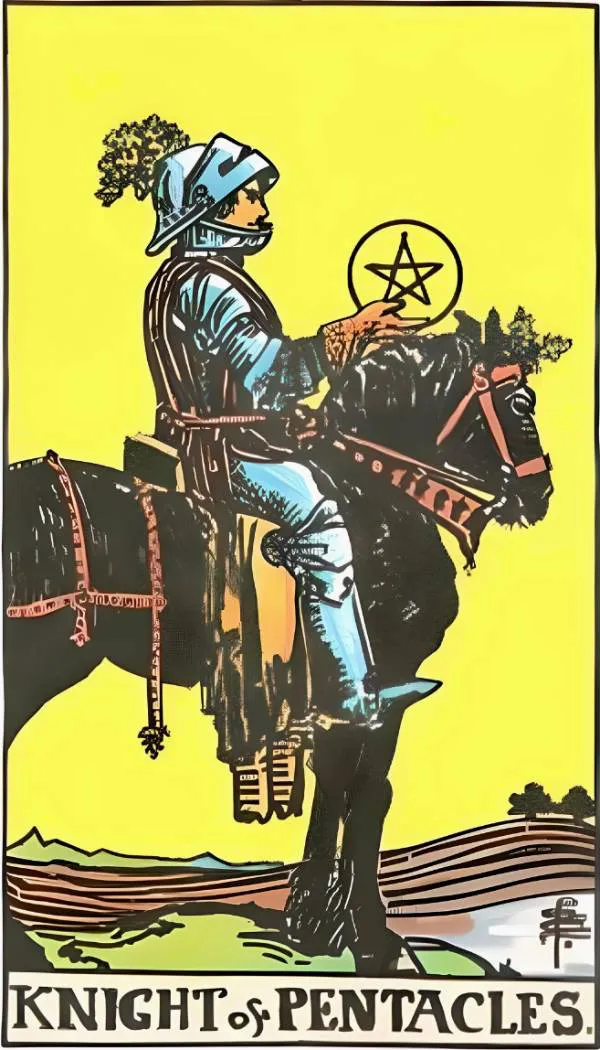
The young man riding a standing black horse and holding a coin while gazing forward is the Knight of Pentacles.

The strong black horse is matched with a thick red saddle and reins, with a red cushion hanging on the side. The Knight pauses briefly to observe the distant view ahead and contemplates the gains of the past.

The Knight wears a helmet adorned with a tassel of green leaves, and the black horse also has the same leaf tassel on its head. He is dressed in heavy armor, draped in a dark red cloak, and wearing red gloves.

The Knight of Pentacles is in an open field, with a view that should be endless, and he is aware of the situation ahead.

Detail Pattern Explanation

The Knight of Pentacles has an honest and simple appearance, with a determined and persistent gaze looking forward. His hair and eyes are dark brown, which is a sign of a resolute and pragmatic character, and even his physique and attire are substantial. This Knight sits on the horse but pauses temporarily, holding a coin in front, but his gaze is not here, but extends over the coin, looking into the distance, and his horse seems to be looking in the same direction. What he is thinking about is the prospect of the coin, and the entire pause is to wait for a better opportunity, looking forward to the most appropriate time to strike. What is his destination, is it planning, inviting, or following his heart? What he sees in the future is unknown to us, but it is a space that we can imagine.

From the picture, we can see that the posture of the Knight of Pentacles is the slowest among the four Knights, but he is the one with the strongest carrying capacity and the most steady pace. The posture and expression of the Knight of Pentacles fully demonstrate the characteristics of a pragmatic faction. Even his mount, the black horse, gives a feeling of carrying a heavy burden and going a long way. Its thick body indicates a strong carrying capacity, and its endurance is long and enduring. The saddle and cushion are red, representing heat and compulsion, and an additional red coat indicates that he still has the momentum and enthusiasm of a Knight.

The Knight's helmet, decorated with green leaves, indicates the extraction of power from nature. The whole body is armed with dark armor, ready for battle at any time. Such well-protected equipment shows his cautious character, and he will be very thorough in preparing for any action.

The scene where the Knight of Pentacles is located is a slightly undulating wilderness. Although the horse's hooves step on the green grass, the surrounding rock veins and distant mountains and forests all show that this is not a rich place. This represents that the current environment still needs to be developed, and success can only be achieved through one's own efforts. The fruits of the harvest are in the prospect and the future.

The Knight

The figure of the Knight riding a horse represents the quest for a goal, and in this case, a material or earthly one. The Knight is the embodiment of duty, loyalty, and steadfastness.

Plowed Fields

The fields in the background signify fertility and the potential for growth. They also symbolize the fruits of labor and the potential for material gain through hard work.

The Horse

The horse signifies the power to carry plans forward. Its solid stance indicates stability and dependability, reiterating the card’s theme of reliable pursuit of objectives.

The Pentacle in Hand

The Pentacle that the Knight holds directly in front of him symbolizes his focus on material and earthly matters. He holds his pentacle carefully, almost as if in meditation. This suggests a cautious approach to his goals, an intense focus, and a commitment to see his tasks through to completion with thoroughness and consistent effort.

Armor

The armor the Knight wears symbolizes his resilience and preparedness. It stands for the boundaries one places around oneself while working diligently towards goals.

The Helmet

The helmet that the Knight wears is not only a part of his armor but also symbolizes his intellectual faculties. It suggests that calculated planning and strategic thinking are employed in the pursuit of his material objectives.

Psychological patterns in Knight of Pentacles
Timing Perfectionism
The same knight who appears patient can also become suspended in the pause itself. The horse is equipped, the field is open, the pentacle is in hand, yet the image holds all energy at the threshold before movement. That threshold is the core of Timing Perfectionism in study. You may wait for the right mood, the right desk setup, the right study block, the right confidence level, or the right amount of background reading before beginning the actual work. The reversed texture of the card shows timing turning into a defensive gate. The problem is not that timing does not matter; it is that the demand for the right moment can become a socially acceptable way to avoid the vulnerable moment of starting.
Comfort Zone Attachment
The Knight's armor and the horse's grounded stillness can look dependable, but in reversal the same physical structure becomes too heavy to redirect. The open field is there, yet the body is organized around staying fortified rather than testing a new route. This is the point where stability stops serving direction and starts defending familiarity. The psyche may call the known path practical because it reduces uncertainty, but the deeper mechanism is attachment to a controllable zone of effort, identity, and routine. Comfort Zone Attachment appears when You keep choosing the path that preserves predictability over the path that still feels alive. In a direction reading, the reversed Knight of Pentacles shows how a well-built life structure can become a psychological enclosure when it no longer allows the inner compass to update.
Purpose Anchoring
The Knight sits armored on a motionless black horse, holding the pentacle in front of him while his gaze reaches past it toward the horizon. The body is not scattered across the open field; it is organized around one concrete object and one forward line of attention. That visual containment turns the pentacle into a psychological anchor. Instead of letting the vast future split attention into endless possible lives, the mind chooses a single reference point and tests direction against it. The armor adds boundary: not everything outside the self gets to define where energy should go. Purpose Anchoring is the pattern that forms when You use a stable inner marker to keep the long path from becoming noise. In a direction reading, this card does not flatten the future into a rigid plan; it shows the psyche building enough structure to hear which route still carries meaning.
Delayed Gratification
The pentacle is held steadily in front of the knight, and the field behind him suggests growth that will require time rather than instant reward. His body does not lunge toward the horizon; it holds position with the weight of someone willing to wait for real yield. This visual structure turns desire into endurance. The card's psychology is not about denying feeling, but about placing feeling inside a longer container where consistency can be tested. In romance, Delayed Gratification appears when You can tolerate not receiving every reassurance immediately because the deeper question is whether the relationship can sustain repeated care. The pattern becomes a strength when patience protects the bond from impulsive escalation. It becomes worth auditing when waiting starts to hide unspoken needs, because the same steady posture that builds trust can also postpone direct emotional contact.
Timing Discernment
The red-gloved hands hold the pentacle with deliberate care while the knight looks beyond it toward the distance. The horse is powerful enough to move, but the whole image is organized around a pause before action. That pause is not empty hesitation; it is a timing mechanism. The body, the object, and the horizon form a narrow channel between what is available now and what could grow later. In love, this pattern watches whether the relationship has enough evidence, rhythm, and mutual consistency before it accelerates. Timing Discernment becomes useful when You can tell the difference between a protective pause and fear disguised as patience. The knight's stillness shows a mind trying to let intimacy ripen through repeated reality checks instead of forcing a relationship to perform certainty too early.
Analysis Paralysis
The pentacle sits directly in the Knight's hand, close enough to be examined endlessly. His gaze reaches beyond it, but the horse does not move, creating a split between mental projection and embodied action. The field remains open, yet the decision point is held inside a tight loop of looking, weighing, and not releasing. Analysis Paralysis emerges when evaluation becomes a substitute for contact with reality. The pentacle turns into a screen for projected outcomes, and the distant horizon becomes a place where the mind rehearses every possible consequence before taking one grounded step. The body stays still because the cognitive system keeps asking for one more round of certainty. In timing questions, this pattern explains why more information does not always create more readiness. You may be trying to solve a timing issue by thinking harder, when the actual blockage is the repeated conversion of uncertainty into research, comparison, and mental rehearsal. The card makes that loop visible without shaming it: the pause began as preparation, then became a closed circuit.
Perfectionism
The armored knight holds the pentacle with careful control while the black horse stands still in a field that clearly waits to be worked. Nothing in the image is careless: the armor is complete, the reins are managed, the object is centered, and the body stays composed before the task begins. That visual discipline mirrors a study pattern where precision becomes emotional protection. You may call it being thorough, but the deeper structure is that a draft, exam, or assignment starts to feel unsafe unless it is already polished enough to survive judgment. Perfectionism appears here as controlled effort that has become too fused with protection. The card does not shame the need for quality; it shows the exact point where quality control stops serving learning and starts defending you from exposure.
Overfunctioning
The knight stays mounted, armored, and ready even though no immediate action is required. The pentacle remains lifted in front of him, and the open field stretches outward as if there will always be more ground to manage. Reversed, that endurance can become Overfunctioning. In a family system, usefulness becomes the safest identity: planning ahead, preventing conflict, smoothing logistics, remembering everyone's needs, and carrying tasks that other people have quietly stopped holding. The pattern is costly because You may mistake exhaustion for competence. The card shows a reliable body that never dismounts, revealing the hidden loop where being the steady one keeps the family running while your own limits disappear from the map.
Parentification
The knight is young, armored, mounted, and already carrying the pentacle with solemn care. The horse stands like a load-bearing structure beneath him, while the undeveloped field implies a long future of maintenance, cultivation, and practical responsibility. In the reversed orientation, the image can show a family role where being dependable became identity before it became choice. Parentification forms when the psyche learns that safety, approval, or belonging depends on becoming the stable one, the prepared one, the one who can hold the family's practical or emotional pentacle without dropping it. The pattern is not simply responsibility. It is responsibility arriving too early or too automatically, until You notice yourself managing parents, siblings, moods, money, logistics, or emotional fallout before anyone has asked whether the burden is yours.
Certainty Seeking
The knight does not charge into the field; he pauses, holds the pentacle at the center of attention, and scans the route ahead before moving. The open landscape is available, but the body waits until the next step feels sufficiently mapped. That pause reflects a mind that uses information as a stabilizer. In academic life, the rubric, the advisor's wording, the grading criteria, or the exact reading list can become the pentacle: a concrete object that makes uncertainty feel containable. Certainty Seeking is not the same as laziness or lack of ambition. The card shows a capable system trying to reduce risk before action, but it also reveals how the need for perfect clarity can delay the independent judgment that serious study eventually requires.
Core Struggles in Knight of Pentacles
Readiness Loop
The pentacle is ready, the rider is prepared, and the horse is capable, yet the scene keeps returning to preparation instead of passage. The open field does not become a road because the safest move is repeatedly postponed. In romance, this is the loop of waiting until everything feels certain enough to risk closeness. You may keep gathering signs, improving conditions, or proving seriousness, while the relationship remains just outside the moment of actual choice. Readiness Loop names the exhaustion of preparation that never converts into emotional movement. The card shows how maturity can become a protective delay when readiness is treated as a requirement that must be perfected before love can be entered fully.
Direction Stagnation
The black horse stands fully equipped in an open field, with the knight upright in armor and the pentacle held steady before him. Everything in the image is built for travel, yet the body of movement is paused under the weight of caution, observation, and containment. For a direction reading, that stillness names the moment when the future is visible but not inhabitable. You are not lacking horizon; the struggle is that the route has not become a bodily permission to move, so the open field turns into a pressure chamber of possible paths.
Caretaker Role Lock
The horse is strong enough to carry weight, and the knight is armored enough to endure it, but the reversed card fixes both into a narrow zone of use. The pentacle stays central, guarded, and repeatedly available, while the field around it receives no shared distribution of the load. That is the shape of becoming the caretaker friend: the one who listens longer, remembers more, checks in first, absorbs tension, and keeps the bond functioning. The role may have started as love, but over time it can become the only position the friendship knows how to offer you. The card does not frame care as weakness. It shows the lock that forms when care becomes identity, and when stepping out of the caretaker role feels like threatening the friendship itself.
Timing Control Strain
The red reins hold a powerful black horse in a square, steady halt, while the rider's armor and mounted posture keep the body ready for deployment. Energy is present, but it is compressed into the question of when release is allowed. For a crossroads decision, the strain sits in trying to make timing carry more certainty than timing can hold. You may be waiting for the moment to feel unquestionably correct, while the card shows that the act of controlling the moment has become the heavier load.
Cycle-Action Desynchronization
The Knight of Pentacles does not rush across the field; he holds the coin still and lets the terrain, the season, and the visible distance matter. His horse has the strength to move, but the card freezes the action at the exact place where inner readiness and outer timing must meet. Cycle-Action Desynchronization appears when one part of your life is prepared while another part has not reached the same season. You may have discipline, tools, or a clear plan, but the field around the plan is not moving at the same tempo. This card gives that mismatch a concrete body: a rider ready to proceed, a resource held carefully, and a landscape that refuses instant proof. The struggle is the disorienting task of telling the difference between real delay, necessary ripening, and the moment when continued waiting becomes its own resistance.
Stagnation Lock
The horse's planted stance can stop being a strategic pause and become a full body habit. The armor, reins, and careful grip keep everything contained, but the more perfectly the structure holds, the less the open field functions as a path. Stagnation Lock is the point where waiting has hardened into identity. You may still describe the delay as preparation, timing, or caution, but the card shows an action system that has become too practiced at remaining ready. In timing questions, this reversed pressure names the hidden cost of endless pre-launch stability. The field is still there, but the body has adapted to not entering it, and the real work becomes seeing where readiness has quietly turned into immobilization.
Process-Vision Split
The pentacle sits in the knight's hand, close enough to protect and measure, while his gaze passes beyond it toward the far landscape. The near object and distant horizon do not occupy the same line of action; one asks for maintenance, the other asks for orientation. This is the physical shape of a life path divided between process and vision. You may be doing the concrete work, keeping the token safe, and still feel the future refusing to connect with the daily steps in front of you.
Pacing Control Strain
The black horse stands still with its strength gathered under a rider who is already looking forward. The reins, armor, and careful hold on the pentacle create a body prepared for motion while still negotiating how much movement can be allowed. You meet this structure when inner pacing becomes more than patience. The card gives shape to the place where self-reflection, caution, and the need for emotional safety all tighten around the next step, leaving clarity present but movement heavily controlled.
Perfect Readiness Trap
The knight's protective system is complete: armor covers the body, reins control the horse, and the pentacle is held with exact care. In the reversed texture, this level of preparedness becomes disproportionate to the fact that no movement is happening. Perfect Readiness Trap appears when career action is postponed because the body keeps demanding one more credential, one more plan, one more proof of safety. The card gives that trap a concrete shape: a worker fully equipped for the field, still waiting for readiness to feel undeniable. The struggle is not simple indecision. It is the burden of treating every next step as if it must be armored against every possible consequence before it can begin.
Delayed Reward Fatigue
The plowed fields and distant hills hold the promise of growth, but the harvest is not in the knight's immediate reach. His armored body and heavy horse carry the labor of duration, while the pentacle remains a future-facing object rather than a present release. This struggle forms when the long road keeps demanding patience without returning enough felt confirmation. You can keep showing up and still feel worn down by a direction that only proves itself later.
Inner Emotions in Knight of Pentacles
Discipline Fatigue
The rider's armor, red gloves, dark cloak, and loaded horse make effort feel physically carried. Every part of the image is prepared, covered, and burdened with continuity. In academic life, that visual weight becomes the exhaustion of being consistent for too long without enough inner replenishment. You meet Discipline Fatigue when the study system still functions, but the person inside it feels increasingly reduced to output. The card reveals the cost of staying braced: the same structure that protects focus can also seal out softness. Its emotional message is not that discipline is wrong, but that endurance has a body and that body is asking to be counted.
Analysis Paralysis
The horse is built to move, yet every visible line of the card holds it in place: armor, reins, the lifted pentacle, and the distant gaze. The Knight is dressed for action while the scene suspends him in calculation. Analysis Paralysis forms when the decision system keeps asking for one more scan of the horizon before allowing movement. The card mirrors the way a choice can become heavier each time you try to make it perfectly rational, until clarity starts feeling like another condition you must satisfy.
Stalled Momentum Dread
The strongest tension in the card is the horse's stored power held in absolute stillness. The field stretches ahead, the pentacle is ready, and the knight is equipped, yet the scene refuses the release of actual movement. When this structure turns inward, the body can read preparedness as confinement. You may feel surrounded by possible futures while your lived momentum stays locked in place, creating a pressure that grows precisely because nothing looks visibly broken. For a direction question, Stalled Momentum Dread names the fear that your life is becoming an endless pause. The card does not treat that dread as laziness or lack of ambition; it shows a system with resources, weight, and endurance that has not yet found the route where movement becomes meaningful.
Premature Bloom Anxiety
The green leaf tassels on the knight and horse sit against an open field that still looks more like potential than harvest. The pentacle is present, but the land around it has not yet become the abundant result the gaze is reaching for. Premature Bloom Anxiety comes from that mismatch between visible seed and unfinished season. In timing questions, the card can mirror the pressure to make a future arrive before the ground, resources, or cycle can support it. The inner tension is not just impatience; it is the fear that waiting means missing out, even while forcing growth would strain the whole field. You may be sensing possibility and scarcity at the same time. This card names the ache of seeing the outline of the future before the conditions have ripened enough to hold it.
Timing Dependence Anxiety
The Knight waits with his gaze fixed beyond the pentacle, as if the landscape must reveal one more condition before motion begins. The horse's strength is present, but the whole scene is organized around suspension. Timing Dependence Anxiety appears when the choice starts to feel authorized only by the perfect moment. The card names the pressure of outsourcing movement to external timing, while still showing that the resource and the capacity to move are already in your hands.
Resentful Waiting
The Knight sits with the pentacle in hand while the horse does not advance, and the cultivated promise of the field remains somewhere ahead rather than underfoot. The image carries a long delay: effort is present, capacity is present, but arrival is held at a distance. In a relationship, that delay can turn patience into a private buildup of heat. You may keep telling yourself that steadiness matters, while another part of you quietly counts every postponed conversation, every vague promise, and every moment where progress should have become visible. Resentful Waiting fits the reversed Knight of Pentacles because the card shows loyalty trapped in suspension. The feeling is not simple impatience; it is the bitterness that forms when your willingness to wait starts costing more than the relationship is returning.
Obligation Dread
The pentacle is held carefully in front of the knight, but in the reversed emotional texture it becomes less like a resource and more like a weight that must be displayed. Armor, reins, horse, and field collapse into a single apparatus of duty, with the rider suspended inside it. Family obligation can feel exactly like that: the request arrives already loaded with expectation, and your body reacts before you have chosen anything. The dread is not about one task alone; it is the pressure of being positioned as someone whose care must be proven through carrying.
Grounded Agency
The reins, pentacle, horse, and field are all distinct in the Knight's composition. Nothing is blurred into everything else, and the rider's grip shows contact without panic. That separation matters for lifestyle work because energy leaks when every demand feels equally urgent. You can feel agency returning when time, money, sleep, food, movement, and space become separate resources instead of one tangled pressure field. Grounded Agency is the emotional steadiness of having a handle on your actual life materials. The card does not inflate control into domination; it shows a body placed inside clear limits, able to choose its next transfer of effort.
Cautious Trust
The armored rider holds the pentacle with care while his black horse stands still in the open field. Nothing in the image rushes forward; the body, the reins, and the object in his hand all organize desire into a slower, more deliberate rhythm. In love, that physical stillness becomes the emotional logic of trust that has to be tested through consistency. You are not closed to intimacy, but your system wants evidence before it relaxes into the bond. Cautious Trust belongs to this card because the Knight does not reject connection; he studies whether it can be carried. The feeling is not coldness, but a careful willingness to let someone prove they can meet your pace without forcing your boundaries open.
Disciplined Calm
The knight's heavy armor does not crumple him; it gives his body a firm outline. Around him, the open field leaves enough space for the pause to breathe, while the red gloves and reins keep heat inside a controlled frame. This is the inner weather of Disciplined Calm: a steadying force that does not depend on everything being easy. In timing questions, the card shows a nervous system holding its shape while external pressure asks for speed, proof, or visible progress. You may be trying to stay grounded while the world treats stillness as failure. The card makes that composure visible as an active discipline, a way of keeping your agency intact until the next move has the right conditions.
Outer Contexts in Knight of Pentacles
Analysis Paralysis
The horse is built to move, but it stands still while the rider studies the distance over a carefully held pentacle. The open field expands the number of possible routes without giving the body a clear entry point. In personal growth, that becomes the stage where research, comparison, and planning keep replacing action. You are not facing a lack of information; the card points to a stuck interface between knowing enough and transferring weight into one workable first step.
Productivity Theater
The pentacle is displayed clearly, the armor is complete, and the horse is ready, but the scene remains motionless. Under strain, the card’s material symbols can become a performance of readiness rather than a transfer of effort into the field. That is the core structure of Productivity Theater in a lifestyle context. Planners, dashboards, reset routines, Notion pages, calendars, and productivity language can create the visible signs of control while the actual body still lacks rest, clean space, completed tasks, or usable time. The card exposes the difference between looking organized and being operational. It gives you a way to see where preparation has become the main event, so the life system can be judged by movement and recovery rather than by the aesthetics of control.
Launch Window Readiness
The horse is strong enough to carry the Knight forward, yet the reins hold the movement in check while the Knight studies the distance. Armor, gloves, and the pentacle show that action has been prepared as a material operation, not a spontaneous leap. This is the visual logic of launch readiness: capacity exists, but release depends on whether the outer field can receive the move. The card keeps attention on the gap between having a plan and entering the moment where the plan can survive contact with reality. For timing work, this context names the final inspection before commitment. You are not only asking whether the desire is strong enough; you are checking whether the equipment, terrain, and opening have converged enough for the move to hold.
Resource Readiness Check
The pentacle, armor, saddle, reins, and strong horse form a complete working kit before any dramatic advance happens. The scene does not treat ambition as enough; it shows capacity, protection, and equipment as part of the same structure. For personal growth, this places your next reset inside a practical readiness check. The card highlights the reality that a life change has to survive time, energy, money, attention, and ordinary friction before it can become more than a declaration.
Strategic Timing Window
The stationary black horse, the held pentacle, and the Knight's fixed gaze create a scene of readiness without immediate motion. The card shows power under restraint: the body, the equipment, and the route are all present, but the moment of release has not been taken yet. In a timing question, that visual structure maps directly onto a period where action only works if it meets the right external opening. You may have enough stamina, planning, and intention, but the field still has to offer a usable point of entry. This context names the difference between hesitation and strategic waiting. The Knight is not absent from the road; he is reading the terrain before spending his strength, which makes the current challenge less about forcing momentum and more about recognizing the window where effort can actually land.
Delayed Reward Discipline Drift
Turned upside down, the still horse becomes a closed circuit of effort. The rider, armor, reins, and coin remain intact, but the prepared system no longer transfers energy into visible movement across the field. In daily life, this is the point where discipline starts to drift because the structure has stopped giving feedback. You may still be tracking habits, maintaining schedules, or repeating routines, yet the distance ahead keeps looking unchanged, making the system feel less like progress and more like suspended labor. The card gives the drift a concrete shape: not laziness, not a lack of seriousness, but a stalled exchange between effort and return. The useful question becomes where the feedback loop broke, because a routine that cannot show traction eventually starts consuming the very steadiness it was meant to build.
Premature Insight Harvest
The field is not shown as a finished harvest; it is rough, green, and still requiring work. The knight already holds a pentacle, but the larger landscape has not yet produced what that coin promises. In introspection, that image points to pressure to extract a clean lesson before the material has matured. You may have one symbol, one phrase, one realization, or one journal entry, but the field behind it still needs repetition and context. The card names the mismatch between wanting a breakthrough now and needing slower cultivation before the insight can become reliable.
Delayed Reward Discipline
The stationary black horse, level pentacle, and plowed fields show progress held inside a long material timetable. Nothing in the scene is dramatic; the pressure comes from the amount of steadiness required before the field can return anything visible. In personal growth, that maps to a stage where your routines are doing real work before they produce proof. The card grounds the situation in low-feedback discipline, where repeated practice has to become a real structure before it can become a visible result.
Skill Underutilization Trap
The black horse has the build to carry distance, and the rider is equipped for demanding work, yet their combined capacity is held in place. The pentacle is present, guarded, and visible, but it is not being planted into the field or exchanged for a larger result. The image concentrates competence without releasing it into motion. That is the practical shape of skill underutilization at work. You may be reliable, trained, and trusted with responsibility, but the role keeps converting your capability into maintenance, coverage, and invisible execution rather than growth. The organization benefits from your steadiness while giving little back in authority, learning curve, or strategic exposure. The card clarifies why this can feel so hard to name. Nothing appears obviously broken from the outside; the problem is the mismatch between capacity and deployment. Seeing that mismatch gives you a cleaner way to separate your actual value from the narrow use your workplace is making of it.
Commitment Delay Loop
The black horse has strength under the saddle, the field ahead is visible, and the knight is fully equipped, yet nothing moves. The pentacle is held with care, but in this state that care becomes a checkpoint that keeps absorbing attention. In a relationship, this maps onto a loop where commitment is always being prepared for but never entered. The person may cite timing, money, work, readiness, or the need for certainty, while the visible path remains unused and the relationship keeps waiting at the same threshold. The card helps you separate real preparation from a delay system. It gives you a way to name whether the pause is protecting the relationship's foundation or quietly replacing commitment with endless evaluation.