King of Pentacles Tarot Card Meaning

Overall Image Structure

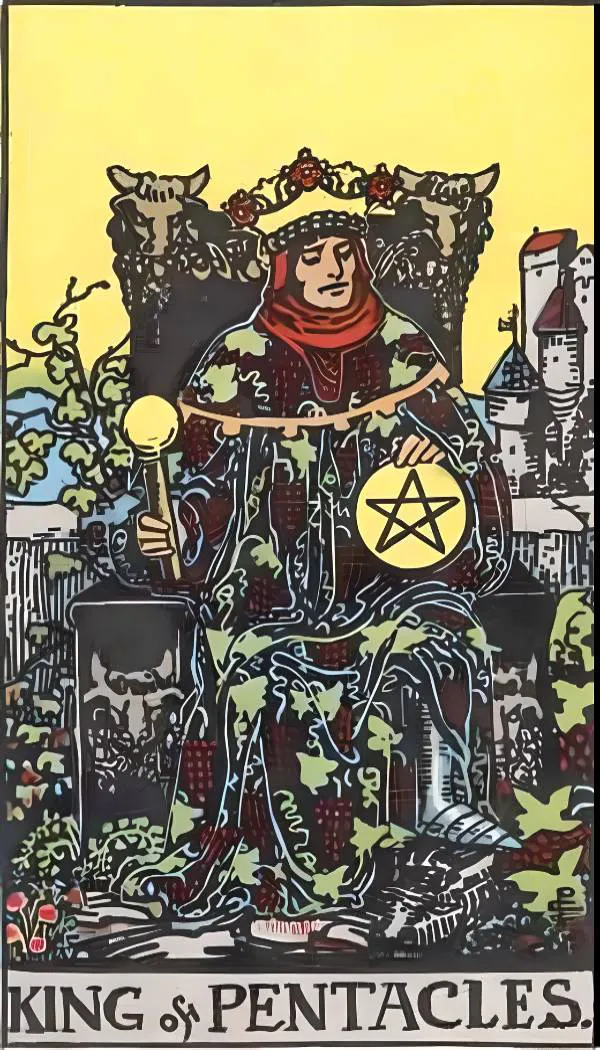
The mature man in the picture sits comfortably and securely, this character is the King of Pentacles.

The King's right hand rests on the armrest of the throne, holding the orb scepter. His left hand holds the pentacle coin and props up his left foot to place the large coin more stably on his knee. The King leans lazily against the back of the chair, looking down at his exclusive item - the coin, with a sense of ease.

This King wears a magnificent crown, and his robe falls to the ground, with patterns on the robe blending with the greenery of the scene.

The throne, carved with four ox heads from black marble, is located in his manor. Behind the throne is a crenelated wall, and behind it is the King's castle or palace.

Detail Pattern Description

The King of Pentacles has a bony and angular facial contour, which also indicates firm determination and patience. His complexion is somewhat dark, representing a calm and steady demeanor, but also slightly with a tendency towards comfort or a hint of old age. The King of Pentacles loves his exclusive item, looking down at the coin pressed by his left hand. His other hand firmly holds the scepter symbolizing power.

His robe is wrapped in armor, which can be seen from his exposed left foot. This combat attire represents that he is always ready to face challenges and various situations. His left foot, clad in iron shoes, is stepping on an animal - a wild boar, which is his prey. This shows that although he appears calm and gentle, he actually has an aggressive and predatory nature.

This King wears a golden crown adorned with floral and leaf decorations, with flowers and wreaths of leaves, representing the laurel wreath of glory and victory. There are three red five-petaled flowers on the top of the crown, as well as less noticeable yellow lilies. This is another combination of roses and lilies. A red scarf wraps around his neck and chest, implying inner passion. The dark robe is filled with grape patterns, with the more distinct being the grape leaves, and the purple particles forming an inverted triangular shape are the grape fruits. Surrounding it are grapevines, full of grape leaves, and you can also see real grape fruits.

The King's throne is made of black marble, noble and heavy, but it inevitably gives people a cold feeling. The entire throne can be seen with four ox heads, with two bronze ox heads inlaid at both ends of the backrest, and the front ends of the two armrests are also carved, which is very similar to the Emperor's four rams. These ox heads represent the symbol of endless life. The throne is located in his manor, with a city wall behind it, surrounding the King's castle or palace. The King sitting in nature indicates abundance, enjoying and managing everything he has. The throne is entwined with the leaves of plants, integrating with the environment and nature. The King's robe has green leaf patterns, and the tail of the robe falls to the ground, blending with the greenery of the scene. Everything in the background of the picture is owned by this King, including buildings and land, the royal city and the manor.

The Throne

The King of Pentacles sits upon a grand and ornate throne, adorned with symbols of bulls and vines. The throne itself is a representation of stability and authority. The bulls signify his relation to the Earth and the signs of Taurus and Capricorn, while the vines are emblematic of prosperity and growth.

The Pentacle

In his hand, the King holds a singular pentacle, which unlike the Queen of Pentacles, he does not gaze upon. This illustrates his external focus on his empire and the material world. The pentacle signifies wealth, but also responsibility; he is a guardian of not just riches but also of the practical and tangible assets in his domain.

The Sceptre

He also holds a sceptre which is a universal symbol of authority and rulership. The sceptre signifies the King’s dominion over the material and financial realms, reinforcing his role as a leader capable of manifesting prosperity not just for himself but for his realm.

The Robes and Armor

The King wears a robe adorned with grapes and vines, underneath which lies a suit of armor. The robe signifies abundance and pleasure, the gifts of the earth, while the armor underneath denotes his readiness for battle and his resilient nature.

The Landscape

Behind him is a lush and fertile landscape, a garden of plenty. This landscape serves as a symbol of the prosperous domain over which he rules, and the fruits of labor and wise investment.

The Castle

In the distance, a castle can be seen, further emphasizing the idea of a secure and prosperous domain. It symbolizes the end result of a life built upon hard work, business acumen, and practical wisdom.

Psychological patterns in King of Pentacles
Sunk Cost Fallacy
The throne, castle, wall, vines, robe, scepter, and pentacle all point to accumulation. The King appears physically nested inside what has already been built, so movement away from the estate would not look like a simple next step; it would feel like separating from proof, effort, and identity. That is the visual logic of Sunk Cost Fallacy. The psyche mistakes past investment for present alignment, using years, effort, money, status, or sacrifice as evidence that the current direction must continue. In a direction reading, this pattern can keep You loyal to a path that no longer returns energy. The card shows how the past becomes heavy enough to impersonate wisdom, even when the future is asking for a cleaner decision.
Boundary Discernment
The throne is set inside a defined manor, with the castle wall behind him and the King's body occupying a clear protected center. His robe blends with the land, but the wall, armor, and throne keep the estate from becoming shapeless. That visual boundary maps onto the psychological skill of separating real responsibility from outside pressure. In a crossroads choice, this pattern helps name what is truly yours to decide, what belongs to other people's preferences, and which hidden costs would cross a line you cannot sustainably carry.
Self-Accountability
The King does not look away from the pentacle he physically supports; his hand, knee, and armored foot make the object stable rather than decorative. The scepter in the other hand shows that control is paired with stewardship, and the wall behind him gives his responsibility a visible boundary. The psychological link is ownership without melodrama. You are invited to see growth as a domain you manage through repeated choices, where agency is grounded in what you actually hold, protect, and maintain.
Resource Alignment
The robe’s vine pattern blends into the living garden while the pentacle remains stabilized on the King’s knee. The scene is not empty abundance; it is an ecosystem where growth, effort, and containment are visibly connected. Resource Alignment comes from that ecosystem logic. In social circles, you may be auditing where your time, attention, and loyalty actually create energy instead of just adding access. The upright King frames belonging as stewardship: the right network is not the biggest one, but the one that can hold reciprocal investment without draining the ground.
Comfort Zone Attachment
The same throne that supports the King can also become too heavy to leave; black marble, wall, castle, robe, and vines form layered enclosure around a seated body. The pentacle and scepter occupy both hands, so the figure appears secure but unavailable to movement. In this orientation, protection starts consuming mobility. You may be using what already works as a defense against the uncertainty of the next level, turning safety into action paralysis because growth would require stepping outside the domain that proves you are competent.
Transactional Intimacy
The pentacle rests under the King’s hand while the sceptre stays upright in the other, creating a closed circuit between value and authority. The surrounding estate reinforces the idea that everything in the field can be measured, managed, and secured. Transactional Intimacy appears when that circuit enters social life. You may feel safest in relationships where roles, benefits, status, or usefulness are clear, because practical value is easier to trust than emotional uncertainty. The reversed King shows how social connection can become an exchange table when the nervous system does not believe closeness is safe without a visible return.
Scarcity Mindset
The pentacle is held close, the scepter stays in hand, and the heavy throne makes the entire estate revolve around one guarded center. In the reversed texture of this image, abundance does not feel spacious; it becomes something that must be watched, defended, and kept within reach. Scarcity Mindset is the defensive logic that turns workplace value into a zero-sum field. Credit, mentorship, budget, influence, and promotion access begin to feel like resources that can disappear if you loosen your grip. The pattern does not reveal greed; it reveals a nervous system trying to protect status in an environment where recognition feels unstable or unfairly distributed.
Possessive Attachment
The King's hands do not merely hold symbols; they secure them, while the walled estate and heavy throne make the surrounding world feel owned and enclosed. The armored foot planted over the animal adds a quiet dominance beneath the surface of luxury. When this structure turns inward in love, closeness can start to feel like territory that must be defended. You may experience a partner's autonomy as a threat to safety, so care mutates into monitoring, jealousy, or pressure to keep the bond under your control.
Status Quo Bias
The throne is heavy, the wall is fortified, and the king's body is fully settled into an established domain. Reversed, that durability can become psychological inertia: the structure is so proven that leaving it, editing it, or replacing it feels irrational even when it no longer serves the system. That image mirrors a cognitive bias toward what already exists. Familiar routines, possessions, subscriptions, schedules, and domestic setups gain authority simply because they have been there for a long time. In lifestyle work, Status Quo Bias appears when You keep tolerating friction because change would disturb the known order. The card shows how stability can become a trap when the system's age is mistaken for its usefulness.
Provider Identity Fusion
The King sits inside a fully built domain: throne under him, castle behind him, pentacle held at the body, scepter fixed in the hand. Nothing in the image feels accidental or unresolved; even the vines and robe fold into the larger structure of ownership, management, and visible stability. That visual density mirrors a psyche that has learned to create safety through competence. You do not simply use responsibility as a skill; the card shows how responsibility can become the container that tells you who you are allowed to be. The hidden armor beneath the robe matters here, because the polished surface is still protecting something more guarded underneath. Provider Identity Fusion forms when being stable, useful, and dependable stops being one part of the self and becomes the whole identity structure. In introspection, this pattern makes softer emotional material hard to reach because grief, need, fear, and desire must first pass through the question of whether they are productive, controlled, or worthy of being included in the inner kingdom.
Core Struggles in King of Pentacles
Resource Integration Strain
The sceptre, pentacle, armor, vines, throne, wall, and castle each belong to a different operating logic, yet the King has to hold them inside one seated arrangement. The card's stability is impressive, but it is built from parts that do not visibly share the same hinge. In daily life, this becomes the strain of having separate systems for work, sleep, meals, money, space, health, beauty, and recovery without a shared architecture. You may not be lacking resources; the pressure comes from making individually reasonable modules coexist inside one body and one week. The card makes the hidden friction concrete. A lifestyle can be materially supported and still feel fragmented when its parts do not speak to each other.
Intergenerational Control Loop
Reversed, the King's seated command hardens into a closed control system. The throne carries the body, the sceptre stays active, the pentacle remains guarded, and the estate turns inherited stability into the only visible coordinate map. In family dynamics, control can become difficult to name when it wears the costume of competence, provision, or common sense. The structure may look successful from the outside, yet inside it every choice is measured against rules that were established before you had a voice in them. You may feel pulled back into old roles even after building an adult life elsewhere. This card identifies the loop as intergenerational control: a repeated transfer of authority through resources, expectations, and definitions of safety that keep the family system steering your inner compass.
Masked Self-Division
The king's robe offers softness, abundance, and cultivated ease, but armor shows beneath it and the metal foot presses down on conquered animal force. The card places refinement and threat-readiness in the same body, without letting either one disappear. For introspection, this image gives form to the split between the composed self and the guarded self underneath. You may know how to look steady, generous, capable, or untouchable while a deeper layer remains braced, watchful, and unwilling to be seen without protection. The struggle is not that one side is false and the other is true. The card reveals a divided inner architecture: the visible self maintains polish, while the hidden self keeps wearing armor long after the immediate danger has passed.
Comfort Entrapment
The King's body is almost fully absorbed by throne, robe, coin, and estate. His position looks stable because every surface supports him, yet that same support leaves very little room for a fresh movement. In academic life, familiar routines can become that throne: the same subject area, the same note system, the same safe assignment style, the same level of effort that keeps you respectable. You may remain functional while the learning edge quietly disappears. The armored foot on the subdued animal adds a harder line to the comfort. The card shows a study setup that has already conquered uncertainty once and now keeps repeating the conditions of that old victory, even when growth requires stepping off it.
Abundance Overload
The King sits with a pentacle in one hand, a sceptre in the other, a crown above him, vines on his robe, and an estate pressing outward behind the throne. The image does not show lack; it shows a body surrounded by more managed value than a body can casually hold. For lifestyle questions, that visual crowding maps to a home, routine, wardrobe, wellness stack, calendar, and comfort standard that all look like evidence of a better life while quietly becoming another layer to carry. You are not failing because you have too little; the card locates the strain in a system where enough has multiplied into upkeep, choice, and sensory weight. The struggle becomes visible when comfort no longer arrives as relief, because every good thing also asks to be stored, cleaned, scheduled, protected, or optimized. The card gives that heaviness a boundary: abundance has crossed from support into load.
Power-Connection Split
The scepter remains upright in one hand while the pentacle is kept close to the body, and the black marble throne places the King above the living garden around him. His position grants command, but it also creates a hard edge between contact and access. In a social network, that edge appears when being competent, respected, or useful makes people approach your role more than your actual self. You can hold influence and still feel unreached, because the structure rewards your authority while keeping softer connection outside the walls.
Golden Handcuff Bind
The walled manor, heavy throne, rich robe, and fixed pentacle create a world that is materially complete and physically enclosed. When the scene hardens, the safest seat also becomes the place hardest to leave. In love, this is the shape of staying because the life around the relationship is too well built to question. You may feel the bond's comfort and cost at the same time, with security acting less like support and more like gravity.
Energy Distribution Strain
The King's body is seated in ease, but both hands are already occupied: one grips the scepter, the other stabilizes the pentacle on his raised knee. The estate behind him looks abundant, yet the whole scene narrows authority, access, and material care into one fixed body. That visual load mirrors the social strain of being the person who hosts, replies, connects, remembers, and stays available while also trying to keep something for yourself. You are not simply tired from people; the card locates the exhaustion in a distribution system where every connection asks for a portion of the same limited inner resource.
Inner World Entrapment
Turned inward, the king's estate becomes less like a place of grounded abundance and more like a sealed inner domain. The wall, castle, throne, vines, coin, and robe all belong to the same controlled field, and the body is absorbed into the system it has built. This is the structure of an inner world that has become too self-contained to refresh itself. You may be able to name, organize, protect, and manage what happens inside, yet the old emotional material keeps circulating inside the same guarded enclosure. The card locates the trap in the success of the container itself. The inner system is not chaotic; it is over-secured, and that over-security can keep stale feeling, shadow material, and psychological residue from finding an exit.
Security-Identity Fusion
The robe's leaf pattern blends into the garden, and the throne is wrapped into the same cultivated field as the estate behind it. The figure is not merely sitting among possessions; his outline is visually fused with the land, symbols, and architecture that prove stability. In a direction reading, that fusion marks the moment when changing course threatens more than a plan. You may be trying to choose a future, but the card locates the deeper pressure where security has become part of identity, so movement can feel like losing the self that the old path successfully built.
Inner Emotions in King of Pentacles
Grounded Agency
The pentacle is not floating as an abstract promise; it is pressed into the king's hand, weighted against his knee, inside a walled estate filled with vines and cultivated land. The scene keeps attention close to what is tangible, owned, grown, and maintained. For timing questions, this visual field pulls the mind away from panic about the next opening and back toward actual leverage. The castle, manor, throne, and coin form a map of available capacity: what has been built, what can be sustained, and what is ready to be used without overextending. Grounded Agency is the emotional weather of realizing that timing is not only something that happens outside you. It also comes from being able to name your resources clearly enough to act from choice rather than pressure.
Hollow Control
The sceptre, crown, pentacle, throne, wall, manor, and castle all remain intact, but together they can form a closed circuit of possession. The more the eye follows these symbols of command, the more the scene can feel sealed around control rather than alive with movement. That sealed quality is especially sharp in timing questions. When every variable has to be owned before action feels possible, timing stops being a rhythm and becomes a private fortress. You may be managing the moment so tightly that the moment can no longer breathe. Hollow Control names the emptiness inside over-secured command. The card shows how the wish to master timing can quietly separate you from the flexible responsiveness that timing actually requires.
Comfort Numbness
The King’s throne is luxurious, but its black marble carries a cold heaviness, and the body sinks into it with very little visible motion. The robe, vines, and ornamentation wrap the figure so completely that comfort begins to look like a surface that absorbs movement. In personal growth, that image reflects a state where stability has become insulating. You may have routines, resources, or achievements around you, yet the inner signal that once pulled you forward feels muted by the very comfort that was supposed to support you. Comfort Numbness is not simple laziness. It is the strange quiet that appears when ease loses contact with aliveness, leaving you protected from pressure but also less able to feel what you genuinely want next.
Hollow Abundance
The vines, grapes, pentacle, manor, and castle pack the image with visible plenty, yet the King's attention narrows to the object held closest to his body. The scene can feel less like nourishment and more like inventory: full around the edges, strangely unreachable at the center. Hollow Abundance names the inner split where stability, comfort, or visible progress fails to touch the place that actually feels underfed. In an introspective reading, the card reflects the ache of realizing that having enough around you is not the same as feeling met inside.
Authority Claustrophobia
The black marble throne, ox heads, scepter, wall, and castle stack authority into a dense vertical structure around one seated figure. The body has room to sit, but the scene's power objects press the air into rules, ownership, and inherited rank. In family dynamics, that visual weight becomes the feeling of shrinking under parental or elder control even when no one is raising their voice. You may be an adult, but the room can still make your nervous system behave as if permission lives somewhere outside you.
Status Anxiety
The crown, scepter, pentacle, throne, wall, and castle stack visible legitimacy around the king's body. Under the robe, armor remains present, suggesting that the display of security still requires a protected core and a readiness to defend what has been built. Status Anxiety grows from that pressure to keep every marker intact. In career, the title, salary band, team perception, and leadership image can become less like achievements and more like exposed assets that need constant maintenance. The card's authority is material, but the reversed emotional texture makes it feel guarded rather than settled. You may have evidence of success, yet the inner system keeps scanning for the moment that evidence might be questioned, downgraded, or taken out of your hands.
Transactional Unease
The sceptre, pentacle, crown, and castle gather around the King as symbols of resource, authority, and secured territory. When the relational field is read through that stack of objects, support begins to feel conditional rather than warm. Transactional Unease surfaces in love when care begins to feel measured, owed, or quietly leveraged. You may not be dealing with open conflict, but the body notices when generosity arrives with invisible accounting, and the card gives that unease a concrete image.
Security Hunger
The pentacle is not simply displayed; it is braced against the knee and watched closely, with the castle and wall reinforcing the scene's need for tangible proof. The whole picture gathers around what can be held, owned, and verified. Security Hunger in love grows when reassurance has to become physical, repeated, or undeniable before the inner system can rest. The card links that craving to a relationship field where stability matters deeply, yet the search for proof can start to outrun the actual presence of care.
Quiet Certainty
The pentacle, scepter, crown, and castle all sit in the frame without competing for attention, and the King's gaze lowers toward what he already holds. His posture turns external validation into a quiet inventory of what is real, stable, and already built. In a social network, Quiet Certainty is the calm of knowing your value before the group reacts. You are not measuring every invite or silence as proof; the card points to a self-positioning that stays intact while other people's attention moves around you.
Embodied Ease
The King’s body is fully supported by the throne, with one hand resting on the scepter and the other settling the pentacle against his knee. Nothing in the posture looks hurried; the scene lets weight, texture, wealth, and time gather around one steady center. That visual structure turns lifestyle into something physical rather than aspirational. A routine is not only a checklist here; it is a chair that can hold you, a boundary that can contain you, and a resource system that does not require constant panic to remain intact. Embodied Ease appears when your daily architecture starts lowering the friction in your body. You can feel the difference between performing stability and actually being held by a life that has been built with enough room, rhythm, and material support to let your nervous system stand down.
Outer Contexts in King of Pentacles
Safe Harbor Option
The crenelated wall, fertile manor, and distant castle create a protected enclosure around the seated figure. The throne is heavy, the symbols are intact, and the body has enough room to hold position without bracing against immediate loss. That is the external logic of a Safe Harbor Option: a stable base exists while the broader route is being recalibrated. You are not being pushed by open chaos here; the useful question is whether this protection gives you leverage for a cleaner direction, or whether it quietly becomes the only direction allowed.
Scorekeeping Friendship
The king's hand fixes the pentacle in place while the scepter marks authority over the surrounding domain. The image can become a ledger-like scene: value is held, guarded, and evaluated from a position of control. In friendship, that structure appears when every ride, gift, reply, secret, bill split, apology, and emotional favor is tracked. The bond may still use the language of loyalty, but the atmosphere starts to feel like an audit. The cold black throne sharpens the point. This is not ordinary awareness of reciprocity; it is a rule system where affection becomes evidence, and you are left trying to prove you have paid enough into the friendship to keep your place.
Family Resource Gatekeeping
The pentacle is large, singular, and pressed under the king's hand, while the castle sits behind a defended wall. The image gathers land, wealth, and permission into one seated center instead of showing resources moving through many hands. Inside a family system, that can mirror support that exists but cannot be reached without passing through the resource holder's approval. The issue is not only money; it is the way access to practical help, information, housing, or inheritance talk becomes a lever for compliance.
Conditional Family Support
The king's left hand pins the pentacle against his knee while the other hand keeps the scepter upright, and the manor behind him makes material security unmistakably visible. Provision is present, but it is not floating freely; it is held, named, and administered by a single authority figure. In a family context, that visual economy maps onto help that arrives with a quiet ownership clause. You may have access to money, housing, introductions, or emotional approval, yet the same structure that protects you can start measuring whether you are grateful enough, agreeable enough, or still moving inside the family-approved lane.
Lifestyle System Overhaul
The King sits inside a fully cultivated estate, with the pentacle, scepter, throne, wall, vines and castle all arranged as parts of one managed domain. Nothing in the image functions as an isolated object; each symbol depends on a wider structure of protection, maintenance and practical command. That visual system maps cleanly onto a life that can no longer be fixed through one tiny habit or one productivity trick. You are looking at the architecture of daily living itself: the way food, sleep, work, money, space, tools and recovery either support one another or compete for the same limited bandwidth. The card gives this context its weight because the King does not merely own resources; he governs an environment. Lifestyle System Overhaul appears when the real task is to rebuild the operating structure around your life, so your routine stops depending on scattered willpower and starts behaving like a coherent domain.
Resource Readiness Check
The large pentacle braced against the King's knee, the scepter in his other hand, and the estate behind him create a scene where action is supported by real assets rather than raw momentum. The abundance is organized into tools, walls, land, authority, and harvestable growth. That makes Resource Readiness Check a precise timing context. You are not only asking whether to move, but whether the physical and social supports around the move can sustain it after the first burst of effort.
Transactional Friendship Circle
The single pentacle, the scepter, the estate, and the castle all concentrate value around one seated figure. In this state, the image no longer feels like shared abundance; it feels like access to resources is being displayed, measured, and controlled. A friendship circle can start to mirror that structure when closeness depends on favors, money, lifestyle access, social usefulness, invitations, or who can provide the best platform for the group. The bond still looks lush from the outside, but its inner logic becomes exchange. This context exposes the moment when friendship starts carrying the texture of a private economy. You may still care about the people involved, but the card reveals the contract-like layer underneath: what must be provided to stay close, visible, or included.
Status Anxiety Circle
The crown, throne, scepter, marble carvings, manor, and castle make rank visible before anyone speaks. The whole scene is arranged around who sits at the center, who owns the domain, and what material symbols prove legitimacy. In a social network, that becomes a circle where people constantly scan status: credentials, income signals, taste, proximity to influence, who gets invited, and who appears successful enough to matter. Connection can start to feel like being evaluated inside a polished room where everyone pretends the ranking is not happening. The card reframes the pressure as a social architecture built around visible value. You do not have to reduce yourself to the hierarchy in order to see it clearly, and seeing it clearly helps separate real belonging from status performance.
Budget Ownership Trial
The coin balanced on the King's knee, the sceptre held at the side, and the heavy throne beneath him create a picture of material authority that has become visible, formal, and measurable. The body is not reaching for possibility; it is seated inside responsibility, surrounded by tools that turn wealth, land, and status into something that must be managed. Budget Ownership Trial appears when a career step gives you control over money, headcount, revenue, or operational outcomes. The card frames this as more than a confidence test: it asks whether the workplace has aligned authority, resources, accountability, and protection around the role, or whether the coin has simply been placed on your knee for public display.
Post-Achievement Plateau
The King is already seated inside the result: the throne is built, the estate is visible, and the symbols of ownership are in hand. The scene carries the weight of arrival, but it offers little visible motion beyond maintaining what has been gained. Post-Achievement Plateau describes the timing confusion that arrives after a goal has delivered status but not a next direction. You may be standing after the milestone, not before it, and the real question becomes how to read a new season when the old success structure no longer generates movement.