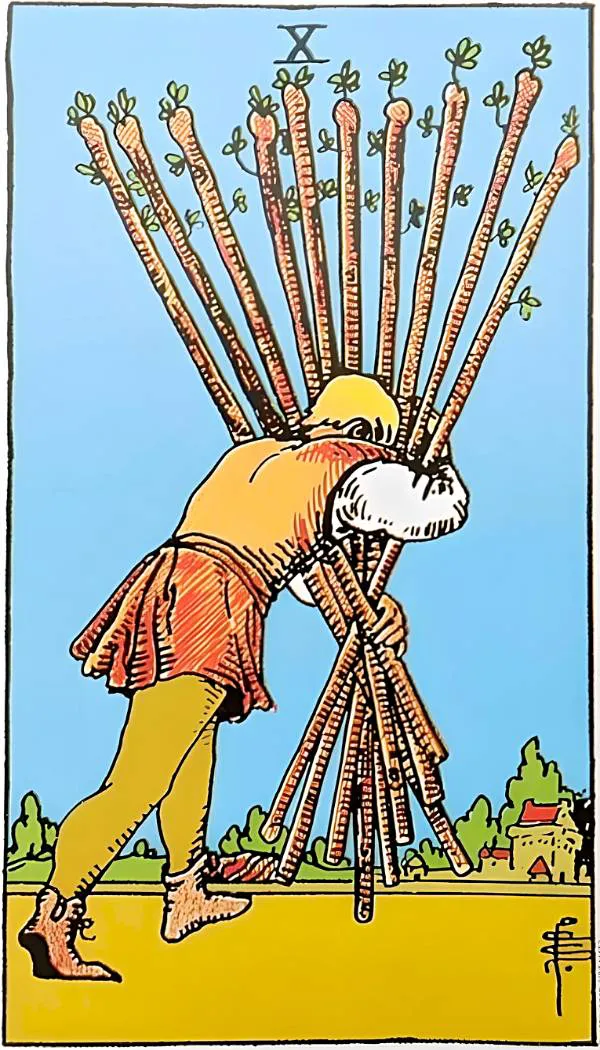
Quiet PromotionThe bent figure's face disappears behind ten heavy wands, while the road toward town remains open but difficult to see. The bundle is a direct image of a work role whose separate tasks have fused into one continuous physical load: meetings, training, decisions, and urgent messages all travel on the same back. You can still move and produce, but the scale of the load changes what the road allows. As the workplace routes more senior work through you, evenings become overflow space and recovery becomes an afterthought. The image makes the lifestyle cost concrete: the organization gets a wider workday while your ordinary life carries the weight.
Study Life Boundary CreepThe carrier advances toward a fixed destination while ten wands crowd the space between his body and the town. That visible journey mirrors a deadline cycle in which every near-term obligation is pulled forward at once, causing the period before submission to consume evenings and weekends that were supposed to support recovery. The upright road confirms that the cycle has an endpoint you can see, but it also exposes how much must be carried before reaching it. Your timing problem is therefore not simply moving too slowly; it is a cadence that stacks multiple academic clocks onto the same stretch of personal time.
Second Shift BurdenThe ten staffs gathered into one bundle and carried by one bent figure toward a settled town portray a family system supported by concentrated labour. You hold the meal planning, cleaning, appointments, supplies, forms, and next-day preparation together while other household members interact mainly with the completed result. The town ahead shows that the family reaches each practical reset because a route and capable carrier remain available. The upright scene also exposes the structural cost: shared needs have been converted into one person's role, making family stability dependent on your continued ability to absorb the load.
Process Debt CycleAn arched figure bends forward beneath a bundle of wands, with the town visible only beyond the load. Each wand can stand for an unretired check, duplicate tracker, approval, or undocumented exception; the path is present, but the carried bundle makes a short delivery route slow and physically costly. You are still moving work, but your effort is spent transporting the workflow's history rather than completing the request. Because the upright image keeps the figure on his feet and headed somewhere, the structure contains enough continuity to deliver, yet it makes speed depend on how much invisible process weight you can carry.
Care Work SpilloverThe worker carries all ten wands toward the town with his face obscured by the bundle. In a career setting, that load resembles a formal job sitting on top of unrecognised household care, while management evaluates only whether the visible delivery reaches its destination. Upright, you may still meet deadlines and preserve professional continuity, but the route is being completed through personal overextension. The card exposes a workload-accounting gap: your employer can interpret each disruption as an isolated scheduling issue while the combined work-and-care burden remains systematically uncounted.
Friend Group Logistics ResetThe figure’s hands contain every staff, leaving nobody else in the scene sharing the weight, while the destination associated with communal life remains in view. That image reflects a friendship role in which caring has become fused with organising, so the person who initiates also schedules, reminds, compromises, and repairs each stalled plan. Upright, the destination confirms that the friendships can still produce real contact, but the path exposes its unequal cost. You can value the group while recognising that repeatedly carrying its entire maintenance bundle is not the same as receiving mutual effort from close friends.
Family Boundary CreepTen wands fill the carrier's field of view, bend his posture, and make the nearby town harder to reach. The bundle captures how small family favours, calls, visits, and administrative tasks can accumulate until they occupy the physical space that should hold meals, rest, domestic upkeep, and unclaimed time. The town remains visible and the carrier is still moving, so the workload can be audited rather than treated as an unavoidable identity. You can distinguish the obligations required for your own life from the family tasks added through assumed availability, revealing where a functioning routine has quietly become an unpaid service role.
Lease Cosigning PressureBent beneath all ten wands while still trying to reach the town ahead, the figure makes transferred workload physically visible. The destination remains reachable, but only by carrying a bundle large enough to obstruct sight and movement, echoing a lease request that imports another household's rent risk, paperwork, and monitoring into your own daily system. You may still be managing work, bills, messages, and plans for your own home while the cosigning request adds clauses to review, figures to verify, and consequences to track. The pressure is therefore not confined to one signature; it becomes an extra layer of life administration that consumes attention without giving you control over the tenancy.
Sunk Cost Exit DilemmaThe bundle is visibly valuable: ten living wands gathered through effort, held close, and carried toward a near destination. That value is exactly what makes the load difficult to question, because dropping it would mean confronting how much has already been invested. This is the structure of a sunk cost exit dilemma in a direction reading. You may know a path no longer fits, but the years, money, reputation, skill, identity, or public story attached to it keep making the next step feel like a verdict on everything already carried. The Ten of Wands separates past investment from future obligation. It shows that the bundle can be real and costly without being entitled to define the rest of the road.
Adulting Performance PressureTen wands are gathered into one oversized bundle and carried by a figure whose posture is compressed and whose view of the destination is obstructed. In career terms, the load reflects paid work plus responsiveness, networking, skill development, visibility, side projects, and the domestic recovery labour required to return ready for another week. The town is still ahead and the load is physically identifiable, so the upright image keeps redistribution and scope visibility conceptually available. You can separate the responsibilities that belong to the job from the extra labour carried to look ambitious, reliable, and fully established outside it.