Six of Pentacles Tarot Card Meaning

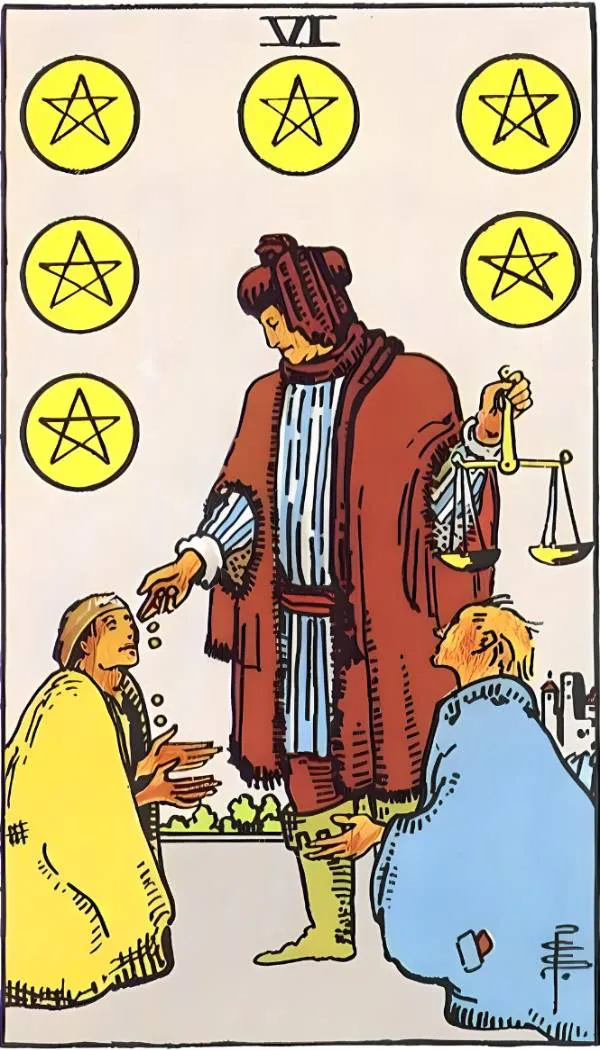
Six golden pentacles hang in the air, symbolizing prosperity, stability, and the accumulation of wealth. They are distributed in the center and on both sides, but not in perfect balance.

The central figure, dressed in splendid attire, wears a blue striped garment with a thick red coat and a matching red hat, wrapped in a dark brown turban. He is the protagonist of the story, a successful merchant, and the benefactor who holds the material resources.

Before this benefactor, there are two impoverished individuals, one on each side. He holds a set of scales in his left hand to weigh the coins, and with his right hand, he is pouring some coins downwards.

These two individuals seeking relief kneel on the ground facing the benefactor, looking up at him with eager anticipation, and both have their hands outstretched to receive the aid. They are wrapped in warm cotton cloth, and the one on the benefactor's left side has both hands outstretched to catch the falling coins. He is dressed in earthy tones and wears a turban on his head.

The person beneath the benefactor's left-hand scales is waiting for the benefactor to act, with one hand extended in anticipation. He is wrapped in blue cloth with a hole revealing the same red as the benefactor's attire. Through the gap in the blue-clothed man's back, one can see the distant buildings.

All three figures are positioned on a platform, with a backdrop of greenery on the horizon, matching the color of the benefactor's shoes. The entire sky, except for the six pentacles, is clear and uncluttered. The arrangement of the six pentacles is skewed to one side, with three on the benefactor's right hand side and only two on the left side where he holds the scales, indicating a current process of financial balancing.

Scales

The scales in the Six of Pentacles symbolize balance, fairness, and justice. They serve as a reminder that what is given will eventually be received, and what is taken must eventually be repaid. It represents the universal law of cause and effect.

Coins

The coins depict material wealth, resources, or opportunities that are either being given or received. In the Six of Pentacles, the act of sharing wealth is evident, emphasizing the role of generosity and charity.

Rich Man

The figure of the rich man stands as a symbol of power, capability, and abundance. He is the giver in this scenario, and his actions represent the will to distribute resources wisely and fairly.

Beggars

The beggars who receive the alms signify those in a state of need, lack, or inequality. They are dependent on the generosity of the rich man, and their presence in the card points to social imbalances that require rectification.

Robes and Attire

The attire of the rich man and beggars holds symbolism. The rich man’s richly adorned robe suggests his authority and status. The beggars’ tattered clothing signifies their vulnerability and need. These contrasting garments highlight the disparities present in the material world.

Almsgiving

The act of giving and receiving alms is central to the Six of Pentacles. It represents the concept of charity, compassion, and assistance. The rich man’s act of giving can be seen as an embodiment of benevolence and an understanding of the interconnectedness of all beings.

Psychological patterns in Six of Pentacles
Rescuer Identity
The standing figure controls both the scale and the falling coins while the lower figures organize themselves around his hands. His identity in the scene is not simply that he has resources; it is that the whole field turns toward him as the one who distributes them. Rescuer Identity forms when being useful becomes the safest way to stay above your own need. In personal growth, helping others can become a refined avoidance strategy, letting you remain the capable giver while your own unfinished work waits on the ground.
Relational Scorekeeping
The uneven pentacles above the figures, the scales in the giver's hand, and the coins falling to one side all pull attention toward imbalance. The image is not just about generosity; it is about the mind noticing who gets what, when, and under whose control. In its reversed form, this becomes Relational Scorekeeping. The defense tries to protect you from being exploited by converting emotional ambiguity into numbers, comparisons, and evidence. In romance, the pattern can make every late reply, apology, favor, or sacrifice part of a private case file. The card shows why the mechanism feels compelling: when fairness has not been spoken directly, the psyche starts building a ledger to regain control.
Timing Discernment
The eye moves from the suspended pentacles to the scales, then down to the coins and open hands. The card is not frozen at the point of perfect equality; it captures the moment when imbalance is being read, weighed, and adjusted. That is the core of Timing Discernment. You are tracking whether the field is ready, whether resistance is useful data, and whether the next move belongs to giving, receiving, waiting, or redirecting. The clear sky gives the scene room to breathe, which matters psychologically. This pattern is not about obsessively finding the flawless moment; it is about recognizing the usable moment where imperfect conditions still contain enough structure to act intelligently.
Emotional Reciprocity
The merchant's left hand holds the scales while the right hand pours coins to one kneeling figure, and the second recipient waits with a hand extended. The scene is not pure abundance; it is calibrated flow, where care moves only when the system can perceive proportion. Emotional Reciprocity appears here as the social nervous system's need to know whether care can circulate both ways. You may be noticing where your friend group, network, or community has turned into a one-way channel, and the card gives that discomfort a visible structure instead of leaving it as vague guilt or resentment.
Guilt Conditioning
The standing figure holds the scales above the kneeling recipients while the coins fall from his raised hand, making care visible but vertically controlled. The bodies below are open and waiting, so the exchange is not only about support; it is also about who gets to define when support arrives and what it costs emotionally. That visual structure mirrors a family system where help becomes psychologically loaded. A favor, payment, visit, or sacrifice may look generous on the surface, but the nervous system starts reading it as a future claim on compliance, gratitude, or silence. Guilt Conditioning forms when the inner ledger is installed before you can question it. You may feel indebted before anyone directly asks for anything, because the old family rule has already taught you that receiving care means giving up some portion of autonomy.
Energy Scorekeeping
The scales make the exchange countable, and the coins make the count visible. In the reversed texture of the image, measurement can harden into a ledger where every unit of effort asks whether the return was fair enough. Energy Scorekeeping appears in academic life when hours studied, grades received, feedback given, and recognition withheld become a running internal account. The pattern can protect you from wasting energy, but it can also make learning feel impossible unless the system first proves that every effort will pay back cleanly.
Resource Alignment
The standing figure holds the scales in one hand while releasing coins with the other, turning generosity into a measured act rather than an emotional spill. The six pentacles are not perfectly balanced in the sky, so the card does not show endless abundance; it shows active distribution under constraint. That visual structure maps directly onto Resource Alignment because the psyche is trying to make capacity visible before it gets spent. You are not simply being asked to give more or do less; the pattern reveals where your time, attention, money, body energy, and recovery are being weighed against each other inside one finite system. In a lifestyle context, this card becomes a quiet audit of the daily ledger. The issue is not whether you are productive enough, but whether your personal architecture gives resources to the parts of life that actually keep you stable instead of letting urgency, guilt, or aesthetics decide the allocation.
Transactional Intimacy
The scales hang beside the falling coins, so the act of giving is visually tied to measurement. Nothing in the image feels purely spontaneous; the hand gives, the instrument weighs, and the kneeling figures receive inside a structured economy. In the reversed texture of the card, that structure can harden into Transactional Intimacy. Care becomes a currency, vulnerability becomes leverage, and affection is tracked by what it proves, costs, or earns. In love, this pattern can make every gesture carry an invisible invoice. The card's imbalance exposes the mechanism clearly: the relationship is no longer asking whether care is real, but whether the exchange keeps anyone from feeling powerless.
Scarcity Mindset
The six pentacles are visible above the figures, but their arrangement is uneven and the coins are released in a measured trickle. The kneeling bodies make the distribution feel immediate and personal, as if every token has to be watched before it disappears. In the reversed career reading, that visual pressure becomes Scarcity Mindset. You start reading promotions, praise, budget, mentorship, and stretch assignments as a limited supply, so another person's gain can feel like a direct threat to your own place. The card's psychology is not simple ambition; it is attention narrowed by perceived shortage. The scale and falling coins show how the mind can confuse uneven access with permanent exclusion, trapping you in comparison instead of strategic positioning.
Overfunctioning
The central figure is the only person standing, the only person holding the scales, and the only person actively moving resources. The two kneeling figures create a field of visible need, while his body becomes the hinge through which all relief, balance, and motion must pass. Reversed, that posture becomes Overfunctioning because the system keeps assigning agency to the person who can still distribute. The giving hand does not simply represent generosity; it becomes a compulsive output channel that keeps working because stopping would expose how dependent the whole arrangement has become on one person's capacity. In a lifestyle reading, this points to the daily architecture of doing too much because the system around you has learned that you will. You may be managing schedules, supplies, emotional tone, deadlines, chores, and recovery plans, while your own sleep, space, and body needs wait like the second figure under the scales.
Core Struggles in Six of Pentacles
Autonomy Guilt Bind
The kneeling route has become the available path toward the coins, and the suspended scale keeps the exchange psychologically unfinished. The bodies below can receive, but the scene does not show them standing afterward with equal ground restored. In family systems, this reversed pressure turns support into a debt signal that follows the adult self into choices, distance, and independence. You may try to leave, choose differently, or build your own life, while the remembered structure of receiving keeps asking whether separation is a form of nonpayment. Autonomy Guilt Bind is not simple guilt; it is guilt attached to the architecture of help. The card makes that architecture visible through repeated transfer without restored agency: the resource arrives, but the right to move freely still feels weighed.
Unseen Cost Bind
The coin stream is visible, but the exchange around it is not neutral: a scale hangs beside the giving hand, patched clothing exposes the body underneath, and one recipient waits while another receives. The benefit can be counted faster than the dependency it may create. Unseen Cost Bind lives in that delay between what is offered and what it will ask from you later. The card gives shape to the part of a decision where the obvious gain is bright and measurable, while the future concession, obligation, or loss of self-direction remains harder to price.
Unspoken Expectation Load
The scales hover beside the coins, turning the act of giving into something that can be counted. In the reversed structure, the problem is not the absence of help; it is the invisible ledger attached to help once it enters the relationship. In love, a favor, compromise, gift, apology, or sacrifice may look generous in the moment and return later as emotional evidence. You are left sensing a cost before anyone says it out loud, which makes receiving feel unsafe even when the gesture itself is kind. Unspoken Expectation Load is the pressure created by care that has not declared its terms. The Six of Pentacles exposes the hidden accounting system, giving a boundary to the vague dread that every gift may become a claim.
Caretaker Role Lock
The giver's hands are split between measuring and releasing, and the receivers remain arranged around that split. In the reversed field, the transaction no longer looks like a single act of support; it becomes a role system that keeps reproducing itself. In love, one partner may keep fixing, paying, soothing, explaining, initiating, or rescuing while the other keeps waiting for repair. The relationship survives through this exchange, but survival is not the same as intimacy when both people are held in positions they cannot exit. Caretaker Role Lock names the exhaustion of being needed in a way that prevents mutuality. The card shows how care can become a station you are assigned to, rather than a living current that moves both ways.
Timing Control Strain
The merchant holds the scales in one hand while coins leave the other, so measurement and release are not sequential; they are happening at the same time. The body has to stabilize the symbol of balance while also committing to a visible transfer. In timing work, that split becomes the strain of trying to make the moment exact before allowing movement to happen. You may keep searching for the perfect measure because acting too early, too late, or with incomplete information feels like it could distort the whole outcome. Timing Control Strain sits inside that split-arm posture. The card shows the point where control stops being clarity and becomes a load-bearing position, forcing you to hold the scale longer than the situation can actually remain still.
Reciprocity Deficit
The falling coins, open hands, and suspended scales make the exchange visible, but they do not make it mutual. One body controls the flow, two bodies wait beneath it, and the uneven pentacle arrangement keeps the idea of balance physically unfinished. In friendship, that structure becomes the ache of caring inside a bond where support can be tracked but not fully reciprocated. You may keep showing up, listening, covering, inviting, or absorbing, yet the relationship still feels organized around an imbalance that everyone can sense and no one quite names. The Six of Pentacles anchors Reciprocity Deficit in a very specific shape: movement without circulation. The friendship is not empty of care; it is caught in a channel where care travels in one direction often enough that mutuality starts to feel like a promise waiting above the scene rather than something happening on the ground.
Power-Intimacy Split
The Six of Pentacles places one figure upright and resourced while two others kneel below him with open hands. The coins may be moving, but the height difference remains: closeness is staged through unequal posture before it becomes an exchange. In love, this image carries the strain of trying to feel intimate with someone who also holds leverage. The relationship may include real generosity, real care, and real moments of relief, yet the deeper field keeps asking one person to look up and the other to decide what can be released. Power-Intimacy Split is the point where affection cannot fully settle because equality has not reached the body of the bond. The card gives that discomfort a visible structure: you are not only asking whether love is present, but whether love can survive the hierarchy it is moving through.
Power-Belonging Split
The red of the giver's robe reappears through the torn blue cloth of one receiver. The image shows a shared substance across unequal coverings: the figures are connected, but that connection is distributed through status, exposure, and vertical position. That is the family tension behind Power-Belonging Split. You can belong to the same bloodline, household story, or emotional history while still feeling that access to warmth depends on accepting the power arrangement that comes with it. The card gives this struggle a precise visual boundary. Belonging is not absent; it is present inside a hierarchy, and the pain comes from trying to receive family connection without letting the hierarchy define the whole self.
Power-Connection Split
The standing figure occupies the center while the two receivers reach upward from the ground, turning support into a vertical arrangement. The gold pentacles hang above the scene, and even the shared red color appears unequally distributed: full robe at the center, small exposed tear at the edge. In friendship, this visual hierarchy becomes the strain of wanting closeness with someone whose resources, confidence, social influence, or emotional control shape the terms of connection. You may be inside the bond, yet still feel positioned below the person whose approval, attention, or access seems to decide the flow. The Six of Pentacles gives Power-Connection Split a concrete image: intimacy routed through inequality. The friendship is not simply lacking affection; it is trying to hold affection inside a structure where one person has the hand that releases and the other has the hand that waits.
Power-Choice Split
The rich figure stands upright while the two recipients kneel below his hands, so the flow of coins is controlled from one level of the scene. The person receiving support can reach, wait, or catch, but the timing and amount still pass through someone else's position. Power-Choice Split appears when a decision is shaped by access rather than desire alone. You are not simply choosing between options; the card shows how support, approval, money, status, or opportunity can become a gate that changes what freedom feels like.
Inner Emotions in Six of Pentacles
Timeline Panic
The scales hang in the giver's hand while the recipients look up from below, turning the whole scene into a suspended judgment about when enough will be released. The uneven pentacles overhead intensify the sense that timing is being counted, but not evenly shared. You may feel as if your window is being measured somewhere outside you. Timeline Panic emerges when waiting stops feeling strategic and starts feeling like evidence that you are late, under-resourced, or about to miss the moment that matters. The Six of Pentacles does not confirm that panic; it displays the structure producing it. By making the unequal pace visible, the card helps separate your actual readiness from the pressure of an external clock.
Hollow Control
The standing figure holds the exchange from above, with the scales becoming as important as the coins themselves. Contact is filtered through measurement, and the kneeling bodies remain suspended in a posture of waiting. Hollow Control emerges when the inner world copies that arrangement. You may keep yourself composed by weighing every feeling before it is allowed to move, but the constant management can drain the emotional life out of the very order it was meant to protect. The card links this emotion to control that looks functional while feeling empty inside. The scales promise clarity, yet when they dominate the scene, they also show how emotional safety can turn into a sterile audit of what may be felt, given, or received.
Mutuality Hunger
Two open hands reach upward while the coin flow moves in only one direction. The card shows help arriving, but it also shows the ache of receiving from below rather than meeting support at eye level. Mutuality Hunger comes from that asymmetry. In direction questions, it names the longing for guidance, mentorship, or resources that does not require you to shrink, perform gratitude, or outsource your inner compass. You may not be rejecting help. You may be looking for a form of support that lets your future remain yours, where exchange restores clarity instead of quietly turning your path into someone else's project.
Hidden Resentment
The coins fall from one hand, but the scale in the other hand keeps the exchange under visible control. The scene can look generous on the surface while still holding a sharp vertical divide between the person who decides and the people who wait. Hidden Resentment grows in that exact divide. In love, support can be real and still feel emotionally costly when one partner controls the timing, amount, or moral tone of what is given. The card gives resentment a non-dramatic structure: it is the feeling that rises when gratitude is expected before equality has been restored. You are not only reacting to what was offered; you are registering the position you were placed in to receive it.
Quiet Shame
The kneeling body, the extended hand, and the torn cloth make vulnerability physically visible without making it dramatic. Need appears close to the ground, partially covered, and still exposed enough to be seen. Quiet Shame is the emotional weather of that image turned inward. You may not feel publicly humiliated; instead, a smaller and more persistent heat gathers around the exposed part of you that wants care, approval, rest, or repair. The Six of Pentacles supports this feeling because the card does not hide need behind abstraction. It places need in a measured exchange, showing how shame can form when the inner self feels visible before it feels safe.
Abundance Guilt
The standing figure's red coat, full hand, and steady scales place him in the position of visible capacity. His resources are not hidden, and the open hands below make his ability to give impossible to ignore. For friendship, that image catches the discomfort of being the one with more bandwidth, money, stability, or clarity. You may want to be generous, but the card exposes the private unease that generosity could turn you into the powerful one in the room.
Performative Warmth
The red coat, open hand, and visible act of giving create an image of warmth performed in public space. The gesture is kind on the surface, but the elevation of the giver and the presence of the scales keep the warmth carefully managed. Performative Warmth appears when the inner self learns to look generous, calm, and emotionally available while maintaining a private distance from the feeling itself. You may offer the correct tone, the helpful response, or the graceful apology while another part of you stays watchful behind the gesture. The Six of Pentacles connects to this emotion because its warmth is inseparable from presentation, position, and control. The card names the strain of displaying care while the inner system is still deciding how much real contact it can tolerate.
Status Anxiety
The standing merchant and kneeling figures create a vertical social map before any words are spoken. Clothing, posture, and access all sit at different heights, so the scene turns status into a physical arrangement. Status Anxiety enters when a group feels organized by who stands above, who waits below, and who gets to distribute attention. You are not simply comparing achievements; you are reading the room as if belonging depends on rank, visibility, and proximity to resources.
Permission Anxiety
The kneeling recipient beneath the scales is not just waiting for coins; the whole body is organized around someone else's hand. The suspended scale turns motion into a checkpoint, and the upward gaze makes approval feel like the doorway to movement. In personal growth, this becomes the inner pressure of needing a mentor, audience, credential, or invisible authority to confirm that you are allowed to begin. You may have enough desire to move, but the emotional system keeps looking upward for a signal before it lets your own agency come online.
Ethical Unease
The scales hang beside an uneven stream of coins, and the two waiting figures do not receive from an identical position. The image makes fairness visible without making it simple. Ethical Unease enters when a decision carries benefits that cannot be distributed cleanly. You may be choosing the better option and still feel the rub of who absorbs the cost, who gets left waiting, or what gets quietly justified. For choice work, this card does not accuse you. It names the moral texture inside the decision so that discomfort can become information instead of background noise.
Outer Contexts in Six of Pentacles
Professional Infantilization
The kneeling bodies occupy the lower edge of the scene while the standing figure holds both judgment and resources. Their hands are open, but their physical position keeps them smaller than their capability. In career language, this points to a workplace that keeps someone in a junior or dependent posture even when they are ready for more responsibility. The card's hierarchy makes the problem visible: the issue is not only skill, but who is allowed to stand as a full professional.
Scorekeeping Friendship
The scales at the center of the scene turn generosity into accounting. In a friendship context, that visual logic points to a relationship where care, money, texts, invitations, emotional availability, and loyalty are tracked like entries in a ledger. The uneven pentacles above the figures sharpen the problem. The friendship may still contain real support, but the atmosphere changes when every act of care can later be counted, compared, or used to prove who has done more. This context asks you to look at the hidden measurement system running under the friendship. The question is not whether reciprocity matters; it is whether the friendship has become so audited that connection now depends on keeping score.
Family Resource Gatekeeping
The six pentacles are present, but they are not freely circulating; they hang above a scene where one figure controls both the coins and the scales. The visual problem is not scarcity alone. It is concentrated access. Inside a family system, this becomes the parent, elder, sibling, or relative who controls money, housing, introductions, documents, family information, or approval while presenting that control as order. You may be told support exists, but the route to it runs through someone else's timing, judgment, and private criteria. The card's hierarchy makes the pressure concrete: the resource is visible, the need is visible, and the gatekeeper stands in the middle. Naming the structure helps separate practical dependence from personal worth, so the question becomes where access is being controlled and what other channels can be built.
Resource Gatekeeping Role
The standing merchant holds the tool of measurement and the moving coins at the same time. The scene places distribution power in one body while the other figures wait with open hands. That visual hierarchy matches a decision where you have become the checkpoint for other people's needs, expectations, or access. You may technically have the authority to choose, but the card shows how authority can become a visible pressure system when every option creates a winner, a delay, or a shortfall for someone else.
Scarcity Lifestyle Lock-In
The pentacles are unevenly arranged, and only a small amount of coin is released into waiting hands. The scene shows life organized around portions, limits, and dependence on the next small transfer. In your lifestyle system, this can look like every choice being filtered through scarce time, scarce energy, scarce money, scarce quiet, or scarce help. The day becomes reactive because each module waits for just enough resource to keep moving. The fixed lower position of the receiving bodies shows why the pattern can feel hard to exit. The card gives the lock-in a structure, making it possible to see which resource shortage is actually holding the whole routine in place.
Support Access Barrier
The two recipients kneel below the standing figure, and the resources move only from his hand. The scales are not held by everyone in the scene; they sit with the person who already controls the coins, turning help into something filtered through another person's timing and judgment. That visual hierarchy makes access the central pressure point. You may have the will to move, but the next step can still be blocked by someone else's budget, approval, platform, feedback, invitation, or practical support. The card gives shape to a delay that is easy to misread as personal failure. The bottleneck is not simply whether you want the next phase enough; it is whether the resource channel above you is open, fair, and responsive enough for your timing to become usable.
Conditional Family Support
The standing figure distributes coins from above while the kneeling figures wait below the scale. The image holds support and hierarchy in the same frame, making access dependent on the approval of the person who controls the resource. In a direction question, this can describe family-backed stability that becomes difficult to separate from family expectation. You may be receiving housing, money, tuition help, connections, or emotional approval, while also being steered toward the version of life that keeps that support intact. The unequal height of the figures matters because the pressure is structural before it is personal. The card helps name the difference between genuine backing and conditional support that quietly narrows the path you are allowed to choose.
Student Financial Insecurity
The coins are bright and present, but they hang over figures whose clothing shows visible material strain. The image holds resource and lack in the same frame, making study conditions impossible to separate from money conditions. You may be trying to keep academic performance steady while tuition timing, rent, textbooks, commuting, food costs, paid shifts, or grant delays keep entering the study space. The card names the practical truth beneath the pressure: learning capacity is shaped by material bandwidth, and clarity begins by seeing that bandwidth as part of the academic system.
Pay Equity Negotiation
The scale in the benefactor's hand sits beneath an uneven field of pentacles, making value measurable but not yet balanced. The coins are present, yet their release depends on a controlled judgment rather than simple abundance. In career terms, this links directly to pay equity because compensation is the visible proof of how an organization measures your contribution. You are not looking at a vague worthiness question; the card frames the issue as a system of evidence, leverage, and selective allocation.
Resource Mismatch Cycle
The pentacles do not sit in perfect balance, and the giving does not reach both recipients in the same way. Everyone is on the same platform, but access is uneven, which means shared context does not automatically produce shared readiness. That uneven distribution is the core of a resource mismatch cycle. You may be trying to act inside a season where one part of life has momentum while another lacks time, money, support, approval, confidence, or practical capacity. The card makes misalignment concrete. Instead of treating delay as laziness or bad effort, it shows a system where the wrong resource is arriving at the wrong moment, and the timing work is to rebalance the exchange before repeating the same push-and-stall pattern.