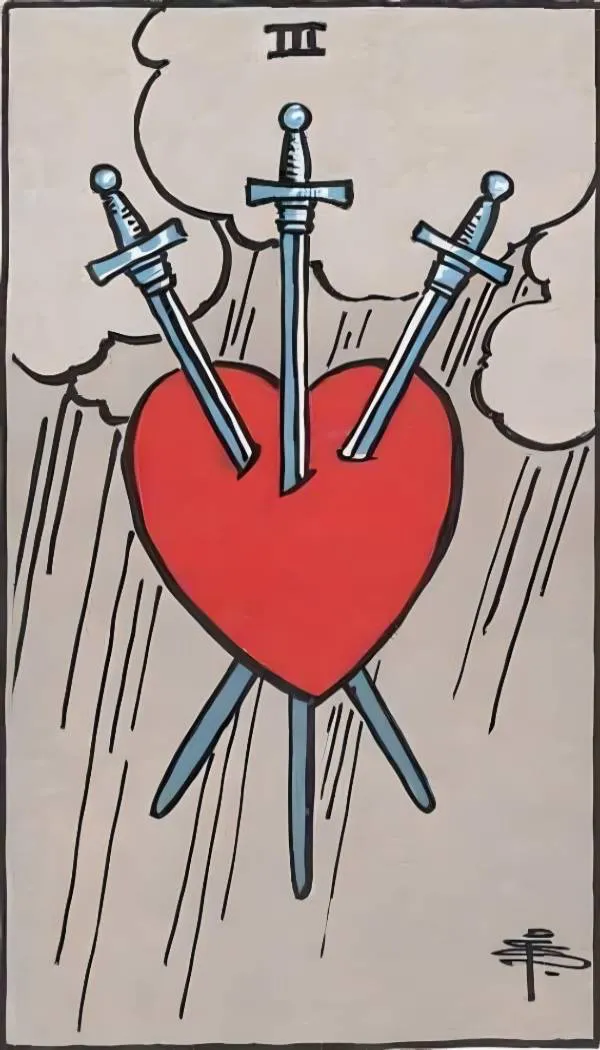
Three of Swords Tarot Card Meaning

Three swords pierce a red heart from above and at an angle from the sides, converging at a single point, which is the very center of the heart. The three swords form an even angle between them. Meanwhile, the three hilts and three tips create a hexagonal or hexagram pattern, which is another mysterious hint.

These three swords enter from different places, symbolizing harm from various sources, but all hit the vital spot and converge inward, meeting at the deepest part of the heart. This forms a wound with three swords and six eyes, so many injuries are really hard to heal.

The background is full of gloomy clouds and mist, covering the top of the red heart. Slightly slanted straight lines fill the surroundings of the red heart, like falling rain. The entire background is also gray, which deepens the tragic image and atmosphere.

Although there is no character, it is the most plot-rich because it directly depicts the human heart. This is a card that focuses very much on the psyche, expressing emotional and spiritual pain and harm. This card clearly shows that the sharpness of the sword is to stab the feelings, extremely sad, pessimistic, disappointed, negative emotions, and harm from the outside.

This is a very famous picture and is one of the few pictures in the Waite Tarot without characters (the Three of Swords and the Eight of Wands have no characters, the rest all have, especially the Eight of Wands). However, the idea of this card is not the originality of the Waite Tarot. The "Illuminating Ancient Tarots" from the 15th century also has a similar picture to the Three of Swords - the Three of Swords and the Three of Wands.

Three Swords

The three swords piercing the heart serve as a stark representation of emotional and mental turmoil. Swords are associated with the mind and communication, suggesting that the pain being experienced is not just emotional but also a matter of thought patterns and mental attitudes that exacerbate the suffering.

Heart

The heart as a symbol generally signifies love, compassion, and emotional connection. When pierced by swords, these attributes are turned into their opposites: loss, sorrow, and emotional disconnection. The wounded heart on the card speaks to experiences of betrayal, sadness, and emotional suffering.

Clouds

The clouds usually depicted in the background signify confusion and obscurity. They hint at a lack of clarity, perhaps emotional fog, making it difficult to see situations for what they truly are. The clouds serve as a backdrop that symbolizes the nebulous, unclear nature of emotional states.

Rain

Rain is another prominent feature in the background of the Three of Swords. Rain symbolizes the outpouring of emotion or tears. It can also represent cleansing, the process through which emotional and psychological impurities are purged, suggesting a form of release or the need for it.

Grey Sky

The grey sky that often accompanies the other elements serves as a canvas that intensifies the card’s atmosphere of gloom and despair. Unlike a black sky, which might signify a complete absence of hope, or a blue sky, which could suggest optimism, the grey hints at an in-between state. It symbolizes the murky emotional and mental space one is in, where things are neither entirely bleak nor optimistic.

Psychological patterns in Three of Swords
Rumination
Three swords enter the red heart from different angles, but the eye is forced to follow every line back to one central puncture. The rain repeats that downward motion around the heart, so the whole image behaves like a mental loop that cannot stop revisiting the point of impact. In your daily system, Rumination appears when a missed habit, a messy room, or a blown sleep schedule becomes something you keep reviewing instead of structurally auditing. The mind keeps trying to solve the wound by pressing attention into it again, which feels like analysis but quietly drains the bandwidth needed to redesign the day.
Catastrophizing
The three blades narrow the whole image into one severe point, while the clouded sky and rain remove visual breadth. The card does not give the eye a future path; it gives the eye a wound that seems to explain everything. Catastrophizing in personal growth works by turning one painful signal into a total forecast. You miss one habit, receive one critique, or feel one moment of resistance, and the mind rushes to the largest possible conclusion about identity, potential, or the future. The reversed pressure of this image is not simply sadness; it is prediction built from injury. The swords become mental lines that move from a single puncture to an imagined collapse, showing how pain can shrink reality until only the worst outcome feels visible.
Shame Binding
When the Three of Swords is read reversed, the same pierced heart can look less like a fresh impact and more like a wound that has been internalized. The blades are no longer only entering the heart; they appear to hold its shape, as if the injury has become part of the structure that defines it. Shame Binding shows up socially when an awkward moment, rejection, or exclusion stops being processed as something that happened and becomes proof of what you are. The missing body around the heart matters because there is no wider self visible, no larger identity container to place the pain inside. This pattern fits the reversed card because the image captures the collapse between social wound and self-concept. The audit point is not that the pain is imaginary; it is that the mind has fused an interpersonal injury with identity, making every new group feel like a courtroom where the old verdict might be repeated.
Self-Judgment Loop
The swords do not merely touch the heart; they pierce it with clean, deliberate symmetry. The image turns pain into a hard internal structure, as if the sharpest thought has been given permission to enter the softest place. In your lifestyle architecture, Self-Judgment Loop appears when criticism starts impersonating discipline. Rest, clutter, skipped workouts, or unfinished chores become evidence against you, and the punishment briefly creates a sense of control while damaging the very energy required for repair.
Guilt Conditioning
The three swords are arranged with unsettling balance, as if the hurt has been given a formal structure. The heart remains fixed inside that structure, held in place by the same pattern that injures it. Guilt Conditioning appears in friendship when care has been trained to mean constant access, emotional availability, or automatic apology. Setting a boundary then feels less like self-respect and more like betrayal, even when the friendship has become one-sided. The card exposes the conditioning by showing pain stabilized into a system. You are not simply reluctant to speak up; the bond may have taught the heart to experience another person's disappointment as evidence that you have done something wrong.
Emotional Flooding
Turned into its reversed pressure, the heart no longer looks like it is simply holding pain; it looks saturated by it. The blades remain fixed while the rain and clouds crowd the field, leaving the image with no breathable space around the wound. Emotional Flooding in friendship happens when a painful cue overwhelms the system before interpretation can stabilize. A group-chat silence, a perceived betrayal, or a boundary conversation can trigger a surge so fast that the mind reaches for screenshots, long messages, or absolute conclusions. The card links this pattern to the failure of containment. The emotion is real, but the structure has no channel for it, so the energy spills into urgency instead of becoming a clean signal about what needs to be named.
Rejection Sensitivity
Three swords pierce the red heart instead of a shield, a desk, or a visible opponent. The injury is not placed at the edge of the image; it is placed at the center, where the card makes a professional message feel like it has gone straight into the organ of value and belonging. That is the mechanism behind Rejection Sensitivity at work. You may hear a neutral edit, a delayed reply, or a promotion decision as a direct signal that your place in the system is unsafe. The pain is real, but the pattern compresses professional feedback and personal worth into one wound, making every correction feel like exclusion.
Exclusion Spiral
Reversed, the three blades can be read as a stalled system rather than a single event. Their repeated angles keep the heart locked around one point of impact, while the rain and cloud cover make the surrounding field feel closed, heavy, and difficult to navigate. Exclusion Spiral fits this reversed image because social pain begins to reproduce itself. One perceived slight leads to withdrawal or guardedness, that distance changes how the group responds, and the changed response then feels like confirmation that exclusion was inevitable. The card's mechanism is precise: thought and communication pierce feeling, then the sealed emotional atmosphere keeps the wound cycling. You are not simply reacting to one social event; the loop is turning hurt into behavior, behavior into distance, and distance back into more hurt.
Truth Weaponization
The three swords do not merely hover around the red heart; they enter it with clean, controlled angles. The visual language is surgical rather than chaotic, as if sharp thought, speech, or judgment has found the most vulnerable emotional point and pressed there with precision. That is the inner mechanism of Truth Weaponization in love. The pattern turns clarity into impact: facts, timing, tone, or intimate knowledge become tools for winning the conflict instead of repairing the bond. You may recognize this when a fight stops being about what happened and starts becoming about who can deliver the more undeniable sentence. The card exposes how communication can become a blade when emotional pain is routed through accuracy rather than vulnerability.
Limiting Beliefs
The swords do not strike randomly; they form a precise structure around the heart. Their clean geometry gives the wound the appearance of certainty, as if emotional pain has been converted into a stable argument about what is true. That is the core movement of Limiting Beliefs in personal growth. You may not experience the belief as fear, because it often arrives dressed as realism: I am not disciplined enough, I am too late, I am not the kind of person who follows through. The card links this pattern to the moment pain becomes proof. The heart is isolated in the gray field, and the mind builds a convincing structure around the injury, making a temporary wound feel like a permanent rule about potential.
Core Struggles in Three of Swords
Sunk Cost Paralysis
In reversal, the pierced heart appears held in place by the blades themselves. The wound is no longer only an injury; it becomes part of the structure keeping the image suspended. That is the physical logic of Sunk Cost Paralysis in a choice reading. You may know a path hurts, but the time, effort, identity, and emotional proof already embedded in it start functioning like anchors. The card does not reduce this to bad judgment. It shows why leaving can feel like tearing out the supports that have been holding the whole decision story together, even when those supports are also the source of the pain.
Vulnerability Without Containment
The red heart is exposed without ribs, skin, hands, or any surrounding body to regulate contact. Rain and gray air fill the image, but neither element becomes a container; the heart is visible, reachable, and unprotected at the same time. That is the shape of social vulnerability without a holding field. You may be showing up, sharing, posting, networking, or letting people see more of you, yet the circle around you does not provide enough structure to hold what has been revealed. The card locates the pain in exposure without containment, not in the act of wanting connection.
Consequence Lock
Three swords enter the heart from separate directions and meet at one center point. The image does not show one clean wound; it shows a convergence of consequences, where every angle finds the same vulnerable core. In a decision spread, that structure names the pressure of choices that cannot be made painless by more analysis. You can compare the options, map the risks, and still face the same central truth: each path asks something real from you. Consequence Lock forms when the choice is no longer organized around preference, but around the wound each option will create. The card holds that moment with brutal precision, making the cost visible enough to stop pretending that there is a perfectly clean way through.
Truth-Connection Split
Three swords enter the red heart from different directions and meet at the same center. The image does not show a clean break from connection; it shows connection itself becoming the place where sharp truth, spoken pain, and emotional attachment occupy the same wound. In friendship, this is the exact pressure point where honesty stops feeling clarifying and starts feeling dangerous. You may know that something needs to be named, but naming it appears to threaten the shared history, the group balance, or the fragile sense that the bond can still survive. The card holds the split between truth and connection without flattening either side. The wound is not random sensitivity; it is the structure formed when the mind's sharp need for clarity pierces the same emotional center that still wants the friend to matter.
Closure Deficit
The reversed heart still carries the blades while rain moves around them. The image contains motion, weather, and possible release, but the metal objects remain lodged in the exact places that keep the wound structurally open. Social fallout can leave the same unfinished architecture behind. A friendship may fade, a group may go quiet, or someone may never say what happened, yet the absence of a clean ending keeps the inner shape unresolved. The card names the deficit of closure as a missing boundary around the wound, not a failure to simply move on.
Boundary Collapse
The red heart has no skin, ribs, or hands around it; three steel blades cross its center while the grey rain leaves no dry edge around the wound. In a love reading, that exposed geometry turns intimacy into a problem of access: the same opening that lets closeness reach you also gives conflict a direct route to the vital point. You are not just dealing with one harsh conversation or one bad moment. The card locates a boundary structure where messages, demands, apologies, and fears all arrive without a separate receiving chamber, so the relationship starts to feel like connection that keeps crossing the line into intrusion. The struggle is not whether love should be open. It is whether the bond has enough boundary architecture to let closeness reach you without every point of contact becoming another blade in the same center.
Avoided Closure
The heart is pierced, but the card shows no hand holding the swords and no speaker standing beside them. The impact is undeniable, while the source remains strangely absent from the frame. That is the structure of a friendship rupture that never receives a shared account. Someone acts normal, the group smooths it over, the message goes unanswered, or the apology never names the actual cut, leaving you with evidence of harm but no clean place to put it. The reversed tension makes closure unavailable because the wound is visible while accountability is missing. The card does not force a verdict; it locates the unfinished edge where friendship pain keeps circulating because no one has agreed on what happened.
Emotional Processing Strain
The pierced heart stays suspended under rain, with no hands removing the blades and no shelter interrupting the weather. Motion continues around the wound, but the wound itself remains structurally open. In lifestyle terms, this is what happens when daily routines keep moving while emotional residue has nowhere to be metabolized. You can still answer messages, clean the kitchen, and show up to work, but the card marks the hidden processing load that keeps taxing the whole architecture from the center.
Triangulated Belonging
Three swords enter the heart from separate angles and meet at one exact center, turning a single organ into the crossing point of several claims. The geometry is too balanced to feel accidental; each blade has its own route, but none of them leaves the heart untouched. In a family system, that image carries the pressure of being pulled into loyalties that cannot all be honored at once. You may be asked to stay close, stay neutral, protect one person, forgive another, and still keep the bond intact, while the actual wound sits where those demands intersect.
Regret Lock
The heart is shown after impact but before release. In reversal, that suspended moment becomes a closed chamber, with the swords still fixed and the rain pressing the scene inward. Regret Lock forms when a future wound is treated as already real. The decision is not being weighed only by what might happen; it is being weighed from inside the imagined pain of having chosen wrong. The card gives that anticipatory regret a precise boundary. You are not simply overthinking the choice; the choice field has become organized around a wound that has not happened yet, and every option is being forced to answer for it.
Inner Emotions in Three of Swords
Timeline Panic
Three blades entering from different directions create the feeling of multiple clocks striking the same inner point at once. The heart has no body around it, no hands to defend it, and no room to step back from the impact. In a timing reading, that visual pressure becomes Timeline Panic: the sense that every social milestone, delayed plan, or comparison point has turned into a blade aimed at your center. You may feel less like you are choosing a moment and more like the moment is closing in on you. The gray weather surrounding the heart intensifies the pressure because it removes emotional distance. There is no clear sky where the larger cycle can be seen, only the immediate sting of feeling behind, exposed, and urgently measured.
Imposter Exposure Fear
The heart in the Three of Swords is not hidden inside a body; it is suspended in the open, pierced and displayed. With no face, hands, or room around it, the image removes every social layer and leaves only the vulnerable center under examination. Imposter Exposure Fear appears in academic life when feedback or performance feels capable of revealing that you never fully belonged in the room. A seminar answer, a marked essay, a failed exam, or a supervisor’s silence can feel like a sword because it seems to point straight through the outer role of student, researcher, or high achiever. The card anchors this fear in exposure rather than truth. It shows how assessment can make you feel publicly opened up, while the deeper work is to separate the fact of being evaluated from the fear of being unmasked.
Emotional Numbness
The three swords do not merely pierce the heart; they hold it in a rigid, almost formal arrangement. The wound becomes strangely clean, a diagram of impact where living tissue is forced into stillness. Emotional Numbness fits the reversed social field because repeated small cuts can make feeling each one too expensive. You may keep answering messages, attending events, and performing ease, while the inner warmth goes quiet under the pressure of staying socially functional. The Three of Swords identifies numbness as a protective freeze around an overhandled wound. It does not shame the shutdown; it shows where your social self has stopped bleeding outward because it has been asked to absorb too much without repair.
Unspoken Grief
Three blades meet at the exact center of the red heart while rain falls behind it, making a private impact visible without giving it a voice. There is no face, witness, or gesture of explanation, so the image holds the hurt before it becomes a conversation. In love, that structure mirrors the grief that forms when something real has been cut into but cannot be cleanly named between two people. You may still be in the relationship, still checking the messages, still replaying the last exchange, while the central feeling remains suspended in the weather around it. Unspoken Grief belongs here because the card does not show a dramatic scene between partners; it shows the inner organ after the words have landed. The pain is not asking to be performed, only accurately recognized.
Suppressed Rage
The swords in the reversed Three of Swords do not merely touch the heart; they enter from separate directions and meet inside it. The scene has rain and mist, but no clear outlet, no hand pulling the blades free, and no boundary protecting the red center from further contact. Suppressed Rage forms in that sealed pressure. In introspection, it often appears underneath careful self-analysis, especially when you have explained your pain so many times that the raw protest underneath was never allowed to take shape. This card does not turn anger into a command. It gives the compressed charge a visible structure, showing where hurt has been intellectualized, contained, and folded inward until the inner world needs a cleaner name for the force it has been holding down.
Adult Child Panic
Reversed, the pierced heart can feel less like a wound being witnessed and more like a wound that has taken over the whole nervous field. The blades lock the center in place, the rain crowds the space, and there is no body around the heart to help it orient. Adult Child Panic appears when contact with family collapses your adult perspective back into an older role. A text, visit, tone shift, or implied expectation can make the present feel crowded by old rules, leaving you tense, exposed, and strangely younger inside. The card gives that regression a visual map. It shows the emotional center pinned from several angles at once, which is why your reaction may feel bigger than the current exchange. The point is not that you are powerless; it is that the old structure is being activated fast enough to feel like the room has shrunk.
Guarded Sadness
The red heart remains pierced by three blades beneath dense clouds and falling rain, making romantic hurt visually undeniable even though no human face is available to express it. Reversed, the image turns that hurt inward: the heartbreak is privately contained, minimised in conversation, or separated from the composed version of the relationship shown to others. The swords remain lodged in the heart rather than becoming a clean symbol of release. This gives guarded sadness its blocked quality, where pain is clearly present in the inner structure but cannot yet move through language, mutual recognition, or an openly witnessed emotional process.
Rejection Chill
Hard polished blades cross the red heart under a gray, rain-filled sky, and the whole image is stripped of bodily warmth. The heart is visible, exposed, and alone in the frame, with no hand reaching toward it and no landscape to soften the impact. Rejection Chill enters love readings as the sudden temperature drop after someone pulls away, withholds care, or leaves the bond emotionally unanswered. You may understand the situation intellectually, but the body still registers the distance as a cold line through the center. This card anchors that feeling through contrast: red warmth held open by steel, intimacy translated into distance, weather pressing in without comfort. The emotion is not just hurt; it is the cold clarity of realizing that access has been withdrawn.
Stalled Momentum Dread
The heart in this card is not scattered across the scene; it is pinned at one exact point. The swords create a rigid geometry around the center, turning motion into pressure and pressure into a visible lock. In timing questions, that fixed convergence reflects the dread of pushing into a cycle that will not open. You may be applying effort, discipline, and urgency, yet the situation keeps answering with friction rather than flow. The rain gives the scene movement, but the heart itself cannot move with it. Stalled Momentum Dread lives in that mismatch between outer motion and inner blockage, where every attempt to force progress makes the stuckness feel more painful.
Missed Window Grief
The red heart held under falling rain makes the pain feel exposed and weather-bound, as if the emotional center is being asked to absorb a loss before the sky has cleared enough to explain it. The swords do not circle the heart from a distance; they meet at the very place where attachment, hope, and timing would normally gather into a single decision. In a timing reading, that convergence mirrors the ache of realizing that a window may have closed while you were still trying to become ready. You are not only reacting to delay; you are grieving the imagined version of the moment where everything could have lined up cleanly. The gray background matters because it withholds a visible horizon. Missed Window Grief lives in that foggy afterspace, where the mind keeps replaying the point of impact and trying to locate the exact second when momentum became loss.
Outer Contexts in Three of Swords
Sunk Cost Exit Dilemma
With the heart pinned by blades, movement itself becomes part of the injury. The picture does not show a clean escape route; it shows a structure where removing the blades and keeping them in place both carry a cost. That is the anatomy of a sunk cost exit dilemma. You are not only deciding whether to leave an option; you are facing the exposed record of time, money, loyalty, identity, or hope already placed inside it, and the card makes that investment visible without letting it control the whole map.
Critique Panel Pressure
Three blades enter the red heart from separate angles and meet in one exact center. In an academic critique, comments do not arrive as loose background noise; they converge on the project, the argument, and the part of the work that feels most exposed. The balanced geometry of the swords mirrors the formality of a panel, studio review, viva, or proposal defense. You are not just receiving feedback from one person; you are standing inside a structured evaluative field where multiple voices can make one draft feel like the entire target. The card makes this pressure legible without turning it into a personal defect. It shows how critique can be both procedurally valid and physically hard to absorb when every blade points toward the same academic center.
Family Boundary Backlash
The red heart hangs without ribs, skin, or any enclosing body, while the swords enter from separate angles and meet at the center. The card makes exposure visible before it makes pain visible: there is no protected edge where contact has to stop. Family Boundary Backlash fits this scene because the pressure intensifies at the exact point where a perimeter should exist. When you set a limit around visits, money, privacy, dating, location, or contact, the system may treat that limit as a wound inflicted on the family rather than a boundary around your life. The image helps separate the boundary from the backlash. The problem is not that the heart needs to stay open to every blade; the problem is a structure that has learned to experience your self-protection as rejection.
Emotional Blackmail Cycle
Three swords meeting inside one exposed red heart gives family pressure a precise physical shape: several outside forces aim at the same vulnerable center. The image does not show a private body around the heart, so the emotional organ is treated like public territory, open to contact, judgment, and repeated impact. In a family system, that visual structure maps onto guilt, loyalty, disappointment, and obligation arriving from different directions while demanding the same response from you. The wound is not random; it is organized around the place where connection is supposed to live. Emotional Blackmail Cycle names the moment when affection becomes a pressure mechanism. The card frames the problem as a structure you can inspect rather than a personal defect: who is holding the blade, what message is being used as leverage, and which part of your autonomy keeps being targeted.
Unscaffolded Healing Environment
The red heart is suspended in weather with no hands, shelter, tools, or body around it. The scene shows injury without infrastructure: the wound is visible, but nothing in the environment helps hold it. For personal growth, this points to being expected to process rupture, criticism, or life change without a stable container. The card makes the missing scaffolding visible, so the problem is not reduced to willpower when the surrounding environment has offered no real place for repair.
Triangulated Family Mediator
Three separate swords enter from three separate directions, yet the image forces all of them into one shared center. There are no visible people, rooms, or sides of the table; the heart becomes the entire meeting place for the conflict. That is the architecture of a triangulated family role. Different relatives may not speak directly, but their complaints, disappointments, and unfinished arguments are routed through you because you are treated as the point where the system can discharge pressure. The card makes the hidden workload visible. You are not simply being caring or mature in the abstract; you may be carrying the contact point for a conflict that belongs between other adults, and seeing that geometry is the first act of reclaiming your position.
Harsh Honesty Fallout
Three swords entering the red heart from different angles create a picture of communication that has stopped being abstract. The blades do not hover around the issue; they meet at the exact center, turning words, critique, and judgment into a visible impact point. In a career setting, this mirrors the moment when feedback becomes too precise to soften. A manager, stakeholder, or review panel may name the same weakness from several directions, and the professional mask no longer has room to keep the message at a polite distance. The gray rain around the heart matters because the fallout is not only the comment itself. It is the atmosphere after the meeting, when the truth has landed, the room has changed, and You have to separate useful signal from the shock of how sharply it was delivered.
Silent Treatment Loop
The heart is pinned in the rain with no road, door, hand, or horizon around it. The swords keep the wound open, while the grey field offers atmosphere but no channel for repair. Silent Treatment Loop belongs to this card because the injury is held in suspension. In a family system, unanswered messages, cold pauses, and withheld contact can keep the conflict present without giving it a usable form. The card does not romanticize silence as depth. It shows silence as a structure that can immobilize repair, leaving you to read the weather around the wound instead of receiving direct, accountable communication.
No-Win Decision
Every visible line in the image ends at the heart. There is no decorative blade, no harmless direction, and no open landscape competing with the injury as the center of attention. That visual structure matches a no-win decision because each available route appears to carry a meaningful loss. The card does not erase your agency; it shows that agency may begin with refusing the fantasy of a clean option and comparing the real forms of damage in front of you.
Silent Group Chat Exclusion
The Three of Swords shows clear injury without showing the person who caused it. The blades are present, the heart is marked, and the grey cloud cover hides the source of pressure above the scene. In its blocked social form, that becomes the quiet violence of omission rather than open confrontation. Messages slow down, plans move elsewhere, and the group continues to exist around you while access to it becomes harder to prove or challenge. Silent Group Chat Exclusion fits because the wound is visible in its effects but not easy to attach to a single actor. The card helps you name the structure of indirect removal, so the situation can be assessed through patterns of access rather than through one missing reply.